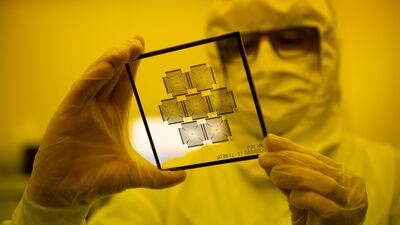
Advanced research has opened up the prospect of neurological material replacing computer chips to power computers we use in our daily lives. AFP

Computer memory: Could lab-grown brains one day power our laptops?


Daniel Bardsley
  • English
  • Arabic

The media talks perhaps too often about science fiction becoming scientific fact, but such discussion may be justified when it comes to recent work in China.

Researchers at Tianjin University created a robot – compared in one report to Frankenstein’s monster – that had a brain-like control centre made from a clump of nerve cells or neurons cultured in a laboratory.

This ambitious fusion of electronics and biology is one of the latest inventions in the brave new world of biocomputing.

According to a recent report by the UK-based Nuffield Council on Bioethics, technologists are increasingly looking to develop devices where organoids – tiny, lab-grown organs – are connected to sensors and output mechanisms and that, like the Tianjin robot, respond to electrical stimulation and carry out tasks.

A robot guided by a lab-grown brain was developed by Chinese researchers. Photo: Tianjin University

Artificial brains in laptops?

The field of biocomputing involves much more than sci-fi robots, as clusters of neurons may have the potential to be used within computers of the kind that most of us have.

Brain organoids –tiny brain-like bundles of neurons – are typically generated from stem cells, just as tiny kidney or lung organoids have been for many years, often because they are useful research tools.

According to Dr Michael Barros, a lecturer in AI and engineering in medicine at the University of Essex in the UK, it is "absolutely" possible that even consumer electronics could in future have real neurological material embedded within them.

"It comes with a bit of a challenge because we now have to make living organisms survive alone or by themselves or have the necessary environment to do their job," he said.

An expert said neurological material could one day be used in everyday consumer electronics. AFP

"You need to keep cells alive and have a specific infrastructure for that and we have companies that are thinking about this problem."

The cells could be contained within a structure that provides them with a stable environment and protects them from the conditions of the outer environment, which may alter.

Biological material does not live for ever, so another consideration would be ensuring that the limited lifespan of the cells did not render useless the device that they were part of.

"The best estimate is that these biocomputers can live up to 200 days, so you can ... plan to replace biocomputing units every so often. That will be part of the cost of operating this sort of infrastructure," Dr Barros said.

"In our lab we’re also interested in reliability. If we’re operating with a biological system, it tends to change over time. How can we ensure that doesn’t happen or that if it does happen, it doesn’t affect the computing task?"

Replacing the trusty computer chip

A key question is why manufacturers might want to use biological material within their computers. Why not just perfect the standard silicon-chip-based device?

Andrew Jackson, a professor neural interfaces at Newcastle University in the UK, said that the answer lay in efficiency.

"In what ways are our brains better than artificial neural networks?" he said. "One of the things that our brains are very good at is performing computations, but doing it in a very power-efficient way compared to the power required to run computer-based AI systems.

" … Presumably our brains have evolved over millions of years to be very efficient information processors. One potentially interesting thing is whether we could devise artificial intelligence systems that are much more power-efficient if we leverage the principles of biology and neuroscience."

Not all researchers are convinced that brain organoids could eventually find their way into routine use in consumer electronics.

Instead, an alternative role for them may be in helping people to better understand how actual brains work, as this could lead to the creation of more efficient computers that mimic the properties of biological material.

Prof Thomas Hartung, of the Centre for Alternatives to Animal Testing at the John Hopkins Bloomberg School of Public Health. Photo: John Hopkins University

"I would say that creating an architecture that’s more brain-like is the more likely outcome than something that mixes a cell culture and a computer," said Prof Thomas Hartung, of the Centre for Alternatives to Animal Testing at the John Hopkins Bloomberg School of Public Health in the United States.

Most of the activities with brain organoids that Prof Hartung is involved with are, he said, "virtual experiments" in which the organoid may be playing a computer game.

One possible scenario that could be seen over time is that brain organoids, potentially trained using artificial intelligence, become used within supercomputers.

This could cut the electricity demands of today’s large-scale devices, which consume vastly more energy for a given level of computing power than the human brain.

Advancing healthcare

Separate to biocomputing, brain organoids could prove useful for understanding neurodevelopmental conditions, such as autism, or neurodegenerative diseases such as Parkinson’s.

As brain organoids become more complex, ethical issues may become more prominent, although some may consider these to be dwarfed in importance by concerns over the use in laboratory experiments of more than 115 million live animals each year, according to the Humane Society International.

Prof Hartung said that brain organoid technology was "very far away" from creating a system with properties such as self-awareness or the ability to experience suffering.

In his work the brain organoids are less than half a millimetres in diameter and have fewer neurological cells than a housefly. Typically, they may consist of tens of thousands of neurons, while a human brain has tens of billions.

Nevertheless, he said that ethicists visit his facility to discuss the work and he said that it was important to consider formulating an ethical framework around what takes place while the technology is at an early stage.

"We’re having these discussions now [so] we’re coming to something where we should say there should be a limit," he said.

Prof Søren Holm, who researches bioethical issues at the University of Manchester in the UK and the University of Oslo in Norway, said that current neural technologies were not "anywhere near" the point at which organoids could develop sentience – the ability to feel things positively or negatively – or consciousness, which would enable them to not just feel pain, but understand what they were feeling.

"They’re simply not large enough or complex enough," said Prof Holm, who is a former editor-in-chief of the Journal of Medical Ethics.

"They’re order of magnitude smaller than the simplest mammalian brain. We don’t have any reason to believe the organoids we create now would have anything like sentience or consciousness."

A key technical hurdle, he said, is that organoids do not have a blood supply, which significantly limits their size and, therefore, their capabilities.

Even if they could grow to a level of complexity in which they were sentient or conscious, he said it would be "in a quite different way" to the consciousness that we experience.

"Sentience and consciousness in organoids is a very interesting question, but with what we can do with organoids now, it is not something that, for instance, a regulator needs to think about, because it’s not [for] the near future," he said.

"I would take a fairly large bet we’re not going to see sentience or consciousness in organoids for the next 20 years."


UAE currency: the story behind the money in your pockets
hall of shame

SUNDERLAND 2002-03

No one has ended a Premier League season quite like Sunderland. They lost each of their final 15 games, taking no points after January. They ended up with 19 in total, sacking managers Peter Reid and Howard Wilkinson and losing 3-1 to Charlton when they scored three own goals in eight minutes.

SUNDERLAND 2005-06

Until Derby came along, Sunderland’s total of 15 points was the Premier League’s record low. They made it until May and their final home game before winning at the Stadium of Light while they lost a joint record 29 of their 38 league games.

HUDDERSFIELD 2018-19

Joined Derby as the only team to be relegated in March. No striker scored until January, while only two players got more assists than goalkeeper Jonas Lossl. The mid-season appointment Jan Siewert was to end his time as Huddersfield manager with a 5.3 per cent win rate.

ASTON VILLA 2015-16

Perhaps the most inexplicably bad season, considering they signed Idrissa Gueye and Adama Traore and still only got 17 points. Villa won their first league game, but none of the next 19. They ended an abominable campaign by taking one point from the last 39 available.

FULHAM 2018-19

Terrible in different ways. Fulham’s total of 26 points is not among the lowest ever but they contrived to get relegated after spending over £100 million (Dh457m) in the transfer market. Much of it went on defenders but they only kept two clean sheets in their first 33 games.

LA LIGA: Sporting Gijon, 13 points in 1997-98.

BUNDESLIGA: Tasmania Berlin, 10 points in 1965-66

Haemoglobin disorders explained

Thalassaemia is part of a family of genetic conditions affecting the blood known as haemoglobin disorders.

Haemoglobin is a substance in the red blood cells that carries oxygen and a lack of it triggers anemia, leaving patients very weak, short of breath and pale.

The most severe type of the condition is typically inherited when both parents are carriers. Those patients often require regular blood transfusions - about 450 of the UAE's 2,000 thalassaemia patients - though frequent transfusions can lead to too much iron in the body and heart and liver problems.

The condition mainly affects people of Mediterranean, South Asian, South-East Asian and Middle Eastern origin. Saudi Arabia recorded 45,892 cases of carriers between 2004 and 2014.

A World Health Organisation study estimated that globally there are at least 950,000 'new carrier couples' every year and annually there are 1.33 million at-risk pregnancies.

The specs

Engine: Two permanent-magnet synchronous AC motors

Transmission: two-speed

Power: 671hp

Torque: 849Nm

Range: 456km

Price: from Dh437,900 

On sale: now

THE LOWDOWN

Romeo Akbar Walter

Rating: 2/5 stars
Produced by: Dharma Productions, Azure Entertainment
Directed by: Robby Grewal
Cast: John Abraham, Mouni Roy, Jackie Shroff and Sikandar Kher 

The five pillars of Islam

1. Fasting 

2. Prayer 

3. Hajj 

4. Shahada 

5. Zakat 

UAE currency: the story behind the money in your pockets
Lexus LX700h specs

Engine: 3.4-litre twin-turbo V6 plus supplementary electric motor

Power: 464hp at 5,200rpm

Torque: 790Nm from 2,000-3,600rpm

Transmission: 10-speed auto

Fuel consumption: 11.7L/100km

On sale: Now

Price: From Dh590,000

Farage on Muslim Brotherhood

Nigel Farage told Reform's annual conference that the party will proscribe the Muslim Brotherhood if he becomes Prime Minister.
"We will stop dangerous organisations with links to terrorism operating in our country," he said. "Quite why we've been so gutless about this – both Labour and Conservative – I don't know.
“All across the Middle East, countries have banned and proscribed the Muslim Brotherhood as a dangerous organisation. We will do the very same.”
It is 10 years since a ground-breaking report into the Muslim Brotherhood by Sir John Jenkins.
Among the former diplomat's findings was an assessment that “the use of extreme violence in the pursuit of the perfect Islamic society” has “never been institutionally disowned” by the movement.
The prime minister at the time, David Cameron, who commissioned the report, said membership or association with the Muslim Brotherhood was a "possible indicator of extremism" but it would not be banned.

Living in...

This article is part of a guide on where to live in the UAE. Our reporters will profile some of the country’s most desirable districts, provide an estimate of rental prices and introduce you to some of the residents who call each area home.

UAE currency: the story behind the money in your pockets
The%20Witcher%20-%20season%20three
%3Cp%3E%3Cstrong%3EDirector%3A%20%3C%2Fstrong%3EVarious%0D%3Cbr%3E%3Cstrong%3E%0D%3Cbr%3EStars%3A%20%3C%2Fstrong%3EHenry%20Cavill%2C%20Freya%20Allan%2C%20Anya%20Chalotra%3Cstrong%3E%0D%3Cbr%3E%0D%3Cbr%3ERating%3A%3C%2Fstrong%3E%203%2F5%3C%2Fp%3E%0A
Neil Thomson – THE BIO

Family: I am happily married to my wife Liz and we have two children together.

Favourite music: Rock music. I started at a young age due to my father’s influence. He played in an Indian rock band The Flintstones who were once asked by Apple Records to fly over to England to perform there.

Favourite book: I constantly find myself reading The Bible.

Favourite film: The Greatest Showman.

Favourite holiday destination: I love visiting Melbourne as I have family there and it’s a wonderful place. New York at Christmas is also magical.

Favourite food: I went to boarding school so I like any cuisine really.

MATCH INFO

Uefa Champions League, Group B
Barcelona v Inter Milan
Camp Nou, Barcelona
Wednesday, 11pm (UAE)

Spider-Man%202
%3Cp%3E%3Cstrong%3EDeveloper%3A%3C%2Fstrong%3E%20Insomniac%20Games%0D%3Cbr%3E%3Cstrong%3EPublisher%3A%3C%2Fstrong%3E%20%20Sony%20Interactive%20Entertainment%0D%3Cbr%3E%3Cstrong%3EConsole%3A%20%3C%2Fstrong%3EPlayStation%205%0D%3Cbr%3E%3Cstrong%3ERating%3A%3C%2Fstrong%3E%205%2F5%3C%2Fp%3E%0A
European arms

Known EU weapons transfers to Ukraine since the war began: Germany 1,000 anti-tank weapons and 500 Stinger surface-to-air missiles. Luxembourg 100 NLAW anti-tank weapons, jeeps and 15 military tents as well as air transport capacity. Belgium 2,000 machine guns, 3,800 tons of fuel. Netherlands 200 Stinger missiles. Poland 100 mortars, 8 drones, Javelin anti-tank weapons, Grot assault rifles, munitions. Slovakia 12,000 pieces of artillery ammunition, 10 million litres of fuel, 2.4 million litres of aviation fuel and 2 Bozena de-mining systems. Estonia Javelin anti-tank weapons.  Latvia Stinger surface to air missiles. Czech Republic machine guns, assault rifles, other light weapons and ammunition worth $8.57 million.

Updated: July 13, 2024, 3:00 AM