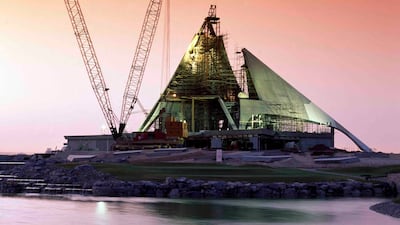
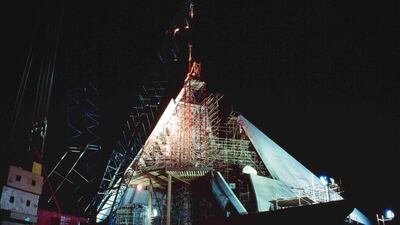
For all the monumental, record-setting projects that define Dubai today, one building that helped introduce the city to the world was a relatively diminutive dhow-shaped structure.
The Dubai Creek Golf & Yacht Club, which celebrates its 30th anniversary this year, was the city’s bold statement to whoever was hesitant to visit the region as it emerged out of the 1991 Gulf War. It also signalled the nation's penchant for curious architecture.
A world-class course with an instantly recognisable golf club was meant to show that, in spite of uncertainty perceived from the region, Dubai was a safe tourist destination.
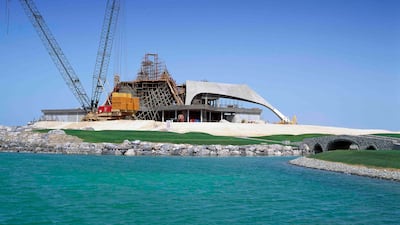
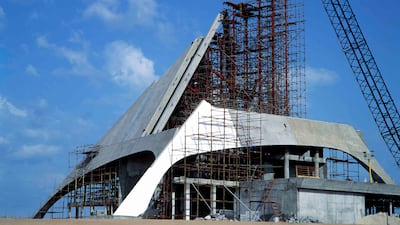
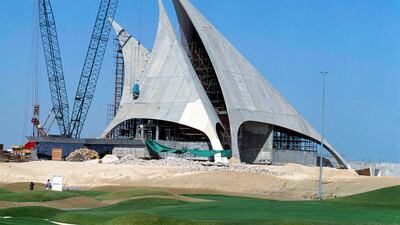
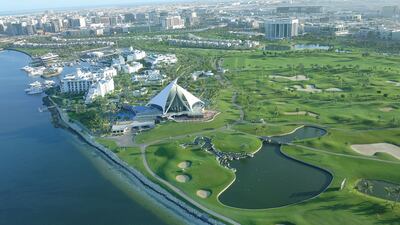
Dubai Creek Golf & Yacht Club is still a landmark in Deira, even against the soaring towers huddled in the skyline. The clubhouse is renowned for its design that reflects the lateen sails of a traditional dhow. It was even featured on the back of the Dh20 bank note.
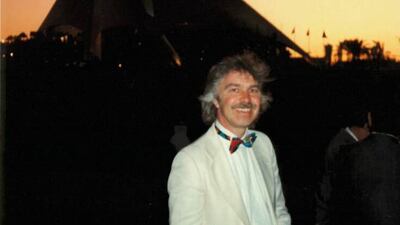
It was designed by British architect Brian Johnson, who has been behind several other projects in Dubai, including the Emirates Golf Club, Bab Al Shams and, more recently, Al Seef, a cultural and retail development along the creek that takes its cue from the traditional wind towers of Bastakiya, more commonly known as Al Fahidi Historical Neighbourhood.
The clubhouse opened on January 28, 1993, with a party that was unlike anything Dubai had seen at the time. Welsh singer Dame Shirley Bassey performed in front of 2,000 guests, including Sheikh Mohammed bin Rashid, Vice President and Ruler of Dubai. It was also one of the first events that featured a lavish fireworks display. It was a novelty for Dubai, a city that would come to be renowned for its frequent light shows.
“It needed to say Dubai. And it was by the creek, an important part of the city where all the dhows would shelter from the storms,” Johnson said in a 2018 interview with The National. “The difficulty was turning it into a building. From every angle, you can see a dhow sail.
“It's like a favourite child and has a special place in my heart.”
Dubai Creek Golf & Yacht Club is not only about tourism. The UAE’s first golf academy was established there. It also featured a driving range, par-three course, putting green and advanced golf studio to entice those who may have never picked a golf club before. The golf course, designed by architect Karl Litten, was overhauled in the mid-2000s.
Since its opening, the venue has also become a frequent entertainment venue, hosting the likes of Stevie Wonder, Sir Rod Stewart, Roger Waters and Sir Elton John.
“When you have the Eiffel Tower in the background, everyone immediately knows you are in Paris. So it is a symbol of Dubai,” Johnson said.
“The creek has a special place in my heart. It is in a fabulous location, a fabulously visible location ... It was a fantastic opportunity to do something a bit different and we pulled it off. Dubai made it possible.”

The%20specs
%3Cp%3E%3Cstrong%3EEngine%3A%20%3C%2Fstrong%3E4.0-litre%20twin-turbo%20V8%0D%3Cbr%3E%3Cstrong%3EPower%3A%20%3C%2Fstrong%3E640hp%20at%206%2C000rpm%0D%3Cbr%3E%3Cstrong%3ETorque%3A%20%3C%2Fstrong%3E850Nm%20from%202%2C300-4%2C500rpm%0D%3Cbr%3E%3Cstrong%3ETransmission%3A%20%3C%2Fstrong%3E8-speed%20auto%0D%3Cbr%3E%3Cstrong%3EFuel%20consumption%3A%20%3C%2Fstrong%3E11.9L%2F100km%0D%3Cbr%3E%3Cstrong%3EPrice%3A%20%3C%2Fstrong%3EDh749%2C800%0D%3Cbr%3E%3Cstrong%3EOn%20sale%3A%20%3C%2Fstrong%3Enow%3C%2Fp%3E%0A
PULITZER PRIZE 2020 WINNERS
JOURNALISM
Public Service
Anchorage Daily News in collaboration with ProPublica
Breaking News Reporting
Staff of The Courier-Journal, Louisville, Ky.
Investigative Reporting
Brian M. Rosenthal of The New York Times
Explanatory Reporting
Staff of The Washington Post
Local Reporting
Staff of The Baltimore Sun
National Reporting
T. Christian Miller, Megan Rose and Robert Faturechi of ProPublica
and
Dominic Gates, Steve Miletich, Mike Baker and Lewis Kamb of The Seattle Times
International Reporting
Staff of The New York Times
Feature Writing
Ben Taub of The New Yorker
Commentary
Nikole Hannah-Jones of The New York Times
Criticism
Christopher Knight of the Los Angeles Times
Editorial Writing
Jeffery Gerritt of the Palestine (Tx.) Herald-Press
Editorial Cartooning
Barry Blitt, contributor, The New Yorker
Breaking News Photography
Photography Staff of Reuters
Feature Photography
Channi Anand, Mukhtar Khan and Dar Yasin of the Associated Press
Audio Reporting
Staff of This American Life with Molly O’Toole of the Los Angeles Times and Emily Green, freelancer, Vice News for “The Out Crowd”
LETTERS AND DRAMA
Fiction
"The Nickel Boys" by Colson Whitehead (Doubleday)
Drama
"A Strange Loop" by Michael R. Jackson
History
"Sweet Taste of Liberty: A True Story of Slavery and Restitution in America" by W. Caleb McDaniel (Oxford University Press)
Biography
"Sontag: Her Life and Work" by Benjamin Moser (Ecco/HarperCollins)
Poetry
"The Tradition" by Jericho Brown (Copper Canyon Press)
General Nonfiction
"The Undying: Pain, Vulnerability, Mortality, Medicine, Art, Time, Dreams, Data, Exhaustion, Cancer, and Care" by Anne Boyer (Farrar, Straus and Giroux)
and
"The End of the Myth: From the Frontier to the Border Wall in the Mind of America" by Greg Grandin (Metropolitan Books)
Music
"The Central Park Five" by Anthony Davis, premiered by Long Beach Opera on June 15, 2019
Special Citation
Ida B. Wells
Winners
Best Men's Player of the Year: Kylian Mbappe (PSG)
Maradona Award for Best Goal Scorer of the Year: Robert Lewandowski (Bayern Munich)
TikTok Fans’ Player of the Year: Robert Lewandowski
Top Goal Scorer of All Time: Cristiano Ronaldo (Manchester United)
Best Women's Player of the Year: Alexia Putellas (Barcelona)
Best Men's Club of the Year: Chelsea
Best Women's Club of the Year: Barcelona
Best Defender of the Year: Leonardo Bonucci (Juventus/Italy)
Best Goalkeeper of the Year: Gianluigi Donnarumma (PSG/Italy)
Best Coach of the Year: Roberto Mancini (Italy)
Best National Team of the Year: Italy
Best Agent of the Year: Federico Pastorello
Best Sporting Director of the Year: Txiki Begiristain (Manchester City)
Player Career Award: Ronaldinho
The biog
Name: Dr Lalia Al Helaly
Education: PhD in Sociology from Cairo
Favourite authors: Elif Shafaq and Nizar Qabbani.
Favourite music: classical Arabic music such as Um Khalthoum and Abdul Wahab,
She loves the beach and advises her clients to go for meditation.
Tom Fletcher on 'soft power'
F1 The Movie
Starring: Brad Pitt, Damson Idris, Kerry Condon, Javier Bardem
Director: Joseph Kosinski
Rating: 4/5
Ten tax points to be aware of in 2026
1. Domestic VAT refund amendments: request your refund within five years
If a business does not apply for the refund on time, they lose their credit.
2. E-invoicing in the UAE
Businesses should continue preparing for the implementation of e-invoicing in the UAE, with 2026 a preparation and transition period ahead of phased mandatory adoption.
3. More tax audits
Tax authorities are increasingly using data already available across multiple filings to identify audit risks.
4. More beneficial VAT and excise tax penalty regime
Tax disputes are expected to become more frequent and more structured, with clearer administrative objection and appeal processes. The UAE has adopted a new penalty regime for VAT and excise disputes, which now mirrors the penalty regime for corporate tax.
5. Greater emphasis on statutory audit
There is a greater need for the accuracy of financial statements. The International Financial Reporting Standards standards need to be strictly adhered to and, as a result, the quality of the audits will need to increase.
6. Further transfer pricing enforcement
Transfer pricing enforcement, which refers to the practice of establishing prices for internal transactions between related entities, is expected to broaden in scope. The UAE will shortly open the possibility to negotiate advance pricing agreements, or essentially rulings for transfer pricing purposes.
7. Limited time periods for audits
Recent amendments also introduce a default five-year limitation period for tax audits and assessments, subject to specific statutory exceptions. While the standard audit and assessment period is five years, this may be extended to up to 15 years in cases involving fraud or tax evasion.
8. Pillar 2 implementation
Many multinational groups will begin to feel the practical effect of the Domestic Minimum Top-Up Tax (DMTT), the UAE's implementation of the OECD’s global minimum tax under Pillar 2. While the rules apply for financial years starting on or after January 1, 2025, it is 2026 that marks the transition to an operational phase.
9. Reduced compliance obligations for imported goods and services
Businesses that apply the reverse-charge mechanism for VAT purposes in the UAE may benefit from reduced compliance obligations.
10. Substance and CbC reporting focus
Tax authorities are expected to continue strengthening the enforcement of economic substance and Country-by-Country (CbC) reporting frameworks. In the UAE, these regimes are increasingly being used as risk-assessment tools, providing tax authorities with a comprehensive view of multinational groups’ global footprints and enabling them to assess whether profits are aligned with real economic activity.
Contributed by Thomas Vanhee and Hend Rashwan, Aurifer