

Afghan girls are turning to religious madrassas in place of official schools, a year after the Taliban effectively banned girls above the age of 13 from learning in classrooms.
In the remote village of Shaikhan in eastern Laghman province, more than 300 girls were overnight left without access to education when the group took over in August 2021. In the village’s Babaji High School, a 45-minute drive from the provincial capital Mehtarlam Baba, now only girls in grades one to six are studying.
Husna, 16, who was preparing to graduate from Babaji next year, told The National she has already forgotten everything she learnt and gets bored at home.
“There is no one at home to help me with studies so I keep forgetting everything I studied at school. I am busy doing house chores all day. I miss my school and my classmates. I can’t see them every day.”
But some girls find refuge at an all-female religious school in the nearby village of Lwarra Morra. A female instructor from the neighbouring village runs the religious school at her house, where girls learn basic religious scripts and translation of the Quran.
Inside the guest room, the madrassa can usually accommodate about 30 people, but on busy days, up to 100 students sit on the room's floor. The windows have no glass and are sealed with plastic sheeting during winter.
Crucially, the madrassa provides a place for pupils to socialise with other girls.
“I come here to learn something useful. I don’t want to become illiterate all over again. I also meet my friends here. In the schoolyard, we would play and eat snacks together. But now we can only see each other and share stories,” said Marzia, 14.
The female instructor takes a two-hour class with a male scholar by telephone every evening before she teaches her students the next morning.
“She records the lesson every night on her phone and repeats it several times before she is ready for teaching her students the next day,” Rohullah, the female instructor’s husband, told The National. “About 200 girls from surrounding villages study at our house in morning and evening shifts and they are really happy,” he said.
-
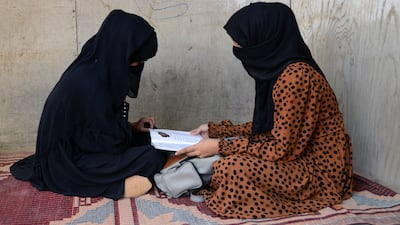
Schoolgirls Marwa Ayoubi (R) and Madina Mohammadi study at home in Kandahar, Afghanistan. The Taliban have ordered girls' secondary schools to shut only hours after they had reopened. All photos: AFP -
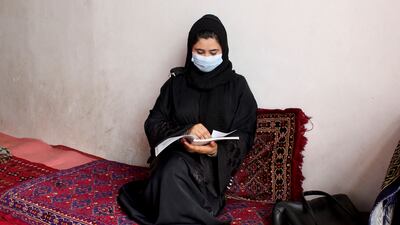
Raihana studies at home in Kunduz province. Education ministers offered no coherent explanation even as officials held a ceremony in the capital to mark the start of the academic year, and said it was a matter for the country's leadership. -

The Taliban insisted that pupils aged 12 to 19 would be segregated, even though most Afghan schools are already same-sex and operate according to Islamic principles. -

School girl Alina Nazari (R) holds a book after the Taliban ordered girls' secondary schools in Afghanistan to shut. -
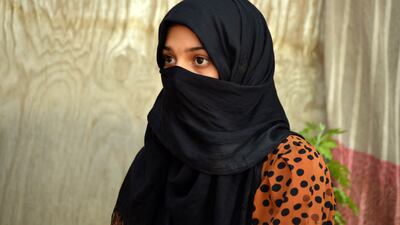
Marwa Ayoubi was sent home in Kandahar, while crestfallen girls at Zarghona High School in the capital Kabul tearfully packed up their belongings after teachers halted lessons. -
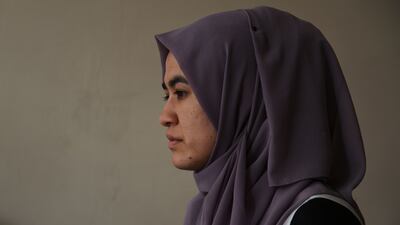
The latest education policy reversal by the hardline leaders sparked heartbreak and confusion. -

The U-turn came shortly after thousands of girls had resumed lessons for the first time since August, when the Taliban seized control imposed harsh restrictions on women. -
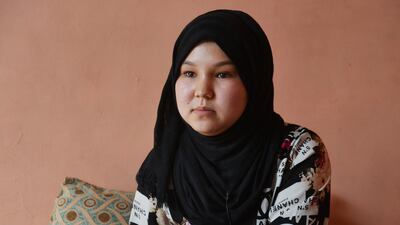
Schoolgirl Alina Nazari said she fears that the Taliban will shut down all formal education for girls, as they did in their first stint in power from 1996 to 2001. -

Nobel Prize laureate Malala Yousafzai, who survived a Pakistani Taliban assassination attempt when she was 15, tweeted: ‘They will keep finding excuses to stop girls from learning – because they are afraid of educated girls and empowered women.' -
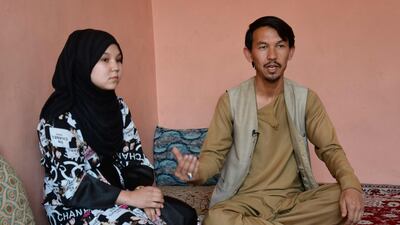
Mohammed Anwar Nazari and his daughter Alina give an interview. Even if schools do reopen fully, barriers to girls returning to education remain, with many families suspicious of the Taliban and reluctant to allow their daughters outside. -
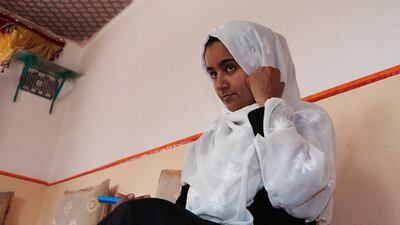
‘What will be our future?’ schoolgirl Qahera Mohammadi asks from her home in Panjshir province.


The instructor, who asked not to be named, was prevented by her husband from speaking to The National herself.
While informal schooling may be on the increase, the Babaji High School is closer to failing ― a waste of the colossal effort it took to get it open in the first place.
It is the only girls’ school in the area and community elders had to initially convince local officials to invest in construction of the school building and then families to send their girls to school.
“There was so much disinterest and even resistance from everyone ― land owners, village elders and community members ― to have a girls’ school in the village, but we were committed,” Irman Azizi, head of the village council, told The National.
“Together with the imam in our village and some community elders, we had to talk to families and convince them to send their girls to school. If secondary schools don’t reopen for girls, our years-long efforts will be wasted.”
Like many other parts of the country, younger girls in the eastern provinces of Afghanistan are allowed to go to school only in the company of an elder sister or another family member. Now that their older sisters can no longer attend, some of the younger girls in Babaji High School cannot go to school either.
Despite repeated promises by the Taliban government to reopen schools for all girls and boys, girls' secondary schools remain closed in several provinces. Education experts believe barring girls from going to school is already having a huge effect on the girls.
“Many girls find it difficult to comprehend why they are not allowed to go to school while boys from their families go to school every day,” Ahmadullah Safi, an educator and expert in Kabul, told The National.
“Even if girls’ secondary schools reopen tomorrow, which is unlikely, female students will have major challenges in catching up with their previous studies. They might have already forgotten a big part of what they studied.”
During their first rule between 1996 and 2001, the Taliban prohibited female pupils and teachers from going to school. This time, even though the Taliban said they will provide some form of education to girls by implementing new parameters, it is not certain when secondary schools will reopen for girls.
So far, the Taliban have mentioned technical issues, cultural considerations and differences among religious clerics over girls’ education as the main reasons for the closure of schools in many provinces. However, schools are open for girls of all ages in at least nine provinces and girls attend universities throughout the country, with classes for males and females segregated.

