Dispatch from Calais: in limbo waiting for the last leg of the escape from Kabul to the UK


Layla Maghribi
  • English
  • Arabic

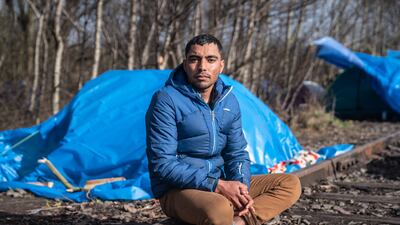
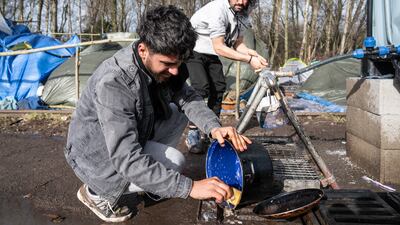
With his most treasured possession — a medical examination certificate — safely stowed away, Baheer is hoping to complete the final leap of a long journey to a new life, having already tried to cross the English Channel from France once this month.

Baheer, 25, is among about 2,000 people at a roadside migrant camp in northern France. After completing his medical degree in 2019, he worked with a European charity at a hospital in Jalalabad.

When the Taliban took over Afghanistan in August, the emergency ward doctor set off to Europe hoping to reach the UK.

He had already applied to continue his specialty in the UK and was set to take the entrance exam when the Afghan government collapsed.

"Then the emails stopped and I didn’t hear from anyone,” Baheer says. “I want to get a visa to continue my education, not to get asylum. I have my exam card.

He paid a smuggler £2,500 ($3,385) to get on a boat with 30 other people but the weather wasn’t safe enough.

“Then the police came and punctured our boat,” Basheer tells The National.

It us one of a range of tactics used by French authorities to stem the tide of people — about 28,000 people in 2021 — crossing the narrow arm of the Atlantic Ocean separating the southern coast of England from the northern coast of France.

Last year France banned the sale of inflatable boats in Channel ports, while some rest stops for lorry drivers on the route to Calais have been closed.

“You can’t find a kayak for sale anywhere in Dunkirk,” says Clement, a Frenchman who assists with humanitarian work for migrants in northern France.

Clement works in a camp about 40 kilometres north of Calais in Grande-Synthe, a commune near the city of Dunkirk and a less famous place where migrants heading to the UK converge.

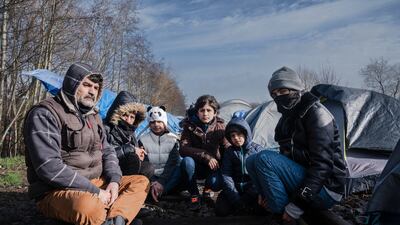
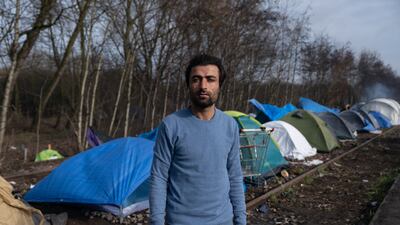
After regular police evictions, the "camp" in Grande-Synthe, like those in Calais, is a roving one. Sometimes the collection of flimsy shelters is fixed in a wasteland behind derelict buildings.

At other times, as when The National visited, tents are lined up along a disused rail track, like passengers waiting to board a train.

Islamudin was a police officer in Afghanistan before the Taliban took over in August. "This is why I went abroad," he says in Grande-Synthe camp, where he has been for 10 days. “My goal is to get to the UK and I accept the dangers that come with going this way. We have no choice, there is no other way.”

If Baheer does make it to UK shores, his only chance of staying and pursuing his medical career is to make a claim for asylum, a process that is notoriously difficult and presently burdened by a back-log.

Under Home Secretary Priti Patel’s proposed new legislation, people who enter the UK by "irregular routes" to seek asylum will be treated as criminals, at the risk of prison or deportation.

It is law that has gathered widespread international criticism.

Why do migrants want to go to the UK?

Most of the people who cross land borders in Europe seek asylum in one of the EU countries, if practical and permissible, but a small minority of people found along the 100km of the Pas de Calais and Nord continue the march to Britain.

A complex set of understanding is at play for those who make the journey. After Brexit, the UK was no longer subject to the EU’s Dublin Agreement, under which asylum-seekers with proceedings pending or closed in one EU nation have to stay there, meaning applications in the UK are treated as new and separate claims.

Other reasons to try the UK include asylum-seekers having English-language skills, connections in the country or the belief that the British asylum system will be more favourable to them.

“If I go to the UK and study then hopefully I can work in one or two years,” Baheer says hopefully.

He says he will give the crossing another chance when the weather conditions are better.

Ali left war-torn Sudan nearly a year ago. After working in Libya for several months to save money, he took a boat to Italy and continued his journey to northern France.

As we speak, the first of three storms to sweep across the Atlantic that week had landed and smooth waters in the Channel were not on the horizon.

“We are scared here, the weather, the conditions," says Baheer. "Last night we couldn’t sleep because of the wind and the rain.

"We can only take a shower once a week. It’s not good. But what can I do? It’s the only way.”

Record number of refugees lead to mounting tragedies

Last November, 27 people drowned on the English Channel in the deadliest crossing there on record.

While the tragedy elicited much international sympathy, outrage and the condemnation of traffickers, it has done little to stem the trials of desperate people.

Stormy seas

Weather warnings show that Storm Eunice is soon to make landfall. The videographer and I are scrambling to return to the other side of the Channel before it does. As we race to the port of Calais, I see miles of wire fencing topped with barbed wire all around it, a silent ‘Keep Out’ sign for those who, unlike us, aren’t lucky enough to have the right to move freely and safely across borders.

We set sail on a giant ferry whose length dwarfs the dinghies migrants use by nearly a 100 times. Despite the windy rain lashing at the portholes, we arrive safely in Dover; grateful but acutely aware of the miserable conditions the people we’ve left behind are in and of the privilege of choice. 

“I’m scared but what can I do? This is the only way. Afghans are already scared in Afghanistan, here, everywhere,” Baheer says.

For many of those fleeing war or persecution, the dangers of remaining in country appear to outweigh the treacherous journey they have undertaken.

“You can’t live in Afghanistan now, it’s very dangerous," Kamran, from Kandahar, tells The National.

"I used to work with American soldiers as a translator so it was very dangerous for me to stay."

Kamran, 22, was on a trip overseas when the US forces withdrew from Afghanistan and flew out several thousand Afghans who had formerly worked with them.

Having missed the opportunity to leave at the time, he says he tried contacting US authorities for resettlement but decided to leave on his own when his queries went unanswered.

After six months of travelling overland from Iran through Europe, Kamran, 22, arrived in Grande-Synthe a month ago. Despite the inhospitable conditions, he says it is far better than what he has endured.

“I walked, took a car, went in a container," Kamran says. "If you feel like the situation is bad then you do everything you need to.

“I saw so many people dead in the snow in front of my eyes in Bosnia, Turkey, Serbia — it’s very dangerous.”

There is a lot more humanitarian help in Grande-Synthe, he says, nodding towards volunteers distributing food or digging up ground gravel to lay down plastic tubes for running water.

The next part of Kamran’s journey involves going to London, where he has a relative, “by container, boat, anything".

Islamudin, 30, shares the same destination and for him the goal is a reunion with family members.

“I have family in the UK and I want to live together with them,” says the former Kabul police officer, who left his country soon after the Taliban swept to power.

After a six-month journey overland starting in Iran, Islamudin arrived in Grande-Synthe 10 days earlier.

All around the camp, loose tarpaulin flutters furiously as the stormy winds approach. But weather conditions are no deterrent.

“Inshallah, when the conditions are good I will go with the refugees here in the same way they go,” Islamudin says, referring to the infamous water route.

“I accept the dangers that come with going this way. We have no choice, there is no other way.”

Desperate times , desperate measures

Shocking as the record number of Channel boat crossings is, much of the figure is caused by the absence of other viable routes to claim asylum in the UK, as refugee resettlement and family reunification schemes are few and far between.

In 2020, France dealt with 80,000 asylum applications and the EU as a whole with 416,000. The UK dealt with 27,000.

Parvez, 16, left Baghlan in Afghanistan in September, shortly after the fall of the capital, and made the same overland journey across Europe by train, car and foot.

“It was difficult in the back of a Peugeot with other people," Parvez says. "Sometimes we were beaten up."

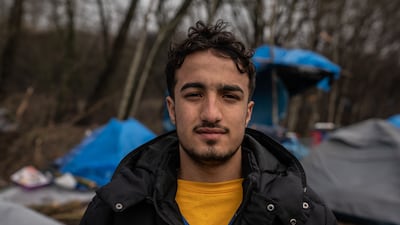
He arrived in France a week ago, a pit-stop on his way to join a brother who lives in the UK. Whether it is because of youthful folly or he is accustomed to peril, the teenager seems unfazed by the dangers that await.

“Why should I be scared? All the ways are dangerous in the end,” Parvez says.

In Calais, the ‘highway’ of migration for more than three decades, the feeling among the displaced is less optimistic.

After the notorious "Calais Jungle" was dismantled in 2016 by French authorities, up to 2,000 people live in semi-sheltered encampments dotted around the city at any one time.

A large proportion of migrants in Calais are from Africa, Sudan and Eritrea in particular, and many have found themselves stuck for longer than intended at England’s de facto southern border.

Police evictions happen more regularly here, creating more transient and dangerous environments for migrants.

Sitting around a small fire near a cluster of tents was Faisal, a Sudanese who has been in France for three months.

He has been trying to be smuggled on to a lorry or container on its way to the port of Dover.

“I want to go to the UK because I have many dreams,” Faisal says, without divulging what they are. “I’ll tell you when I get there."

Sudan has long been beset by conflict. Two rounds of north-south civil war cost the lives of 1.5 million people, and a continuing conflict in the western region of Darfur has driven more than two million people from their homes and killed almost 400,000 people.

Instability at home is what pushed Ali, 20, to drop out of university and cross northern Africa into Libya, where he worked for seven months to save $4,000 for the 30-hour boat ride to Italy.

He arrived in Calais four months ago and has been living on derelict land where small trees surround huddled tents.

Ali says he tries his luck at hitching a ride to the UK on a lorry every few days.

With enough time and tragedy, the hope of going to the UK has been muted among many.

Migrants regularly die in forests, at sea, from hunger and cold, or under the wheels of a lorry, as happened to one of Faisal’s friends recently.

“Even if I got to the UK today, I wouldn’t be happy after everything I’ve seen,” he says.

THE BIO

Favourite author - Paulo Coelho 

Favourite holiday destination - Cuba 

New York Times or Jordan Times? NYT is a school and JT was my practice field

Role model - My Grandfather 

Dream interviewee - Che Guevara

Global state-owned investor ranking by size

1.

United States

2.

China

3.

UAE

4.

Japan

5

Norway

6.

Canada

7.

Singapore

8.

Australia

9.

Saudi Arabia

10.

South Korea

The biog

Hometown: Cairo

Age: 37

Favourite TV series: The Handmaid’s Tale, Black Mirror

Favourite anime series: Death Note, One Piece and Hellsing

Favourite book: Designing Brand Identity, Fifth Edition

Dubai World Cup factbox

Most wins by a trainer: Godolphin’s Saeed bin Suroor(9)

Most wins by a jockey: Jerry Bailey(4)

Most wins by an owner: Godolphin(9)

Most wins by a horse: Godolphin’s Thunder Snow(2)

Heather, the Totality
Matthew Weiner,
Canongate 

Unresolved crisis

Russia and Ukraine have been locked in a bitter conflict since 2014, when Ukraine’s Kremlin-friendly president was ousted, Moscow annexed Crimea and then backed a separatist insurgency in the east.

Fighting between the Russia-backed rebels and Ukrainian forces has killed more than 14,000 people. In 2015, France and Germany helped broker a peace deal, known as the Minsk agreements, that ended large-scale hostilities but failed to bring a political settlement of the conflict.

The Kremlin has repeatedly accused Kiev of sabotaging the deal, and Ukrainian officials in recent weeks said that implementing it in full would hurt Ukraine.

UAE currency: the story behind the money in your pockets
Key features of new policy

Pupils to learn coding and other vocational skills from Grade 6

Exams to test critical thinking and application of knowledge

A new National Assessment Centre, PARAKH (Performance, Assessment, Review and Analysis for Holistic Development) will form the standard for schools

Schools to implement online system to encouraging transparency and accountability

Mercer, the investment consulting arm of US services company Marsh & McLennan, expects its wealth division to at least double its assets under management (AUM) in the Middle East as wealth in the region continues to grow despite economic headwinds, a company official said.

Mercer Wealth, which globally has $160 billion in AUM, plans to boost its AUM in the region to $2-$3bn in the next 2-3 years from the present $1bn, said Yasir AbuShaban, a Dubai-based principal with Mercer Wealth.

Within the next two to three years, we are looking at reaching $2 to $3 billion as a conservative estimate and we do see an opportunity to do so,” said Mr AbuShaban.

Mercer does not directly make investments, but allocates clients’ money they have discretion to, to professional asset managers. They also provide advice to clients.

“We have buying power. We can negotiate on their (client’s) behalf with asset managers to provide them lower fees than they otherwise would have to get on their own,” he added.

Mercer Wealth’s clients include sovereign wealth funds, family offices, and insurance companies among others.

From its office in Dubai, Mercer also looks after Africa, India and Turkey, where they also see opportunity for growth.

Wealth creation in Middle East and Africa (MEA) grew 8.5 per cent to $8.1 trillion last year from $7.5tn in 2015, higher than last year’s global average of 6 per cent and the second-highest growth in a region after Asia-Pacific which grew 9.9 per cent, according to consultancy Boston Consulting Group (BCG). In the region, where wealth grew just 1.9 per cent in 2015 compared with 2014, a pickup in oil prices has helped in wealth generation.

BCG is forecasting MEA wealth will rise to $12tn by 2021, growing at an annual average of 8 per cent.

Drivers of wealth generation in the region will be split evenly between new wealth creation and growth of performance of existing assets, according to BCG.

Another general trend in the region is clients’ looking for a comprehensive approach to investing, according to Mr AbuShaban.

“Institutional investors or some of the families are seeing a slowdown in the available capital they have to invest and in that sense they are looking at optimizing the way they manage their portfolios and making sure they are not investing haphazardly and different parts of their investment are working together,” said Mr AbuShaban.

Some clients also have a higher appetite for risk, given the low interest-rate environment that does not provide enough yield for some institutional investors. These clients are keen to invest in illiquid assets, such as private equity and infrastructure.

“What we have seen is a desire for higher returns in what has been a low-return environment specifically in various fixed income or bonds,” he said.

“In this environment, we have seen a de facto increase in the risk that clients are taking in things like illiquid investments, private equity investments, infrastructure and private debt, those kind of investments were higher illiquidity results in incrementally higher returns.”

The Abu Dhabi Investment Authority, one of the largest sovereign wealth funds, said in its 2016 report that has gradually increased its exposure in direct private equity and private credit transactions, mainly in Asian markets and especially in China and India. The authority’s private equity department focused on structured equities owing to “their defensive characteristics.”

The bio

Favourite book: Peter Rabbit. I used to read it to my three children and still read it myself. If I am feeling down it brings back good memories.

Best thing about your job: Getting to help people. My mum always told me never to pass up an opportunity to do a good deed.

Best part of life in the UAE: The weather. The constant sunshine is amazing and there is always something to do, you have so many options when it comes to how to spend your day.

Favourite holiday destination: Malaysia. I went there for my honeymoon and ended up volunteering to teach local children for a few hours each day. It is such a special place and I plan to retire there one day.

Uefa Nations League: How it works

The Uefa Nations League, introduced last year, has reached its final stage, to be played over five days in northern Portugal. The format of its closing tournament is compact, spread over two semi-finals, with the first, Portugal versus Switzerland in Porto on Wednesday evening, and the second, England against the Netherlands, in Guimaraes, on Thursday.

The winners of each semi will then meet at Porto’s Dragao stadium on Sunday, with the losing semi-finalists contesting a third-place play-off in Guimaraes earlier that day.

Qualifying for the final stage was via League A of the inaugural Nations League, in which the top 12 European countries according to Uefa's co-efficient seeding system were divided into four groups, the teams playing each other twice between September and November. Portugal, who finished above Italy and Poland, successfully bid to host the finals.

PRO BASH

Thursday’s fixtures

6pm: Hyderabad Nawabs v Pakhtoon Warriors

10pm: Lahore Sikandars v Pakhtoon Blasters

Teams

Chennai Knights, Lahore Sikandars, Pakhtoon Blasters, Abu Dhabi Stars, Abu Dhabi Dragons, Pakhtoon Warriors and Hyderabad Nawabs.

Squad rules

All teams consist of 15-player squads that include those contracted in the diamond (3), platinum (2) and gold (2) categories, plus eight free to sign team members.

Tournament rules

The matches are of 25 over-a-side with an 8-over power play in which only two fielders allowed outside the 30-yard circle. Teams play in a single round robin league followed by the semi-finals and final. The league toppers will feature in the semi-final eliminator.

Fresh faces in UAE side

Khalifa Mubarak (24) An accomplished centre-back, the Al Nasr defender’s progress has been hampered in the past by injury. With not many options in central defence, he would bolster what can be a problem area.

Ali Salmeen (22) Has been superb at the heart of Al Wasl’s midfield these past two seasons, with the Dubai club flourishing under manager Rodolfo Arrubarrena. Would add workrate and composure to the centre of the park.

Mohammed Jamal (23) Enjoyed a stellar 2016/17 Arabian Gulf League campaign, proving integral to Al Jazira as the capital club sealed the championship for only a second time. A tenacious and disciplined central midfielder.

Khalfan Mubarak (22) One of the most exciting players in the UAE, the Al Jazira playmaker has been likened in style to Omar Abdulrahman. Has minimal international experience already, but there should be much more to come.

Jassim Yaqoub (20) Another incredibly exciting prospect, the Al Nasr winger is becoming a regular contributor at club level. Pacey, direct and with an eye for goal, he would provide the team’s attack an extra dimension.

A Long Way Home by Peter Carey
Faber & Faber

The President's Cake

Director: Hasan Hadi

Starring: Baneen Ahmad Nayyef, Waheed Thabet Khreibat, Sajad Mohamad Qasem 

Rating: 4/5

RESULTS

Light Flyweight (48kg): Alua Balkibekova (KAZ) beat Gulasal Sultonalieva (UZB) by points 4-1.

Flyweight (51kg): Nazym Kyzaibay (KAZ) beat Mary Kom (IND) 3-2.

Bantamweight (54kg): Dina Zholaman (KAZ) beat Sitora Shogdarova (UZB) 3-2.

Featherweight (57kg): Sitora Turdibekova (UZB) beat Vladislava Kukhta (KAZ) 5-0.

Lightweight (60kg): Rimma Volossenko (KAZ) beat Huswatun Hasanah (INA) KO round-1.

Light Welterweight (64kg): Milana Safronova (KAZ) beat Lalbuatsaihi (IND) 3-2.

Welterweight (69kg): Valentina Khalzova (KAZ) beat Navbakhor Khamidova (UZB) 5-0

Middleweight (75kg): Pooja Rani (IND) beat Mavluda Movlonova (UZB) 5-0.

Light Heavyweight (81kg): Farida Sholtay (KAZ) beat Ruzmetova Sokhiba (UZB) 5-0.

Heavyweight (81 kg): Lazzat Kungeibayeva (KAZ) beat Anupama (IND) 3-2.

Profile

Company: Justmop.com

Date started: December 2015

Founders: Kerem Kuyucu and Cagatay Ozcan

Sector: Technology and home services

Based: Jumeirah Lake Towers, Dubai

Size: 55 employees and 100,000 cleaning requests a month

Funding:  The company’s investors include Collective Spark, Faith Capital Holding, Oak Capital, VentureFriends, and 500 Startups. 

Stormy seas

Weather warnings show that Storm Eunice is soon to make landfall. The videographer and I are scrambling to return to the other side of the Channel before it does. As we race to the port of Calais, I see miles of wire fencing topped with barbed wire all around it, a silent ‘Keep Out’ sign for those who, unlike us, aren’t lucky enough to have the right to move freely and safely across borders.

We set sail on a giant ferry whose length dwarfs the dinghies migrants use by nearly a 100 times. Despite the windy rain lashing at the portholes, we arrive safely in Dover; grateful but acutely aware of the miserable conditions the people we’ve left behind are in and of the privilege of choice. 

Updated: February 26, 2022, 8:44 AM