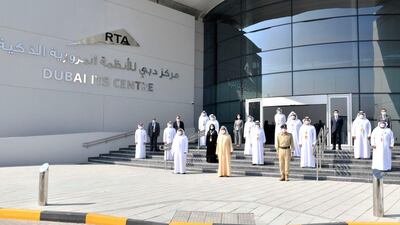
Dubai's Roads and Transport Authority is carrying out key infrastructure work. Photo: RTA

Dubai aims to ease Hessa Street congestion as three new roads are built


Anam Rizvi
  • English
  • Arabic

Transport chiefs have overseen the construction of three new roads to serve thousands of residents in Dubai communities and support the emirate's urban expansion plans.

The Roads and Transport Authority have also begun work on a further four internal roads in new residential communities to meet the needs of Dubai's growing population.

Dubai's population passed the 3.5 million mark in April amid a post-pandemic rise in migration.

The completed roads are in Al Quoz 2, Nad Al Sheba 2 and Al Barsha South 3. Together, they cover 37 kilometres.

The road-building drive aims to ease traffic on Hessa Street, one of the busiest routes for commuters in Dubai.

Work on new roads and street lighting is under way in Margham, Lahbab, Al Lesaily and Hatta and is expected to be completed next year.

“Such a drive is prompted by the need to cope with the needs of demographic and urban expansion and improve the well-being and happiness of people in the emirate,” said RTA director general Mattar Al Tayer.

RTA completed the construction of a network of main roads extending 16km at Al Quoz 2 in the area between Al Khail and Meydan Roads.

“It carried out paving of roads along with infrastructure works that included a rainwater drainage network and street lighting,” said Mr Al Tayer.

“As such, the accessibility of Al Quoz 2 around the market complex and Al Quoz Pond Park will improve and serve about 3,000 residents.”

In Al Barsha South 3, authorities have developed roads extending 6.4km at the Mohammed bin Rashid Gardens, surrounded by Al Barsha South 2 to the north, Al Hebiah 1 and 4 to the south — Motor City and Sports City — Arjan to the east, and Al Barsha South 4 to the West. Authorities also constructed street lights, car parks and bus stops.

The project increased accessibility to recently developed areas of Al Barsha South 3 and will serve about 4,500 residents.

Boosting traffic capacity at Hessa Street

Mr Al Tayer also said that the project improved the connectivity of the area by raising the capacity of entry and exit points of Hessa Street by 1,500 vehicles per hour.

This would also ease the movement to and from Umm Suqeim Street as well as the roads network of Al Barsha South 2, he said.

In Nad Al Sheba 2, RTA completed the construction of internal roads extending 12km, as well as parallel parking, street lights and rainwater drainage system and a sewage network.

The scheme aims to improve the traffic flow and public safety and ease congestion in entry and exit points of the area.

The coming work at Margham covers the construction of roads on the Dubai-Al Ain Road near Skydive Dubai.

At Lahbab, improvement works will involve paving roads extending 4km, along with rainwater drainage and street lights.

The internal roads at Al Lesaily extend 7km and street lighting will be constructed to cover the route.

The work will support about 2,900 residents in the neighbourhood.

At Hatta, roads will be extended by 2km at Sa’aeer, Al Salami and Suhaila in addition to infrastructure works that include rainwater drainage and street lights.

Dubai traffic measures - in pictures

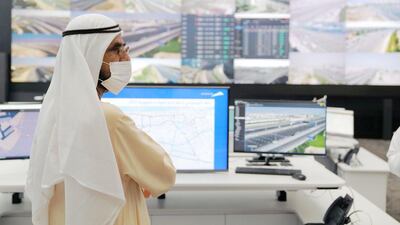
  • Sheikh Mohammed bin Rashid, Vice President and Ruler of Dubai, inaugurates the Smart Centre for Traffic Management. All photos: Dubai Media Office
    Sheikh Mohammed bin Rashid, Vice President and Ruler of Dubai, inaugurates the Smart Centre for Traffic Management. All photos: Dubai Media Office
  • The Intelligent Traffic System cost Dh590 million ($160.6m) and centralises a network of smart cameras linked to databases.
    The Intelligent Traffic System cost Dh590 million ($160.6m) and centralises a network of smart cameras linked to databases.
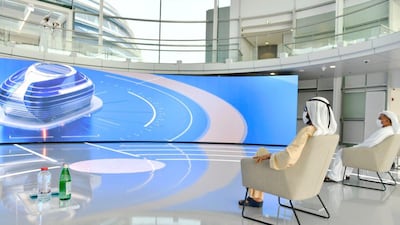
  • The traffic centre is one of the biggest and most sophisticated in the world.
    The traffic centre is one of the biggest and most sophisticated in the world.
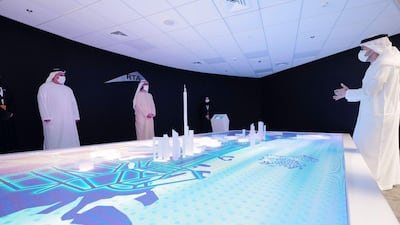
  • It was developed to meet the needs of Dubai's rapid urban growth, the infrastructure expansion required for Expo 2020 Dubai, and also to support current and future transport systems.
    It was developed to meet the needs of Dubai's rapid urban growth, the infrastructure expansion required for Expo 2020 Dubai, and also to support current and future transport systems.
  • The centre expands the coverage of intelligent traffic systems from 11 per cent to 60 per cent of the road network in the emirate and improves detection times for accidents.
    The centre expands the coverage of intelligent traffic systems from 11 per cent to 60 per cent of the road network in the emirate and improves detection times for accidents.
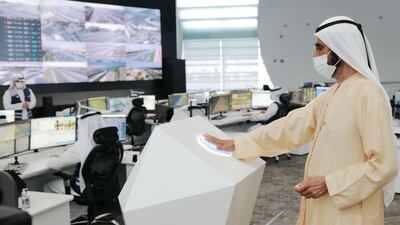
  • More than 110 cameras were installed to measure the average speed of cars, while 17 weather-sensing stations were also established. All data is put into a system monitored by officers who can also issue important messages to the public from the centre.
    More than 110 cameras were installed to measure the average speed of cars, while 17 weather-sensing stations were also established. All data is put into a system monitored by officers who can also issue important messages to the public from the centre.
Scoreline

Bournemouth 2

Wilson 70', Ibe 74'

Arsenal 1

Bellerin 52'

Winners

Ballon d’Or (Men’s)
Ousmane Dembélé (Paris Saint-Germain / France)

Ballon d’Or Féminin (Women’s)
Aitana Bonmatí (Barcelona / Spain)

Kopa Trophy (Best player under 21 – Men’s)
Lamine Yamal (Barcelona / Spain)

Best Young Women’s Player
Vicky López (Barcelona / Spain)

Yashin Trophy (Best Goalkeeper – Men’s)
Gianluigi Donnarumma (Paris Saint-Germain and Manchester City / Italy)

Best Women’s Goalkeeper
Hannah Hampton (England / Aston Villa and Chelsea)

Men’s Coach of the Year
Luis Enrique (Paris Saint-Germain)

Women’s Coach of the Year
Sarina Wiegman (England)

Key figures in the life of the fort

Sheikh Dhiyab bin Isa (ruled 1761-1793) Built Qasr Al Hosn as a watchtower to guard over the only freshwater well on Abu Dhabi island.

Sheikh Shakhbut bin Dhiyab (ruled 1793-1816) Expanded the tower into a small fort and transferred his ruling place of residence from Liwa Oasis to the fort on the island.

Sheikh Tahnoon bin Shakhbut (ruled 1818-1833) Expanded Qasr Al Hosn further as Abu Dhabi grew from a small village of palm huts to a town of more than 5,000 inhabitants.

Sheikh Khalifa bin Shakhbut (ruled 1833-1845) Repaired and fortified the fort.

Sheikh Saeed bin Tahnoon (ruled 1845-1855) Turned Qasr Al Hosn into a strong two-storied structure.

Sheikh Zayed bin Khalifa (ruled 1855-1909) Expanded Qasr Al Hosn further to reflect the emirate's increasing prominence.

Sheikh Shakhbut bin Sultan (ruled 1928-1966) Renovated and enlarged Qasr Al Hosn, adding a decorative arch and two new villas.

Sheikh Zayed bin Sultan (ruled 1966-2004) Moved the royal residence to Al Manhal palace and kept his diwan at Qasr Al Hosn.

Sources: Jayanti Maitra, www.adach.ae

If you go...

Etihad Airways flies from Abu Dhabi to Kuala Lumpur, from about Dh3,600. Air Asia currently flies from Kuala Lumpur to Terengganu, with Berjaya Hotels & Resorts planning to launch direct chartered flights to Redang Island in the near future. Rooms at The Taaras Beach and Spa Resort start from 680RM (Dh597).

UAE%20v%20West%20Indies
%3Cp%3EFirst%20ODI%20-%20Sunday%2C%20June%204%20%0D%3Cbr%3ESecond%20ODI%20-%20Tuesday%2C%20June%206%20%0D%3Cbr%3EThird%20ODI%20-%20Friday%2C%20June%209%26nbsp%3B%3C%2Fp%3E%0A%3Cp%3EMatches%20at%20Sharjah%20Cricket%20Stadium.%20All%20games%20start%20at%204.30pm%0D%3Cbr%3E%0D%3Cbr%3E%3Cstrong%3EUAE%20squad%3C%2Fstrong%3E%0D%3Cbr%3EMuhammad%20Waseem%20(captain)%2C%20Aayan%20Khan%2C%20Adithya%20Shetty%2C%20Ali%20Naseer%2C%20Ansh%20Tandon%2C%20Aryansh%20Sharma%2C%20Asif%20Khan%2C%20Basil%20Hameed%2C%20Ethan%20D%E2%80%99Souza%2C%20Fahad%20Nawaz%2C%20Jonathan%20Figy%2C%20Junaid%20Siddique%2C%20Karthik%20Meiyappan%2C%20Lovepreet%20Singh%2C%20Matiullah%2C%20Mohammed%20Faraazuddin%2C%20Muhammad%20Jawadullah%2C%20Rameez%20Shahzad%2C%20Rohan%20Mustafa%2C%20Sanchit%20Sharma%2C%20Vriitya%20Aravind%2C%20Zahoor%20Khan%0D%3C%2Fp%3E%0A

Mercer, the investment consulting arm of US services company Marsh & McLennan, expects its wealth division to at least double its assets under management (AUM) in the Middle East as wealth in the region continues to grow despite economic headwinds, a company official said.

Mercer Wealth, which globally has $160 billion in AUM, plans to boost its AUM in the region to $2-$3bn in the next 2-3 years from the present $1bn, said Yasir AbuShaban, a Dubai-based principal with Mercer Wealth.

Within the next two to three years, we are looking at reaching $2 to $3 billion as a conservative estimate and we do see an opportunity to do so,” said Mr AbuShaban.

Mercer does not directly make investments, but allocates clients’ money they have discretion to, to professional asset managers. They also provide advice to clients.

“We have buying power. We can negotiate on their (client’s) behalf with asset managers to provide them lower fees than they otherwise would have to get on their own,” he added.

Mercer Wealth’s clients include sovereign wealth funds, family offices, and insurance companies among others.

From its office in Dubai, Mercer also looks after Africa, India and Turkey, where they also see opportunity for growth.

Wealth creation in Middle East and Africa (MEA) grew 8.5 per cent to $8.1 trillion last year from $7.5tn in 2015, higher than last year’s global average of 6 per cent and the second-highest growth in a region after Asia-Pacific which grew 9.9 per cent, according to consultancy Boston Consulting Group (BCG). In the region, where wealth grew just 1.9 per cent in 2015 compared with 2014, a pickup in oil prices has helped in wealth generation.

BCG is forecasting MEA wealth will rise to $12tn by 2021, growing at an annual average of 8 per cent.

Drivers of wealth generation in the region will be split evenly between new wealth creation and growth of performance of existing assets, according to BCG.

Another general trend in the region is clients’ looking for a comprehensive approach to investing, according to Mr AbuShaban.

“Institutional investors or some of the families are seeing a slowdown in the available capital they have to invest and in that sense they are looking at optimizing the way they manage their portfolios and making sure they are not investing haphazardly and different parts of their investment are working together,” said Mr AbuShaban.

Some clients also have a higher appetite for risk, given the low interest-rate environment that does not provide enough yield for some institutional investors. These clients are keen to invest in illiquid assets, such as private equity and infrastructure.

“What we have seen is a desire for higher returns in what has been a low-return environment specifically in various fixed income or bonds,” he said.

“In this environment, we have seen a de facto increase in the risk that clients are taking in things like illiquid investments, private equity investments, infrastructure and private debt, those kind of investments were higher illiquidity results in incrementally higher returns.”

The Abu Dhabi Investment Authority, one of the largest sovereign wealth funds, said in its 2016 report that has gradually increased its exposure in direct private equity and private credit transactions, mainly in Asian markets and especially in China and India. The authority’s private equity department focused on structured equities owing to “their defensive characteristics.”

Real estate tokenisation project

Dubai launched the pilot phase of its real estate tokenisation project last month.

The initiative focuses on converting real estate assets into digital tokens recorded on blockchain technology and helps in streamlining the process of buying, selling and investing, the Dubai Land Department said.

Dubai’s real estate tokenisation market is projected to reach Dh60 billion ($16.33 billion) by 2033, representing 7 per cent of the emirate’s total property transactions, according to the DLD.

Groom and Two Brides

Director: Elie Semaan

Starring: Abdullah Boushehri, Laila Abdallah, Lulwa Almulla

Rating: 3/5

Desert Warrior

Starring: Anthony Mackie, Aiysha Hart, Ben Kingsley

Director: Rupert Wyatt

Rating: 3/5

The National in Davos

We are bringing you the inside story from the World Economic Forum's Annual Meeting in Davos, a gathering of hundreds of world leaders, top executives and billionaires.

THE CLOWN OF GAZA

Director: Abdulrahman Sabbah 

Starring: Alaa Meqdad

Rating: 4/5

What is a robo-adviser?

Robo-advisers use an online sign-up process to gauge an investor’s risk tolerance by feeding information such as their age, income, saving goals and investment history into an algorithm, which then assigns them an investment portfolio, ranging from more conservative to higher risk ones.

These portfolios are made up of exchange traded funds (ETFs) with exposure to indices such as US and global equities, fixed-income products like bonds, though exposure to real estate, commodity ETFs or gold is also possible.

Investing in ETFs allows robo-advisers to offer fees far lower than traditional investments, such as actively managed mutual funds bought through a bank or broker. Investors can buy ETFs directly via a brokerage, but with robo-advisers they benefit from investment portfolios matched to their risk tolerance as well as being user friendly.

Many robo-advisers charge what are called wrap fees, meaning there are no additional fees such as subscription or withdrawal fees, success fees or fees for rebalancing.

Ten tax points to be aware of in 2026

1. Domestic VAT refund amendments: request your refund within five years

If a business does not apply for the refund on time, they lose their credit.

2. E-invoicing in the UAE

Businesses should continue preparing for the implementation of e-invoicing in the UAE, with 2026 a preparation and transition period ahead of phased mandatory adoption. 

3. More tax audits

Tax authorities are increasingly using data already available across multiple filings to identify audit risks. 

4. More beneficial VAT and excise tax penalty regime

Tax disputes are expected to become more frequent and more structured, with clearer administrative objection and appeal processes. The UAE has adopted a new penalty regime for VAT and excise disputes, which now mirrors the penalty regime for corporate tax.

5. Greater emphasis on statutory audit

There is a greater need for the accuracy of financial statements. The International Financial Reporting Standards standards need to be strictly adhered to and, as a result, the quality of the audits will need to increase.

6. Further transfer pricing enforcement

Transfer pricing enforcement, which refers to the practice of establishing prices for internal transactions between related entities, is expected to broaden in scope. The UAE will shortly open the possibility to negotiate advance pricing agreements, or essentially rulings for transfer pricing purposes. 

7. Limited time periods for audits

Recent amendments also introduce a default five-year limitation period for tax audits and assessments, subject to specific statutory exceptions. While the standard audit and assessment period is five years, this may be extended to up to 15 years in cases involving fraud or tax evasion. 

8. Pillar 2 implementation 

Many multinational groups will begin to feel the practical effect of the Domestic Minimum Top-Up Tax (DMTT), the UAE's implementation of the OECD’s global minimum tax under Pillar 2. While the rules apply for financial years starting on or after January 1, 2025, it is 2026 that marks the transition to an operational phase.

9. Reduced compliance obligations for imported goods and services

Businesses that apply the reverse-charge mechanism for VAT purposes in the UAE may benefit from reduced compliance obligations. 

10. Substance and CbC reporting focus

Tax authorities are expected to continue strengthening the enforcement of economic substance and Country-by-Country (CbC) reporting frameworks. In the UAE, these regimes are increasingly being used as risk-assessment tools, providing tax authorities with a comprehensive view of multinational groups’ global footprints and enabling them to assess whether profits are aligned with real economic activity. 

Contributed by Thomas Vanhee and Hend Rashwan, Aurifer

Four motivational quotes from Alicia's Dubai talk

“The only thing we need is to know that we have faith. Faith and hope in our own dreams. The belief that, when we keep going we’re going to find our way. That’s all we got.”

“Sometimes we try so hard to keep things inside. We try so hard to pretend it’s not really bothering us. In some ways, that hurts us more. You don’t realise how dishonest you are with yourself sometimes, but I realised that if I spoke it, I could let it go.”

“One good thing is to know you’re not the only one going through it. You’re not the only one trying to find your way, trying to find yourself, trying to find amazing energy, trying to find a light. Show all of yourself. Show every nuance. All of your magic. All of your colours. Be true to that. You can be unafraid.”

“It’s time to stop holding back. It’s time to do it on your terms. It’s time to shine in the most unbelievable way. It’s time to let go of negativity and find your tribe, find those people that lift you up, because everybody else is just in your way.”

Dust and sand storms compared

Sand storm

  • Particle size: Larger, heavier sand grains
  • Visibility: Often dramatic with thick "walls" of sand
  • Duration: Short-lived, typically localised
  • Travel distance: Limited 
  • Source: Open desert areas with strong winds

Dust storm

  • Particle size: Much finer, lightweight particles
  • Visibility: Hazy skies but less intense
  • Duration: Can linger for days
  • Travel distance: Long-range, up to thousands of kilometres
  • Source: Can be carried from distant regions
Electric scooters: some rules to remember
  • Riders must be 14-years-old or over
  • Wear a protective helmet
  • Park the electric scooter in designated parking lots (if any)
  • Do not leave electric scooter in locations that obstruct traffic or pedestrians
  • Solo riders only, no passengers allowed
  • Do not drive outside designated lanes
Updated: November 13, 2022, 10:27 AM