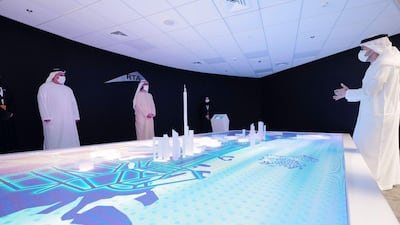
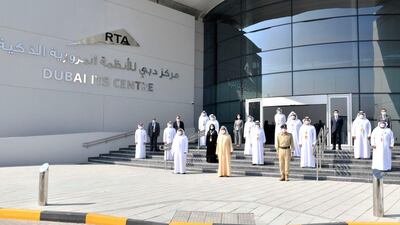
Dubai saved Dh210 billion ($57.18bn) in working hours, time and fuel between 2006 and 2020 thanks to investment in roads and transport infrastructure, officials have said.
About Dh140bn was spent over the 14-year period to improve the roads and transport network in the emirate.
The RTA’s projects have cemented the competitiveness of the UAE, which had consequently been ranked number one in road quality worldwide for five years in a row
Mattar Al Tayer,
Roads and Transport Authority
Dubai more than doubled its road network from 8,715 kilometres to 18,255km during that time, and increased the number of vehicle bridges and tunnels from 129 in 2006 to 844 in 2020.
“Similarly, we have increased the number of pedestrian bridges and tunnels by four times from 26 to 125 around the same time, and extended our cycling track network from 9km in 2006 to 463km in 2020. It is expected to reach 668km by 2025,” said Mattar Al Tayer, director general and chairman of the Roads and Transport Authority (RTA).
He made the announcement during his address at the 18th International Road Federation World Meeting and Exhibition in Dubai.
The authority completed mega projects in “record time” during that period under the direction of Sheikh Mohammed bin Rashid, Vice President and Ruler of Dubai, and other leaders, Mr Al Tayer said according to state news agency Wam.
“The Dubai Metro project, [was] delivered in just four years, and the Dubai Water Canal project [was] completed in less than three years," he said.
"The RTA’s projects have cemented the competitiveness of the UAE, which had consequently been ranked number one in road quality worldwide for five years in a row.”
Smart traffic systems
Joint efforts with Dubai Police have helped to reduce road accident fatalities from 22 cases to 1.8 for every 100,000 people between 2006 and 2020, and reduced pedestrian fatalities from 9.5 to 0.5 for every 100,000 people between 2007 and 2020, he said.
The use of artificial intelligence has been vital to this, Mr Al Tayer said.
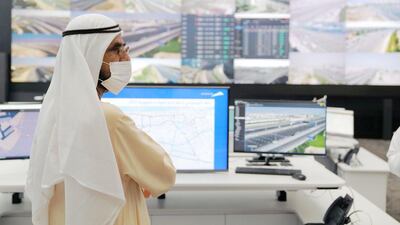
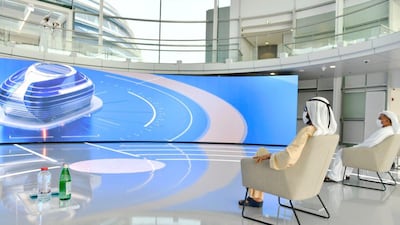
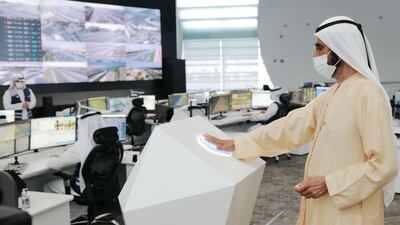
The Dubai Centre for Intelligent Traffic Systems was inaugurated by Sheikh Mohammed in November 2020.
It cost Dh590 million and centralises a network of smart cameras linked to databases.
"The centre raised the percentage of road network coverage with smart traffic systems from 11 per cent to 60 per cent, which is expected to increase to 100 per cent by 2023,” Mr Al Tayer said.
Technology has also been useful in managing parking, with machine-learning technology capable of scanning more than 10,000 parking spaces every hour, with 99 per cent accuracy, and issuing tickets for breaches automatically.
Mr Al Tayer also discussed the emirate’s goal for one in four journeys to be driverless by 2030.
“This strategy differs from other strategies as it includes all public and private modes of transport, such as the metro, buses, marine transportation, taxis and private vehicles, as opposed to numerous cities focusing on a limited number of modes of transportation," he said.
“In this regard, the RTA signed a partnership agreement with General Motors-Cruise to operate GM’s autonomous vehicles to deliver taxi and shared mobility services by 2023, which would make Dubai the first city in the world, outside America, to operate these vehicles,” he said.

Inside the smart room that monitors Al Ain's traffic
Indoor cricket in a nutshell
Indoor Cricket World Cup - Sept 16-20, Insportz, Dubai
16 Indoor cricket matches are 16 overs per side
8 There are eight players per team
9 There have been nine Indoor Cricket World Cups for men. Australia have won every one.
5 Five runs are deducted from the score when a wickets falls
4 Batsmen bat in pairs, facing four overs per partnership
Scoring In indoor cricket, runs are scored by way of both physical and bonus runs. Physical runs are scored by both batsmen completing a run from one crease to the other. Bonus runs are scored when the ball hits a net in different zones, but only when at least one physical run is score.
Zones
A Front net, behind the striker and wicketkeeper: 0 runs
B Side nets, between the striker and halfway down the pitch: 1 run
C Side nets between halfway and the bowlers end: 2 runs
D Back net: 4 runs on the bounce, 6 runs on the full
KILLING OF QASSEM SULEIMANI
Europe’s rearming plan
- Suspend strict budget rules to allow member countries to step up defence spending
- Create new "instrument" providing €150 billion of loans to member countries for defence investment
- Use the existing EU budget to direct more funds towards defence-related investment
- Engage the bloc's European Investment Bank to drop limits on lending to defence firms
- Create a savings and investments union to help companies access capital
Mercer, the investment consulting arm of US services company Marsh & McLennan, expects its wealth division to at least double its assets under management (AUM) in the Middle East as wealth in the region continues to grow despite economic headwinds, a company official said.
Mercer Wealth, which globally has $160 billion in AUM, plans to boost its AUM in the region to $2-$3bn in the next 2-3 years from the present $1bn, said Yasir AbuShaban, a Dubai-based principal with Mercer Wealth.
“Within the next two to three years, we are looking at reaching $2 to $3 billion as a conservative estimate and we do see an opportunity to do so,” said Mr AbuShaban.
Mercer does not directly make investments, but allocates clients’ money they have discretion to, to professional asset managers. They also provide advice to clients.
“We have buying power. We can negotiate on their (client’s) behalf with asset managers to provide them lower fees than they otherwise would have to get on their own,” he added.
Mercer Wealth’s clients include sovereign wealth funds, family offices, and insurance companies among others.
From its office in Dubai, Mercer also looks after Africa, India and Turkey, where they also see opportunity for growth.
Wealth creation in Middle East and Africa (MEA) grew 8.5 per cent to $8.1 trillion last year from $7.5tn in 2015, higher than last year’s global average of 6 per cent and the second-highest growth in a region after Asia-Pacific which grew 9.9 per cent, according to consultancy Boston Consulting Group (BCG). In the region, where wealth grew just 1.9 per cent in 2015 compared with 2014, a pickup in oil prices has helped in wealth generation.
BCG is forecasting MEA wealth will rise to $12tn by 2021, growing at an annual average of 8 per cent.
Drivers of wealth generation in the region will be split evenly between new wealth creation and growth of performance of existing assets, according to BCG.
Another general trend in the region is clients’ looking for a comprehensive approach to investing, according to Mr AbuShaban.
“Institutional investors or some of the families are seeing a slowdown in the available capital they have to invest and in that sense they are looking at optimizing the way they manage their portfolios and making sure they are not investing haphazardly and different parts of their investment are working together,” said Mr AbuShaban.
Some clients also have a higher appetite for risk, given the low interest-rate environment that does not provide enough yield for some institutional investors. These clients are keen to invest in illiquid assets, such as private equity and infrastructure.
“What we have seen is a desire for higher returns in what has been a low-return environment specifically in various fixed income or bonds,” he said.
“In this environment, we have seen a de facto increase in the risk that clients are taking in things like illiquid investments, private equity investments, infrastructure and private debt, those kind of investments were higher illiquidity results in incrementally higher returns.”
The Abu Dhabi Investment Authority, one of the largest sovereign wealth funds, said in its 2016 report that has gradually increased its exposure in direct private equity and private credit transactions, mainly in Asian markets and especially in China and India. The authority’s private equity department focused on structured equities owing to “their defensive characteristics.”
Tips from the expert
Dobromir Radichkov, chief data officer at dubizzle and Bayut, offers a few tips for UAE residents looking to earn some cash from pre-loved items.
- Sellers should focus on providing high-quality used goods at attractive prices to buyers.
- It’s important to use clear and appealing photos, with catchy titles and detailed descriptions to capture the attention of prospective buyers.
- Try to advertise a realistic price to attract buyers looking for good deals, especially in the current environment where consumers are significantly more price-sensitive.
- Be creative and look around your home for valuable items that you no longer need but might be useful to others.
Emergency phone numbers in the UAE
Estijaba – 8001717 – number to call to request coronavirus testing
Ministry of Health and Prevention – 80011111
Dubai Health Authority – 800342 – The number to book a free video or voice consultation with a doctor or connect to a local health centre
Emirates airline – 600555555
Etihad Airways – 600555666
Ambulance – 998
Knowledge and Human Development Authority – 8005432 ext. 4 for Covid-19 queries
The specs: 2017 Lotus Evora Sport 410
Price, base / as tested Dh395,000 / Dh420,000
Engine 3.5L V6
Transmission Six-speed manual
Power 410hp @ 7,000rpm
Torque 420Nm @ 3,500rpm
Fuel economy, combined 9.7L / 100km
Our legal consultant
Name: Dr Hassan Mohsen Elhais
Position: legal consultant with Al Rowaad Advocates and Legal Consultants.
How to wear a kandura
Dos
- Wear the right fabric for the right season and occasion
- Always ask for the dress code if you don’t know
- Wear a white kandura, white ghutra / shemagh (headwear) and black shoes for work
- Wear 100 per cent cotton under the kandura as most fabrics are polyester
Don’ts
- Wear hamdania for work, always wear a ghutra and agal
- Buy a kandura only based on how it feels; ask questions about the fabric and understand what you are buying
Read more from Kareem Shaheen
Leap of Faith
Michael J Mazarr
Public Affairs
Dh67
Navdeep Suri, India's Ambassador to the UAE
There has been a longstanding need from the Indian community to have a religious premises where they can practise their beliefs. Currently there is a very, very small temple in Bur Dubai and the community has outgrown this. So this will be a major temple and open to all denominations and a place should reflect India’s diversity.
It fits so well into the UAE’s own commitment to tolerance and pluralism and coming in the year of tolerance gives it that extra dimension.
What we will see on April 20 is the foundation ceremony and we expect a pretty broad cross section of the Indian community to be present, both from the UAE and abroad. The Hindu group that is building the temple will have their holiest leader attending – and we expect very senior representation from the leadership of the UAE.
When the designs were taken to the leadership, there were two clear options. There was a New Jersey model with a rectangular structure with the temple recessed inside so it was not too visible from the outside and another was the Neasden temple in London with the spires in its classical shape. And they said: look we said we wanted a temple so it should look like a temple. So this should be a classical style temple in all its glory.
It is beautifully located - 30 minutes outside of Abu Dhabi and barely 45 minutes to Dubai so it serves the needs of both communities.
This is going to be the big temple where I expect people to come from across the country at major festivals and occasions.
It is hugely important – it will take a couple of years to complete given the scale. It is going to be remarkable and will contribute something not just to the landscape in terms of visual architecture but also to the ethos. Here will be a real representation of UAE’s pluralism.
Brief scores:
Toss: Nepal, chose to field
UAE 153-6: Shaiman (59), Usman (30); Regmi 2-23
Nepal 132-7: Jora 53 not out; Zahoor 2-17
Result: UAE won by 21 runs
Series: UAE lead 1-0
Result
Crystal Palace 0 Manchester City 2
Man City: Jesus (39), David Silva (41)
German intelligence warnings
- 2002: "Hezbollah supporters feared becoming a target of security services because of the effects of [9/11] ... discussions on Hezbollah policy moved from mosques into smaller circles in private homes." Supporters in Germany: 800
- 2013: "Financial and logistical support from Germany for Hezbollah in Lebanon supports the armed struggle against Israel ... Hezbollah supporters in Germany hold back from actions that would gain publicity." Supporters in Germany: 950
- 2023: "It must be reckoned with that Hezbollah will continue to plan terrorist actions outside the Middle East against Israel or Israeli interests." Supporters in Germany: 1,250
Source: Federal Office for the Protection of the Constitution
UAE currency: the story behind the money in your pockets
Dr Afridi's warning signs of digital addiction
Spending an excessive amount of time on the phone.
Neglecting personal, social, or academic responsibilities.
Losing interest in other activities or hobbies that were once enjoyed.
Having withdrawal symptoms like feeling anxious, restless, or upset when the technology is not available.
Experiencing sleep disturbances or changes in sleep patterns.
What are the guidelines?
Under 18 months: Avoid screen time altogether, except for video chatting with family.
Aged 18-24 months: If screens are introduced, it should be high-quality content watched with a caregiver to help the child understand what they are seeing.
Aged 2-5 years: Limit to one-hour per day of high-quality programming, with co-viewing whenever possible.
Aged 6-12 years: Set consistent limits on screen time to ensure it does not interfere with sleep, physical activity, or social interactions.
Teenagers: Encourage a balanced approach – screens should not replace sleep, exercise, or face-to-face socialisation.
Source: American Paediatric Association