
Engineers in Sharjah 3D-printed a house with the help of a Dh1 million robot.
The house, made of sustainable eco-friendly cement, was built in almost two weeks.
Scientists and engineers built an early prototype of a single-storey home at the Sharjah Research, Technology and Innovation Park that could become the blueprint for hundreds of similar houses in future.
In a project backed by the American University of Sharjah, academics imported technology from Holland to print the walls of the traditional Emirati home in less than two weeks.
Up to 20 similar buildings are now planned for 2021, which could start a new era of 3D-printed construction projects in the UAE.
Hussain Al Mahmoudi, chief executive of SRTI Park, said while costs for the prototype were about 40 per cent more expensive than a traditional build, that is sure to come down.
It will become economical when houses in whole neighbourhoods are 3D-printed and economies of scale are achieved.
“It is not a straightforward process, but that is the challenge and an opportunity at the same time,” Mr Al Mahmoudi said.
“The price will come down and 3D houses will eventually be cheaper than traditional constructions. They will be faster to build and use less labour.
-

The house, made of sustainable eco-friendly cement, was built in about two weeks. All photos: Wam -
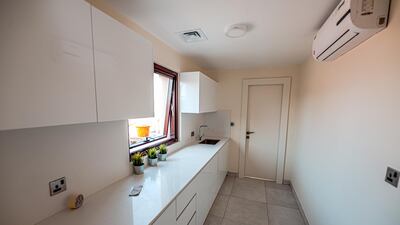
Only four skilled workers were required for the construction of the two-bedroom house. -

The technology was imported from the Netherlands to print the walls of the traditional Emirati home. -

The biggest challenge now facing the project’s developers is to convince people that 3D mortar is a viable alternative to bricks, steel and timber.


“Eventually, we would like to produce our own robotics, mortar and software in the UAE to enable us to reduce the cost even further.”
Currently, everything from the mortar, robotics, software and skilled labour is imported, resulting in a high cost for the prototype.
Only three to four skilled workers were required for the construction of the two-bedroom, single-storey house compared with a team of more than 50 usually required for a similar project built the traditional way.
The CyBe Construction robot was imported from Holland. It is designed to operate for 24 hours continuously and costs about Dh1 million.
The considerable savings in labour and material should result in 3D-printed homes eventually costing half that of traditional builds, and take a fraction of the six months usually set aside for such projects.
In October 2019, Dubai Municipality unveiled the world’s largest two-storey 3D-printed house, in Warsan.
While that took two years to complete, including testing procedures, the homes printed in Sharjah can be developed in a fraction of the time.

And with the eco-friendly materials used, it promises to be more environmentally sound.
“The mortar we used is more sustainable than elsewhere and it is significantly different,” said Haidar AlHaidary, a project executive who worked on the design.
“It does not use Portland cement, so we can reduce carbon emissions by about 60 per cent.
“It is also stronger so that should increase the lifespan of the building to about 50 years or so.
“It is a big difference.”
The special mortar used is the project’s “secret sauce”. It replaces the usual carbon-intensive Portland cement with a special formula, which is protected by the manufacturer.
The biggest challenge now facing the project’s developers is to convince people that 3D mortar is a viable alternative to bricks, steel and timber.
“Once people understand the technology, it will become commercially feasible,” Mr AlHaidary said.
“With interest in the market, we can reduce the monopoly, increase competition and bring the prices down.
“These are important points.
“It may not be cheaper in every aspect from Day 1, and we don’t want to replace traditional methods altogether, but we want 3D-printed to become a viable method of construction.”

