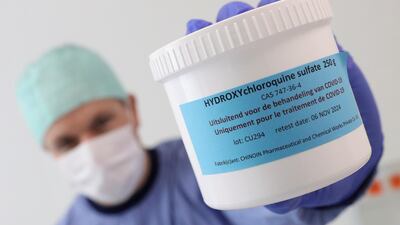
Remember that antimalarial treatment US President Trump said should be "put in use immediately" against Covid-19 back in March? He took a lot of flak for backing hydroxychloroquine, but now a new study of almost 3,500 patients in Italian hospitals has found it cuts death rates by 30 per cent.
Not so fast: in the past few days another study, this time involving about 12,000 patients given the drug, known colloquially as HCQ, concluded it does not save lives at all – and may actually be harmful. So who is right?
Welcome to the baffling world of evidence-based medicine, where science seems incapable of reaching definitive answers.
Hardly a week goes by without some equally headline-grabbing study turns accepted wisdom on its head
It is not only with Covid-19 that the evidence seems to forever flip-flop. In recent weeks, researchers have claimed that statins may really be useless for controlling cholesterol, and that pregnant women face a far higher risk from caffeine than currently believed.
Hardly a week goes by without some equally headline-grabbing study turning accepted wisdom on its head. Yet while they often appear in prestigious journals after supposedly being checked by experts, the truth is they are not equally reliable. This is not because the researchers are making stuff up (though that can and has happened).
Most often, the reason is the study or the interpretation of its findings – and sometimes both – is not fit for purpose.
Again, this does not (necessarily) mean the researchers are incompetent. So what are the telltale signs a study is likely to prove reliable?
What is the most reliable type of study?
When investigating “what works”, the gold standard is a double-blinded Randomised Controlled Trial, or RCT. Put simply, these compare two groups of patients, randomly allocated to receive either the treatment under test, or an alternative “control” treatment, which is often an inactive placebo.
The randomisation cuts the chances of anything other than the treatment affecting the outcome, as both groups are equally likely to get their share of patients who fare better or worse from other causes.
Both the researchers and the patient are also “blinded” to who is getting what, to eliminate any bias – unconscious or deliberate – in interpreting the outcome.
So why aren’t RCTs always used?
Decades of research have shown that most treatments do not work with most patients. As a result, an RCT will often need many hundreds or even thousands of patients to reveal the effectiveness of a treatment with enough precision to tell if it’s worth using. This makes RCTs time-consuming and very expensive – and often limits their size.
An alternative is to run a so-called observational study, where researchers just compare those given the treatment with those who weren’t – while trying to account for any effects not caused by the treatment by analysing patient data. This was the approach used by researchers in Italy who claimed HCQ is effective against Covid-19.
What is wrong with observational studies?
Lacking randomisation and blinding, observational studies can fall prey to various biases, including unknown “confounders” that aren’t balanced out between the two groups of patients.
The Italian study on HCQ was also retrospective, meaning the researchers could not always find important information such as what dosage patients received, or whether other drugs were also used. So while the sheer number of patients looks impressive, the study’s headline claim was treated with scepticism by many researchers.
How about combining lots of small trials?
While the most reliable evidence comes from large RCTs, it’s possible to combine many small studies in a “meta-analysis”. This is what an international team has now done for HCQ, examining 28 studies of patients who received the drug.
As most of the studies were observational, the team carried out a “systematic review” to weed out studies at high risk of bias. They then used statistical methods to combine the outcome of those remaining, including three RCTs. The results – based on more than 12,000 HCQ patients – were revealing.
The observational studies collectively pointed to a possible benefit from HCQ, but with a lot of uncertainty. In contrast, the three RCTs all pointed to HCQ being at best useless – and most probably harmful.
Given the greater reliability of RCTs, most researchers – and the World Health Organisation – have concluded HCQ should be abandoned.
So what about statins and cholesterol?
More than 200 million people worldwide take statins to protect against heart attacks and strokes. So last month's publication of a study claiming statins do not work inevitably made headlines.
On the face of it, the evidence seems impressive. The researchers based their conclusion on a systematic review of 35 studies – all of them RCTs – involving tens of thousands of patients.
However, the researchers didn't perform a meta-analysis, claiming the RCTs covered too many different types of patient and statin. Instead, they simply totted up how many of the RCTs gave statistically non-significant findings.
Crucially, this does not mean the trials had shown statins do not work – but merely that they have failed to give convincing evidence either way. Statisticians have warned researchers about making this blunder for decades.
Combined with other, more technical, errors, the statins study serves chiefly to show that publication in a “serious” journal is no guarantee of reliability.
What about caffeine and pregnant mums?
Mothers-to-be have long been advised to cut back on caffeine intake, but according to a new review of the evidence, the only safe amount is zero.
Again, the evidence seems impressive, being based on dozens of studies. Yet all but one were observational and thus subject to biases, making it impossible to claim caffeine is responsible for any ill-effects.
Importantly, the review was also not systematic – meaning the author may have missed studies that could overturn the overall conclusion.
The upshot for pregnant mums: nothing to see here – and don’t worry about having an occasional cup of coffee.
Robert Matthews is visiting professor of science at Aston University, Birmingham, UK

Mercer, the investment consulting arm of US services company Marsh & McLennan, expects its wealth division to at least double its assets under management (AUM) in the Middle East as wealth in the region continues to grow despite economic headwinds, a company official said.
Mercer Wealth, which globally has $160 billion in AUM, plans to boost its AUM in the region to $2-$3bn in the next 2-3 years from the present $1bn, said Yasir AbuShaban, a Dubai-based principal with Mercer Wealth.
“Within the next two to three years, we are looking at reaching $2 to $3 billion as a conservative estimate and we do see an opportunity to do so,” said Mr AbuShaban.
Mercer does not directly make investments, but allocates clients’ money they have discretion to, to professional asset managers. They also provide advice to clients.
“We have buying power. We can negotiate on their (client’s) behalf with asset managers to provide them lower fees than they otherwise would have to get on their own,” he added.
Mercer Wealth’s clients include sovereign wealth funds, family offices, and insurance companies among others.
From its office in Dubai, Mercer also looks after Africa, India and Turkey, where they also see opportunity for growth.
Wealth creation in Middle East and Africa (MEA) grew 8.5 per cent to $8.1 trillion last year from $7.5tn in 2015, higher than last year’s global average of 6 per cent and the second-highest growth in a region after Asia-Pacific which grew 9.9 per cent, according to consultancy Boston Consulting Group (BCG). In the region, where wealth grew just 1.9 per cent in 2015 compared with 2014, a pickup in oil prices has helped in wealth generation.
BCG is forecasting MEA wealth will rise to $12tn by 2021, growing at an annual average of 8 per cent.
Drivers of wealth generation in the region will be split evenly between new wealth creation and growth of performance of existing assets, according to BCG.
Another general trend in the region is clients’ looking for a comprehensive approach to investing, according to Mr AbuShaban.
“Institutional investors or some of the families are seeing a slowdown in the available capital they have to invest and in that sense they are looking at optimizing the way they manage their portfolios and making sure they are not investing haphazardly and different parts of their investment are working together,” said Mr AbuShaban.
Some clients also have a higher appetite for risk, given the low interest-rate environment that does not provide enough yield for some institutional investors. These clients are keen to invest in illiquid assets, such as private equity and infrastructure.
“What we have seen is a desire for higher returns in what has been a low-return environment specifically in various fixed income or bonds,” he said.
“In this environment, we have seen a de facto increase in the risk that clients are taking in things like illiquid investments, private equity investments, infrastructure and private debt, those kind of investments were higher illiquidity results in incrementally higher returns.”
The Abu Dhabi Investment Authority, one of the largest sovereign wealth funds, said in its 2016 report that has gradually increased its exposure in direct private equity and private credit transactions, mainly in Asian markets and especially in China and India. The authority’s private equity department focused on structured equities owing to “their defensive characteristics.”
The specs: 2019 Audi A8
Price From Dh390,000
Engine 3.0L V6 turbo
Gearbox Eight-speed automatic
Power 345hp @ 5,000rpm
Torque 500Nm @ 1,370rpm
Fuel economy, combined 7.5L / 100km
Skoda Superb Specs
Engine: 2-litre TSI petrol
Power: 190hp
Torque: 320Nm
Price: From Dh147,000
Available: Now
BUNDESLIGA FIXTURES
Saturday, May 16 (kick-offs UAE time)
Borussia Dortmund v Schalke (4.30pm)
RB Leipzig v Freiburg (4.30pm)
Hoffenheim v Hertha Berlin (4.30pm)
Fortuna Dusseldorf v Paderborn (4.30pm)
Augsburg v Wolfsburg (4.30pm)
Eintracht Frankfurt v Borussia Monchengladbach (7.30pm)
Sunday, May 17
Cologne v Mainz (4.30pm),
Union Berlin v Bayern Munich (7pm)
Monday, May 18
Werder Bremen v Bayer Leverkusen (9.30pm)
The specs: 2017 Dodge Viper SRT
Price, base / as tested Dh460,000
Engine 8.4L V10
Transmission Six-speed manual
Power 645hp @ 6,200rpm
Torque 813Nm @ 5,000rpm
Fuel economy, combined 16.8L / 100km
F1 The Movie
Starring: Brad Pitt, Damson Idris, Kerry Condon, Javier Bardem
Director: Joseph Kosinski
Rating: 4/5
A timeline of the Historical Dictionary of the Arabic Language
- 2018: Formal work begins
- November 2021: First 17 volumes launched
- November 2022: Additional 19 volumes released
- October 2023: Another 31 volumes released
- November 2024: All 127 volumes completed
Should late investors consider cryptocurrencies?
Wealth managers recommend late investors to have a balanced portfolio that typically includes traditional assets such as cash, government and corporate bonds, equities, commodities and commercial property.
They do not usually recommend investing in Bitcoin or other cryptocurrencies due to the risk and volatility associated with them.
“It has produced eye-watering returns for some, whereas others have lost substantially as this has all depended purely on timing and when the buy-in was. If someone still has about 20 to 25 years until retirement, there isn’t any need to take such risks,” Rupert Connor of Abacus Financial Consultant says.
He adds that if a person is interested in owning a business or growing a property portfolio to increase their retirement income, this can be encouraged provided they keep in mind the overall risk profile of these assets.
Company%C2%A0profile
%3Cp%3E%3Cstrong%3ECompany%20name%3A%20%3C%2Fstrong%3Eamana%3Cbr%3E%3Cstrong%3EStarted%3A%20%3C%2Fstrong%3E2010%3Cbr%3E%3Cstrong%3EFounders%3A%3C%2Fstrong%3E%20Karim%20Farra%20and%20Ziad%20Aboujeb%3Cbr%3E%3Cstrong%3EBased%3A%20%3C%2Fstrong%3EUAE%3Cbr%3E%3Cstrong%3ERegulator%3A%20%3C%2Fstrong%3EDFSA%3Cbr%3E%3Cstrong%3ESector%3A%20%3C%2Fstrong%3EFinancial%20services%3Cbr%3E%3Cstrong%3ECurrent%20number%20of%20staff%3A%20%3C%2Fstrong%3E85%3Cbr%3E%3Cstrong%3EInvestment%20stage%3A%20%3C%2Fstrong%3ESelf-funded%3Cbr%3E%3C%2Fp%3E%0A
Company%20profile
%3Cp%3E%3Cstrong%3ECompany%20name%3A%20%3C%2Fstrong%3EHakbah%0D%3Cbr%3E%3Cstrong%3EStarted%3A%20%3C%2Fstrong%3E2018%0D%3Cbr%3E%3Cstrong%3EFounder%3A%20%3C%2Fstrong%3ENaif%20AbuSaida%0D%3Cbr%3E%3Cstrong%3EBased%3A%20%3C%2Fstrong%3ESaudi%20Arabia%0D%3Cbr%3E%3Cstrong%3ESector%3A%20%3C%2Fstrong%3EFinTech%0D%3Cbr%3E%3Cstrong%3ECurrent%20number%20of%20staff%3A%20%3C%2Fstrong%3E22%20%0D%3Cbr%3E%3Cstrong%3EInitial%20investment%3A%20%3C%2Fstrong%3E%24200%2C000%0D%3Cbr%3E%3Cstrong%3EInvestment%20stage%3A%20%3C%2Fstrong%3Epre-Series%20A%0D%3Cbr%3E%3Cstrong%3EInvestors%3A%20%3C%2Fstrong%3EGlobal%20Ventures%20and%20Aditum%20Investment%20Management%0D%3Cbr%3E%3Cbr%3E%3C%2Fp%3E%0A
Sholto Byrnes on Myanmar politics
In numbers: China in Dubai
The number of Chinese people living in Dubai: An estimated 200,000
Number of Chinese people in International City: Almost 50,000
Daily visitors to Dragon Mart in 2018/19: 120,000
Daily visitors to Dragon Mart in 2010: 20,000
Percentage increase in visitors in eight years: 500 per cent
LA LIGA FIXTURES
Friday
Granada v Real Betis (9.30pm)
Valencia v Levante (midnight)
Saturday
Espanyol v Alaves (4pm)
Celta Vigo v Villarreal (7pm)
Leganes v Real Valladolid (9.30pm)
Mallorca v Barcelona (midnight)
Sunday
Atletic Bilbao v Atletico Madrid (4pm)
Real Madrid v Eibar (9.30pm)
Real Sociedad v Osasuna (midnight)
England squad
Goalkeepers: Jordan Pickford, Nick Pope, Aaron Ramsdale
Defenders: Trent Alexander-Arnold, Conor Coady, Marc Guehi, Reece James, Harry Maguire, Tyrone Mings, Luke Shaw, John Stones, Ben White
Midfielders: Jude Bellingham, Conor Gallagher, Mason Mount, Jordan Henderson, Declan Rice, James Ward-Prowse
Forwards: Tammy Abraham, Phil Foden, Jack Grealish, Harry Kane, Bukayo Saka, Emile Smith Rowe, Raheem Sterling
The five pillars of Islam
Pari
Produced by: Clean Slate Films (Anushka Sharma, Karnesh Sharma) & KriArj Entertainment
Director: Prosit Roy
Starring: Anushka Sharma, Parambrata Chattopadhyay, Ritabhari Chakraborty, Rajat Kapoor, Mansi Multani
Three stars
%20Ramez%20Gab%20Min%20El%20Akher
%3Cp%3E%3Cstrong%3ECreator%3A%3C%2Fstrong%3E%20Ramez%20Galal%3C%2Fp%3E%0A%3Cp%3E%3Cstrong%3EStarring%3A%3C%2Fstrong%3E%20Ramez%20Galal%3C%2Fp%3E%0A%3Cp%3E%3Cstrong%3EStreaming%20on%3A%20%3C%2Fstrong%3EMBC%20Shahid%3C%2Fp%3E%0A%3Cp%3E%3Cstrong%3ERating%3A%20%3C%2Fstrong%3E2.5%2F5%3C%2Fp%3E%0A
The%20specs
%3Cp%3E%3Cstrong%3EPowertrain%3A%20%3C%2Fstrong%3ESingle%20electric%20motor%0D%3Cbr%3E%3Cstrong%3EPower%3A%20%3C%2Fstrong%3E201hp%0D%3Cbr%3E%3Cstrong%3ETorque%3A%20%3C%2Fstrong%3E310Nm%0D%3Cbr%3E%3Cstrong%3ETransmission%3A%20%3C%2Fstrong%3ESingle-speed%20auto%0D%3Cbr%3E%3Cstrong%3EBattery%3A%20%3C%2Fstrong%3E53kWh%20lithium-ion%20battery%20pack%20(GS%20base%20model)%3B%2070kWh%20battery%20pack%20(GF)%0D%3Cbr%3E%3Cstrong%3ETouring%20range%3A%20%3C%2Fstrong%3E350km%20(GS)%3B%20480km%20(GF)%0D%3Cbr%3E%3Cstrong%3EPrice%3A%20%3C%2Fstrong%3EFrom%20Dh129%2C900%20(GS)%3B%20Dh149%2C000%20(GF)%0D%3Cbr%3E%3Cstrong%3EOn%20sale%3A%3C%2Fstrong%3E%20Now%3C%2Fp%3E%0A
The specs
Engine: 2.0-litre 4cyl turbo
Power: 261hp at 5,500rpm
Torque: 405Nm at 1,750-3,500rpm
Transmission: 9-speed auto
Fuel consumption: 6.9L/100km
On sale: Now
Price: From Dh117,059