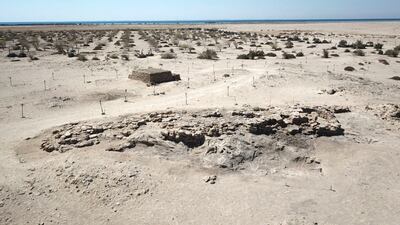
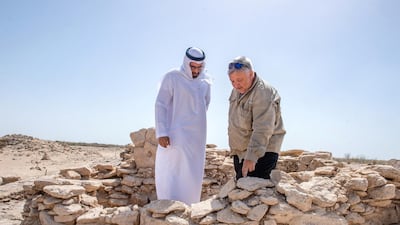
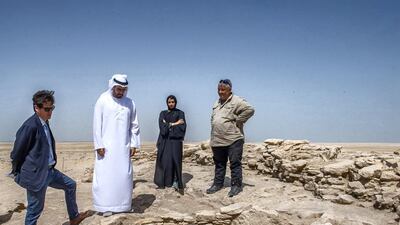
• The earliest known buildings in the UAE, more than 8,500 years old, have been unearthed by archaeologists from Abu Dhabi's Department of Culture and Tourism. All pictures by DCT Abu Dhabi
    The earliest known buildings in the UAE, more than 8,500 years old, have been unearthed by archaeologists from Abu Dhabi's Department of Culture and Tourism. All pictures by DCT Abu Dhabi
  • The stone structures are believed to have been the homes of people on Ghagha Island, west of Abu Dhabi, who formed the country's earliest community.
    The stone structures are believed to have been the homes of people on Ghagha Island, west of Abu Dhabi, who formed the country's earliest community.
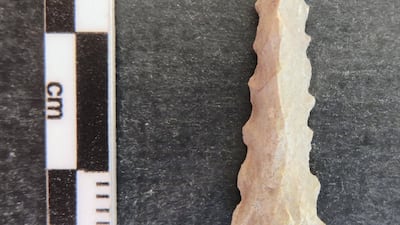
  • The archaeologists found hundreds of ancient artefacts including finely worked stone arrowheads.
    The archaeologists found hundreds of ancient artefacts including finely worked stone arrowheads.

Abu Dhabi archaeologists uncover UAE's oldest buildings dating back 8,500 years


  • English
  • Arabic

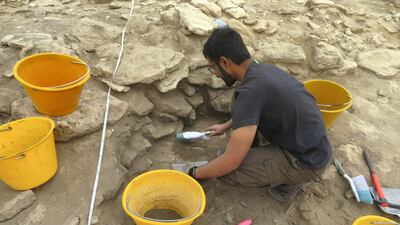
Archaeologists in Abu Dhabi have unearthed startling new evidence of the first known buildings in the Emirates dating back more than 8,500 years — at least 500 years earlier than previously thought.

The fascinating findings by experts from the capital's Department of Culture and Tourism were made on the island of Ghagha, west of Abu Dhabi.

The discovery of the stone structures, which likely housed the country's first communities, sheds new light on early chapters of the country's rich history.

It was believed that long-distance maritime trade routes which developed during the Neolithic period were the catalyst for settlements in the area, but the latest discovery proves that Neolithic settlements existed before then.

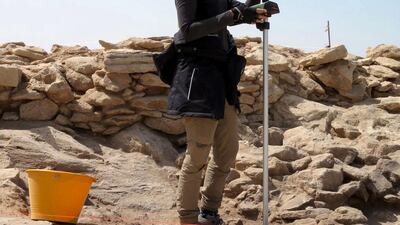
The DCT team have been using cutting-edge techniques to help unravel the history of the country.

The biggest discovery was revealed by carbon-14 analysis of charcoal fragments, which indicated the structures were at least 8,500 years old — breaking the previous record for the earliest known structures built in the UAE, which were detected on Marawah Island, also off the coast of Abu Dhabi.

“These archaeological finds have shown that people were settling and building homes here 8,500 years ago. The discoveries on Ghagha Island highlight that the characteristics of innovation, sustainability and resilience have been part of the DNA of the inhabitants of this region for thousands of years,” said Mohamed Al Mubarak, Chairman of DCT Abu Dhabi.

“The finds reinforce an appreciation of history, as well as the deep cultural connections between the people of the UAE and the sea.

“We are also reminded that there is still much to discover across the emirate of Abu Dhabi, and that it is vitally important we continue working to discover, preserve and protect our invaluable heritage for current and future generations to learn more about our ancestral past.”

The new evidence, along with the previous findings on the island of Marawah, indicate the islands of Abu Dhabi were a focal point of human innovation and settlement during the Neolithic period, the last stage of the stone age which is viewed as a key era in the development of humanity across the globe.

What did experts find?

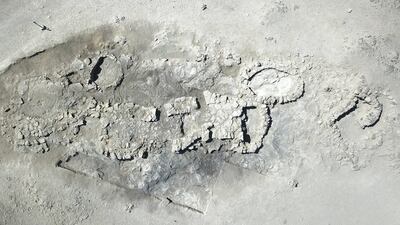
The ancient structures were simple round rooms, the walls of which were made of stone and preserved to nearly one metre in height.

It is believed they were probably houses for small communities who inhabited the island year-round.

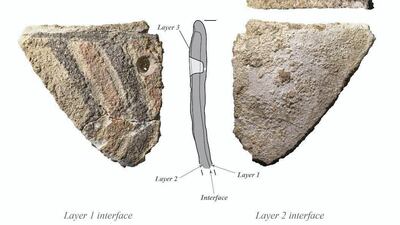
Hundreds of artefacts were found in the rooms, including finely worked stone arrowheads that would have been used for hunting.

It is likely that the community would also have used the rich resources of the sea. How long the settlement existed is unknown, but after it was abandoned, it apparently remained an important part of the cultural landscape, as nearly 5,000 years ago a person was buried in the ruins of the structures. It is one of the few burials from this period known on the Abu Dhabi islands.

Digging deep into the past

  • The latest archaeological excavations on Marawah Island shed new light on Abu Dhabi’s earliest known settlement, which dates back 8,000 years. Courtesy Department of Culture and Tourism - Abu Dhabi
    The latest archaeological excavations on Marawah Island shed new light on Abu Dhabi’s earliest known settlement, which dates back 8,000 years. Courtesy Department of Culture and Tourism - Abu Dhabi
  • Some of the items found at Abu Dhabi’s earliest known settlement. Courtesy Department of Culture and Tourism - Abu Dhabi
    Some of the items found at Abu Dhabi’s earliest known settlement. Courtesy Department of Culture and Tourism - Abu Dhabi
  • Specialist teams from DCT Abu Dhabi carry out excavations on Marawah island. Courtesy Department of Culture and Tourism - Abu Dhabi
    Specialist teams from DCT Abu Dhabi carry out excavations on Marawah island. Courtesy Department of Culture and Tourism - Abu Dhabi
  • Specialist teams from DCT Abu Dhabi excavate on Marawah island, Abu Dhabi's earliest settlement. Courtesy Department of Culture and Tourism - Abu Dhabi
    Specialist teams from DCT Abu Dhabi excavate on Marawah island, Abu Dhabi's earliest settlement. Courtesy Department of Culture and Tourism - Abu Dhabi
  • Mohamed Al Mubarak, chairman of the Department of Culture and Tourism Abu Dhabi, inspects the new discoveries on Marawah Island. Courtesy Department of Culture and Tourism - Abu Dhabi
    Mohamed Al Mubarak, chairman of the Department of Culture and Tourism Abu Dhabi, inspects the new discoveries on Marawah Island. Courtesy Department of Culture and Tourism - Abu Dhabi
  • An aerial view of the Marawah Island archaeological site. Courtesy Department of Culture and Tourism - Abu Dhabi
    An aerial view of the Marawah Island archaeological site. Courtesy Department of Culture and Tourism - Abu Dhabi
  • One of the artefacts found at Marawah Island during recent excavations. Courtesy Department of Culture and Tourism - Abu Dhabi
    One of the artefacts found at Marawah Island during recent excavations. Courtesy Department of Culture and Tourism - Abu Dhabi
  • Mohamed Al Mubarak, chairman of the Department of Culture and Tourism Abu Dhabi, inspects the new discoveries on Marawah Island. Courtesy Department of Culture and Tourism - Abu Dhabi
    Mohamed Al Mubarak, chairman of the Department of Culture and Tourism Abu Dhabi, inspects the new discoveries on Marawah Island. Courtesy Department of Culture and Tourism - Abu Dhabi

The significant findings on Ghagha Island are just the latest success story for the tourism department's emirate-wide archaeological programme.

In addition to the breakthroughs at Ghagha and Marawah islands, teams have uncovered the remains of an ancient monastery on Sir Bani Yas Island, as well as the Unesco-inscribed Cultural Site of Al Ain, comprising a series of oases, historic monuments, archaeological sites and natural areas, which has been a World Heritage Site since 2011.

Abu Dhabi's historic treasure trove also includes Miocene Trackways — footprints of a herd of an extinct form of ancient elephant — which six to eight million years ago; a 3,000 year old falaj in Al Ain, indicating the earliest known widespread use of this irrigation technology in the world; stone tools dating more than 300,000 years ago, which were found in surveys around Jebel Hafit; and a well preserved Iron Age fortress dating back 3,000 years, which was discovered during excavations at Al Ain’s Hili 14 archaeological site.

A series of late pre-Islamic tombs have also been found in various locations in Al Ain.

Haemoglobin disorders explained

Thalassaemia is part of a family of genetic conditions affecting the blood known as haemoglobin disorders.

Haemoglobin is a substance in the red blood cells that carries oxygen and a lack of it triggers anemia, leaving patients very weak, short of breath and pale.

The most severe type of the condition is typically inherited when both parents are carriers. Those patients often require regular blood transfusions - about 450 of the UAE's 2,000 thalassaemia patients - though frequent transfusions can lead to too much iron in the body and heart and liver problems.

The condition mainly affects people of Mediterranean, South Asian, South-East Asian and Middle Eastern origin. Saudi Arabia recorded 45,892 cases of carriers between 2004 and 2014.

A World Health Organisation study estimated that globally there are at least 950,000 'new carrier couples' every year and annually there are 1.33 million at-risk pregnancies.

The burning issue

The internal combustion engine is facing a watershed moment – major manufacturer Volvo is to stop producing petroleum-powered vehicles by 2021 and countries in Europe, including the UK, have vowed to ban their sale before 2040. The National takes a look at the story of one of the most successful technologies of the last 100 years and how it has impacted life in the UAE. 

Read part four: an affection for classic cars lives on

Read part three: the age of the electric vehicle begins

Read part one: how cars came to the UAE


SPECS
%3Cp%3E%3Cstrong%3EEngine%3A%3C%2Fstrong%3E%201.5-litre%204-cylinder%3Cbr%3E%3Cstrong%3EPower%3A%3C%2Fstrong%3E%20101hp%3Cbr%3E%3Cstrong%3ETorque%3A%3C%2Fstrong%3E%20135Nm%3Cbr%3E%3Cstrong%3ETransmission%3C%2Fstrong%3E%3A%20Six-speed%20auto%3Cbr%3E%3Cstrong%3EPrice%3A%3C%2Fstrong%3E%20From%20Dh79%2C900%3Cbr%3E%3Cstrong%3EOn%20sale%3A%3C%2Fstrong%3E%20Now%3C%2Fp%3E%0A
UK-EU trade at a glance

EU fishing vessels guaranteed access to UK waters for 12 years

Co-operation on security initiatives and procurement of defence products

Youth experience scheme to work, study or volunteer in UK and EU countries

Smoother border management with use of e-gates

Cutting red tape on import and export of food

About RuPay

A homegrown card payment scheme launched by the National Payments Corporation of India and backed by the Reserve Bank of India, the country’s central bank

RuPay process payments between banks and merchants for purchases made with credit or debit cards

It has grown rapidly in India and competes with global payment network firms like MasterCard and Visa.

In India, it can be used at ATMs, for online payments and variations of the card can be used to pay for bus, metro charges, road toll payments

The name blends two words rupee and payment

Some advantages of the network include lower processing fees and transaction costs

The specs

Engine: 6.2-litre V8

Transmission: ten-speed

Power: 420bhp

Torque: 624Nm

Price: Dh325,125

On sale: Now

Profile box

Company name: baraka
Started: July 2020
Founders: Feras Jalbout and Kunal Taneja
Based: Dubai and Bahrain
Sector: FinTech
Initial investment: $150,000
Current staff: 12
Stage: Pre-seed capital raising of $1 million
Investors: Class 5 Global, FJ Labs, IMO Ventures, The Community Fund, VentureSouq, Fox Ventures, Dr Abdulla Elyas (private investment)

SPECS

Mini John Cooper Works Clubman and Mini John Cooper Works Countryman

Engine: two-litre 4-cylinder turbo

Transmission: nine-speed automatic

Power: 306hp

Torque: 450Nm

Price: JCW Clubman, Dh220,500; JCW Countryman, Dh225,500

Lexus LX700h specs

Engine: 3.4-litre twin-turbo V6 plus supplementary electric motor

Power: 464hp at 5,200rpm

Torque: 790Nm from 2,000-3,600rpm

Transmission: 10-speed auto

Fuel consumption: 11.7L/100km

On sale: Now

Price: From Dh590,000

Desert Warrior

Starring: Anthony Mackie, Aiysha Hart, Ben Kingsley

Director: Rupert Wyatt

Rating: 3/5

The specs

Engine: 1.5-litre 4-cyl turbo

Power: 194hp at 5,600rpm

Torque: 275Nm from 2,000-4,000rpm

Transmission: 6-speed auto

Price: from Dh155,000

On sale: now

Key figures in the life of the fort

Sheikh Dhiyab bin Isa (ruled 1761-1793) Built Qasr Al Hosn as a watchtower to guard over the only freshwater well on Abu Dhabi island.

Sheikh Shakhbut bin Dhiyab (ruled 1793-1816) Expanded the tower into a small fort and transferred his ruling place of residence from Liwa Oasis to the fort on the island.

Sheikh Tahnoon bin Shakhbut (ruled 1818-1833) Expanded Qasr Al Hosn further as Abu Dhabi grew from a small village of palm huts to a town of more than 5,000 inhabitants.

Sheikh Khalifa bin Shakhbut (ruled 1833-1845) Repaired and fortified the fort.

Sheikh Saeed bin Tahnoon (ruled 1845-1855) Turned Qasr Al Hosn into a strong two-storied structure.

Sheikh Zayed bin Khalifa (ruled 1855-1909) Expanded Qasr Al Hosn further to reflect the emirate's increasing prominence.

Sheikh Shakhbut bin Sultan (ruled 1928-1966) Renovated and enlarged Qasr Al Hosn, adding a decorative arch and two new villas.

Sheikh Zayed bin Sultan (ruled 1966-2004) Moved the royal residence to Al Manhal palace and kept his diwan at Qasr Al Hosn.

Sources: Jayanti Maitra, www.adach.ae

Honeymoonish
%3Cp%3E%3Cstrong%3EDirector%3A%3C%2Fstrong%3E%20Elie%20El%20Samaan%3C%2Fp%3E%0A%3Cp%3E%3Cstrong%3EStarring%3A%20%3C%2Fstrong%3ENour%20Al%20Ghandour%2C%20Mahmoud%20Boushahri%3C%2Fp%3E%0A%3Cp%3E%3Cstrong%3ERating%3A%3C%2Fstrong%3E%203%2F5%3C%2Fp%3E%0A
Results

2pm: Al Sahel Contracting Company – Maiden (PA) Dh50,000 (Dirt) 1,200m; Winner: AF Mutakafel, Tadhg O’Shea (jockey), Ernst Oertel (trainer)

2.30pm: Dubai Real Estate Centre – Maiden (TB) Dh60,000 (D) 1,200m; Winner: El Baareq, Antonio Fresu, Rashed Bouresly

3pm: Shadwell – Rated Conditions (TB) Dh100,000 (D) 1,950m; Winner: Lost Eden, Andrea Atzeni, Doug Watson

3.30pm: Keeneland – Handicap (TB) Dh84,000 (D) 1,000m; Winner: Alkaraama, Dane O’Neill, Musabah Al Muhairi

4pm: Keeneland – Handicap (TB) Dh76,000 (D) 1,800m; Winner: Lady Snazz, Saif Al Balushi, Bhupat Seemar

4.30pm: Hive – Conditions (TB) Dh100,000 (D) 1,600m; Winner: Down On Da Bayou, Royston Ffrench, Salem bin Ghadayer

5pm: Dubai Real Estate Centre – (TB) Handicap Dh64,000 (D) 1,600m; Winner: Lahmoom, Royston Ffrench, Salem bin Ghadayer

Updated: July 24, 2025, 12:24 PM