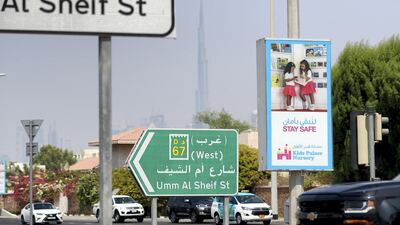
Men in the UAE are placing themselves at a greater risk of developing Covid-19 by adopting unhealthy lifestyles, putting off medical appointments and ignoring safety rules, the authorities have warned.
Government statistics revealed that men accounted for 62 per cent of all Covid-19 infections across the Emirates as of November 9.
Dr Ahmed Al Hammadi, an infectious disease consultant at Tawam Hospital and spokesman for Abu Dhabi Health Services Company, Seha, said a variety of factors contributed to the gender health gap.
He said men typically have more pre-existing health conditions, which can lead to higher mortality rates, such as heart disease, hypertension, diabetes, chronic renal diseases, and cancer.
Men also make up two thirds of the UAE's population.
This gender imbalance is due to the high number of men who emigrate to the UAE for work.
Despite this, Dr Al Hammadi said men were also more likely to do things that not only increase their likelihood of catching the virus but made them prone to more serious infections.
Social expectations and stereotypes around masculinity could make men less likely to obey rules such as social distancing
“They [men] are more prone to engage in higher risk activities such as smoking, alcohol consumption and closer social interaction, for example at sporting events, and in bars and clubs,” Dr Al Hammadi said.
“Smoking, especially, is seen as a risk factor for having serious complications to Covid-19 as it damages healthy lungs and exposes them to more serious complications and respiratory failure."
He said a tendency to delay hospital visits and a desire to adhere to masculine stereotypes could also have played a role in the gender disparity.
“Social expectations and stereotypes around masculinity could make men less likely to obey rules such as social distancing, wearing masks and regular washing of their hands,” he said.
"It is a combination of multiple socioeconomic, social and biological factors. Men in general tend to ignore health conditions and delay hospital or clinic visits more than women.
"They sometimes tend to take symptoms less seriously, leading to delayed diagnosis and consequent further damage."
Dr Al Hammadi urged men to book a check-up if they have any concerns about their health.
"Many chronic and life-threatening illnesses that affect men are those that do not present with symptoms immediately and are only diagnosed through regular check-ups," he said.
"During the Covid-19 pandemic, delayed diagnosis of heart attacks, strokes and other diseases can lead to bad health outcomes that could be otherwise prevented."
Although global figures indicate Covid-19 afflicts men and women at a fairly even rate, mortality rates have been found to be higher among men.
Dr Al Hammadi pointed to a stronger immune system as a reason for the lower number of infections for women.
“Many reports show that women have a stronger innate immune system compared to men.
"This may be because of female hormones, as females have demonstrated stronger immune responses to the virus, leading to a shorter period of illness and milder symptoms.”
Dr Al Hammadi said higher numbers of men are exposed to harsh climates and air pollution – such as those in the construction industry – and many have poorer nutrition than women.
“Healthy nutrition is important to provide essential components for the immune systems such as vitamins, antioxidants and proteins which are needed to build a good immune system,” Dr Al Hammadi said.
The wider implications of the pandemic, such as remote working and job security, have also taken a toll on the mental health of people across the globe.
“Awareness around mental health is important but seeking out help from professionals or speaking to loved ones is far more important," said Dr Al Hammadi.
"There are several health departments and initiatives that have been undertaken in the UAE for this purpose and it is advisable to seek them out where help is needed.”

CONFIRMED%20LINE-UP
%3Cp%3EElena%20Rybakina%20(Kazakhstan)%0D%3Cbr%3EOns%20Jabeur%20(Tunisia)%0D%3Cbr%3EMaria%20Sakkari%20(Greece)%0D%3Cbr%3EBarbora%20Krej%C4%8D%C3%ADkov%C3%A1%20(Czech%20Republic)%0D%3Cbr%3EBeatriz%20Haddad%20Maia%20(Brazil)%0D%3Cbr%3EJe%C4%BCena%20Ostapenko%20(Latvia)%0D%3Cbr%3ELiudmila%20Samsonova%0D%3Cbr%3EDaria%20Kasatkina%E2%80%AF%0D%3Cbr%3EVeronika%20Kudermetova%E2%80%AF%0D%3Cbr%3ECaroline%20Garcia%20(France)%E2%80%AF%0D%3Cbr%3EMagda%20Linette%20(Poland)%E2%80%AF%0D%3Cbr%3ESorana%20C%C3%AErstea%20(Romania)%E2%80%AF%0D%3Cbr%3EAnastasia%20Potapova%E2%80%AF%0D%3Cbr%3EAnhelina%20Kalinina%20(Ukraine)%E2%80%AF%E2%80%AF%0D%3Cbr%3EJasmine%20Paolini%20(Italy)%E2%80%AF%0D%3Cbr%3EEmma%20Navarro%20(USA)%E2%80%AF%0D%3Cbr%3ELesia%20Tsurenko%20(Ukraine)%0D%3Cbr%3ENaomi%20Osaka%20(Japan)%20-%20wildcard%0D%3Cbr%3EEmma%20Raducanu%20(Great%20Britain)%20-%20wildcard%3Cbr%3EAlexandra%20Eala%20(Philippines)%20-%20wildcard%3C%2Fp%3E%0A
The specs: Rolls-Royce Cullinan
Price, base: Dh1 million (estimate)
Engine: 6.75-litre twin-turbo V12
Transmission: Eight-speed automatic
Power: 563hp @ 5,000rpm
Torque: 850Nm @ 1,600rpm
Fuel economy, combined: 15L / 100km
The specs: Aston Martin DB11 V8 vs Ferrari GTC4Lusso T
Price, base: Dh840,000; Dh120,000
Engine: 4.0L V8 twin-turbo; 3.9L V8 turbo
Transmission: Eight-speed automatic; seven-speed automatic
Power: 509hp @ 6,000rpm; 601hp @ 7,500rpm
Torque: 695Nm @ 2,000rpm; 760Nm @ 3,000rpm
Fuel economy, combined: 9.9L / 100km; 11.6L / 100km
THE%C2%A0SPECS
%3Cp%3E%3Cstrong%3EEngine%3A%20%3C%2Fstrong%3E2.4-litre%20four-cylinder%0D%3Cbr%3E%3Cstrong%3EPower%3A%3C%2Fstrong%3E%20210hp%0D%3Cbr%3E%3Cstrong%3ETorque%3A%3C%2Fstrong%3E%20320Nm%0D%3Cbr%3E%3Cstrong%3EPrice%3A%3C%2Fstrong%3E%20Starting%20from%20Dh89%2C900%0D%3Cbr%3E%3Cstrong%3EOn%20sale%3A%20%3C%2Fstrong%3ENow%0D%3Cbr%3E%3C%2Fp%3E%0A
Ten tax points to be aware of in 2026
1. Domestic VAT refund amendments: request your refund within five years
If a business does not apply for the refund on time, they lose their credit.
2. E-invoicing in the UAE
Businesses should continue preparing for the implementation of e-invoicing in the UAE, with 2026 a preparation and transition period ahead of phased mandatory adoption.
3. More tax audits
Tax authorities are increasingly using data already available across multiple filings to identify audit risks.
4. More beneficial VAT and excise tax penalty regime
Tax disputes are expected to become more frequent and more structured, with clearer administrative objection and appeal processes. The UAE has adopted a new penalty regime for VAT and excise disputes, which now mirrors the penalty regime for corporate tax.
5. Greater emphasis on statutory audit
There is a greater need for the accuracy of financial statements. The International Financial Reporting Standards standards need to be strictly adhered to and, as a result, the quality of the audits will need to increase.
6. Further transfer pricing enforcement
Transfer pricing enforcement, which refers to the practice of establishing prices for internal transactions between related entities, is expected to broaden in scope. The UAE will shortly open the possibility to negotiate advance pricing agreements, or essentially rulings for transfer pricing purposes.
7. Limited time periods for audits
Recent amendments also introduce a default five-year limitation period for tax audits and assessments, subject to specific statutory exceptions. While the standard audit and assessment period is five years, this may be extended to up to 15 years in cases involving fraud or tax evasion.
8. Pillar 2 implementation
Many multinational groups will begin to feel the practical effect of the Domestic Minimum Top-Up Tax (DMTT), the UAE's implementation of the OECD’s global minimum tax under Pillar 2. While the rules apply for financial years starting on or after January 1, 2025, it is 2026 that marks the transition to an operational phase.
9. Reduced compliance obligations for imported goods and services
Businesses that apply the reverse-charge mechanism for VAT purposes in the UAE may benefit from reduced compliance obligations.
10. Substance and CbC reporting focus
Tax authorities are expected to continue strengthening the enforcement of economic substance and Country-by-Country (CbC) reporting frameworks. In the UAE, these regimes are increasingly being used as risk-assessment tools, providing tax authorities with a comprehensive view of multinational groups’ global footprints and enabling them to assess whether profits are aligned with real economic activity.
Contributed by Thomas Vanhee and Hend Rashwan, Aurifer
MATCH INFO
Champions League quarter-final, first leg
Tottenham Hotspur v Manchester City, Tuesday, 11pm (UAE)
Matches can be watched on BeIN Sports
The President's Cake
Director: Hasan Hadi
Starring: Baneen Ahmad Nayyef, Waheed Thabet Khreibat, Sajad Mohamad Qasem
Rating: 4/5
Getting there
Flydubai flies direct from Dubai to Tbilisi from Dh1,025 return including taxes
How England have scored their set-piece goals in Russia
Three Penalties
v Panama, Group Stage (Harry Kane)
v Panama, Group Stage (Kane)
v Colombia, Last 16 (Kane)
Four Corners
v Tunisia, Group Stage (Kane, via John Stones header, from Ashley Young corner)
v Tunisia, Group Stage (Kane, via Harry Maguire header, from Kieran Trippier corner)
v Panama, Group Stage (Stones, header, from Trippier corner)
v Sweden, Quarter-Final (Maguire, header, from Young corner)
One Free-Kick
v Panama, Group Stage (Stones, via Jordan Henderson, Kane header, and Raheem Sterling, from Tripper free-kick)