Worshippers across the UAE took part in late-night prayers during Ramadan for the first time since the start of the Covid-19 pandemic.
Muslims performed tahajjud at mosques on Sunday amid a gradual easing of safety restrictions.
In late April, authorities revealed that the optional prayer, performed during the night, would be held at mosques in the final 10 days of Ramadan after complying with precautionary measures.
The prayers must be held between midnight and 12.30pm. Elderly people and those with chronic illnesses are advised to pray at home.
Muaz Shabandri, an Indian communications professional in Dubai, said he was happy with the return of an important Ramadan tradition for the first time since 2019.
“To get back to tahajjud prayers was great as this is a big part of Ramadan rituals," he said.
“There was happiness all around.
“In many ways it is yet another way of things coming back to normal.
“For a Muslim these are the most important nights of Ramadan and the entire year.
"There is a sense of calm and serenity when attending the prayers at midnight.”
Mr Shabandri said he had prayed tahajjud at mosques in the country for 10 years now.
Islam places an emphasis on praying in congregation in the last 10 nights of Ramadan, which are viewed as the most precious of the holy month.
Mr Shabandri said worshippers had to follow social-distancing protocols, wear masks, and carry their prayer mats.
He said security guards at mosques helped manage crowds and ensure people followed rules.
'An eagerly awaited experience'
-
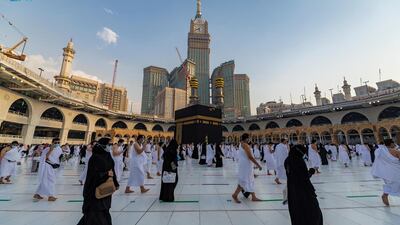
Pilgrims perform Umrah in compliance with Covid-19 social-distancing norms at the Grand Mosque in Makkah, Saudi Arabia. SPA -
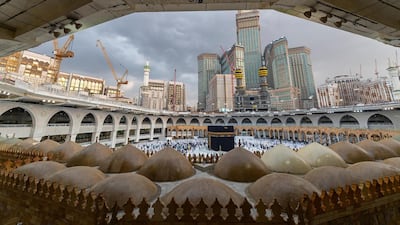
Pilgrims perform Umrah at the Grand Mosque in Makkah as the last 10 days of Ramadan considered by Muslims to be highly rewarding began on Monday. SPA -
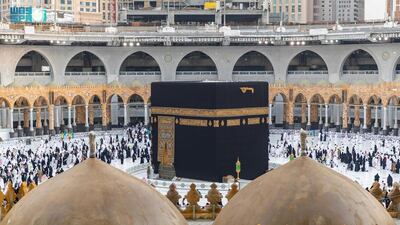
Pilgrims perform Umrah at the Grand Mosque in Makkah on Monday as Muslims mark the final 10 days of Ramadan. SPA -
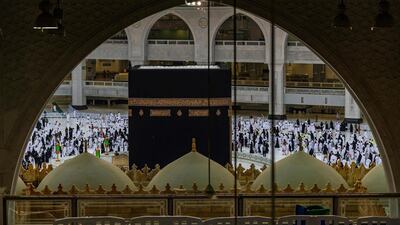
A view of pilgrims walking around Kaaba in circles as they perform Umrah at the Grand Mosque in Makkah, Saudi Arabia. SPA -

Pilgrims pass Maqam Ibrahim as they perform Umrah at the Grand Mosque in Makkah, Saudi Arabia. SPA -
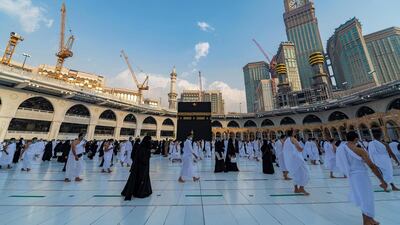
Pilgrims perform tawaf of the Kaaba in compliance with Covid-19 social-distancing norms at the Grand Mosque, in Makkah, Saudi Arabia. SPA
Mohammed Abdulla, an Indian resident in Dubai, said participating in prayers at a mosque was a joyous occasion.
"It was emotional and eagerly awaited experience to return to tahajjud at the mosque," he said.
“It was a spiritually uplifting experience and everyone had a smile on their face.”
Mr Abdulla grew up in the Emirates and attended the prayers at mosques in the country since he was 10.
The 38-year-old resident reminisced about attending prayers with his family and children.
He said he had hoped to attend the prayers last year but mosques had remained shut.
“I was born in the UAE, and have prayed at mosques here for close to 28 years," he said.
“When I was a child, I would go to the mosque with my father and play or sleep there.
“People are diligent and get their own prayer mats and follow the rules."
He said being back at the mosque helped him feel united with the community, and spiritually connected, even amid a pandemic.
In previous years, tens of thousands of people could come together for tahajjud.
In 2013, about 52,000 worshippers performed tahajjud on the 27th night of Ramadan at Sheikh Zayed Grand Mosque in Abu Dhabi.
Volunteers at mosques are instrumental in controlling crowds and ensuring people followed social distancing guidelines.
Worshippers must keep a distance of two metres from each other.

Mohammad Moin Uddin, the imam of Ali Salem Al Kaabi Mosque in Abu Dhabi, said the mosque could accommodate 350 worshippers previously, but can now take only 100 because of social-distancing rules.
“I was emotional and happy to lead prayers. It felt very good,” said Mr Moin Uddin.
“It felt very peaceful to lead the prayers at midnight.”
He reminded worshippers of social-distancing guidelines at the beginning of prayers.
To ensure people follow regulations, Sheikh Dr Fares Al Mustafa, religious and cultural affairs adviser, imam and khateeb at Al Farooq Omar bin Al Khattab Mosque and Centre in Dubai, also gives daily reminders of social distancing before starting prayers.
Before the pandemic, about 3,500 people used to gather for tahajjud at the mosque every day. Now the mosque can accommodate a maximum of 800 people.

Dubai Bling season three
Cast: Loujain Adada, Zeina Khoury, Farhana Bodi, Ebraheem Al Samadi, Mona Kattan, and couples Safa & Fahad Siddiqui and DJ Bliss & Danya Mohammed
Rating: 1/5
if you go
The flights
Air Astana flies direct from Dubai to Almaty from Dh2,440 per person return, and to Astana (via Almaty) from Dh2,930 return, both including taxes.
The hotels
Rooms at the Ritz-Carlton Almaty cost from Dh1,944 per night including taxes; and in Astana the new Ritz-Carlton Astana (www.marriott) costs from Dh1,325; alternatively, the new St Regis Astana costs from Dh1,458 per night including taxes.
When to visit
March-May and September-November
Visas
Citizens of many countries, including the UAE do not need a visa to enter Kazakhstan for up to 30 days. Contact the nearest Kazakhstan embassy or consulate.
Mercer, the investment consulting arm of US services company Marsh & McLennan, expects its wealth division to at least double its assets under management (AUM) in the Middle East as wealth in the region continues to grow despite economic headwinds, a company official said.
Mercer Wealth, which globally has $160 billion in AUM, plans to boost its AUM in the region to $2-$3bn in the next 2-3 years from the present $1bn, said Yasir AbuShaban, a Dubai-based principal with Mercer Wealth.
“Within the next two to three years, we are looking at reaching $2 to $3 billion as a conservative estimate and we do see an opportunity to do so,” said Mr AbuShaban.
Mercer does not directly make investments, but allocates clients’ money they have discretion to, to professional asset managers. They also provide advice to clients.
“We have buying power. We can negotiate on their (client’s) behalf with asset managers to provide them lower fees than they otherwise would have to get on their own,” he added.
Mercer Wealth’s clients include sovereign wealth funds, family offices, and insurance companies among others.
From its office in Dubai, Mercer also looks after Africa, India and Turkey, where they also see opportunity for growth.
Wealth creation in Middle East and Africa (MEA) grew 8.5 per cent to $8.1 trillion last year from $7.5tn in 2015, higher than last year’s global average of 6 per cent and the second-highest growth in a region after Asia-Pacific which grew 9.9 per cent, according to consultancy Boston Consulting Group (BCG). In the region, where wealth grew just 1.9 per cent in 2015 compared with 2014, a pickup in oil prices has helped in wealth generation.
BCG is forecasting MEA wealth will rise to $12tn by 2021, growing at an annual average of 8 per cent.
Drivers of wealth generation in the region will be split evenly between new wealth creation and growth of performance of existing assets, according to BCG.
Another general trend in the region is clients’ looking for a comprehensive approach to investing, according to Mr AbuShaban.
“Institutional investors or some of the families are seeing a slowdown in the available capital they have to invest and in that sense they are looking at optimizing the way they manage their portfolios and making sure they are not investing haphazardly and different parts of their investment are working together,” said Mr AbuShaban.
Some clients also have a higher appetite for risk, given the low interest-rate environment that does not provide enough yield for some institutional investors. These clients are keen to invest in illiquid assets, such as private equity and infrastructure.
“What we have seen is a desire for higher returns in what has been a low-return environment specifically in various fixed income or bonds,” he said.
“In this environment, we have seen a de facto increase in the risk that clients are taking in things like illiquid investments, private equity investments, infrastructure and private debt, those kind of investments were higher illiquidity results in incrementally higher returns.”
The Abu Dhabi Investment Authority, one of the largest sovereign wealth funds, said in its 2016 report that has gradually increased its exposure in direct private equity and private credit transactions, mainly in Asian markets and especially in China and India. The authority’s private equity department focused on structured equities owing to “their defensive characteristics.”
On the menu
First course
▶ Emirati sea bass tartare Yuzu and labneh mayo, avocado, green herbs, fermented tomato water
▶ The Tale of the Oyster Oyster tartare, Bahraini gum berry pickle
Second course
▶ Local mackerel Sourdough crouton, baharat oil, red radish, zaatar mayo
▶ One Flew Over the Cuckoo’s Nest Quail, smoked freekeh, cinnamon cocoa
Third course
▶ Bahraini bouillabaisse Venus clams, local prawns, fishfarm seabream, farro
▶ Lamb 2 ways Braised lamb, crispy lamb chop, bulgur, physalis
Dessert
▶ Lumi Black lemon ice cream, pistachio, pomegranate
▶ Black chocolate bar Dark chocolate, dates, caramel, camel milk ice cream
Day 1 results:
Open Men (bonus points in brackets)
New Zealand 125 (1) beat UAE 111 (3)
India 111 (4) beat Singapore 75 (0)
South Africa 66 (2) beat Sri Lanka 57 (2)
Australia 126 (4) beat Malaysia -16 (0)
Open Women
New Zealand 64 (2) beat South Africa 57 (2)
England 69 (3) beat UAE 63 (1)
Australia 124 (4) beat UAE 23 (0)
New Zealand 74 (2) beat England 55 (2)
Also on December 7 to 9, the third edition of the Gulf Car Festival (www.gulfcarfestival.com) will take over Dubai Festival City Mall, a new venue for the event. Last year's festival brought together about 900 cars worth more than Dh300 million from across the Emirates and wider Gulf region – and that first figure is set to swell by several hundred this time around, with between 1,000 and 1,200 cars expected. The first day is themed around American muscle; the second centres on supercars, exotics, European cars and classics; and the final day will major in JDM (Japanese domestic market) cars, tuned vehicles and trucks. Individuals and car clubs can register their vehicles, although the festival isn’t all static displays, with stunt drifting, a rev battle, car pulls and a burnout competition.
Read more about the coronavirus
You might also like
More from Neighbourhood Watch:
More from Neighbourhood Watch
Company%20profile
SM Town Live is on Friday, April 6 at Autism Rocks Arena, Dubai. Tickets are Dh375 at www.platinumlist.net
Specs
Ten tax points to be aware of in 2026
1. Domestic VAT refund amendments: request your refund within five years
If a business does not apply for the refund on time, they lose their credit.
2. E-invoicing in the UAE
Businesses should continue preparing for the implementation of e-invoicing in the UAE, with 2026 a preparation and transition period ahead of phased mandatory adoption.
3. More tax audits
Tax authorities are increasingly using data already available across multiple filings to identify audit risks.
4. More beneficial VAT and excise tax penalty regime
Tax disputes are expected to become more frequent and more structured, with clearer administrative objection and appeal processes. The UAE has adopted a new penalty regime for VAT and excise disputes, which now mirrors the penalty regime for corporate tax.
5. Greater emphasis on statutory audit
There is a greater need for the accuracy of financial statements. The International Financial Reporting Standards standards need to be strictly adhered to and, as a result, the quality of the audits will need to increase.
6. Further transfer pricing enforcement
Transfer pricing enforcement, which refers to the practice of establishing prices for internal transactions between related entities, is expected to broaden in scope. The UAE will shortly open the possibility to negotiate advance pricing agreements, or essentially rulings for transfer pricing purposes.
7. Limited time periods for audits
Recent amendments also introduce a default five-year limitation period for tax audits and assessments, subject to specific statutory exceptions. While the standard audit and assessment period is five years, this may be extended to up to 15 years in cases involving fraud or tax evasion.
8. Pillar 2 implementation
Many multinational groups will begin to feel the practical effect of the Domestic Minimum Top-Up Tax (DMTT), the UAE's implementation of the OECD’s global minimum tax under Pillar 2. While the rules apply for financial years starting on or after January 1, 2025, it is 2026 that marks the transition to an operational phase.
9. Reduced compliance obligations for imported goods and services
Businesses that apply the reverse-charge mechanism for VAT purposes in the UAE may benefit from reduced compliance obligations.
10. Substance and CbC reporting focus
Tax authorities are expected to continue strengthening the enforcement of economic substance and Country-by-Country (CbC) reporting frameworks. In the UAE, these regimes are increasingly being used as risk-assessment tools, providing tax authorities with a comprehensive view of multinational groups’ global footprints and enabling them to assess whether profits are aligned with real economic activity.
Contributed by Thomas Vanhee and Hend Rashwan, Aurifer
Company%20profile
While you're here
Con Coughlin: To survive, Nato must renew its sense of common purpose
Gavin Esler: Nato summit failed for making news more than it made deals
Simon Waldman: Nato continues to be Ankara’s best security guarantor
While you're here
Breast cancer in men: the facts
1) Breast cancer is men is rare but can develop rapidly. It usually occurs in those over the ages of 60, but can occasionally affect younger men.
2) Symptoms can include a lump, discharge, swollen glands or a rash.
3) People with a history of cancer in the family can be more susceptible.
4) Treatments include surgery and chemotherapy but early diagnosis is the key.
5) Anyone concerned is urged to contact their doctor
Why%20all%20the%20lefties%3F
UAE v Ireland
1st ODI, UAE win by 6 wickets
2nd ODI, January 12
3rd ODI, January 14
4th ODI, January 16
Profile box
Founders: Michele Ferrario, Nino Ulsamer and Freddy Lim
Started: established in 2016 and launched in July 2017
Based: Singapore, with offices in the UAE, Malaysia, Hong Kong, Thailand
Sector: FinTech, wealth management
Initial investment: $500,000 in seed round 1 in 2016; $2.2m in seed round 2 in 2017; $5m in series A round in 2018; $12m in series B round in 2019; $16m in series C round in 2020 and $25m in series D round in 2021
Current staff: more than 160 employees
Stage: series D
Investors: EightRoads Ventures, Square Peg Capital, Sequoia Capital India
TECH%20SPECS%3A%20APPLE%20IPHONE%2014%20PLUS
Getting%20there%20and%20where%20to%20stay
MATCH INFO
Uefa Champions League last-16, second leg:
Real Madrid 1 (Asensio 70'), Ajax 4 (Ziyech 7', Neres 18', Tadic 62', Schone 72')
Ajax win 5-3 on aggregate
Springsteen: Deliver Me from Nowhere
Director: Scott Cooper
Starring: Jeremy Allen White, Odessa Young, Jeremy Strong
Rating: 4/5
While you're here
Mustafa Alrawi: To get the 'jab' done, there must be patience and empathy
Damien McElroy: Anti-science attitudes in America are proving lethal
Editorial: What makes the UAE such a good place to test vaccines?
Editorial: The fight against Covid-19 should be guided by science
More from Rashmee Roshan Lall
Company%C2%A0profile
The nine articles of the 50-Year Charter
1. Dubai silk road
2. A geo-economic map for Dubai
3. First virtual commercial city
4. A central education file for every citizen
5. A doctor to every citizen
6. Free economic and creative zones in universities
7. Self-sufficiency in Dubai homes
8. Co-operative companies in various sectors
9: Annual growth in philanthropy
Young women have more “financial grit”, but fall behind on investing
In an October survey of young adults aged 16 to 25, Charles Schwab found young women are more driven to reach financial independence than young men (67 per cent versus. 58 per cent). They are more likely to take on extra work to make ends meet and see more value than men in creating a plan to achieve their financial goals. Yet, despite all these good ‘first’ measures, they are investing and saving less than young men – falling early into the financial gender gap.
While the women surveyed report spending 36 per cent less than men, they have far less savings than men ($1,267 versus $2,000) – a nearly 60 per cent difference.
In addition, twice as many young men as women say they would invest spare cash, and almost twice as many young men as women report having investment accounts (though most young adults do not invest at all).
“Despite their good intentions, young women start to fall behind their male counterparts in savings and investing early on in life,” said Carrie Schwab-Pomerantz, senior vice president, Charles Schwab. “They start off showing a strong financial planning mindset, but there is still room for further education when it comes to managing their day-to-day finances.”
Ms Schwab-Pomerantz says parents should be conveying the same messages to boys and girls about money, but should tailor those conversations based on the individual and gender.
"Our study shows that while boys are spending more than girls, they also are saving more. Have open and honest conversations with your daughters about the wage and savings gap," she said. "Teach kids about the importance of investing – especially girls, who as we see in this study, aren’t investing as much. Part of being financially prepared is learning to make the most of your money, and that means investing early and consistently."
• Remittance charges will be tackled by blockchain
• UAE's monumental and risky Mars Mission to inspire future generations, says minister
• Could the UAE drive India's economy?
• News has a bright future and the UAE is at the heart of it
• Architecture is over - here's cybertecture
• The National announces Future of News journalism competition
• Round up: Experts share their visions of the world to come
THE BIO
Bio Box
Role Model: Sheikh Zayed, God bless his soul
Favorite book: Zayed Biography of the leader
Favorite quote: To be or not to be, that is the question, from William Shakespeare's Hamlet
Favorite food: seafood
Favorite place to travel: Lebanon
Favorite movie: Braveheart
'The worst thing you can eat'
Trans fat is typically found in fried and baked goods, but you may be consuming more than you think.
Powdered coffee creamer, microwave popcorn and virtually anything processed with a crust is likely to contain it, as this guide from Mayo Clinic outlines:
Baked goods - Most cakes, cookies, pie crusts and crackers contain shortening, which is usually made from partially hydrogenated vegetable oil. Ready-made frosting is another source of trans fat.
Snacks - Potato, corn and tortilla chips often contain trans fat. And while popcorn can be a healthy snack, many types of packaged or microwave popcorn use trans fat to help cook or flavour the popcorn.
Fried food - Foods that require deep frying — french fries, doughnuts and fried chicken — can contain trans fat from the oil used in the cooking process.
Refrigerator dough - Products such as canned biscuits and cinnamon rolls often contain trans fat, as do frozen pizza crusts.
Creamer and margarine - Nondairy coffee creamer and stick margarines also may contain partially hydrogenated vegetable oils.


