
This week's US presidential election isn't just between Donald Trump and Joe Biden, but between two visions of what the country is and ought to be – and everything those competing perspectives imply.
So, what's really on the ballot?
First is national self-definition.
Mr Biden embodies the view that the US is, essentially, the expression of a set of ideals, founded to realise enlightenment values of democracy, equality, rule of law and freedom. The corollary is that, whenever possible, Washington should use its global influence to promote these values, particularly over time and in the biggest picture.
Mr Trump, by contrast, is the strongest modern proponent of a very different kind of nationalism, a blood-and-soil nativism reflecting the self-interests of a clearly defined, distinctive people linked by history, ethnicity and culture. Hence his abiding antipathy towards all forms of immigration. Since his worldview flows from a radical distinction between "us" and "them", social diversity is usually regarded as threatening.
-

Dominican Sisters of Hartland, Michigan, listen as US President Donald Trump speaks at a "Make America Great Again" rally at Oakland County International Airport. AFP -
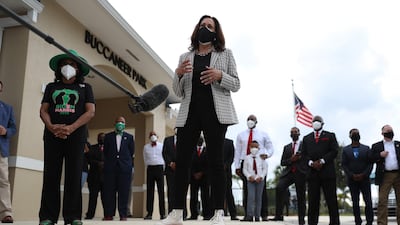
Democratic Vice Presidential Nominee Sen. Kamala Harris speaks to the media during a stop at Buccaneer Park, Miami Gardens, Florida. AFP -

US President Donald Trump speaks at a "Make America Great Again" rally in Newton, Pennsylvania. AFP -
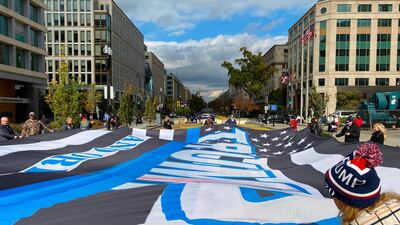
Supporters of US President Donald Trump unfurl a flag reading, "Trump Law and Order" on Black Lives Matter Plaza in Washington, DC. AFP -
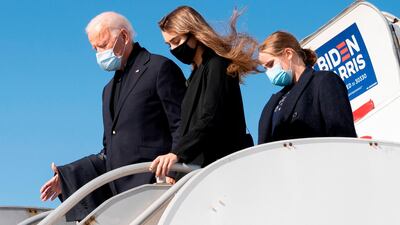
Democratic Presidential Candidate Joe Biden arrives with his granddaughters in Flint, Michigan. AFP -
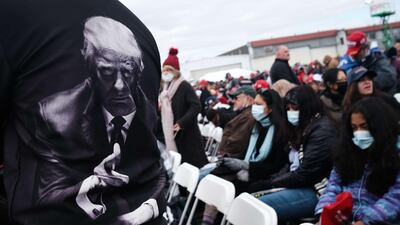
Supporters of President Donald Trump arrive to a rally in Reading, Pennsylvania. Donald Trump is crossing the crucial state of Pennsylvania in the last few days of campaigning. AFP -

US President Donald Trump speaks at a "Make America Great Again" rally in Newton, Pennsylvania. AFP -

Pedestrians walk past campaign signs for Democratic presidential candidate former Vice President Joe Biden ahead of Election Day near the White House in Washington, D.C.. Reuters -
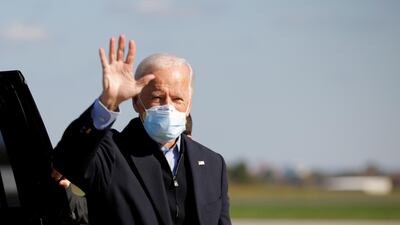
Democratic U.S. presidential nominee and former Vice President Joe Biden gestures at the airport in Flint, Michigan, U.S. Reuters -
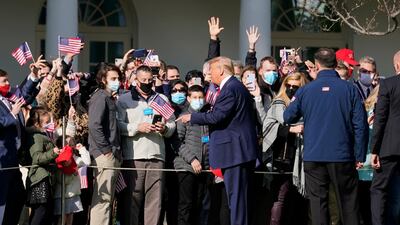
President Donald Trump speaks to supporters as he departs the South Lawn of the White House. AP -
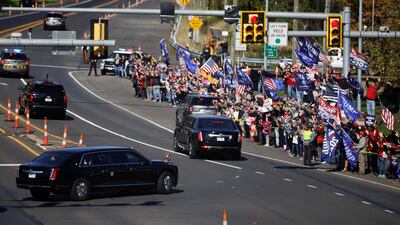
The presidential limousine is seen as U.S. President Donald Trump arrives to hold a campaign event in Newtown, Pennsylvania, U.S. Reuters -
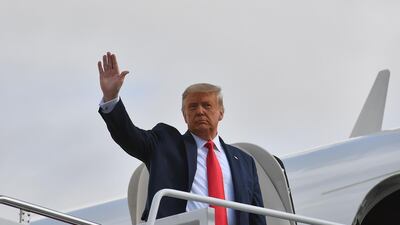
US President Donald Trump boards Air Force One at Andrews Air Force Base in Maryland. AFP -

Democratic presidential candidate Joe Biden arrives to board his plane in New Castle, Delaware. AFP -
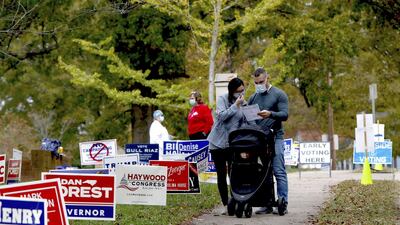
Voters look over a sample ballot handed to them by a volunteer as they arrive at a polling place in Winston-Salem, North Carolina. AFP -
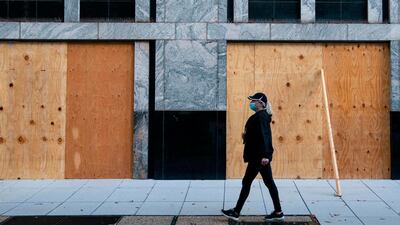
Wooden boards protect a Starbucks location near the White House in Washington, DC. Many Washington businesses are boarding up windows in preparation for possible election related violence. AFP -
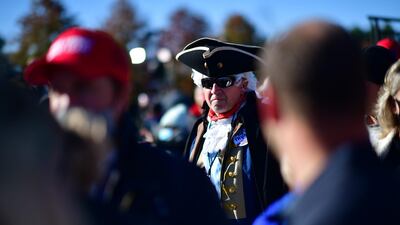
Ron Briggs dresses as George Washington on Halloween to attend a rally with President Donald Trump in Newtown, Pennsylvania. With the election only three days away. AFP -
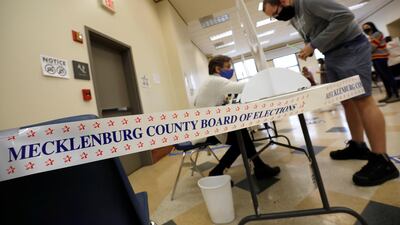
A poll worker assists a voter on the last day of early in-person voting for the general elections near tape identifying the Mecklenburg County Board of Elections in Cornelius, North Carolina. Reuters


Second is international relations.
Mr Trump calls his approach "America First", but he also clearly views the US as just another country that, like any other, seeks to maximise its competitive advantages. Hence his denigration of traditional partners and alliances, and of any guiding principles in foreign policy beyond narrow, immediate self-interest.
Mr Biden seeks to return the US to an idealistic sense of its own expansive vision, both internally, in pursuit of greater justice and equality, and as a source of order, stability and democratic influence in the world, buttressed by robust immigration. He cultivates a much more fluid sense of where "our" interests and identities intersect or even meld with those of others.
Elements of these conflicting concepts about what the US is and how it should behave in the world have been present since the founding of the republic. But recent developments have forced them into a dramatic confrontation.
In foreign policy, the lack of an existentially threatening and universally accepted adversary such as the former Soviet Union has meant the entire Cold War approach is now up for debate and isolationism is back. The foreign policy establishment has failed to convince ordinary American voters of the benefits of traditional levels and forms of international leadership and engagement, which all too often feels to them like an intolerable burden. That's certainly how Mr Trump portrays it.
-
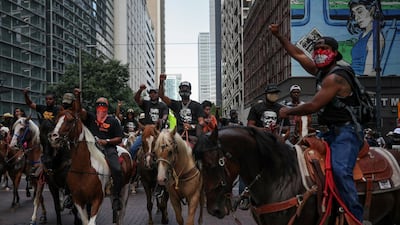
Protesters on horseback rally against the death in Minneapolis police custody of George Floyd, through central Houston, Texas. Reuters -

A broken Statue of Liberty figure is seen between glass shatters outside a looted souvenir shop after a night of protest against the death of an African-American man George Floyd in Minneapolis in Manhattan in New York City. AFP -
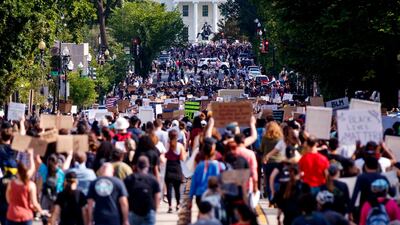
People, who gathered in protest against the death of George Floyd, peacefully march to the White House in Washington DC. EPA -
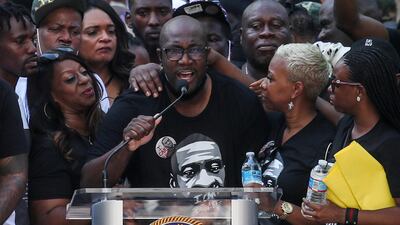
Philonise Floyd, brother of George Floyd, who died in Minneapolis police custody, is surrounded by family members as he speaks at a protest rally against his brother’s death, in Houston, Texas. Reuters -

George Floyd's daughter, Gianna Floyd, 6, is seen during a press conference at Minneapolis City Hall following the death in Minneapolis police custody of George Floyd in Minneapolis, Minnesota. Reuters -
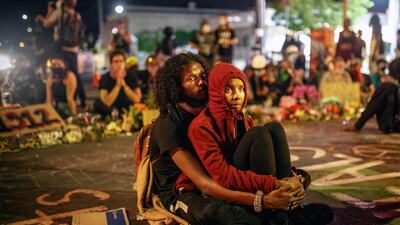
A Somali-American couple, alongside protesters calling for justice for the death of George Floyd, waits after curfew outside the Cup Foods in Minneapolis, Minnesota. AFP -
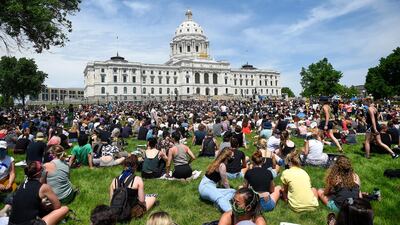
Thousands of protesters turn out for a sit-in at the State capitol, more than a week after George Floyd's death while under arrest, in St Paul, Minnesota. EPA -
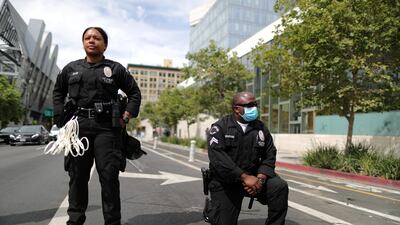
A police officer kneels during a protest against the death in Minneapolis police custody of George Floyd, outside LAPD headquarters in Los Angeles, California. Reuters -
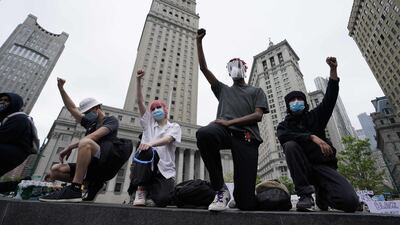
Protesters during a 'Black Lives Matter' demonstration in New York City. AFP -
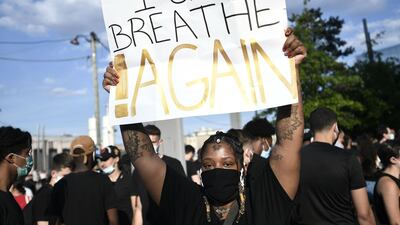
A protester holds a placard during a demonstration after French medical experts exonerated the gendarmes involved in the arrest of Adama Traore, a young black man who died in police custody in 2016, outside the 'Tribunal de Paris' courthouse in Paris. AFP -
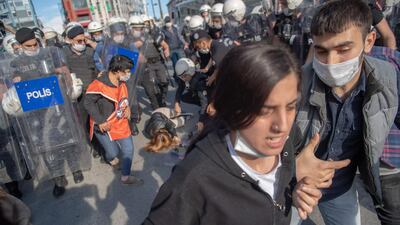
Turkish leftist demonstrators clash with police at Kadikoy in Istanbul, as leftist groups gather in support of US protesters against the death of George Floyd in Minneapolis police custody, and against police violence in Turkey. AFP -
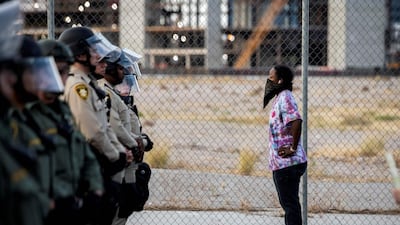
A woman stands in front of Police officers, in downtown Las Vegas, as they take part in a 'Black lives matter' rally in response to the recent death of George Floyd, an unarmed black man who died in police custody. AFP -
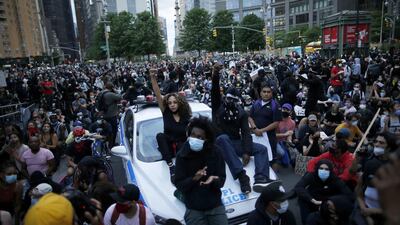
People take part in a protest against the death in Minneapolis police custody of George Floyd, at Trump International Hotel in New York. Reuters -
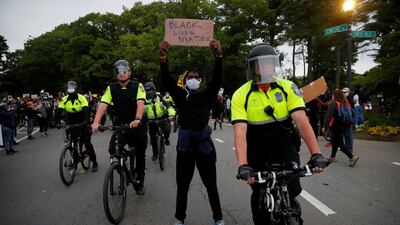
A demonstrator holds a sign during a rally following the death in Minneapolis police custody of George Floyd, in Boston, Massachusetts. Reuters -
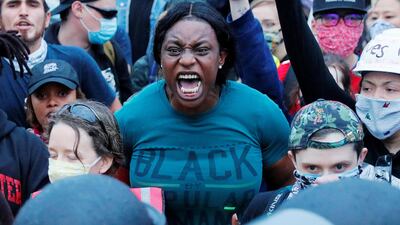
A demonstrator reacts during a rally following the death in Minneapolis police custody of George Floyd, in Boston, Massachusetts. Reuters -
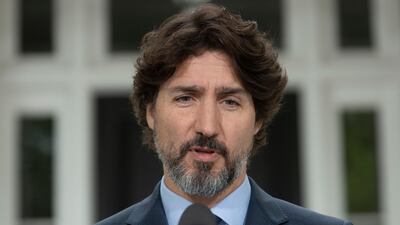
Canadian Prime Minister Justin Trudeau responds to a question on racism during a news conference outside Rideau Cottage in Ottawa. Mr Trudeau said Canadians were watching what’s unfolding in the US with 'horror and consternation'. AP -
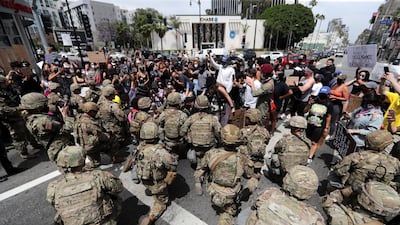
Members of the National Guard take a knee as people protest against the death of George Floyd in Minneapolis police custody, in Hollywood, Califronia. EPA


Third is national identity.
Humans are at the beginning of a remarkably thorough and a dizzyingly rapid revolution of life defined by radical new technologies such as artificial intelligence, genetic engineering and nanotechnology. This is clearly going to be more drastic, disruptive and sudden than any analogous past transformation.
The economic components are often mischaracterised as "globalisation", but the reality is far broader. In fact, the way people live and, especially, work, is being dramatically upended, far more quickly than most people can understand or anyone can effectively manage.
That's all very frightening, and encourages tribalism, nativism and the false reassurance of narrow identities.
In the US, it's compounded by a fundamental social shift that began in the late 1960s whereby the traditionally all-powerful white Christian majority becomes far smaller and less privileged, and must share authority with other social groups.

Mr Biden represents Americans who embrace this change as the realisation of founding ideals and a source of social and economic revitalisation. Mr Trump speaks for those who dread these developments and want to fight them tooth and nail.
Mr Biden's America is defined by freedom and democracy. Mr Trump's America is built on the primacy of the white ethnic community, its culture and conservative Christianity.
Fourth is the meaning and significance of democracy.
Mr Trump and most Republicans now openly pursue and defend minority rule. For years, Republicans sought to restrict voting and avoid anything that smacked of an equitable one-person, one-vote system. But they always vociferously denied it.
Such evasions are no longer possible, so they just don't bother anymore. In the current election, having failed to block widespread postal and other forms of mass voting, they are now focusing on intensive and multi-faceted efforts to invalidate millions of already-cast ballots.
Before Tuesday, the astonishing figure of 100 million early ballots will have been cast, in some key states already exceeding the total number of votes in 2016. This is deeply alarming to Republicans.
Mr Trump keeps reiterating that he expects the Supreme Court to secure his victory by disenfranchising huge numbers of American voters through various technicalities. But that would yield an unprecedented crisis of legitimacy.
Hillary Clinton beat Mr Trump by almost 3 million votes in 2016, yet he became President through the federal electoral college system. If Mr Biden secures a significantly larger victory, as seems very likely, but Mr Trump nonetheless remains President, the crisis of legitimacy and structural collapse of democracy will only be matched by the total absence of any practicable legal or constitutional remedies or means of redress – an impossible stalemate.

Fifth is American decline and the prospect of autocracy.
Mr Trump's autocratic manoeuvres consistently intensified during his presidency. His latest, and potentially most damaging, move on government institutions is a new effort to abolish measures protecting the political independence of the administrative civil service.
That would effectively gut 19th-century reforms that began eliminating once-pervasive political corruption and patronage, and resurrect controversies from the 1880s.
But making these jobs political gifts is indispensable to fully realised autocracy. The Republican Party appears to have become a wholly owned subsidiary of Mr Trump's family business. Given another four years, the entire government could follow.
A particularly insightful commentary on what's at stake in next week's election is Richard Byrne's 12-minute online video play, "A Pair of Shoes", which subtly reads current battles over American decay and resurgence through Edward Gibbon's classic 18th-century history, The Decline and Fall of the Roman Empire.
As the play suggests, and millions of Americans obviously understand, the underlying choices on Tuesday’s ballot are extraordinarily clear and consequential.
With most Americans, for once, fully engaged and participating, the US is set to redefine both itself and its relations with the outside world. This election really is that momentous.
Hussein Ibish is a senior resident scholar at the Arab Gulf States Institute and a US affairs columnist for The National

