• A hijacked commercial plane approaches the World Trade Centre shortly before crashing into the landmark skyscraper in New York on September 11, 2001. AFP
    A hijacked commercial plane approaches the World Trade Centre shortly before crashing into the landmark skyscraper in New York on September 11, 2001. AFP
  • The South Tower of the World Trade Centre collapses sending dust and smoke into the streets in New York on September 11, 2001. Two planes crashed into the towers that later collapsed. AFP
    The South Tower of the World Trade Centre collapses sending dust and smoke into the streets in New York on September 11, 2001. Two planes crashed into the towers that later collapsed. AFP
  • A bird takes flight over the wreckage of the World Trade Centre on September 16, 2001, as clearing work continued on the site of the nation's worst terrorist attack. AFP
    A bird takes flight over the wreckage of the World Trade Centre on September 16, 2001, as clearing work continued on the site of the nation's worst terrorist attack. AFP
  • George W Bush, then US president, reacts after being told about the terrorist attack on September 11, 2001.
    George W Bush, then US president, reacts after being told about the terrorist attack on September 11, 2001.
  • A hijacked United Airlines Flight 175 plane flies towards the World Trade Centre twin towers shortly before slamming into the south tower, as the north tower burns following an earlier attack in New York on September 11, 2001. Reuters
    A hijacked United Airlines Flight 175 plane flies towards the World Trade Centre twin towers shortly before slamming into the south tower, as the north tower burns following an earlier attack in New York on September 11, 2001. Reuters
  • People run away as the second tower of World Trade Centre crumbles down after a plane hit the building on September 11, 2001, in New York. AFP
    People run away as the second tower of World Trade Centre crumbles down after a plane hit the building on September 11, 2001, in New York. AFP
  • Firefighters and emergency workers battle fires as they search for survivors amid the debris of the World Trade Centre in New York on September 13, 2001. AFP
    Firefighters and emergency workers battle fires as they search for survivors amid the debris of the World Trade Centre in New York on September 13, 2001. AFP
  • Firefighters make their way through the rubble of the World Trade Centre on September 11, 2001, in New York, after two hijacked planes flew into the skyscrapers. AFP
    Firefighters make their way through the rubble of the World Trade Centre on September 11, 2001, in New York, after two hijacked planes flew into the skyscrapers. AFP
  • Smoke and flames billow out of the World Trade Centre towers before their collapse on September 11, 2001, in New York. AFP
    Smoke and flames billow out of the World Trade Centre towers before their collapse on September 11, 2001, in New York. AFP
  • An American flag is posted in the rubble of the World Trade Centre on September 13, 2001, in New York. The search for survivors and the recovery of the victims continued in the days following the September 11 terrorist attack. AFP
    An American flag is posted in the rubble of the World Trade Centre on September 13, 2001, in New York. The search for survivors and the recovery of the victims continued in the days following the September 11 terrorist attack. AFP
  • People walk in the street in the area where the World Trade Centre buildings collapsed on September 11, 2001, after two planes slammed into the twin towers in what was then a 'suspected' terrorist attack. AFP
    People walk in the street in the area where the World Trade Centre buildings collapsed on September 11, 2001, after two planes slammed into the twin towers in what was then a 'suspected' terrorist attack. AFP
  • A plane hijacked by terrorists from Boston crashes into the South Tower of the World Trade Centre on September 11, 200,1 in New York. AFP
    A plane hijacked by terrorists from Boston crashes into the South Tower of the World Trade Centre on September 11, 200,1 in New York. AFP
  • A man falls to his death from the World Trade Centre after two planes hit the building on September 11, 2001, in New York. AFP
    A man falls to his death from the World Trade Centre after two planes hit the building on September 11, 2001, in New York. AFP
  • A firefighter breaks down as the World Trade Centre buildings collapsed on September 11, 2001, after two hijacked airplanes slammed into the twin towers in a terrorist attack. AFP
    A firefighter breaks down as the World Trade Centre buildings collapsed on September 11, 2001, after two hijacked airplanes slammed into the twin towers in a terrorist attack. AFP

This 9/11, America's greatest threats are from within


  • English
  • Arabic

The outline of America’s presidential campaign has been obvious for months, if not the last two years, since the Democrats took back the majority in the House of Representatives. November 3 will be a referendum about Donald Trump. No policies to debate, simply a decision about him.

But over the last few months other issues have come up: will the election be free and fair? Will Mr Trump leave office if he loses, as every poll at the moment indicates he will? How much more low-grade violence will accompany this election?

I’m an American. Even asking these questions, as millions are, seems insane. How did America get this way?

That last question is worth thinking about on the anniversary of 9/11.

It's an ironic question. The last time the country was truly united was the day the Twin Towers came down in 2001. I live in London but by chance was in Boston that day, hosting a national radio programme.

On that day and in the weeks that followed, the country was united in a way I had not experienced since I was a boy and president John F Kennedy was assassinated. Given what has happened over the past nearly two decades, should we thank Al Qaeda for providing that moment of unity?

In history there are many before and after moments. The attacks of 9/11 seemed like they might be such a moment for America. But they weren't

It's easy to forget that America was already badly disunited before the attack on the World Trade Centre. Ten months earlier, George W Bush defeated Al Gore in the most contentious presidential election of modern times. Mr Gore won the popular vote but needed to win Florida in order to have a majority in the electoral college. But Florida had irregularities in the original vote count. No winner could be proclaimed until the Florida result was known. Weeks went by. A recount in Miami was broken up by thugs who claimed to support Mr Bush.

Eventually, the US Supreme Court proclaimed Mr Bush the winner in Florida, thus making him president. The country was still bruised by that election when Al Qaeda’s airplane plot came to fruition.

There are many theories of history but I think the state of America today is an example of the “unrepaired roof” theory. It goes like this: a person owns a house and notices that a roof tile has come loose but hasn’t fallen off. He ignores it for a few winters. Then, after a storm, he notices that several other tiles are coming loose and gets an estimate from a builder before deciding he can ride it out for another season because he wants to take his family on holiday or buy a new car.

Then, one day he notices a damp patch in his bedroom ceiling, there is a short circuit in the house’s electrics. And he realises this is because of the moisture coming through the roof. (I understand that this image may not work perfectly for those who live on the Arabian peninsula.) His failure to do basic maintenance has led to greater damage. Then a strong wind comes – not a tornado, just a typical autumn storm – and the roof blows away and his house can no longer be his home.

Long before 9/11, the basic maintenance a society must do to preserve itself had been neglected in America.

Physical infrastructure had not been maintained. It was not just motorways and bridges built in the golden years following the Second World War that were in bad repair. As jobs shifted from manufacturing to service work, the towns and cities that had grown up around factories were simply allowed to disintegrate.

Today a trip through parts of Ohio, Michigan and Pennsylvania is like a visit to ancient Roman ruins, except that many who used to have full-time, good-paying jobs in those ruined factories still live there.

Educational infrastructure had not been maintained for the average American. Elite schools and universities remain global centres of excellence, but the overwhelming majority of American children do not get a good education anymore. The state system that I was educated in at the same time as Steve Jobs, Steve Wozniak and most of the founders of the personal computing age and internet no longer exists. It has been underfunded since the 1970s. It was also turned into a political football.

Political infrastructure had not been maintained. The only way to ensure that American government can function is for Republican and Democratic legislators to acknowledge that neither side can gain everything it wants and to compromise on legislation. During the 1980s, on the Republican side, the idea of politics as a consensual process was lost.

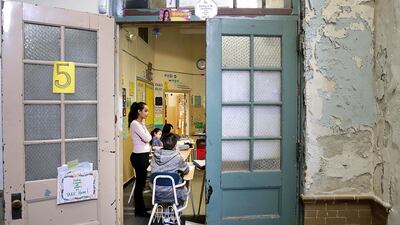
  • A deteriorating wall outside a classroom at the Pickering Middle School in Lynn, Massachusetts is pictured on February 14, 2017. A new school was being built to replace the Pickering. Getty Images
    A deteriorating wall outside a classroom at the Pickering Middle School in Lynn, Massachusetts is pictured on February 14, 2017. A new school was being built to replace the Pickering. Getty Images
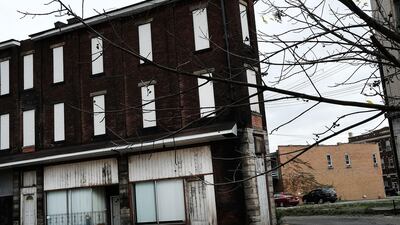
  • An abandoned building stands in downtown on October 24, 2016 in East Liverpool, Ohio. East Liverpool, once prosperous from steel mills and a vibrant ceramics industry, has been negatively effected by unemployment and an opiate epidemic. Ohio has become one of the key battleground states in the 2016 presidential election with both candidates or their surrogates making weekly visits to the Buckeye State. Unlike other parts of America, Ohio has both a rapidly aging and declining population; it is also overwhelmingly white and has a high degree of residents without a college education. AFP
    An abandoned building stands in downtown on October 24, 2016 in East Liverpool, Ohio. East Liverpool, once prosperous from steel mills and a vibrant ceramics industry, has been negatively effected by unemployment and an opiate epidemic. Ohio has become one of the key battleground states in the 2016 presidential election with both candidates or their surrogates making weekly visits to the Buckeye State. Unlike other parts of America, Ohio has both a rapidly aging and declining population; it is also overwhelmingly white and has a high degree of residents without a college education. AFP
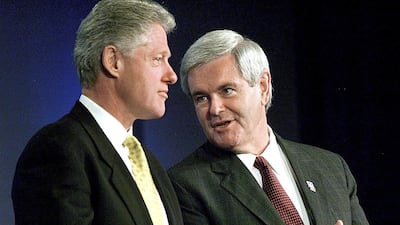
  • This June 4, 1998 photo shows Newt Gingrich, speaker of the US House of Representatives, conferring with US president Bill Clinton in Washington. AFP
    This June 4, 1998 photo shows Newt Gingrich, speaker of the US House of Representatives, conferring with US president Bill Clinton in Washington. AFP
  • Republican presidential nominee George W Bush and Democratic nominee Al Gore talk during their third debate at Washington University in St Louis in October, 2000. AFP
    Republican presidential nominee George W Bush and Democratic nominee Al Gore talk during their third debate at Washington University in St Louis in October, 2000. AFP
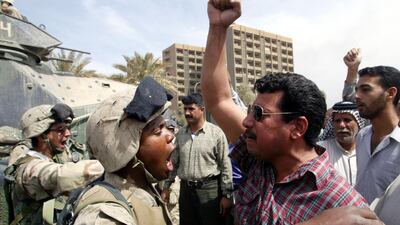
  • US soldiers attempt to calm Iraqis during a rally demanding the reinstatement of law and order, in the centre of Baghdad, on April 12, 2003. US and British troops struggled to restore order to Iraqi cities as looters rampaged through ministries, schools and shops in a frenzy of plunder and arson. Reuters
    US soldiers attempt to calm Iraqis during a rally demanding the reinstatement of law and order, in the centre of Baghdad, on April 12, 2003. US and British troops struggled to restore order to Iraqi cities as looters rampaged through ministries, schools and shops in a frenzy of plunder and arson. Reuters
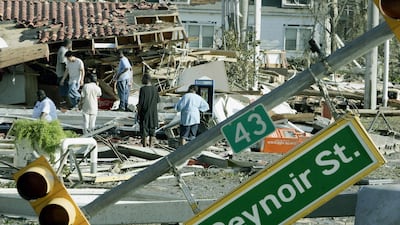
  • Residents inspect damage left by Hurricane Katrina on August 30, 2005 in Biloxi, Mississippi. At least 80 people were feared dead along the coast of the southern state of Mississippi, where glitzy casinos, plush homes and shrimp fishing businesses lay in ruins, after a storm surge up to 10 metres high crashed ashore. Helpless authorities in New Orleans, meanwhile, watched as surging floodwaters gushed through a 600-metre hole in the 17th Street Canal defences, inundating a low-lying city already 80 per cent under water. AFP
    Residents inspect damage left by Hurricane Katrina on August 30, 2005 in Biloxi, Mississippi. At least 80 people were feared dead along the coast of the southern state of Mississippi, where glitzy casinos, plush homes and shrimp fishing businesses lay in ruins, after a storm surge up to 10 metres high crashed ashore. Helpless authorities in New Orleans, meanwhile, watched as surging floodwaters gushed through a 600-metre hole in the 17th Street Canal defences, inundating a low-lying city already 80 per cent under water. AFP
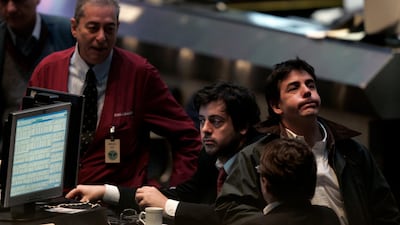
  • Traders work on the floor of the Buenos Aires Stock Exchange in Buenos Aires August 10, 2007. Global stock markets, including those in Argentina, in the wake of the global financial crisis in the US. Reuters
    Traders work on the floor of the Buenos Aires Stock Exchange in Buenos Aires August 10, 2007. Global stock markets, including those in Argentina, in the wake of the global financial crisis in the US. Reuters
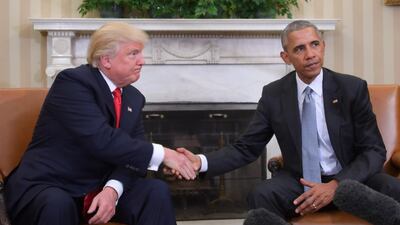
  • US president Barack Obama and president-elect Donald Trump shake hands during a transition planning meeting in the Oval Office at the White House on November 10, 2016 in Washington. AFP
    US president Barack Obama and president-elect Donald Trump shake hands during a transition planning meeting in the Oval Office at the White House on November 10, 2016 in Washington. AFP
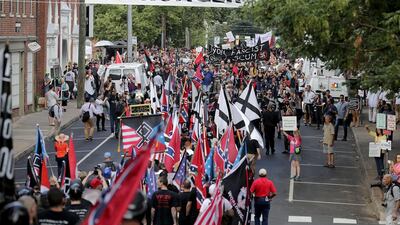
  • Hundreds of white nationalists, neo-Nazis and members of the "alt-right" march down East Market Street toward Emancipation Park during the "Unite the Right" rally August 12, 2017 in Charlottesville, Virginia. After clashes with anti-fascist protesters and police, the rally was declared an unlawful gathering and people were forced out of Emancipation Park, where a statue of Confederate General Robert E Lee is slated to be removed. AFP
    Hundreds of white nationalists, neo-Nazis and members of the "alt-right" march down East Market Street toward Emancipation Park during the "Unite the Right" rally August 12, 2017 in Charlottesville, Virginia. After clashes with anti-fascist protesters and police, the rally was declared an unlawful gathering and people were forced out of Emancipation Park, where a statue of Confederate General Robert E Lee is slated to be removed. AFP
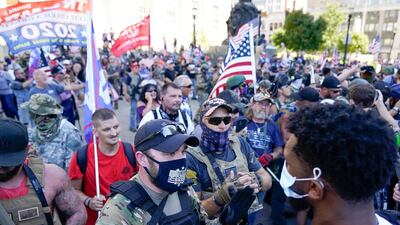
  • Far-right activists and self-described militia members gather to confront Black Lives Matter activists on the day of the Kentucky Derby horse race in Louisville, Kentucky, on September 5, 2020. Reuters
    Far-right activists and self-described militia members gather to confront Black Lives Matter activists on the day of the Kentucky Derby horse race in Louisville, Kentucky, on September 5, 2020. Reuters

By 1994, Republican Newt Gingrich, speaker of the House of Representatives, had turned politics into civil war by other means.

Moral infrastructure had not been maintained. A no-holds-barred kind of capitalism had been unleashed during the 1980s by people who regarded the works of Adam Smith as the fifth gospel, latter-day revelation: "The rich ... are led by an invisible hand to make nearly the same distribution of the necessaries of life, which would have been made, had the earth been divided into equal portions."

Smith’s writing is not an absolute law of nature, but America’s hedge fund managers and private equity folks did not get the memo. Inequality became entrenched. Even as American school children pledged allegiance every morning to “one nation indivisible”, the society was hopelessly split along class, religious, racial and political lines.

Then came 9/11 and for a year or two there was unity. It was a unity that would only start to fall apart as the invasion of Iraq in 2003 loomed, and even then, it didn’t disintegrate until the occupation of that country failed.

Other events showed the country struggling. In 2005, Hurricane Katrina destroyed the city of New Orleans, and government at all levels couldn't organise the relief effort. Tens of thousands of mostly poor people were trapped inside a football arena for days, and three people died while waiting for evacuation.

US President Donald Trump has polarised the American public even further. AFP

The crash of 2008 led to emergency measures to save the banking system and the bankers who had caused it, but the recovery missed out large parts of the population.

By 2015, the media was reporting that America had recovered. It hadn’t. That year, life expectancy for white men and women fell in the US for the first time since the flu pandemic of 1918. It continued to fall for the next three years. Why? Princeton economists Anne Case and Angus Deaton coined the phrase “Deaths of Despair” to explain the phenomenon.

Also by 2015, the terrorist threat most concerning to US officials was coming from white nationalist militia groups. That same year Mr Trump launched his successful bid for the presidency. The states that were left in ruins – Ohio, Michigan and Pennsylvania – provided his winning margin in the electoral college. His pitch to voters was to deepen disunity. Them and us. The memory of a country united in the face of attack is receding.

In history there are many before and after moments. The attacks of 9/11 seemed like they might be such a moment for America. But they weren’t. For the Middle East, perhaps, they were a turning point. But that’s a subject for another essay.

Michael Goldfarb is the host of the First Rough Draft of History podcast

Simran

Director Hansal Mehta

Stars: Kangana Ranaut, Soham Shah, Esha Tiwari Pandey

Three stars

BACK%20TO%20ALEXANDRIA
%3Cp%3E%3Cstrong%3EDirector%3A%20%3C%2Fstrong%3ETamer%20Ruggli%3C%2Fp%3E%0A%3Cp%3E%3Cstrong%3EStarring%3A%20%3C%2Fstrong%3ENadine%20Labaki%2C%20Fanny%20Ardant%3C%2Fp%3E%0A%3Cp%3E%3Cstrong%3ERating%3A%20%3C%2Fstrong%3E3.5%2F5%3C%2Fp%3E%0A
Ruwais timeline

1971 Abu Dhabi National Oil Company established

1980 Ruwais Housing Complex built, located 10 kilometres away from industrial plants

1982 120,000 bpd capacity Ruwais refinery complex officially inaugurated by the founder of the UAE Sheikh Zayed

1984 Second phase of Ruwais Housing Complex built. Today the 7,000-unit complex houses some 24,000 people.  

1985 The refinery is expanded with the commissioning of a 27,000 b/d hydro cracker complex

2009 Plans announced to build $1.2 billion fertilizer plant in Ruwais, producing urea

2010 Adnoc awards $10bn contracts for expansion of Ruwais refinery, to double capacity from 415,000 bpd

2014 Ruwais 261-outlet shopping mall opens

2014 Production starts at newly expanded Ruwais refinery, providing jet fuel and diesel and allowing the UAE to be self-sufficient for petrol supplies

2014 Etihad Rail begins transportation of sulphur from Shah and Habshan to Ruwais for export

2017 Aldar Academies to operate Adnoc’s schools including in Ruwais from September. Eight schools operate in total within the housing complex.

2018 Adnoc announces plans to invest $3.1 billion on upgrading its Ruwais refinery 

2018 NMC Healthcare selected to manage operations of Ruwais Hospital

2018 Adnoc announces new downstream strategy at event in Abu Dhabi on May 13

Source: The National

The five pillars of Islam

1. Fasting 

2. Prayer 

3. Hajj 

4. Shahada 

5. Zakat 

Company%20profile
%3Cp%3E%3Cstrong%3ECompany%20name%3A%3C%2Fstrong%3E%20Ogram%3Cbr%3E%3Cstrong%3EStarted%3A%20%3C%2Fstrong%3E2017%3Cbr%3E%3Cstrong%3EFounders%3A%3C%2Fstrong%3E%20Karim%20Kouatly%20and%20Shafiq%20Khartabil%3Cbr%3E%3Cstrong%3EBased%3A%20%3C%2Fstrong%3EDubai%2C%20UAE%3Cbr%3E%3Cstrong%3EIndustry%3A%3C%2Fstrong%3E%20On-demand%20staffing%3Cbr%3E%3Cstrong%3ENumber%20of%20employees%3A%3C%2Fstrong%3E%2050%3Cbr%3E%3Cstrong%3EFunding%3A%20%3C%2Fstrong%3EMore%20than%20%244%20million%3Cbr%3E%3Cstrong%3EFunding%20round%3A%3C%2Fstrong%3E%20Series%20A%3Cbr%3E%3Cstrong%3EInvestors%3A%20%3C%2Fstrong%3EGlobal%20Ventures%2C%20Aditum%20and%20Oraseya%20Capital%3Cbr%3E%3C%2Fp%3E%0A
Desert Warrior

Starring: Anthony Mackie, Aiysha Hart, Ben Kingsley

Director: Rupert Wyatt

Rating: 3/5