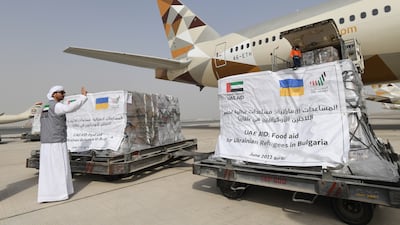
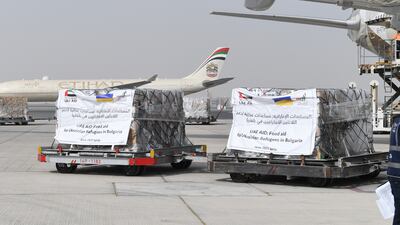
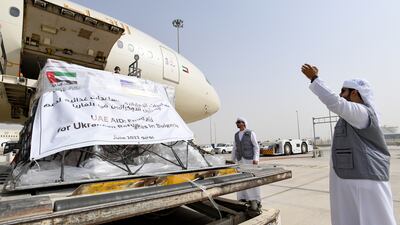
The UAE has provided Dh13 billion of foreign aid since the start of last year, the Ministry of Foreign Affairs and International Co-operation has said.
The figures were revealed to mark World Humanitarian Day, established by the UN to raise awareness about humanitarian assistance worldwide and the importance of international co-operation.
The biggest recipient of aid was Yemen, which received Dh1.16 billion, state news agency Wam reported.
The data revealed a wide range of sectors and programmes that were supported by the Emirates.
The humanitarian work in the UAE is a fundamental pillar of the philanthropic approach adopted by the state since its establishment
Dr Anwar Gargash
“The UAE has become a model of sustainable relief and humanitarian work, by replacing conventional relief operations with development projects that benefit communities, such as those that construct houses, schools, roads and power stations, and dig wells,” Wam reported.
“The country has implemented a clear methodology that does not discriminate based on political orientation.”
Public programmes received more than Dh4.5bn in support, while social services were given more than Dh1.3bn in aid and education projects received more than Dh540 million.
The transport and storage sectors received more than Dh414m while programmes supporting peace and security were given more than Dh273m.
Water and public health service sectors received Dh268m while government and civil society initiatives received about Dh224m.
The energy sector was supported to the tune of Dh212m while more than Dh184m was provided for agricultural projects.
In his first address to the nation after becoming president, Sheikh Mohamed said the UAE would be a friend to those in need, delivering support and humanitarian aid “regardless of race or religion”.
“Continuing Sheikh Zayed’s approach, we will work to strengthen our role among the world’s leading countries by providing humanitarian aid, and by continuing to extend a helping hand to communities in need around the world, irrespective of religion or race,” Sheikh Mohamed said in his July address.
UAE's journey of giving continues
Dr Anwar Gargash, diplomatic adviser to the President said on Twitter that the UAE's humanitarian work reflected the principles upon which the Emirates was founded.
“The humanitarian work in the UAE is a fundamental pillar of the philanthropic approach adopted by the state since its establishment,” he wrote.
“It has never been an urgent action governed by a policy or orientation, but rather a flowing goodness and a lofty message that reflects the principles upon which our country was founded and established by the founding leader Sheikh Zayed bin Sultan Al Nahyan, may God have mercy on him.
“The journey of giving continues under the leadership of His Highness Sheikh Mohamed bin Zayed Al Nahyan, President of the UAE, may God protect him.”
In a second tweet, Dr Gargash said: “Our approach is authentic and firm, and its foundations are solid and firm.
“From this point of view, the humanitarian work was strongly present in the speech he addressed to the people of the UAE in which he highlighted the country's objectives in the coming decades.”
Sheikh Mohammed bin Rashid, Vice President and Ruler of Dubai, thanked the thousands of volunteers who have played a part in helping people in need around the world on behalf of the UAE.
In a tweet on Thursday, Sheikh Mohammed said 145,000 volunteers from 97 countries helped to provide food, aid and support to more than 90 million beneficiaries last year.
As part of the Mohammed bin Rashid Global Initiatives, more than Dh1.1 billion ($299 million) was spent in 2021 through a number of programmes, campaigns and relief and community projects.
UAE sends aid to Ukrainian refugees in Bulgaria — in pictures
The specs
Engine: 2.0-litre 4cyl turbo
Power: 261hp at 5,500rpm
Torque: 405Nm at 1,750-3,500rpm
Transmission: 9-speed auto
Fuel consumption: 6.9L/100km
On sale: Now
Price: From Dh117,059
Jetour T1 specs
Engine: 2-litre turbocharged
Power: 254hp
Torque: 390Nm
Price: From Dh126,000
Available: Now
Libya's Gold
UN Panel of Experts found regime secretly sold a fifth of the country's gold reserves.
The panel’s 2017 report followed a trail to West Africa where large sums of cash and gold were hidden by Abdullah Al Senussi, Qaddafi’s former intelligence chief, in 2011.
Cases filled with cash that was said to amount to $560m in 100 dollar notes, that was kept by a group of Libyans in Ouagadougou, Burkina Faso.
A second stash was said to have been held in Accra, Ghana, inside boxes at the local offices of an international human rights organisation based in France.
UAE currency: the story behind the money in your pockets
Notable salonnières of the Middle East through history
Al Khasan (Okaz, Saudi Arabia)
Tamadir bint Amr Al Harith, known simply as Al Khasan, was a poet from Najd famed for elegies, earning great renown for the eulogy of her brothers Mu’awiyah and Sakhr, both killed in tribal wars. Although not a salonnière, this prestigious 7th century poet fostered a culture of literary criticism and could be found standing in the souq of Okaz and reciting her poetry, publicly pronouncing her views and inviting others to join in the debate on scholarship. She later converted to Islam.
Maryana Marrash (Aleppo)
A poet and writer, Marrash helped revive the tradition of the salon and was an active part of the Nadha movement, or Arab Renaissance. Born to an established family in Aleppo in Ottoman Syria in 1848, Marrash was educated at missionary schools in Aleppo and Beirut at a time when many women did not receive an education. After touring Europe, she began to host salons where writers played chess and cards, competed in the art of poetry, and discussed literature and politics. An accomplished singer and canon player, music and dancing were a part of these evenings.
Princess Nazil Fadil (Cairo)
Princess Nazil Fadil gathered religious, literary and political elite together at her Cairo palace, although she stopped short of inviting women. The princess, a niece of Khedive Ismail, believed that Egypt’s situation could only be solved through education and she donated her own property to help fund the first modern Egyptian University in Cairo.
Mayy Ziyadah (Cairo)
Ziyadah was the first to entertain both men and women at her Cairo salon, founded in 1913. The writer, poet, public speaker and critic, her writing explored language, religious identity, language, nationalism and hierarchy. Born in Nazareth, Palestine, to a Lebanese father and Palestinian mother, her salon was open to different social classes and earned comparisons with souq of where Al Khansa herself once recited.
THE%20SPECS
%3Cp%3EBattery%3A%2060kW%20lithium-ion%20phosphate%3Cbr%3EPower%3A%20Up%20to%20201bhp%3Cbr%3E0%20to%20100kph%3A%207.3%20seconds%3Cbr%3ERange%3A%20418km%3Cbr%3EPrice%3A%20From%20Dh149%2C900%3Cbr%3EAvailable%3A%20Now%3C%2Fp%3E%0A
Stamp duty timeline
December 2014: Former UK finance minister George Osbourne reforms stamp duty, replacing the slab system with a blended rate scheme, with the top rate increasing to 12 per cent from 10 per cent:
Up to £125,000 - 0%; £125,000 to £250,000 – 2%; £250,000 to £925,000 – 5%; £925,000 to £1.5m: 10%; Over £1.5m – 12%
April 2016: New 3% surcharge applied to any buy-to-let properties or additional homes purchased.
July 2020: Rishi Sunak unveils SDLT holiday, with no tax to pay on the first £500,000, with buyers saving up to £15,000.
March 2021: Mr Sunak decides the fate of SDLT holiday at his March 3 budget, with expectations he will extend the perk unti June.
April 2021: 2% SDLT surcharge added to property transactions made by overseas buyers.
Profile
Company: Libra Project
Based: Masdar City, ADGM, London and Delaware
Launch year: 2017
Size: A team of 12 with six employed full-time
Sector: Renewable energy
Funding: $500,000 in Series A funding from family and friends in 2018. A Series B round looking to raise $1.5m is now live.
The%20specs
%3Cp%3E%3Cstrong%3EEngine%3A%20%3C%2Fstrong%3ESingle%20front-axle%20electric%20motor%3Cbr%3E%3Cstrong%3EPower%3A%20%3C%2Fstrong%3E218hp%3Cbr%3E%3Cstrong%3ETorque%3A%20%3C%2Fstrong%3E330Nm%3Cbr%3E%3Cstrong%3ETransmission%3A%20%3C%2Fstrong%3ESingle-speed%20automatic%3Cbr%3E%3Cstrong%3EMax%20touring%20range%3A%20%3C%2Fstrong%3E402km%20(claimed)%3Cbr%3E%3Cstrong%3EPrice%3A%20%3C%2Fstrong%3EFrom%20Dh215%2C000%20(estimate)%3Cbr%3E%3Cstrong%3EOn%20sale%3A%20%3C%2Fstrong%3ESeptember%3C%2Fp%3E%0A
UAE currency: the story behind the money in your pockets
TEACHERS' PAY - WHAT YOU NEED TO KNOW
Pay varies significantly depending on the school, its rating and the curriculum. Here's a rough guide as of January 2021:
- top end schools tend to pay Dh16,000-17,000 a month - plus a monthly housing allowance of up to Dh6,000. These tend to be British curriculum schools rated 'outstanding' or 'very good', followed by American schools
- average salary across curriculums and skill levels is about Dh10,000, recruiters say
- it is becoming more common for schools to provide accommodation, sometimes in an apartment block with other teachers, rather than hand teachers a cash housing allowance
- some strong performing schools have cut back on salaries since the pandemic began, sometimes offering Dh16,000 including the housing allowance, which reflects the slump in rental costs, and sheer demand for jobs
- maths and science teachers are most in demand and some schools will pay up to Dh3,000 more than other teachers in recognition of their technical skills
- at the other end of the market, teachers in some Indian schools, where fees are lower and competition among applicants is intense, can be paid as low as Dh3,000 per month
- in Indian schools, it has also become common for teachers to share residential accommodation, living in a block with colleagues