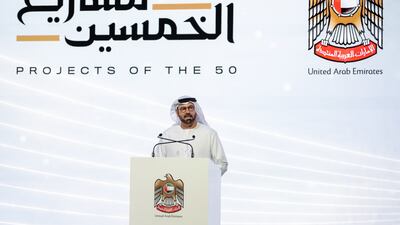
• At Qasr Al Watan, the Presidential Palace in Abu Dhabi, ministers set out the latest 13 items in the UAE's 'Projects of the 50' plan.
    At Qasr Al Watan, the Presidential Palace in Abu Dhabi, ministers set out the latest 13 items in the UAE's 'Projects of the 50' plan.
  • A series of major projects were unveiled on Sunday at Qasr Al Watan in Abu Dhabi. These are to boost the UAE's economy and development in the years to come. Photos: Victor Besa / The National
    A series of major projects were unveiled on Sunday at Qasr Al Watan in Abu Dhabi. These are to boost the UAE's economy and development in the years to come. Photos: Victor Besa / The National
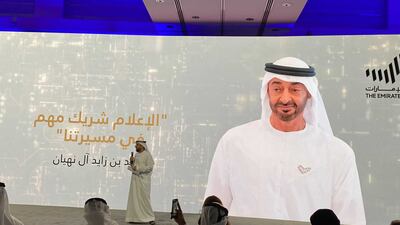
  • Minister of Cabinet Affairs, Mohammed Al Gergawi, said one of the plans was a scheme to spend up to Dh24 billion on getting 75,000 Emiratis into private-sector jobs.
    Minister of Cabinet Affairs, Mohammed Al Gergawi, said one of the plans was a scheme to spend up to Dh24 billion on getting 75,000 Emiratis into private-sector jobs.
  • The 13 plans relate to boosting the country's human capital and significantly increasing the number of Emiratis employed in the private sector.
    The 13 plans relate to boosting the country's human capital and significantly increasing the number of Emiratis employed in the private sector.
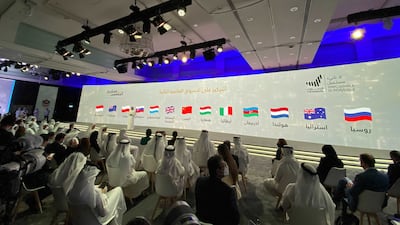
  • Cabinet ministers and senior officials heard how UAE citizens would be given a series of incentives to choose private-sector work.
    Cabinet ministers and senior officials heard how UAE citizens would be given a series of incentives to choose private-sector work.
  • University graduates will be encouraged to take up jobs in the private sector, with the government offering to boost their salary.
    University graduates will be encouraged to take up jobs in the private sector, with the government offering to boost their salary.
  • Ghannam Al Mazrouei, General Secretary of the Emirati Talent Competitiveness Council, addresses ministers and officials.
    Ghannam Al Mazrouei, General Secretary of the Emirati Talent Competitiveness Council, addresses ministers and officials.
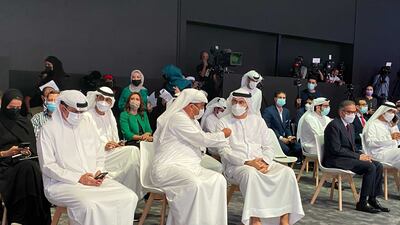
  • Cabinet ministers and senior officials heard how UAE citizens would be given a series of incentives to choose private-sector work.
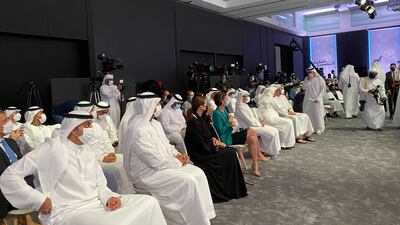
    Cabinet ministers and senior officials heard how UAE citizens would be given a series of incentives to choose private-sector work.
  • At Qasr Al Watan, ministers set out the latest 13 items in the UAE's 'Projects of the 50' plan.
    At Qasr Al Watan, ministers set out the latest 13 items in the UAE's 'Projects of the 50' plan.

Projects of the 50: plan to get 75,000 Emiratis into the private sector


  • English
  • Arabic

Latest: Employers must offer jobs with 'real career growth' to attract Emiratis, say recruiters

A series of major projects to boost the UAE's economy and development were revealed on Sunday.

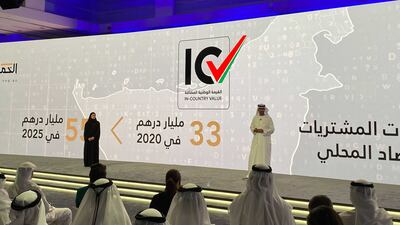
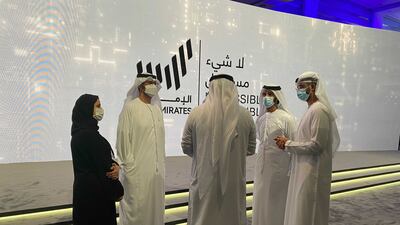
At Qasr Al Watan, the Presidential Palace in Abu Dhabi, ministers set out the latest 13 items in the 'Projects of the 50' plan.

These relate to boosting the country's human capital and increasing the number of Emiratis employed in the private sector.

All private sector companies in the UAE should have a workforce that is at least 10 per cent Emirati in five years' time.

Sheikh Mansour bin Zayed, Deputy Prime Minister and Minister of Presidential Affairs, and Mohammed Al Gergawi, Minister of Cabinet Affairs, were present as the new projects were revealed.

Financial incentives for Emiratis in the private sector

One of the first to be announced was a plan to spend up to Dh24 billion ($6.53bn) on getting 75,000 Emiratis into private sector jobs, Mr Al Gergawi said.

UAE citizens will be offered a series of incentives to choose private sector work.

University graduates will be encouraged to take up jobs in the private sector, with the government offering to boost their salary to make the decision more attractive.

For example, the government will top up an Emirati graduate's private sector salary by Dh5,000 a month, and make support payments for his or her children.

A separate plan will allow federal government employees to take a sabbatical on 50 per cent of their salary to start a business. Another will provide financial grants to encourage Emiratis over the age of 50 who take early retirement to start a businesses.

The 13 latest projects

1) Emirati Talent Competitiveness Council: With Sheikh Mansour bin Zayed as chairman and Sheikh Abdullah bin Zayed, Minister of Foreign Affairs and International Co-operation, as vice chairman, the council brings together representatives across federal government. It is tasked with strengthening private sector partnerships and implementing projects to provide 75,000 private sector jobs for Emiratis.

2) Emirati Salary Support Scheme: A grant contributing to the recruitment and training costs of Emirati graduates in the private sector, with a monthly top-up of up to Dh8,000 for graduates during the first year of training and a monthly top-up of up to Dh5,000 for five years after recruitment. Top-ups are conditional and based on a range of defined target salaries.

3) Merit Programme: A fixed monthly salary top-up of Dh5,000 to be provided for five years to Emirati workers in specialised fields, including nursing, accountancy and financial auditing, also lawyers, financial analysts and coders.

4) Pension Programme: A five-year subsidy against the pension plan contributions of Emirati staff earning less than Dh20,000 per month. And a government-paid contribution on behalf of the company against the cost of pension plans for Emirati staff in the first five years, which ensures zero contributions to the cost of Emiratis' pensions in the first year of private sector employment.

5) Child Allowance Scheme: A government child allowance payment will be made to Emirati staff working in the private sector of up to Dh800 per child, up to a maximum of Dh3,200 per month, to help with the costs of childcare. It will last up to the age of 21.

6) Talent Programme: An investment of Dh1.25 billion in developing specialised vocational skills for Emiratis, with internationally recognised certifications in property management, accounting, business management and technology skills.

7) Apprentice Programme: A train-to-hire initiative to build vocational training for Emiratis in private and semi-private companies with a range of financial awards across a number of business sectors.

8) Recruitment Targets: Every private sector company in UAE must ensure 10 per cent of its workforce is Emirati within five years. The figure should rise by 2 per cent each year until 10 per cent is reached, and the jobs given to UAE nationals should be in knowledge and skilled roles.

9) National Healthcare Programme: An educational grant programme targeting the development of 10,000 Emirati healthcare workers within the coming five years. This will involve rolling out a Graduate Healthcare Assistant Programme: a Higher Diploma in Emergency Medicine and a Bachelor's degree in Nursing. Supported and led by Fatima College of Health Sciences and ACTVET.

10) Unemployment Benefit: An unemployment benefit to be paid to Emiratis working in the private sector who lose their jobs because of circumstances beyond their control, giving them a six-month period to find another position.

11) Start-up Break: Beginning 2021, a subsidised career break of six-to-12 months for Emiratis in federal government positions to start a business. Employees would receive 50 per cent of their salary while away. Will be open to a limited number of staff each year with employer approval.

12) Early Retirement: An opportunity for Emiratis in federal government positions to take early retirement in order to explore business opportunities and start a private sector business. Will include financing of five years' salary payments or a lump sum golden handshake payment. Will be open to a limited number of staff each year, with employer approval.

13) Graduate Fund: A Dh1 billion fund, under the patronage of Sheikh Mansour bin Zayed, to provide micro-loans for university and fresh graduates to support their business projects, in collaboration with UAE universities.

Sheikh Mohammed bin Rashid: 'The future is in the private sector'

Sheikh Mohammed bin Rashid, Vice President and Ruler of Dubai, said: "Today, we have clear and supported targets for the percentage of citizens in the private sector. The future is in the private sector."

He said the private sector will be partners in the country's march forward, adding: "The next 50 [years] will be better and more beautiful."

In a tweet, Sheikh Mohamed bin Zayed, Crown Prince of Abu Dhabi and Deputy Supreme Commander of the Armed Forces, said the plans would empower the country's young people.

"Consistent with our ambitions to empower our people and enhance the strength and sustainability of our economy, the UAE is launching a dedicated plan to boost the employment of UAE nationals in the private sector, which will play a vital role in our nation’s long-term development," he wrote.

The 50 national projects plan was unveiled before the UAE's 50th National Day, which will take place on December 2.

The first 13 initiatives included visas for freelancers, highly skilled professionals, investors, entrepreneurs, top students and graduates to sponsor themselves.

Flexible visas will allow people to sponsor their children into their mid-20s. There will be a visa residency grace period of up to 180 days if people lose or change their job, and new work permits will allow children aged 15 and over to get a part-time job.

These initiatives will be the cornerstone of growth as the country marks 50 years since unification.

50 Projects plan unveiled - in pictures

  • Emirati Minister of Cabinet Affairs Mohammad Al Gergawi. UAE Government Media
    Emirati Minister of Cabinet Affairs Mohammad Al Gergawi. UAE Government Media
  • Saeed Al Eter, chairman of the UAE Government Media Office, addresses the audience at Emirates Towers in Dubai where he revealed 50 new projects for the UAE. All photos: Suhail Akram / The National
    Saeed Al Eter, chairman of the UAE Government Media Office, addresses the audience at Emirates Towers in Dubai where he revealed 50 new projects for the UAE. All photos: Suhail Akram / The National
  • The country will seek $150 billion in inward investment by 2030.
    The country will seek $150 billion in inward investment by 2030.
  • Senior officials set out a bold new vision for the country as it prepares to mark 50 years since the Union was formed.
    Senior officials set out a bold new vision for the country as it prepares to mark 50 years since the Union was formed.
  • The drive will see billions pumped into the economy and hundreds of thousands of people trained and reskilled.
    The drive will see billions pumped into the economy and hundreds of thousands of people trained and reskilled.
  • Officials, along with local and international media, listen intently as the projects and initiatives are unveiled.
    Officials, along with local and international media, listen intently as the projects and initiatives are unveiled.
  • Ministers set out 'new era of prosperity and development'.
    Ministers set out 'new era of prosperity and development'.

The first 13 initiatives announced last week included:

  • Dh5bn from Emirates Development Bank for Project 5Bn to support Emirati initiatives in priority sectors, stimulate industry and contribute towards economic diversification.
  • A green visa to enable highly skilled professionals, investors, entrepreneurs, top students and graduates to sponsor themselves.
  • A freelancer's visa, the first federal visa for self-employed people.
  • Dh5bn, also in partnership with Emirates Development Bank, for Tech Drive to support advanced technology adoption over five years.
  • The 10x10 programme with the aim of achieving a 10 per cent annual increase in UAE exports to 10 global markets: China, the UK, Netherlands, Italy, Russia, Poland, Luxembourg, Australia, New Zealand and Indonesia.
  • Invest.ae, a portal that unites investment-related local entities and 14 economic entities, presenting investment opportunities throughout the UAE. The website will provide resources for businesses and for opening bank accounts.
  • The In-country Value programme to redirect 42 per cent of procurement of the federal government and major UAE companies to local products and services. It aims to increase the number of local suppliers from 5,000 to 7,300 and boost procurement value from Dh33bn to Dh55bn over four years.
  • The Emirates Investment Summit, to be held next spring, to connect investment funds with the public and private sectors to create investment opportunities that attract Dh550bn of inward foreign direct investment to the UAE over the next nine years.
  • The Fourth Industrial Revolution Network to grow 500 national companies through the application of advanced technology over five years.
  • Under Global Economic Partnerships, the UAE will undertake comprehensive economic agreements with eight strategic global markets to achieve a Dh40bn annual increase in the current Dh257bn trade volume with these markets. A Higher Committee for Economic Agreements has also been established.
  • The 100 Coders Every Day initiative to increase the number of coders from 64,000 to 100,000 in a year and support the establishment of programming companies through incentives and benefits.
  • The UAE Data Law, the first federal law to be drafted in partnership with major technology companies. It will empower people to control how their personal data is used, stored and shared. The project is intended to protect privacy.
  • The biggest programming summit in the Middle East, PyCon MEA, to be held next summer. The aim is to connect coders with the public and private sectors, and to develop digital talent and creative programming projects.

The biog

Place of birth: Kalba

Family: Mother of eight children and has 10 grandchildren

Favourite traditional dish: Al Harees, a slow cooked porridge-like dish made from boiled cracked or coarsely ground wheat mixed with meat or chicken

Favourite book: My early life by Sheikh Dr Sultan bin Muhammad Al Qasimi, the Ruler of Sharjah

Favourite quote: By Sheikh Zayed, the UAE's Founding Father, “Those who have no past will have no present or future.”

The specs: 2019 Cadillac XT4

Price, base: Dh145,000

Engine: 2.0-litre turbocharged in-line four-cylinder engine

Transmission: Nine-speed automatic

Power: 237hp @ 5,000rpm

Torque: 350Nm @ 1,500rpm

Fuel economy, combined: 8.7L / 100km

Racecard

6.30pm: Mazrat Al Ruwayah Group Two (PA) US$55,000 (Dirt) 1,600m

7.05pm: Meydan Trophy (TB) $100,000 (Turf) 1,900m

7.40pm: Handicap (TB) $135,000 (D) 1,200m

8.15pm: Balanchine Group Two (TB) $250,000 (T) 1,800m

8.50pm: Handicap (TB) $135,000 (T) 1,000m

9.25pm: Firebreak Stakes Group Three (TB) $200,000 (D) 1,600m

10pm: Handicap (TB) $175,000 (T) 2,410m

The National selections: 6.30pm: RM Lam Tara, 7.05pm: Al Mukhtar Star, 7.40pm: Bochart, 8.15pm: Magic Lily, 8.50pm: Roulston Scar, 9.25pm: Quip, 10pm: Jalmoud

Tips for job-seekers
  • Do not submit your application through the Easy Apply button on LinkedIn. Employers receive between 600 and 800 replies for each job advert on the platform. If you are the right fit for a job, connect to a relevant person in the company on LinkedIn and send them a direct message.
  • Make sure you are an exact fit for the job advertised. If you are an HR manager with five years’ experience in retail and the job requires a similar candidate with five years’ experience in consumer, you should apply. But if you have no experience in HR, do not apply for the job.

David Mackenzie, founder of recruitment agency Mackenzie Jones Middle East

The cost of Covid testing around the world

Egypt

Dh514 for citizens; Dh865 for tourists

Information can be found through VFS Global.

Jordan

Dh212

Centres include the Speciality Hospital, which now offers drive-through testing.

Cambodia

Dh478

Travel tests are managed by the Ministry of Health and National Institute of Public Health.

Zanzibar

AED 295

Zanzibar Public Health Emergency Operations Centre, located within the Lumumba Secondary School compound.

Abu Dhabi

Dh85

Abu Dhabi’s Seha has test centres throughout the UAE.

UK

From Dh400

Heathrow Airport now offers drive through and clinic-based testing, starting from Dh400 and up to Dh500 for the PCR test.

The essentials

What: Emirates Airline Festival of Literature

When: Friday until March 9

Where: All main sessions are held in the InterContinental Dubai Festival City

Price: Sessions range from free entry to Dh125 tickets, with the exception of special events.

Hot Tip: If waiting for your book to be signed looks like it will be timeconsuming, ask the festival’s bookstore if they have pre-signed copies of the book you’re looking for. They should have a bunch from some of the festival’s biggest guest authors.

Information: www.emirateslitfest.com
 

Another way to earn air miles

In addition to the Emirates and Etihad programmes, there is the Air Miles Middle East card, which offers members the ability to choose any airline, has no black-out dates and no restrictions on seat availability. Air Miles is linked up to HSBC credit cards and can also be earned through retail partners such as Spinneys, Sharaf DG and The Toy Store.

An Emirates Dubai-London round-trip ticket costs 180,000 miles on the Air Miles website. But customers earn these ‘miles’ at a much faster rate than airline miles. Adidas offers two air miles per Dh1 spent. Air Miles has partnerships with websites as well, so booking.com and agoda.com offer three miles per Dh1 spent.

“If you use your HSBC credit card when shopping at our partners, you are able to earn Air Miles twice which will mean you can get that flight reward faster and for less spend,” says Paul Lacey, the managing director for Europe, Middle East and India for Aimia, which owns and operates Air Miles Middle East.

How to protect yourself when air quality drops

Install an air filter in your home.

Close your windows and turn on the AC.

Shower or bath after being outside.

Wear a face mask.

Stay indoors when conditions are particularly poor.

If driving, turn your engine off when stationary.

Timeline

2012-2015

The company offers payments/bribes to win key contracts in the Middle East

May 2017

The UK SFO officially opens investigation into Petrofac’s use of agents, corruption, and potential bribery to secure contracts

September 2021

Petrofac pleads guilty to seven counts of failing to prevent bribery under the UK Bribery Act

October 2021

Court fines Petrofac £77 million for bribery. Former executive receives a two-year suspended sentence 

December 2024

Petrofac enters into comprehensive restructuring to strengthen the financial position of the group

May 2025

The High Court of England and Wales approves the company’s restructuring plan

July 2025

The Court of Appeal issues a judgment challenging parts of the restructuring plan

August 2025

Petrofac issues a business update to execute the restructuring and confirms it will appeal the Court of Appeal decision

October 2025

Petrofac loses a major TenneT offshore wind contract worth €13 billion. Holding company files for administration in the UK. Petrofac delisted from the London Stock Exchange

November 2025

180 Petrofac employees laid off in the UAE

A Prayer Before Dawn

Director: Jean-Stephane Sauvaire

Starring: Joe Cole, Somluck Kamsing, Panya Yimmumphai

Three stars

Children who witnessed blood bath want to help others

Aged just 11, Khulood Al Najjar’s daughter, Nora, bravely attempted to fight off Philip Spence. Her finger was injured when she put her hand in between the claw hammer and her mother’s head.

As a vital witness, she was forced to relive the ordeal by police who needed to identify the attacker and ensure he was found guilty.

Now aged 16, Nora has decided she wants to dedicate her career to helping other victims of crime.

“It was very horrible for her. She saw her mum, dying, just next to her eyes. But now she just wants to go forward,” said Khulood, speaking about how her eldest daughter was dealing with the trauma of the incident five years ago. “She is saying, 'mama, I want to be a lawyer, I want to help people achieve justice'.”

Khulood’s youngest daughter, Fatima, was seven at the time of the attack and attempted to help paramedics responding to the incident.

“Now she wants to be a maxillofacial doctor,” Khulood said. “She said to me ‘it is because a maxillofacial doctor returned your face, mama’. Now she wants to help people see themselves in the mirror again.”

Khulood’s son, Saeed, was nine in 2014 and slept through the attack. While he did not witness the trauma, this made it more difficult for him to understand what had happened. He has ambitions to become an engineer.

Evacuations to France hit by controversy
  • Over 500 Gazans have been evacuated to France since November 2023
  • Evacuations were paused after a student already in France posted anti-Semitic content and was subsequently expelled to Qatar
  • The Foreign Ministry launched a review to determine how authorities failed to detect the posts before her entry
  • Artists and researchers fall under a programme called Pause that began in 2017
  • It has benefited more than 700 people from 44 countries, including Syria, Turkey, Iran, and Sudan
  • Since the start of the Gaza war, it has also included 45 Gazan beneficiaries
  • Unlike students, they are allowed to bring their families to France

Mercer, the investment consulting arm of US services company Marsh & McLennan, expects its wealth division to at least double its assets under management (AUM) in the Middle East as wealth in the region continues to grow despite economic headwinds, a company official said.

Mercer Wealth, which globally has $160 billion in AUM, plans to boost its AUM in the region to $2-$3bn in the next 2-3 years from the present $1bn, said Yasir AbuShaban, a Dubai-based principal with Mercer Wealth.

Within the next two to three years, we are looking at reaching $2 to $3 billion as a conservative estimate and we do see an opportunity to do so,” said Mr AbuShaban.

Mercer does not directly make investments, but allocates clients’ money they have discretion to, to professional asset managers. They also provide advice to clients.

“We have buying power. We can negotiate on their (client’s) behalf with asset managers to provide them lower fees than they otherwise would have to get on their own,” he added.

Mercer Wealth’s clients include sovereign wealth funds, family offices, and insurance companies among others.

From its office in Dubai, Mercer also looks after Africa, India and Turkey, where they also see opportunity for growth.

Wealth creation in Middle East and Africa (MEA) grew 8.5 per cent to $8.1 trillion last year from $7.5tn in 2015, higher than last year’s global average of 6 per cent and the second-highest growth in a region after Asia-Pacific which grew 9.9 per cent, according to consultancy Boston Consulting Group (BCG). In the region, where wealth grew just 1.9 per cent in 2015 compared with 2014, a pickup in oil prices has helped in wealth generation.

BCG is forecasting MEA wealth will rise to $12tn by 2021, growing at an annual average of 8 per cent.

Drivers of wealth generation in the region will be split evenly between new wealth creation and growth of performance of existing assets, according to BCG.

Another general trend in the region is clients’ looking for a comprehensive approach to investing, according to Mr AbuShaban.

“Institutional investors or some of the families are seeing a slowdown in the available capital they have to invest and in that sense they are looking at optimizing the way they manage their portfolios and making sure they are not investing haphazardly and different parts of their investment are working together,” said Mr AbuShaban.

Some clients also have a higher appetite for risk, given the low interest-rate environment that does not provide enough yield for some institutional investors. These clients are keen to invest in illiquid assets, such as private equity and infrastructure.

“What we have seen is a desire for higher returns in what has been a low-return environment specifically in various fixed income or bonds,” he said.

“In this environment, we have seen a de facto increase in the risk that clients are taking in things like illiquid investments, private equity investments, infrastructure and private debt, those kind of investments were higher illiquidity results in incrementally higher returns.”

The Abu Dhabi Investment Authority, one of the largest sovereign wealth funds, said in its 2016 report that has gradually increased its exposure in direct private equity and private credit transactions, mainly in Asian markets and especially in China and India. The authority’s private equity department focused on structured equities owing to “their defensive characteristics.”

Teri%20Baaton%20Mein%20Aisa%20Uljha%20Jiya
%3Cp%3E%3Cstrong%3EDirectors%3A%3C%2Fstrong%3E%20Amit%20Joshi%20and%20Aradhana%20Sah%3C%2Fp%3E%0A%3Cp%3E%3Cstrong%3ECast%3A%3C%2Fstrong%3E%20Shahid%20Kapoor%2C%20Kriti%20Sanon%2C%20Dharmendra%2C%20Dimple%20Kapadia%2C%20Rakesh%20Bedi%3C%2Fp%3E%0A%3Cp%3E%3Cstrong%3ERating%3A%3C%2Fstrong%3E%204%2F5%3C%2Fp%3E%0A

Sui Dhaaga: Made in India

Director: Sharat Katariya

Starring: Varun Dhawan, Anushka Sharma, Raghubir Yadav

3.5/5

Guardians%20of%20the%20Galaxy%20Vol%203
%3Cp%3E%3Cstrong%3EDirector%3A%20%3C%2Fstrong%3EJames%20Gunn%3C%2Fp%3E%0A%3Cp%3E%3Cstrong%3EStars%3A%3C%2Fstrong%3E%20Chris%20Pratt%2C%20Zoe%20Saldana%2C%20Dave%20Bautista%2C%20Vin%20Diesel%2C%20Bradley%20Cooper%3C%2Fp%3E%0A%3Cp%3E%3Cstrong%3ERating%3A%3C%2Fstrong%3E%204%2F5%3C%2Fp%3E%0A

Director: Laxman Utekar

Cast: Vicky Kaushal, Akshaye Khanna, Diana Penty, Vineet Kumar Singh, Rashmika Mandanna

Rating: 1/5

From Zero

Artist: Linkin Park

Label: Warner Records

Number of tracks: 11

Rating: 4/5

Ten tax points to be aware of in 2026

1. Domestic VAT refund amendments: request your refund within five years

If a business does not apply for the refund on time, they lose their credit.

2. E-invoicing in the UAE

Businesses should continue preparing for the implementation of e-invoicing in the UAE, with 2026 a preparation and transition period ahead of phased mandatory adoption. 

3. More tax audits

Tax authorities are increasingly using data already available across multiple filings to identify audit risks. 

4. More beneficial VAT and excise tax penalty regime

Tax disputes are expected to become more frequent and more structured, with clearer administrative objection and appeal processes. The UAE has adopted a new penalty regime for VAT and excise disputes, which now mirrors the penalty regime for corporate tax.

5. Greater emphasis on statutory audit

There is a greater need for the accuracy of financial statements. The International Financial Reporting Standards standards need to be strictly adhered to and, as a result, the quality of the audits will need to increase.

6. Further transfer pricing enforcement

Transfer pricing enforcement, which refers to the practice of establishing prices for internal transactions between related entities, is expected to broaden in scope. The UAE will shortly open the possibility to negotiate advance pricing agreements, or essentially rulings for transfer pricing purposes. 

7. Limited time periods for audits

Recent amendments also introduce a default five-year limitation period for tax audits and assessments, subject to specific statutory exceptions. While the standard audit and assessment period is five years, this may be extended to up to 15 years in cases involving fraud or tax evasion. 

8. Pillar 2 implementation 

Many multinational groups will begin to feel the practical effect of the Domestic Minimum Top-Up Tax (DMTT), the UAE's implementation of the OECD’s global minimum tax under Pillar 2. While the rules apply for financial years starting on or after January 1, 2025, it is 2026 that marks the transition to an operational phase.

9. Reduced compliance obligations for imported goods and services

Businesses that apply the reverse-charge mechanism for VAT purposes in the UAE may benefit from reduced compliance obligations. 

10. Substance and CbC reporting focus

Tax authorities are expected to continue strengthening the enforcement of economic substance and Country-by-Country (CbC) reporting frameworks. In the UAE, these regimes are increasingly being used as risk-assessment tools, providing tax authorities with a comprehensive view of multinational groups’ global footprints and enabling them to assess whether profits are aligned with real economic activity. 

Contributed by Thomas Vanhee and Hend Rashwan, Aurifer

Updated: September 13, 2021, 4:00 AM