


Former French president Francois Hollande has said he fears the Cop26 UN climate summit could be a failure because so few countries have submitted their national plans to reduce emissions.
Speaking at Expo 2020 Dubai, Mr Hollande said he was not optimistic about the summit's outcome, despite widespread public recognition of the need for action.
former French president
Mr Hollande was president of France when the Paris Agreement on climate change was made in 2015. The groundbreaking international treaty was adopted by 195 countries and the EU at Cop21.
Cop26 will take place in Glasgow, Scotland from October 31 until November 12.
Speaking to The National at the World Green Economy Summit at Expo 2020 Dubai, Mr Hollande said more governments needed to engage with the process started by the Paris Agreement.
"I am confident the public are aware of the situation and the high level of warming, but I'm not so optimistic because some countries have not given their commitments for the new Cop26," he said.
"Submitting these commitments is very important to mobilise ahead of the conference, [so that] Cop26 does not appear a disappointment.
"We must strengthen the commitments, and we must encourage these countries to participate, to be adapted to the situation.
"We must also have a system of checking the pledges are respected."
So far only 59 per cent of countries have declared their new or updated climate-related targets, known as Nationally Determined Contributions, or NDCs, for reducing their greenhouse-gas emissions.
These non-binding national plans were at the heart of the Paris Agreement and were designed to help the global community limit warming to well below 2°C, preferably to 1.5°C, compared to pre-industrial levels.
These plans are meant to be refreshed every five years, but 41 per cent of countries have not done so, and the new or updated NDCs only account for about 49 per cent of global greenhouse-gas emissions.
China, the world's largest greenhouse-gas emitter according to data released in May from the Rhodium Group of researchers, proposed its updated NDC targets at the UN’s Climate Ambition Summit in December last year, but has yet to officially submit its revised NDC.
India, the third-largest emitter according to the Global Carbon Atlas, has not submitted an updated climate plan or announced in which year it will achieve net zero emissions.
Meanwhile, the UAE submitted its updated NDCs in December 2020, and outlined plans to limit greenhouse gas emissions to about 240 million tonnes by 2030, down 22.5 per cent compared to the business as usual figure of 310 million tonnes.
Increases in clean power capacity, especially through solar and nuclear energy, are central to the efforts to battle climate change.
The UAE has invested more than $40 billion into nuclear and solar power, increasing the country's clean power
capacity significantly.
In 2015, it was just over 100 megawatts, but is now 2,400MW and should reach 14,000MW by 2030.
Solar power in the UAE - in pictures
-
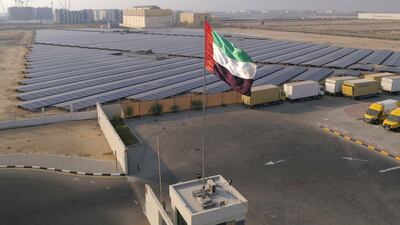
The UAE’s largest ground-mounted private solar plant at Nestle Middle East’s Al Maha factory in Dubai. The UAE intends to derive 44% of its power requirements from clean energy by 2050. -
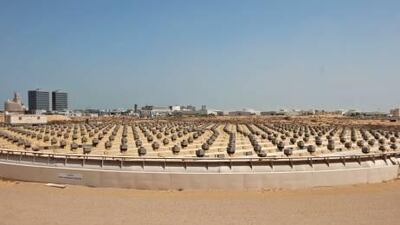
This prototype 100-metre diameter solar island, which can rotate to catch the sun's rays, has been created in a joint partnership between the UAE Centre Suisse d'Electronique et de Microtechnique and the government of Ras al Khaimah. -
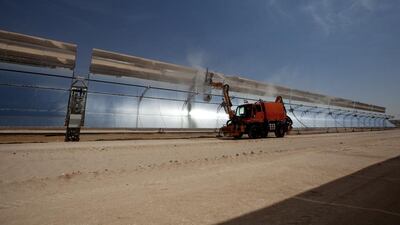
The Shams 1 solar project generates enough electricity to power 20,000 homes in the UAE. -

The Shams 1 project occupies 2.5 square kilometres and has a capacity of 100 megawatts. -
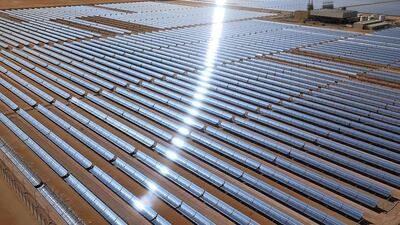
Shams 1 concentrated solar plant in the Abu Dhabi Western region. The UAE accounts for more than half of the GCC’s and Levant’s solar power capacity. -

The President, Sheikh Khalifa, with the leaders of the UAE behind him at the opening of the Shams 1 plant in 2013. -
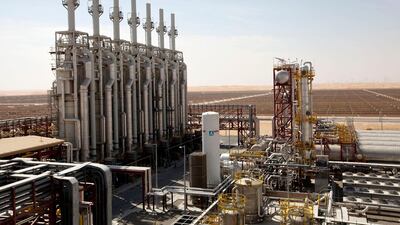
The UAE's first solar plant, Shams 1 was the largest renewable energy project in operation in the Middle East when it launched in 2013



