


A Dubai resident talked of the danger he faced during his historic journey to the bottom of the ocean.
Hamish Harding, 49, broke two world records last week on his mission to explore the depths of the Challenger Deep in the Mariana Trench in the South Pacific Ocean, which at nearly 11 kilometres is regarded as the deepest point beneath the waves.
His 12-hour mission set two Guinness World Records – the greatest distance travelled at full ocean depth and the greatest time spent at full ocean depth.
While the expedition was a success, it did not unfold without unexpected drama that could have been taken straight from a Jules Verne novel.
“Because we were making a record attempt, we had to go to areas that no other human being had been to before,” Mr Harding said.
“We encountered jagged vertical rock faces that were very challenging to get over and we had to ascend very quickly as we didn’t want to get snagged on the rocks.
"We had to use our thrusters the entire time to climb the rock face which was about the size of Burj Khalifa. We were not expecting that at all as we expected a much flatter surface."
Mr Harding, who runs a business jet brokerage firm, was part of a two-man crew that descended to a depth that was the equivalent of about 13 Burj Khalifas.
They achieved the feat in a small submersible vessel called the Limiting Factor.
He was accompanied on the mission by Victor Vescovo, an American explorer and private investor who helped develop the vessel.

Another challenge they encountered was avoiding the debris left by previous failed expeditions.
“We had to be careful not to get snagged on the cables from other countries’ attempts to send remote-operated vehicles down there,” Mr Harding said.
“The cables were abandoned there after they had snapped.”
Scientists claimed the Mariana Trench was so deep that human bones would dissolve because of the intense pressure.
The conditions created further hurdles for Mr Harding to overcome.
“Getting electronics to work down there was a challenge,” he said.
“A cable can work perfectly a million times when tested on the surface but it’s a different story when it is subjected to such intense atmospheric pressure.
“Cables often move together when such pressure is exerted and it creates electrical shorts, which could cause something to suddenly stop.”

Mr Harding said he also discovered a new species in an environment where the atmospheric pressure was 1,200 times higher than what humans experienced on the surface.
He hopes his discovery will be of benefit to the wider scientific community.
“We found a shrimp-like creature that appears to be completely hollow,” he said.
“The reason for this is these creatures have water flowing through them at great pressure. A human head, for example, would be crushed.”
He said the creatures were being analysed by Newcastle University.
Water samples from the mission are also being scrutinised by the same scientists to see whether microplastics are present.
Mr Harding said he was already resigned to those studies finding evidence of pollution.
“The world needs to do something about pollution,” he said.
“Letting plastics get into the ocean is never going to end well.
“Microplastics are already getting into our food chain and that’s not good.”
Mr Harding said his mission was inspired by the UAE, where the UK citizen has lived since 1993.
“With the recent success of its Hope probe, the UAE has proved the impossible is possible and, as a long-term resident, I hope this achievement will in some small part contribute to the country’s reputation in science and exploration,” he said.
Mr Harding’s 13-year-old son Giles was also part of the team.
He updated people on the mission's progress with social media posts from the expedition's base of operations – a research ship previously used by the US Navy to hunt submarines.
Giles, a Dubai College pupil, had to keep to a strict schedule to balance his studies with life on board the vessel.
"I was learning remotely from 1.30pm to about 9.50pm each day," he said.
“I would go straight to bed then as you had to be up at 6am or you would miss breakfast.
“I would definitely like to go on more missions like this if it’s possible.”
Five deep ocean expeditions - in pictures
-
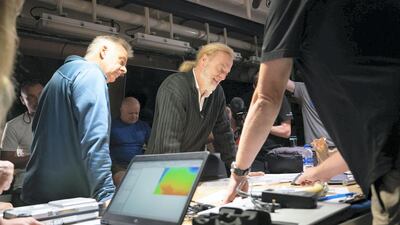
Team reviewing dive sites in the Atlantic Ocean. Courtesy: The Five Deeps Expedition -
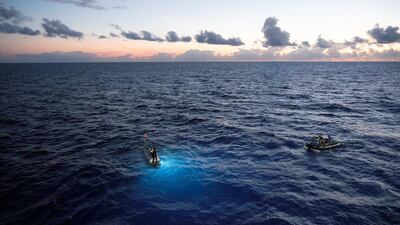
LF emerging from dive at Atlantic Ocean. Courtesy: The 5 Deeps -
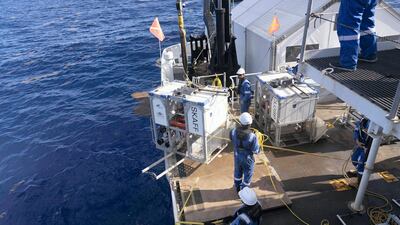
Lander getting ready to launch at the Atlantic Ocean dive site. Courtesy: The Five Deeps Expedition -
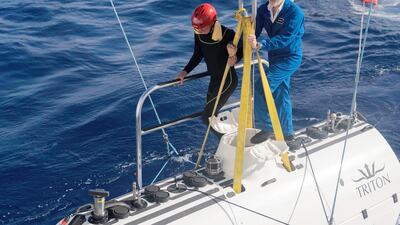
Team entering Limiting Factor for the Atlantic Ocean dive. Courtesy: The Five Deeps Expedition -
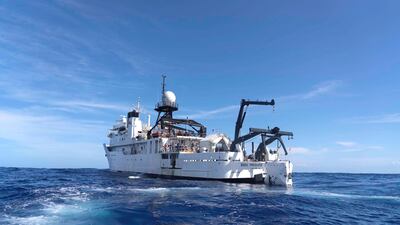
The DSSV Pressure Drop. Courtesy: The Five Deeps Expedition -
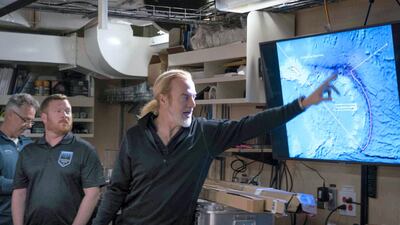
Victor Vescovo indicates to the Expedition Team the proposed routing for the South Sandwich. Courtesy: The Five Deeps Expedition -
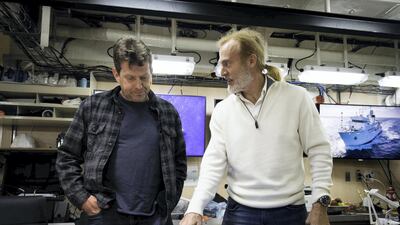
Victor Vescovo discusses plans for the Southern Ocean dive. Courtesy: The Five Deeps Expedition -
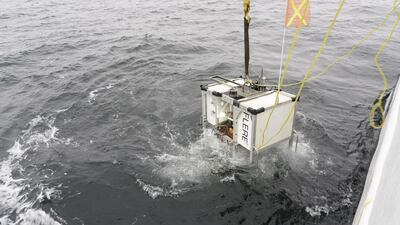
Deployment of science lander "Flere" at the Southern Ocean dive site. Courtesy: The Five Deeps Expedition -
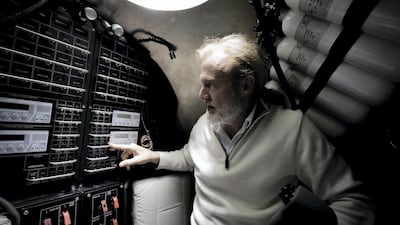
Victor Vescovo on board the DSSV Pressure Drop -
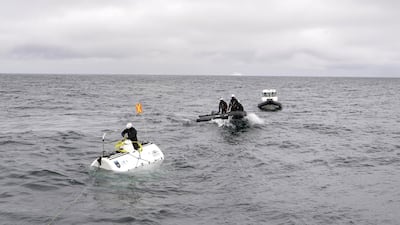
The team works in the Southern Ocean. Courtesy: The Five Deeps Expedition -
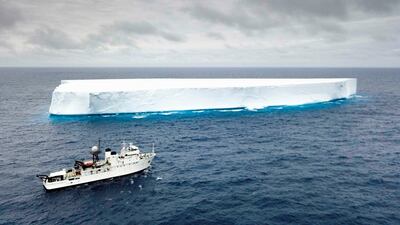
A boat sails past an Iceberg in the Southern Ocean. Courtesy: The Five Deeps Expedition -
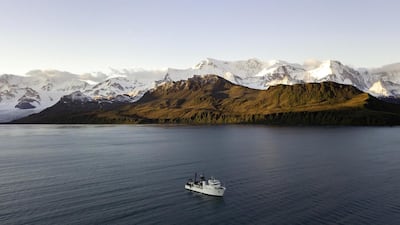
DSSV Pressure Drop sails the Southern Ocean. Courtesy: The Five Deeps Expedition -
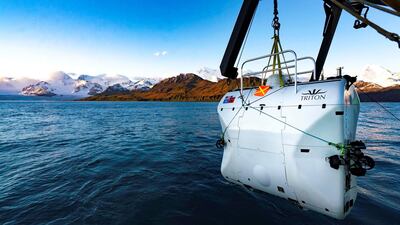
Vescovo's craft is lowered into the sea. Courtesy: The Five Deeps Expedition -
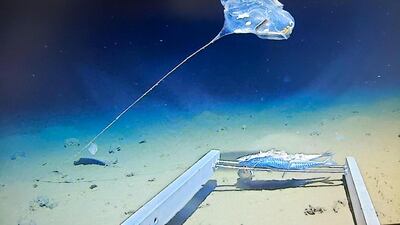
The team discovered a new species of jellyfish in the Indian Ocean. Courtesy: The Five Deeps Expedition -
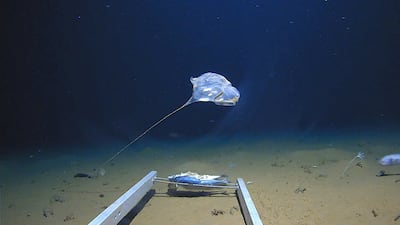
The team discovered a new species of jellyfish in the Indian Ocean. Courtesy: The Five Deeps Expedition -
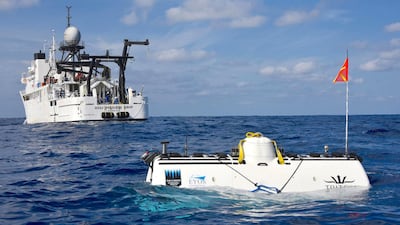
The two crafts float on the Indian Ocean. Courtesy: The Five Deeps Expedition -
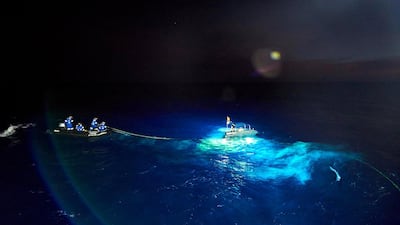
A night dive on the Pacific Ocean. Courtesy: The Five Deeps Expedition -
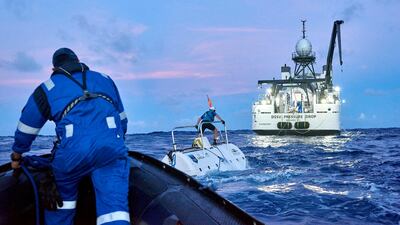
A dive on the Pacific Ocean. Courtesy: The Five Deeps Expedition -
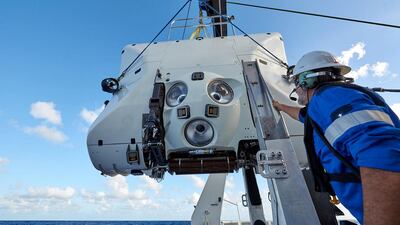
Limiting factor is lifted by DSSV's equipment. Courtesy: The Five Deeps Expedition -
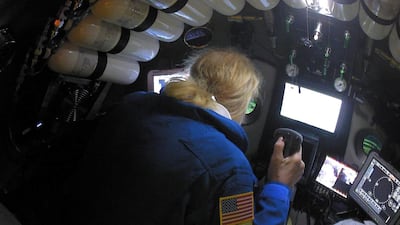
Victor Vescovo inside Limiting Factor. Courtesy: The Five Deeps Expedition



