

Construction of the UAE's first waste-to-energy plant is complete and systems testing is under way.
The plant in Sharjah is central to its plans to become the Middle East's first zero-waste city and support the UAE's 2050 net-zero goals.
The complex will turn unrecyclable waste into clean energy and ensure nothing is sent to landfill, state news agency Wam reported. Currently, about a quarter of Sharjah's waste ends up in the ground.
At full capacity, the plant will help divert up to 300,000 tonnes of unrecyclable waste each year while producing 30 megawatts of low-carbon electricity. This is enough to power 28,000 homes.
It will displace almost 450,000 tonnes of carbon dioxide a year and preserve the equivalent of 45 million cubic metres of natural gas.
The plant is the first project under Emirates Waste to Energy, a joint venture involving Beeah Energy and Masdar.
Khaled Al Huraimel, group chief executive of Beeah, said the commissioning of the plant will be a significant moment for the UAE's sustainability efforts.
“Completion of construction is an important milestone for our Emirates Waste to Energy venture as we continue to pioneer clean energy,” Mr Al Huraimel said.
“We look forward to a successful testing and commissioning phase followed by achieving full operations, which will make Sharjah the Middle East's first zero-waste city.
“We are confident that once the plant is fully operational, we will also show how waste-to-energy is an essential to sustaining the circular economy, tackling the challenge of unrecyclable waste, and serving as a more affordable, low-carbon alternative to fossil fuels.”
Mohamed Al Ramahi, chief executive of Masdar, said the facility will be central to addressing global climate change.
“We look forward to harnessing our knowledge in the growing waste-to-energy space to help tackle the global climate challenge through sustainable waste management enabled by clean energy solutions,” Mr Al Ramahi said.
How does the plant work?
The 80,000 square metre plant was built by French industrial contractor CNIM.
Unrecyclable waste is fed into a boiler to produce steam at high pressure, turning electric turbine generators.
Toxins and pollutants are filtered from the flue gases produced by the process. Bottom ash is collected to recover metals and ash material to be used in construction and roadwork, while fly ash is collected and treated separately.
Unrecyclable waste will be transported to the plant from a nearby waste management complex operated by Beeah.
On the road to net zero
-
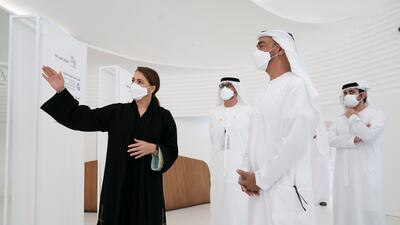
President Sheikh Mohamed, who was Crown Prince of Abu Dhabi and Deputy Supreme Commander of the Armed Forces at the time, at the launch of the UAE’s Net Zero 2050 Strategic Initiative at Expo 2020 Dubai. With him are Sheikh Maktoum bin Mohammed, Deputy Prime Minister and Minister of Finance, right, Mariam Al Mheiri, Minister for Climate Change and Environment, left, and Dr Sultan Al Jaber, Minister of Industry and Advanced Technology, chairman of Masdar and chief executive of Adnoc, second left. All photos: Ministry of Presidential Affairs -
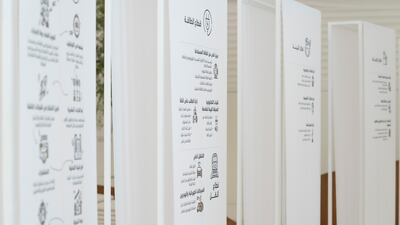
A display about the UAE’s Net Zero 2050 Strategic Initiative in the UAE pavilion at Expo 2020 Dubai. -
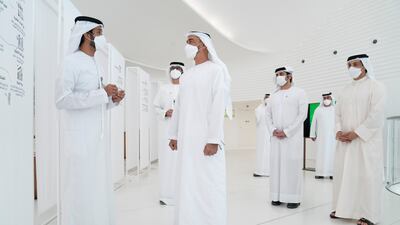
President Sheikh Mohamed, centre, in the UAE pavilion at Expo 2020 Dubai. With him are Sheikh Mansour bin Zayed, Deputy Prime Minister and Minister of Presidential Affairs, right, Sheikh Maktoum bin Mohammed, Deputy Prime Minister and Minister of Finance, second right, Dr Sultan Al Jaber, Minister of Industry and Advanced Technology, fourth right, and Abdullah Al Marri, Minister of Economy, left. -
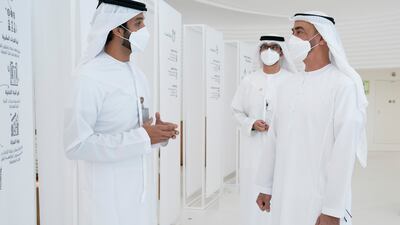
President Sheikh Mohamed, right, with Dr Sultan Al Jaber and Abdullah Al Marri, left. -
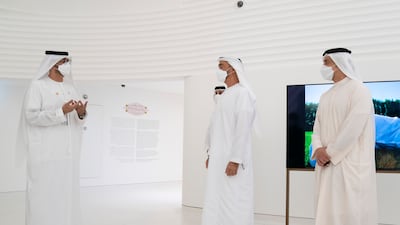
President Sheikh Mohamed, centre, at Expo 2020 Dubai with Sheikh Mansour bin Zayed, Deputy Prime Minister and Minister of Presidential Affairs, right, and Dr Sultan Al Jaber. -
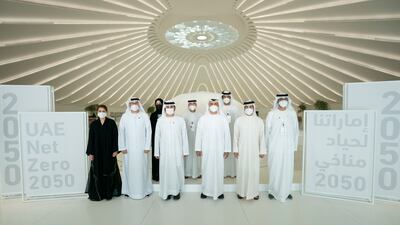
President Sheikh Mohamed, front row, third right, with: Sheikh Mansour bin Zayed, Deputy Prime Minister and Minister of Presidential Affairs, second right; Sheikh Maktoum bin Mohammed Al Maktoum, Deputy Prime Minister and Minister of Finance, fourth right; Dr Sultan Al Jaber, Minister of Industry and Advanced Technology, right; Mohamed Al Gergawi, Minister of Cabinet Affairs, fifth right; and Mariam Al Mheiri, Minister for Climate Change and Environment, left. Back row, from right to left: Abdullah Al Marri, Minister of Economy; Suhail bin Mohamed Al Mazrouei, Minister of Energy and Infrastructure; and Reem Al Hashimi, Minister of State for International Co-operation and Director General of Expo 2020 Dubai. -
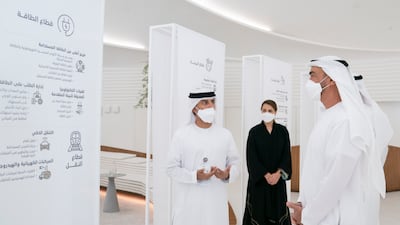
President Sheikh Mohamed with Mariam Al Mheiri and Suhail bin Mohamed Al Mazrouei.


Emirates Waste to Energy aims to open similar plants across the UAE.
“Our goal is to realise a zero-waste, clean energy future, starting with the UAE, where we are driven by the Net Zero by 2050 Strategic Initiative,” Mr Al Huraimel said.
In October, the UAE set out plans to achieve net-zero emissions by that date.
The initiative will involve Dh600 billion being invested in clean and renewable energy sources in the next three decades.
Abu Dhabi this month said it aimed to ensure no waste is sent to landfill after 2071.
The zero waste proposal, made on Thursday at an online discussion of Abu Dhabi’s conservation plans, is part of the emirate’s Environmental Centennial 2071, a 50-year timetable launched by the Environment Agency Abu Dhabi.
Officials said they planned to use satellites to track waste, open sorting centres that use artificial intelligence to separate rubbish from recyclables and use unmanned vehicles to clean the emirate’s streets.
The UAE is supporting global efforts to address climate change and will host the 28th UN global climate talks — Cop28 — in 2023.

