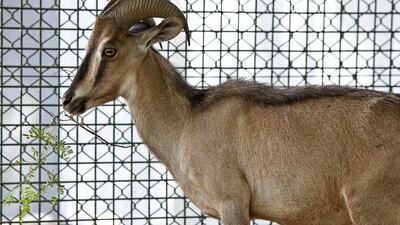
• Scimitar-horned oryx are bred at the Deleika Wildlife Management Centre in Abu Dhabi and sent to Jordan and Chad to boost the animal's wild population. All pictures: Khushnum Bhandari / The National
    Scimitar-horned oryx are bred at the Deleika Wildlife Management Centre in Abu Dhabi and sent to Jordan and Chad to boost the animal's wild population. All pictures: Khushnum Bhandari / The National
  • Ricardo Pusey, left, team manager, and Saeed Alremeithi, facility manager, work inside an enclosure at the centre.
    Ricardo Pusey, left, team manager, and Saeed Alremeithi, facility manager, work inside an enclosure at the centre.
  • Ricardo Pusey and Saeed Alremeithi manage the breeding programme at Deleika Wildlife Management Centre.
    Ricardo Pusey and Saeed Alremeithi manage the breeding programme at Deleika Wildlife Management Centre.
  • The addax is another species being conserved at the centre. The animal is critically endangered and its reintroduction into Chad has reached its second phase.
    The addax is another species being conserved at the centre. The animal is critically endangered and its reintroduction into Chad has reached its second phase.
  • Scimitar-horned oryx are part of the antelope family. Previously classified as critically endangered by the International Union for Conservation of Nature, their populations are being rehabilitated at the centre.
    Scimitar-horned oryx are part of the antelope family. Previously classified as critically endangered by the International Union for Conservation of Nature, their populations are being rehabilitated at the centre.

How animals on the brink of extinction are being saved in the Gulf


Daniel Bardsley
  • English
  • Arabic

Turn the clock back half a century and the now commonly seen Arabian oryx could hardly be found in the deserts of Abu Dhabi.

Driven to extinction in the wild by hunting, the future looked grim for an animal woven into the culture of the Arabian peninsula through poetry and paintings.

But 50 years on, the antelope with a bright white coat and magnificent ringed horns is thriving in the wild thanks to efforts spearheaded by the UAE.

It is one of many species of animals being brought back from the brink through conservation programmes across the Gulf.

Abu Dhabi's first conservation success story

More than 1,200 Arabian oryx are found in the wild, in countries including the UAE and Saudi Arabia, and thousands more live in what is described as semi-captivity.

The International Union for Conservation of Nature now classifies the animal as “vulnerable”, which is three categories up from its previous designation: “extinct in the wild”.

This is an astonishing success story over such a short period of time.

“The Arabian oryx has been the flagship for the introductions in the UAE,” says Justin Chuven, unit head of ex-situ conservation programmes at the Environment Agency Abu Dhabi.

“That population is growing quite well. There are 800 or so in the Empty Quarter [desert that stretches from the UAE into Saudi Arabia]. The source population has also been used for other reintroductions in Jordan and Oman.”

There’s nothing that can describe the feeling you get when you see these animals take their first steps on native soil in their native habitat. It is amazing
Justin Chuven,
Environment Agency Abu Dhabi

More than 10,000 of the animals can be found in the Emirates — about half of which are in Abu Dhabi. The oryx population in the Al Dhafra reserve now stands at 946, a 22 per cent increase from four years ago. Al Dhafra was home to just 160 of the animals in 2007, when the Sheikh Mohamed Bin Zayed Arabian Oryx Reintroduction Programme was established.

Although it is the most celebrated, the Arabian oryx is just one of many species, including other mammals, birds and reptiles, being bred in captivity in the Arabian peninsula for reintroduction to the wild, either here or further afield.

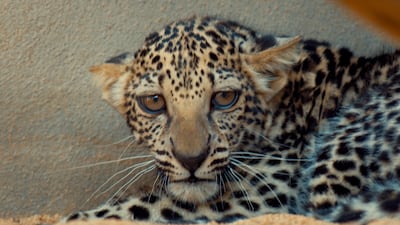
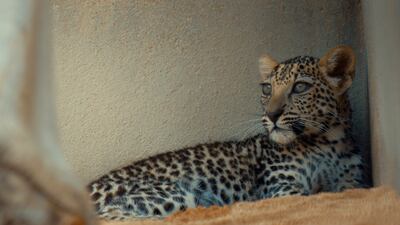
In Saudi Arabia, for example, an Arabian leopard cub was born at the Prince Saud Al Faisal Wildlife Research Centre near Taif in the south-west of the country in April. The Royal Commission for Al Ula (RCU), which runs the breeding programme, ultimately hopes to reintroduce the endangered subspecies — which is extinct in the UAE — to north-west Saudi Arabia.

How species are selected

When deciding which creatures to focus on, a central role is played by the classification system of the IUCN, a Swiss-based organisation, whose president is Razan Al Mubarak.

She is well known in the Emirates as managing director of EAD and the Mohammed bin Zayed Species Conservation Fund.

The IUCN Red List of Threatened Species places species and subspecies in one of seven categories − from “least concern” to “extinct”.

In categorising an organism, the IUCN considers how restricted the geographic range is, the population size and how it is changing, and whether studies have indicated a risk of extinction.

EAD focuses breeding and reintroduction programmes on animals in three categories: “endangered”, “critically endangered” and “extinct in the wild”.

While its Arabian oryx programme is much discussed, EAD is also part of the highly successful reintroduction programme for the scimitar-horned oryx, which remains classed as “extinct in the wild”. There are now about 375 individuals wild in the creature’s native Chad.

Breeding centres in Abu Dhabi

EAD has breeding and reintroduction programmes for two other ungulate species not native to the Arabian peninsula — the dama gazelle and the addax — and two others that are — the Arabian gazelle and the Arabian sand gazelle. The houbara bustard, a large bird native to North Africa, has also benefited from an EAD captive-breeding and reintroduction programme.

(L-R) An addax and the critically endangered Dama gazelle. Photo: Environment Agency - Abu Dhabi / Al Ain Zoo

Much of the work takes place at two breeding centres between Abu Dhabi and Al Ain, Al Faya and Deleika, the latter of which is described by Mr Chuven as being “like a big zoo, it’s just not open to the public”.

“We have a very sophisticated breeding operation going on there,” he says. “We’re breeding them in very carefully curated herds to maximise genetic diversity.

“We’ve gone through a tonne of effort to import those unique genetic differences … They all add diversity to our population and add diversity to the population that we’ve reintroduced in the wild.”

EAD has imported animals from across the US and Europe to add genetic diversity. The animals benefit from careful veterinary care, which includes disease testing and vaccination.

A day in the life at a breeding centre

EAD's conservation work is only possible because of a dedicated team of staff at their breeding centre.

Among them is Antony Shoko, the site supervisor and keeper at Deleika. Working under him are staff responsible for feeding and quarantining the animals and for veterinary care.

His is a job with considerable responsibility because under his ultimate care are more than 1,000 animals from endangered species, including the scimitar-horned oryx.

It is not a job for people who struggle to get up in the morning. Mr Shoko’s duties begin at 7am in the winter and run until 3pm. In the summer, work starts even earlier — at 6am — and continues until 2pm.

Antony Shoko, Supervisor at the Deleika Wildlife Management Centre in Abu Dhabi. Khushnum Bhandari / The National

“My first duty is to make sure everyone has reported for work on time, and we do a safety talk before we start our daily duties,” he says.

“My work continues during the day by making sure that all animals have enough food and drinking water. [Also] checking all animals in case we have had any mortality, a new calf or a sick animal.”

As well as the critical day-to-day business of feeding the animals at Deleika and ensuring that their veterinary needs are looking after, and enjoyable events, such as the arrival of a calf, Mr Shoko is also involved in the translocations.

In fact, he describes this work, which may involve sending scimitar-horned oryx to Chad, as one of the most enjoyable parts of the job.

I have developed a bond with [the animals]
Antony Shoko,
Deleika Wildlife Management Centre

Looking after animals is about more than simply carrying out a prescribed set of duties. Mr Shoko explains that it also involves trying to understand the creatures and their needs. They may not be able to talk, but there are signs that experienced keepers such as Mr Shoko are able to pick up on.

“We all know that animals do not speak, so that understanding is more important,” he says. “We make sure we give them enough food with enough nutrients.

“I have developed a bond with them because every day they know the time we give them food. If we arrive late to give them food, you see them loitering. It’s their way of telling us that today we are late with their food.”

At the end of another busy day at the centre, Mr Shoko sends a report on events to his manager — and then everything starts up again early the next morning.

How the UAE supports species repopulation abroad

Scimitar-horned oryx and addax, bred in the UAE, are also sent to Chad for release in a reserve that is about as large as the Emirates. The journey is a major undertaking: a six-to-seven hour flight on a cargo plane followed by 10 hours on bumpy roads to the reserve.

The animals are let out into acclimation pens, where they remain for several weeks recovering from the journey and getting used to the feeding habits that will sustain them when they are released.

A herd of 25 scimitar-horned Oryx from the UAE are released in their new home at the Ouadi Rime-Ouadi Achim Reserve, Chad. Photo: EAD

“The purpose of the project is to have a sustainable number of animals to be breeding by themselves,” says Mohammed Al Remeithi from EAD.

Research indicates that a population of about 500 adults of breeding age is self-sustaining, although EAD hopes to develop more precise figures.

The Covid-19 pandemic caused reintroductions to be paused, but work restarted in November and further reintroductions were carried out in December.

While breeding and reintroducing animals is always complex, Mr Chuven says it is easier with specific species.

“We are very lucky to be reintroducing herbivores,” he says. “They breed very well in captivity. Reintroducing a herbivore is a lot easier than reintroducing a carnivore.”

Herbivores have to learn where food and water can be found, but carnivores have to learn how to hunt. Also, public acceptance of carnivore introductions may not be forthcoming, especially among farmers worried about livestock being killed.

Reintroductions are not just about preserving the species or subspecies that is being set free; they also strengthen the environments into which the animals are released. Native species are less likely than livestock to eat plants down to the roots, and provide food for the likes of vultures, jackals and hyenas, depending on where releases take place.

“The young ones can be taken by jackals,” says Mr Chuven. “It’s going to create an opportunity for the ecosystem to be much more balanced and healthy.”

Sharjah’s Environment and Protected Areas Authority is another organisation breeding wildlife, including reptiles, so that the creatures can be reintroduced into their native habitats.

The conservation of wildlife and natural habitats has been a mandate across the six countries that form the Gulf Co-operation Council since the signing of a convention in 2001, that came into force in 2003.

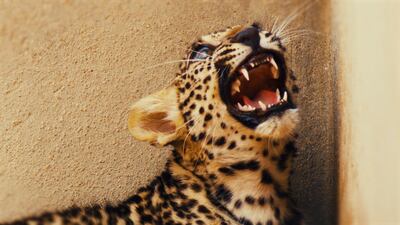
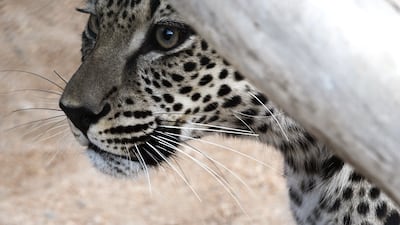
  • In a step towards conserving the endangered Arabian leopard, a cub has been born at a captive breeding centre in Saudi Arabia. All photos: Aline Coquelle
    In a step towards conserving the endangered Arabian leopard, a cub has been born at a captive breeding centre in Saudi Arabia. All photos: Aline Coquelle
  • The female cub is now five months old.
    The female cub is now five months old.
  • The Arabian leopard cub was born at the Prince Saud Al Faisal Wildlife Research Centre near Taif in south-west Saudi Arabia on April 23. The subspecies is native to the Arabian Peninsula..
    The Arabian leopard cub was born at the Prince Saud Al Faisal Wildlife Research Centre near Taif in south-west Saudi Arabia on April 23. The subspecies is native to the Arabian Peninsula..
  • The cub was checked by vets and its gender identified in mid-July.
    The cub was checked by vets and its gender identified in mid-July.
  • There are ambitious plans to reintroduce the big cats in north-west Saudi Arabia, offering hope that they could become more widespread in the wild once again.
    There are ambitious plans to reintroduce the big cats in north-west Saudi Arabia, offering hope that they could become more widespread in the wild once again.
  • Habitat loss, decline of prey species and persecution have caused numbers of Arabian leopards to fall for centuries. There are now thought to be fewer than 200 in the wild.
    Habitat loss, decline of prey species and persecution have caused numbers of Arabian leopards to fall for centuries. There are now thought to be fewer than 200 in the wild.
  • Typically slightly paler than its African cousin, the Arabian leopard is known as An Nimr Al Arabi in Arabic.
    Typically slightly paler than its African cousin, the Arabian leopard is known as An Nimr Al Arabi in Arabic.
  • Classified as critically endangered by the International Union for Conservation of Nature, the subspecies is found in the wild in Oman, Yemen and, possibly, Saudi Arabia.
    Classified as critically endangered by the International Union for Conservation of Nature, the subspecies is found in the wild in Oman, Yemen and, possibly, Saudi Arabia.

Animal conservation in Saudi Arabia

In neighbouring Saudi Arabia, efforts are under way by the RCU, to conserve the Arabian leopard.

Listed as Critically Endangered by the IUCN, the Arabian leopard's numbers in the wild have fallen to below 200 because of habitat fragmentation, hunting and the depletion of prey species.

At the its Taif centre, the organisation carefully selects breeding pairs to maximise genetic diversity, and employs vets and animal husbandry experts to help build a healthy population that can survive after reintroduction to the wild.

“The RCU are upgrading facilities at Taif, making improvements to leopard enclosures, including the addition of more furnishings, water pools and behaviour-enrichment activities,” says Emma Gallacher, the organisation’s conservation initiatives senior specialist.

On-site staff monitor the leopards and the work is guided by a technical advisory group. Their efforts were rewarded with the birth in April of the female cub. The RCU is designing and building a state-of-the-art breeding centre in Al Ula, just outside the Sharaan Nature Reserve, the area in the north-west of the country where the Arabian leopards will ultimately be released.

“The new centre will follow international best practice and include enclosures where we can see how potential candidates for reintroduction perform in a semi-wild controlled environment,” says Ms Gallacher.

While wildlife in the region continues to face threats, many organisations and their staff are committed to safeguarding threatened species and subspecies for future generations. The workers are rewarded for their efforts in ways that are difficult to quantify.

“There’s nothing that can describe the feeling you get when you see these animals take their first steps on native soil in their native habitat,” says Mr Chuven of EAD.

“You see them out there behaving naturally and you see the calves they’ve produced. It’s an amazing thing to be part of.”

Endangered species in the UAE — in pictures

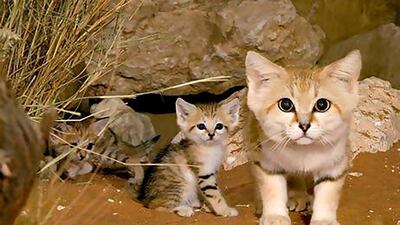
  • The sand dune cat (Felis margarita) is a nocturnal creature that lives in shallow burrows and hunts rodents. Research published in 2005 indicated that only 250 remained in Abu Dhabi emirate. Courtesy, Al Ain Zoo
    The sand dune cat (Felis margarita) is a nocturnal creature that lives in shallow burrows and hunts rodents. Research published in 2005 indicated that only 250 remained in Abu Dhabi emirate. Courtesy, Al Ain Zoo
  • The Arabian leopard is currently listed as critically endangered. Pawan Singh / The National
    The Arabian leopard is currently listed as critically endangered. Pawan Singh / The National
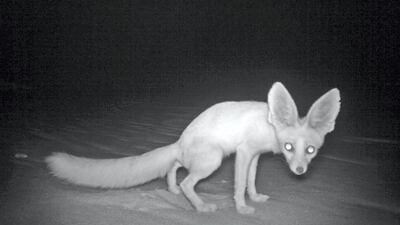
  • This is the first sighting of the rare Rüppell's fox (Vulpes rueppellii) in 13 years. Environment Agency – Abu Dhabi
    This is the first sighting of the rare Rüppell's fox (Vulpes rueppellii) in 13 years. Environment Agency – Abu Dhabi
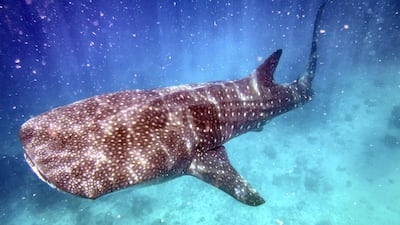
  • Whale sharks are known as jinbe zame in Japanese, inspiring their newly discovered residents' name.. Getty Images
    Whale sharks are known as jinbe zame in Japanese, inspiring their newly discovered residents' name.. Getty Images
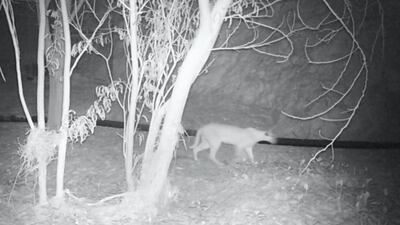
  • Arabian Caracal (Caracal caracal) - IUCN status: least concern - thought to be extinct, the environment agency captured daytime and nighttime footage of the creature for the first time since 1984. Courtesy EAD
    Arabian Caracal (Caracal caracal) - IUCN status: least concern - thought to be extinct, the environment agency captured daytime and nighttime footage of the creature for the first time since 1984. Courtesy EAD
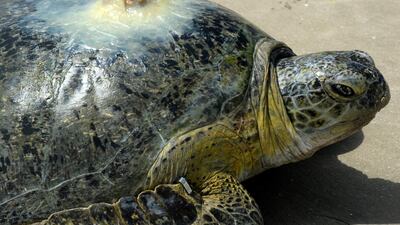
  • Green turtle (Chelonia mydas) - IUCN status: Endangered - The UAE is one of 140 countries where the green turtle is a native species; numbers have fallen worldwide - Two years ago Emirates Wildlife Society – WWF launched Gulf Green Turtle Conservation. Courtesy Paul Velasco/EWS-WWF
    Green turtle (Chelonia mydas) - IUCN status: Endangered - The UAE is one of 140 countries where the green turtle is a native species; numbers have fallen worldwide - Two years ago Emirates Wildlife Society – WWF launched Gulf Green Turtle Conservation. Courtesy Paul Velasco/EWS-WWF
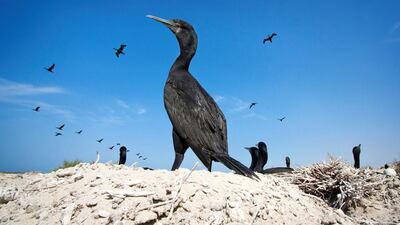
  • Socotra cormorant (Phalacrocorax nigrogularis) - IUCN status: Vulnerable - Found on islands of the coast of several Gulf states, including the UAE - Threatened by development and oil spills, the species has a total population of less than half a million. Courtesy- Rob Gubiani
    Socotra cormorant (Phalacrocorax nigrogularis) - IUCN status: Vulnerable - Found on islands of the coast of several Gulf states, including the UAE - Threatened by development and oil spills, the species has a total population of less than half a million. Courtesy- Rob Gubiani
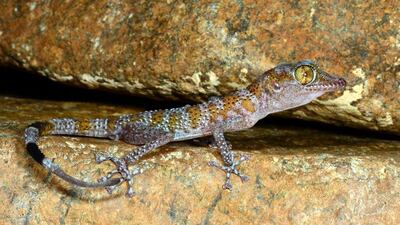
  • Emirati leaf-toed gecko (Asaccus caudivolvulus) - IUCN status: Least concern - Only found in mountainous regions of north-eastern UAE and northern Oman - More recent research suggests it actually consists of three species, one of which is unique to the UAE ‚Äì making it the country's only endemic vertebrate ‚Äì and threatened by development. Photo Courtesy: Johannes Els.
    Emirati leaf-toed gecko (Asaccus caudivolvulus) - IUCN status: Least concern - Only found in mountainous regions of north-eastern UAE and northern Oman - More recent research suggests it actually consists of three species, one of which is unique to the UAE – making it the country's only endemic vertebrate – and threatened by development. Photo Courtesy: Johannes Els.
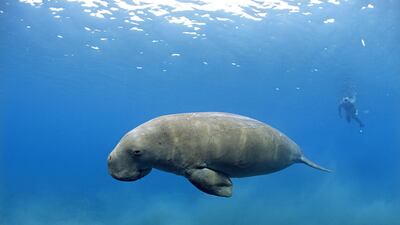
  • Sea cow (Dugong dugon) - IUCN status: Vulnerable - Locally, boat strikes and fishing net entanglement is a threat, although there are major conservation efforts - The population in UAE waters is thought to be several thousand
    Sea cow (Dugong dugon) - IUCN status: Vulnerable - Locally, boat strikes and fishing net entanglement is a threat, although there are major conservation efforts - The population in UAE waters is thought to be several thousand
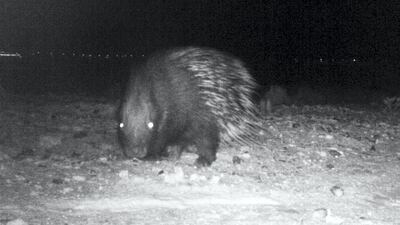
  • The Crested Porcupine, a rodent thought to be extinct in the UAE, was recorded by camera traps in Abu Dhabi. Environment Agency – Abu Dhabi
    The Crested Porcupine, a rodent thought to be extinct in the UAE, was recorded by camera traps in Abu Dhabi. Environment Agency – Abu Dhabi
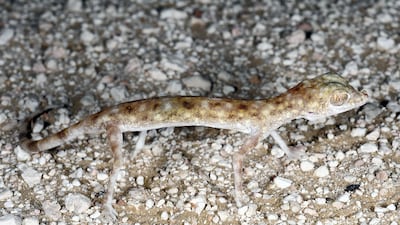
  • Gulf sand gecko (Pseudoceramodactylus khobarensis) - IUCN status: Least concern - Found widely in the Arabian peninsula, especially in the UAE - This species is not endangered but its population is declining, and in the UAE it faces threats from the development of coastal sabkha habitat. Photo courtesy-Salvador Carranza)
    Gulf sand gecko (Pseudoceramodactylus khobarensis) - IUCN status: Least concern - Found widely in the Arabian peninsula, especially in the UAE - This species is not endangered but its population is declining, and in the UAE it faces threats from the development of coastal sabkha habitat. Photo courtesy-Salvador Carranza)
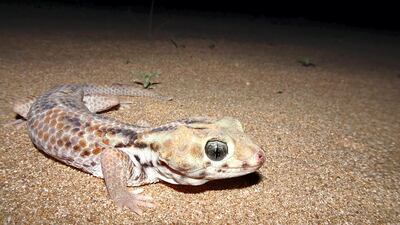
  • Keyserling's wonder gecko (Teratoscincus keyserlingii) - IUCN status: Not yet evaluated - Although this species is also found in Iran, the UAE population is the only one in Arabia - Heavily threatened by development, it could be driven to extinction locally, although the Mohamed bin Zayed Species. Pritpal Soorae / Environment Agency Abu Dhabi
    Keyserling's wonder gecko (Teratoscincus keyserlingii) - IUCN status: Not yet evaluated - Although this species is also found in Iran, the UAE population is the only one in Arabia - Heavily threatened by development, it could be driven to extinction locally, although the Mohamed bin Zayed Species. Pritpal Soorae / Environment Agency Abu Dhabi
  • Hammerhead shark (Sphyrna mokarran) - IUCN status: Endangered - Widely distributed, but threatened by fishing for its fins and as accidental bycatch - Numbers have plummeted by four-fifths over the last quarter of a century. Image by © Norbert Wu/Science Faction/Corbis
    Hammerhead shark (Sphyrna mokarran) - IUCN status: Endangered - Widely distributed, but threatened by fishing for its fins and as accidental bycatch - Numbers have plummeted by four-fifths over the last quarter of a century. Image by © Norbert Wu/Science Faction/Corbis
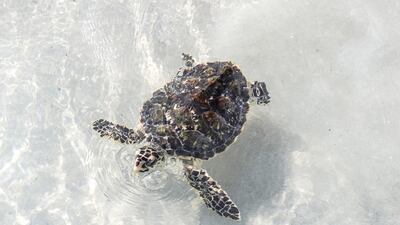
  • Hawksbill turtles, rated as Critically endangered on the International Union for Conservation of Nature Red List of Threatened Species, have begun laying their eggs on a beach in Dubai. Antonie Robertson / The National
    Hawksbill turtles, rated as Critically endangered on the International Union for Conservation of Nature Red List of Threatened Species, have begun laying their eggs on a beach in Dubai. Antonie Robertson / The National
  • Arabian tahr (Arabitragus jayakari) - IUCN status: Endangered - Restricted to mountainous regions of north-eastern UAE and northern Oman - Worldwide population is probably below 5,000. ANTONIE ROBERTSON / The National
    Arabian tahr (Arabitragus jayakari) - IUCN status: Endangered - Restricted to mountainous regions of north-eastern UAE and northern Oman - Worldwide population is probably below 5,000. ANTONIE ROBERTSON / The National
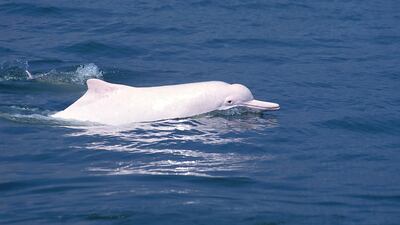
  • Indian Ocean humpback dolphin (Sousa plumbea) - IUCN status: Endangered - Often become entangled in fishing nets - A recent census found 701 individuals, so the waters off Abu Dhabi have the world's largest single population. Roland Seitre / Minden
    Indian Ocean humpback dolphin (Sousa plumbea) - IUCN status: Endangered - Often become entangled in fishing nets - A recent census found 701 individuals, so the waters off Abu Dhabi have the world's largest single population. Roland Seitre / Minden
  • The semaphore gecko is one of several species we have learned a great deal about in recent years. Getty Images
    The semaphore gecko is one of several species we have learned a great deal about in recent years. Getty Images
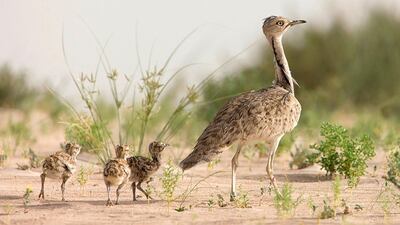
  • The Houbara bustard is classified as a vulnerable species by the International Union for Conservation of Nature. Courtesy International Fund For Houbara Conservation
    The Houbara bustard is classified as a vulnerable species by the International Union for Conservation of Nature. Courtesy International Fund For Houbara Conservation
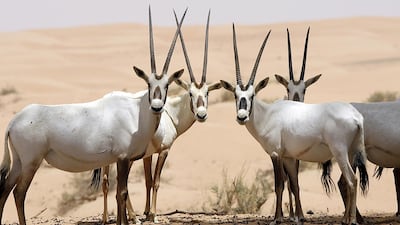
  • Arabian oryx (Oryx leucoryx) - IUCN status: Vulnerable - Formerly listed as endangered, the UAE's reintroduction programme has helped to increase numbers - The wild population is about 1,200, just over half of which are UAE reintroduced individuals. Mike Young / The National
    Arabian oryx (Oryx leucoryx) - IUCN status: Vulnerable - Formerly listed as endangered, the UAE's reintroduction programme has helped to increase numbers - The wild population is about 1,200, just over half of which are UAE reintroduced individuals. Mike Young / The National
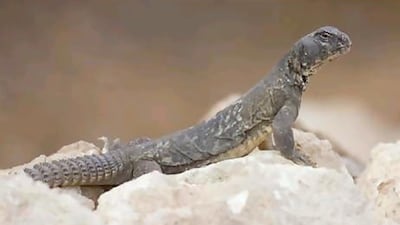
  • Egyptian spiny-tailed lizard (Uromastyx aegyptia) - IUCN status: Vulnerable - Found in much of the Middle East in gravelly and stony areas, but numbers have declined - Two sub-species exist in the UAE, where it is threatened by habitat loss
    Egyptian spiny-tailed lizard (Uromastyx aegyptia) - IUCN status: Vulnerable - Found in much of the Middle East in gravelly and stony areas, but numbers have declined - Two sub-species exist in the UAE, where it is threatened by habitat loss
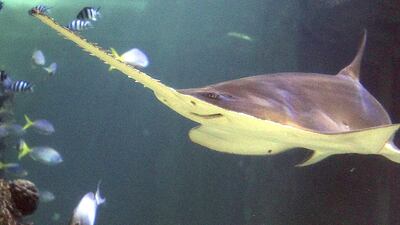
  • Green sawfish (Pristis zijsron) - IUCN status: Critically endangered - The largest sawfish, it can reach up to seven metres in length - This coastal species has declined across its range and has become extinct from some countries. AP Photo
    Green sawfish (Pristis zijsron) - IUCN status: Critically endangered - The largest sawfish, it can reach up to seven metres in length - This coastal species has declined across its range and has become extinct from some countries. AP Photo
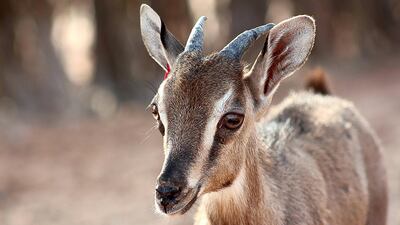
  • The Arabian tahr has been categorised as an endangered species, with a global population of less than 5,000. Courtesy TDIC
    The Arabian tahr has been categorised as an endangered species, with a global population of less than 5,000. Courtesy TDIC
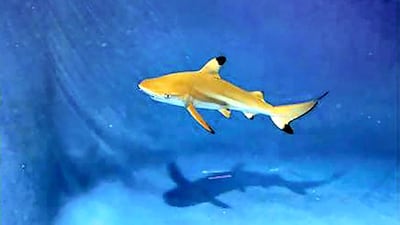
  • Blacktip reef shark (Carcharhinus melanopterus) - IUCN status: Near threatened - Populations have suffered because of fishing - This species was spotted this year off the UAE's east coast
    Blacktip reef shark (Carcharhinus melanopterus) - IUCN status: Near threatened - Populations have suffered because of fishing - This species was spotted this year off the UAE's east coast
How to help

Donate towards food and a flight by transferring money to this registered charity's account.

Account name: Dar Al Ber Society

Account Number: 11 530 734

IBAN: AE 9805 000 000 000 11 530 734

Bank Name: Abu Dhabi Islamic Bank

To ensure that your contribution reaches these people, please send the copy of deposit/transfer receipt to: juhi.khan@daralber.ae

Results

2pm: Handicap (PA) Dh80,000 1,600m; Winner: AF Al Baher, Bernardo Pinheiro (jockey), Ernst Oertel (trainer).

2.30pm: Handicap (TB) Dh100,000 1,600m; Winner: Talento Puma, Xavier Ziani, Salem bin Ghadayer.

3pm: Handicap (TB) Dh90,000 1,950m; Winner: Tailor’s Row, Royston Ffrench, Salem bin Ghadayer.

3.30pm: Jebel Ali Stakes Listed (TB) Dh500,000 1,950m; Winner: Mark Of Approval, Patrick Cosgrave, Mahmood Hussain.

4pm: Conditions (TB) Dh125,000 1,400m; Winner: Dead-heat Raakez, Jim Crowley, Nicholas Bachalard/Attribution, Xavier Ziani, Salem bin Ghadayer.

4.30pm: Jebel Ali Sprint (TB) Dh500,000 1,000m; Winner: AlKaraama, Antonio Fresu, Musabah Al Muhairi.

5pm: Handicap (TB) Dh100,000 1,200m; Winner: Wafy, Richard Mullen, Satish Seemar.

5.30pm: Handicap (TB) Dh90,000 1,400m; Winner: Cachao, Tadhg O’Shea, Satish Seemar.

Jetour T1 specs

Engine: 2-litre turbocharged

Power: 254hp

Torque: 390Nm

Price: From Dh126,000

Available: Now

The National's picks

4.35pm: Tilal Al Khalediah
5.10pm: Continous
5.45pm: Raging Torrent
6.20pm: West Acre
7pm: Flood Zone
7.40pm: Straight No Chaser
8.15pm: Romantic Warrior
8.50pm: Calandogan
9.30pm: Forever Young

'Panga'

Directed by Ashwiny Iyer Tiwari

Starring Kangana Ranaut, Richa Chadha, Jassie Gill, Yagya Bhasin, Neena Gupta

Rating: 3.5/5

VEZEETA PROFILE

Date started: 2012

Founder: Amir Barsoum

Based: Dubai, UAE

Sector: HealthTech / MedTech

Size: 300 employees

Funding: $22.6 million (as of September 2018)

Investors: Technology Development Fund, Silicon Badia, Beco Capital, Vostok New Ventures, Endeavour Catalyst, Crescent Enterprises’ CE-Ventures, Saudi Technology Ventures and IFC

Who has lived at The Bishops Avenue?
  • George Sainsbury of the supermarket dynasty, sugar magnate William Park Lyle and actress Dame Gracie Fields were residents in the 1930s when the street was only known as ‘Millionaires’ Row’.
  • Then came the international super rich, including the last king of Greece, Constantine II, the Sultan of Brunei and Indian steel magnate Lakshmi Mittal who was at one point ranked the third richest person in the world.
  • Turkish tycoon Halis Torprak sold his mansion for £50m in 2008 after spending just two days there. The House of Saud sold 10 properties on the road in 2013 for almost £80m.
  • Other residents have included Iraqi businessman Nemir Kirdar, singer Ariana Grande, holiday camp impresario Sir Billy Butlin, businessman Asil Nadir, Paul McCartney’s former wife Heather Mills. 
Hunting park to luxury living
  • Land was originally the Bishop of London's hunting park, hence the name
  • The road was laid out in the mid 19th Century, meandering through woodland and farmland
  • Its earliest houses at the turn of the 20th Century were substantial detached properties with extensive grounds


ALRAWABI%20SCHOOL%20FOR%20GIRLS
%3Cp%3ECreator%3A%20Tima%20Shomali%3C%2Fp%3E%0A%3Cp%3EStarring%3A%C2%A0Tara%20Abboud%2C%C2%A0Kira%20Yaghnam%2C%20Tara%20Atalla%3C%2Fp%3E%0A%3Cp%3ERating%3A%204%2F5%3C%2Fp%3E%0A
Company profile

Name: Back to Games and Boardgame Space

Started: Back to Games (2015); Boardgame Space (Mark Azzam became co-founder in 2017)

Founder: Back to Games (Mr Azzam); Boardgame Space (Mr Azzam and Feras Al Bastaki)

Based: Dubai and Abu Dhabi 

Industry: Back to Games (retail); Boardgame Space (wholesale and distribution) 

Funding: Back to Games: self-funded by Mr Azzam with Dh1.3 million; Mr Azzam invested Dh250,000 in Boardgame Space  

Growth: Back to Games: from 300 products in 2015 to 7,000 in 2019; Boardgame Space: from 34 games in 2017 to 3,500 in 2019

Yahya Al Ghassani's bio

Date of birth: April 18, 1998

Playing position: Winger

Clubs: 2015-2017 – Al Ahli Dubai; March-June 2018 – Paris FC; August – Al Wahda

The 12 Syrian entities delisted by UK 

Ministry of Interior
Ministry of Defence
General Intelligence Directorate
Air Force Intelligence Agency
Political Security Directorate
Syrian National Security Bureau
Military Intelligence Directorate
Army Supply Bureau
General Organisation of Radio and TV
Al Watan newspaper
Cham Press TV
Sama TV

UAE currency: the story behind the money in your pockets
Indika
%3Cp%3E%3Cstrong%3EDeveloper%3A%3C%2Fstrong%3E%2011%20Bit%20Studios%3Cbr%3E%3Cstrong%3EPublisher%3A%3C%2Fstrong%3E%20Odd%20Meter%3Cbr%3E%3Cstrong%3EConsole%3A%3C%2Fstrong%3E%20PlayStation%205%2C%20PC%20and%20Xbox%20series%20X%2FS%3Cbr%3E%3Cstrong%3ERating%3A%3C%2Fstrong%3E%204%2F5%3C%2Fp%3E%0A
Emiratisation at work

Emiratisation was introduced in the UAE more than 10 years ago

It aims to boost the number of citizens in the workforce particularly in the private sector.

Growing the number of Emiratis in the workplace will help the UAE reduce dependence on overseas workers

The Cabinet in December last year, approved a national fund for Emirati jobseekers and guaranteed citizens working in the private sector a comparable pension

President Sheikh Khalifa has described Emiratisation as “a true measure for success”.

During the UAE’s 48th National Day, Sheikh Khalifa named education, entrepreneurship, Emiratisation and space travel among cornerstones of national development

More than 80 per cent of Emiratis work in the federal or local government as per 2017 statistics

The Emiratisation programme includes the creation of 20,000 new jobs for UAE citizens

UAE citizens will be given priority in managerial positions in the government sphere

The purpose is to raise the contribution of UAE nationals in the job market and create a diverse workforce of citizens

How to protect yourself when air quality drops

Install an air filter in your home.

Close your windows and turn on the AC.

Shower or bath after being outside.

Wear a face mask.

Stay indoors when conditions are particularly poor.

If driving, turn your engine off when stationary.

The%20team
%3Cp%3E%0DFashion%20director%3A%20Sarah%20Maisey%0D%3Cbr%3EPhotographer%3A%20Greg%20Adamski%0D%3Cbr%3EHair%20and%20make-up%3A%20Ania%20Poniatowska%0D%3Cbr%3EModels%3A%20Nyajouk%20and%20Kristine%20at%20MMG%2C%20and%20Mitchell%0D%3Cbr%3EStylist%E2%80%99s%20assistants%3A%20Nihala%20Naval%20and%20Sneha%20Maria%20Siby%0D%3Cbr%3EVideographer%3A%20Nilanjana%20Gupta%3C%2Fp%3E%0A
Ultra processed foods

- Carbonated drinks, sweet or savoury packaged snacks, confectionery, mass-produced packaged breads and buns 

- margarines and spreads; cookies, biscuits, pastries, cakes, and cake mixes, breakfast cereals, cereal and energy bars;

- energy drinks, milk drinks, fruit yoghurts and fruit drinks, cocoa drinks, meat and chicken extracts and instant sauces

- infant formulas and follow-on milks, health and slimming products such as powdered or fortified meal and dish substitutes,

- many ready-to-heat products including pre-prepared pies and pasta and pizza dishes, poultry and fish nuggets and sticks, sausages, burgers, hot dogs, and other reconstituted meat products, powdered and packaged instant soups, noodles and desserts.

Ziina users can donate to relief efforts in Beirut

Ziina users will be able to use the app to help relief efforts in Beirut, which has been left reeling after an August blast caused an estimated $15 billion in damage and left thousands homeless. Ziina has partnered with the United Nations High Commissioner for Refugees to raise money for the Lebanese capital, co-founder Faisal Toukan says. “As of October 1, the UNHCR has the first certified badge on Ziina and is automatically part of user's top friends' list during this campaign. Users can now donate any amount to the Beirut relief with two clicks. The money raised will go towards rebuilding houses for the families that were impacted by the explosion.”

Groom and Two Brides

Director: Elie Semaan

Starring: Abdullah Boushehri, Laila Abdallah, Lulwa Almulla

Rating: 3/5

BAD%20BOYS%3A%20RIDE%20OR%20DIE
%3Cp%3E%3Cstrong%3EDirector%3A%3C%2Fstrong%3E%20Adil%20El%20Arbi%20and%20Bilall%20Fallah%3C%2Fp%3E%0A%3Cp%3E%3Cstrong%3EStarring%3A%20%3C%2Fstrong%3EWill%20Smith%2C%20Martin%20Lawrence%2C%20Joe%20Pantoliano%3C%2Fp%3E%0A%3Cp%3E%3Cstrong%3ERating%3A%3C%2Fstrong%3E%203.5%2F5%3C%2Fp%3E%0A
Second ODI

England 322-7 (50 ovs)
India 236 (50 ovs)

England win by 86 runs

Next match: Tuesday, July 17, Headingley 

Dhadak 2

Director: Shazia Iqbal

Starring: Siddhant Chaturvedi, Triptii Dimri 

Rating: 1/5

Confirmed%20bouts%20(more%20to%20be%20added)
%3Cp%3ECory%20Sandhagen%20v%20Umar%20Nurmagomedov%0D%3Cbr%3ENick%20Diaz%20v%20Vicente%20Luque%0D%3Cbr%3EMichael%20Chiesa%20v%20Tony%20Ferguson%0D%3Cbr%3EDeiveson%20Figueiredo%20v%20Marlon%20Vera%0D%3Cbr%3EMackenzie%20Dern%20v%20Loopy%20Godinez%0D%3Cbr%3E%3C%2Fp%3E%0A%3Cp%3ETickets%20for%20the%20August%203%20Fight%20Night%2C%20held%20in%20partnership%20with%20the%20Department%20of%20Culture%20and%20Tourism%20Abu%20Dhabi%2C%20went%20on%20sale%20earlier%20this%20month%2C%20through%20www.etihadarena.ae%20and%20www.ticketmaster.ae.%0D%3Cbr%3E%3C%2Fp%3E%0A
Grand Slam Los Angeles results

Men:
56kg – Jorge Nakamura
62kg – Joao Gabriel de Sousa
69kg – Gianni Grippo
77kg – Caio Soares
85kg – Manuel Ribamar
94kg – Gustavo Batista
110kg – Erberth Santos

Women:
49kg – Mayssa Bastos
55kg – Nathalie Ribeiro
62kg – Gabrielle McComb
70kg – Thamara Silva
90kg – Gabrieli Pessanha

Founders: Abdulmajeed Alsukhan, Turki Bin Zarah and Abdulmohsen Albabtain.

Based: Riyadh

Offices: UAE, Vietnam and Germany

Founded: September, 2020

Number of employees: 70

Sector: FinTech, online payment solutions

Funding to date: $116m in two funding rounds  

Investors: Checkout.com, Impact46, Vision Ventures, Wealth Well, Seedra, Khwarizmi, Hala Ventures, Nama Ventures and family offices

Ruwais timeline

1971 Abu Dhabi National Oil Company established

1980 Ruwais Housing Complex built, located 10 kilometres away from industrial plants

1982 120,000 bpd capacity Ruwais refinery complex officially inaugurated by the founder of the UAE Sheikh Zayed

1984 Second phase of Ruwais Housing Complex built. Today the 7,000-unit complex houses some 24,000 people.  

1985 The refinery is expanded with the commissioning of a 27,000 b/d hydro cracker complex

2009 Plans announced to build $1.2 billion fertilizer plant in Ruwais, producing urea

2010 Adnoc awards $10bn contracts for expansion of Ruwais refinery, to double capacity from 415,000 bpd

2014 Ruwais 261-outlet shopping mall opens

2014 Production starts at newly expanded Ruwais refinery, providing jet fuel and diesel and allowing the UAE to be self-sufficient for petrol supplies

2014 Etihad Rail begins transportation of sulphur from Shah and Habshan to Ruwais for export

2017 Aldar Academies to operate Adnoc’s schools including in Ruwais from September. Eight schools operate in total within the housing complex.

2018 Adnoc announces plans to invest $3.1 billion on upgrading its Ruwais refinery 

2018 NMC Healthcare selected to manage operations of Ruwais Hospital

2018 Adnoc announces new downstream strategy at event in Abu Dhabi on May 13

Source: The National

While you're here

Expert input

If you had all the money in the world, what’s the one sneaker you would buy or create?

“There are a few shoes that have ‘grail’ status for me. But the one I have always wanted is the Nike x Patta x Parra Air Max 1 - Cherrywood. To get a pair in my size brand new is would cost me between Dh8,000 and Dh 10,000.” Jack Brett

“If I had all the money, I would approach Nike and ask them to do my own Air Force 1, that’s one of my dreams.” Yaseen Benchouche

“There’s nothing out there yet that I’d pay an insane amount for, but I’d love to create my own shoe with Tinker Hatfield and Jordan.” Joshua Cox

“I think I’d buy a defunct footwear brand; I’d like the challenge of reinterpreting a brand’s history and changing options.” Kris Balerite

 “I’d stir up a creative collaboration with designers Martin Margiela of the mixed patchwork sneakers, and Yohji Yamamoto.” Hussain Moloobhoy

“If I had all the money in the world, I’d live somewhere where I’d never have to wear shoes again.” Raj Malhotra

White hydrogen: Naturally occurring hydrogenChromite: Hard, metallic mineral containing iron oxide and chromium oxideUltramafic rocks: Dark-coloured rocks rich in magnesium or iron with very low silica contentOphiolite: A section of the earth’s crust, which is oceanic in nature that has since been uplifted and exposed on landOlivine: A commonly occurring magnesium iron silicate mineral that derives its name for its olive-green yellow-green colour

Profile of Udrive

Date started: March 2016

Founder: Hasib Khan

Based: Dubai

Employees: 40

Amount raised (to date): $3.25m – $750,000 seed funding in 2017 and a Seed round of $2.5m last year. Raised $1.3m from Eureeca investors in January 2021 as part of a Series A round with a $5m target.

Generation Start-up: Awok company profile

Started: 2013

Founder: Ulugbek Yuldashev

Sector: e-commerce

Size: 600 plus

Stage: still in talks with VCs

Principal Investors: self-financed by founder

THE BIO

Born: Mukalla, Yemen, 1979

Education: UAE University, Al Ain

Family: Married with two daughters: Asayel, 7, and Sara, 6

Favourite piece of music: Horse Dance by Naseer Shamma

Favourite book: Science and geology

Favourite place to travel to: Washington DC

Best advice you’ve ever been given: If you have a dream, you have to believe it, then you will see it.

Desert Warrior

Starring: Anthony Mackie, Aiysha Hart, Ben Kingsley

Director: Rupert Wyatt

Rating: 3/5

The nine articles of the 50-Year Charter

1. Dubai silk road

2.  A geo-economic map for Dubai

3. First virtual commercial city

4. A central education file for every citizen

5. A doctor to every citizen

6. Free economic and creative zones in universities

7. Self-sufficiency in Dubai homes

8. Co-operative companies in various sectors

­9: Annual growth in philanthropy

WHEN TO GO:

September to November or March to May; this is when visitors are most likely to see what they’ve come for.

WHERE TO STAY:

Meghauli Serai, A Taj Safari - Chitwan National Park resort (tajhotels.com) is a one-hour drive from Bharatpur Airport with stays costing from Dh1,396 per night, including taxes and breakfast. Return airport transfers cost from Dh661.

HOW TO GET THERE:

Etihad Airways regularly flies from Abu Dhabi to Kathmandu from around Dh1,500 per person return, including taxes. Buddha Air (buddhaair.com) and Yeti Airlines (yetiairlines.com) fly from Kathmandu to Bharatpur several times a day from about Dh660 return and the flight takes just 20 minutes. Driving is possible but the roads are hilly which means it will take you five or six hours to travel 148 kilometres.

OPTA'S PREDICTED TABLE

1. Liverpool 101 points

2. Manchester City 80 

3. Leicester 67

4. Chelsea 63

5. Manchester United 61

6. Tottenham 58

7. Wolves 56

8. Arsenal 56

9. Sheffield United 55

10. Everton 50

11. Burnley 49

12. Crystal Palace 49

13. Newcastle 46

14. Southampton 44

15. West Ham 39

16. Brighton 37

17. Watford 36

18. Bournemouth 36

19. Aston Villa 32

20. Norwich City 29


Short-term let permits explained

Homeowners and tenants are allowed to list their properties for rental by registering through the Dubai Tourism website to obtain a permit.

Tenants also require a letter of no objection from their landlord before being allowed to list the property.

There is a cost of Dh1,590 before starting the process, with an additional licence fee of Dh300 per bedroom being rented in your home for the duration of the rental, which ranges from three months to a year.

Anyone hoping to list a property for rental must also provide a copy of their title deeds and Ejari, as well as their Emirates ID.

Updated: January 24, 2022, 10:49 AM