

More UAE students have enrolled in local branches of international colleges this year, shunning their US and the UK campuses, heads of admissions in universities in the Emirates said.
The drop in the number of students going overseas is largely a result of uncertainty caused by the coronavirus pandemic.
Campuses of international universities in the UAE have reported an increase in domestic enrolment this year.
“We had our highest summer intake in seven years, in the midst of a global pandemic and recession," said Brendan Vyner, director of marketing and student recruitment at University of Wollongong in Dubai.
The university's summer enrolment numbers increased by 23 per cent when compared to the same time last year. Last year, 3,313 students were enrolled at the university.
Students choosing to study closer to home
The fear of being away from family if travel restrictions are imposed and impending lockdowns in countries such as the UK have affected students’ plans for international education.
“With major international education destinations such as the US, UK, Canada and Australia being closed or heavily restricted to international students, we are seeing increased demand from students who are interested in studying at an international university closer to home,” said Mr Vyner.
“The uncertainty caused by Covid-19 has made people wary of international travel, and in some cases removed the option completely.
“This has left many students who would have travelled abroad stranded and not willing to wait for one more year to decide on their future."
Recruitment officers at universities said they faced difficulties brought on by the pandemic but that that situation also provided the education sector in the UAE with opportunities.

“The major boost we saw was increased demand from our domestic sector, where 60,000 students who regularly travel abroad are potentially stuck in Dubai and are unable to attend universities in the US, UK or Australia,” said Mr Vyner.
Carl Casey, recruitment counsellor at Rochester Institute of Technology Dubai (RITD), reported a 25 per cent increase in summer enrolment numbers compared with last year.
“More students have elected to stay within the UAE for further education due to the on-going impact of Covid-19," he said.
Last year, the university admitted 849 students.
Close to half of the university’s students, 46 per cent, come from the Mena region, and 15 per cent are Emiratis.
-
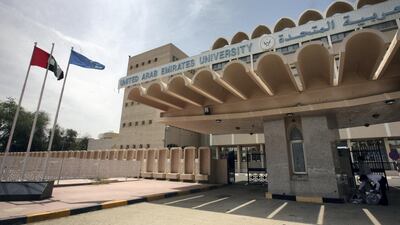
United Arab Emirates University in Al Ain has a strong standing in research and offers one of the country's main medicine degrees. Randi Sokoloff / The National -
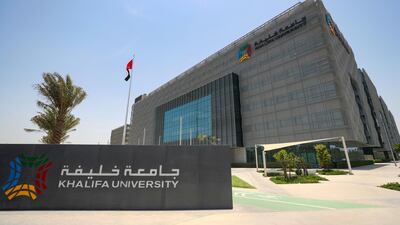
Khalifa University has rapidly climbed the global rankings in recent years but was knocked off the UAE top spot this year by UAEU. It boasts a nuclear engineering school staffed by top nuclear scientists, many of them from South Korea. Chris Whiteoak / The National -
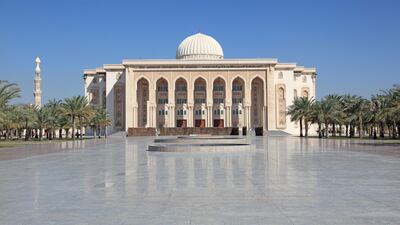
With its its striking architecture, American University of Sharjah offers about two dozen major degrees including humanities, engineering and business to about 5,000 students. It often scores strongly in global rankings and is particularly popular with Arab expat students. Alamy Photo -
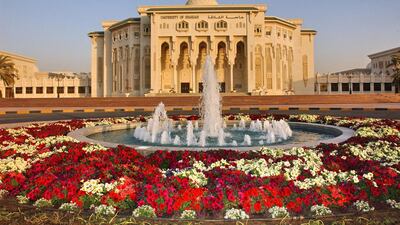
University of Sharjah was established in 1997 and is one of the country's largest, with about 14,000 students enroled. It also has campuses in the town of Dhaid and in Kalba, in Sharjah's east coast enclave. Wikicommons


The University of Birmingham in Dubai also reported an increase in the number of applications.
“We had a noticeable number of increased applications in the UAE, which is demonstrating that a lot of UAE students are not looking to travel overseas,” said Chris Taylor, senior recruitment manager for the University of Birmingham Dubai.
"They are starting to recognise the options that they have here and are staying to study.
“Our largest increase is from within the UAE and we have seen a 20 per cent increase."
Mr Taylor said students felt they had lost out on the last few months of their education and did not want to lose more.
The University of Birmingham in Dubai has about 100 first year students and double that in their second year.
Studying abroad: Perspectives of UAE students
Some students were unable to go abroad for higher studies because of financial constraints and others stayed because of travel restrictions.
Kareem Hany, a 17-year-old Egyptian student in Dubai, wanted to study at the University of Manitoba in Canada but decided to look for options closer to home when the pandemic struck.
Mr Hany, a first-year electrical engineering student at RITD, spoke of his relief at staying in the Emirates.

“With the coronavirus outbreak, I think the UAE handled it better than Canada," he said.
“Things were already going into lockdown at the time, so I decided to stay back here and study in the UAE."
Mr Hany spoke of his fear of being outside the country if travel restrictions were imposed.
“My family is in the UAE and staying far from home during such a time was not the best option,” he said.
“Many of my friends who wanted to study abroad also stayed back.”
Mr Hany was one of many students who won a scholarship.
The financial aid was an important factor in his decision.
He planned to study at one of RIT’s campuses in the US or China for a term.
“There were always good quality education offerings in the UAE but some students had dreams of studying abroad because they wanted to live independently,” he said.
“For me, the pandemic made the decision to stay in the UAE easier.”
Students still keen on exchange programmes
Students at UAE campuses of international universities will still have the option to go abroad for a term or a year.
At the University of Birmingham in Dubai, students can go to the UK for a time.
The academic requirements and fees at campuses in the UAE and the UK remain the same, but students have scholarships based on their academic achievements in the UAE.
-
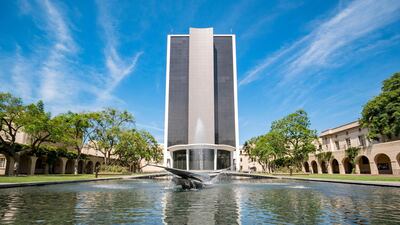
California Institute of Technology, known as Caltech, is renowned for its engineering and natural science schools. It counts tycoon and aviation pioneer Howard Hughes and the legendary filmmaker Frank Capra among its alumni. It is home to just 2,000 students, making it one of the smallest major universities. Alamy Stock Photo -

Located in the heart of Silicon Valley, Stanford was founded in 1885 by Jane and Leland Stanford. Its alumni boasts 19 Nobel laureates and 17 astronauts. Herbert Hoover, the 31st president of the US, was part of the first class. Alamy Stock Photo -

Based in the city of Cambridge, Massachusetts, MIT is among the world's best technology universities, offering digital learning, sustainable energy, big data, human health and more. It is home to about 1,000 faculty members and more than 11,000 undergraduate and graduate students. MIT says its alumni-founded companies have created 4.6 million jobs, generating nearly $2 trillion in annual revenues. Taken together, this ‘MIT Nation’ is equivalent, it is claimed, to the 10th-largest economy in the world. Alamy Stock Photo -

Dating back to 1636, Harvard is the oldest university in the US and has connections to more than 30 heads of state. Situated in Cambridge, Massachusetts, its 5,000-acre campus houses 12 degree-granting schools and about three-quarters of its roughly 22,000 students are postgrads. Its renowned medical school is connected to 10 hospitals at which students get hands-on experience. Harvard boasts the largest academic library in the world, with 20.4 million volumes and 10 million photographs. Alamy Stock Photo -
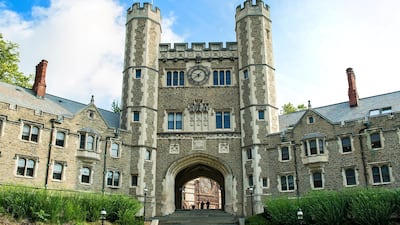
The ultimate Ivy League university, Princeton's park-like New Jersey campus is home to about 10,000 students. Unusually, it offers residential accommodation to all of its undergraduates across all four years of study, with 98 per cent of its 10,000 students living on site. Its prestigious alumni include Michelle Obama, actor Jimmy Stewart and the economist Paul Krugman. Alamy Stock Photo -

Based in New Haven Connecticut, Yale dates back to 1701 and has educated five US presidents: William Howard Taft, Gerald Ford, George H W Bush, Bill Clinton and George W Bush. Unusually for the US, students are housed in residential colleges on the model of Oxford and Cambridge. Many of its Yale's buildings date back to the 18th century Alamy Stock Photo -
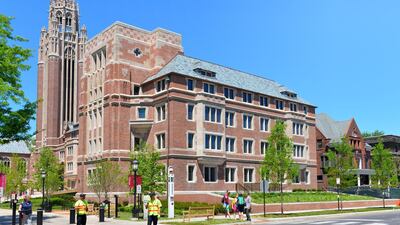
Home to the Obama presidential library and offices of the Obama Foundation, University of Chicago is located on a 200-acre campus in the city's Hyde Park neighbourhood, near Lake Michigan. Known as UChicago, it boasts about 16,000 undergrads and postgrads. Its business school is ranked as No1 in the world by The Economist, while the New York Times found its graduates were among the most sought after in the corporate world. Alamy -

In the top spot for the fourth year is Oxford university, recognisable worldwide for its medieval skyline. It boasts 39 separate colleges and six private hall - some of the most famous are Christ Church, Balliol College and Magdalen - offering virtually every subject in academic study to its 24,000 students. Over the centuries successful graduates have bequeathed fortunes to individual colleges, meaning some boast endowments of hundreds of millions of pounds each. Alamy -

Established by King Henry III in 1231, like Oxford, Cambridge is one of two ancient seats of learning. It is home to about 20,000 students and is recognisable for the 'punts' or boats that sail up and down its river. Many of its brightest technology graduates go on to work in start-ups in a high-tech business district known as 'Silicon Fen'. AFP -

Imperial College excels in science, engineering, medicine and business and many of its 15,000 students per year go on to top jobs in industry. Famous alumni include science fiction author HG Wells, Queen guitarist Brian May, and former prime minister of India Rajiv Gandhi. Imperial’s most notable landmark is the Queen's Tower, a remainder of the Imperial Institute, built to mark Queen Victoria's Golden Jubilee in 1887. Alamy Stock Photo


"Students could also complete their first year in the UAE, and if they were always planning to go to the UK, we can help them go across to the UK campus in the second year," said Mr Taylor.
At the University of Wollongong in Dubai, the university can accept students in Dubai and then transfer them to Australia, Hong Kong or Malaysia next year once travel restrictions ease.

