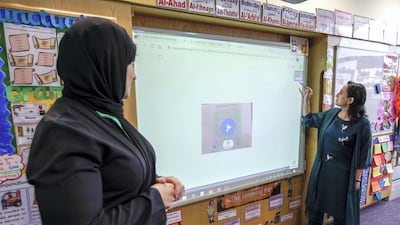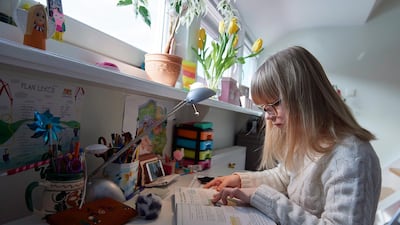
Aisha Siddiqui has established a peer mentorship initiative to help pupils falling behind in studies. Reem Mohammed/The National

UAE pupils set up free peer-to-peer tutoring platforms


Anam Rizvi
  • English
  • Arabic

UAE pupils have set up online platforms to help peers catch up on lessons or clear doubts in various subjects.

Mentors in such peer-to-peer coaching clubs can give individual classes to children.

Aisha Siddiqui, a Year 11 Indian pupil at Cambridge International School Dubai, set up Siddiqui Academy two months ago. The platform is open to pupils in Year 7 and above.

It aims to help those who are struggling with studies or want an extra push to excel.

The platform has helped 50 pupils in various subjects.

“When schools transitioned from in-person to online education, many pupils felt they were falling behind and it was difficult for them to cope," Aisha said.

“There was a reluctance to ask a question during online classes, because you felt all eyes were on you.

“I realised the best person one could learn from was someone their own age as they could ask questions without feeling judged.”

Pupils in years 7 to 13 can become tutors or mentors in various subjects such as biology, chemistry, computer science, drama, debate, English and economics.

The platform is open only to those following the British curriculum.

Aisha also wanted to help pupils who had to be taught at home after their parents lost jobs during the pandemic.

“Some of my friends could not afford to go to school and having someone explain a concept helped them,” she said.

She created Siddiqui Academy and recruited tutors, while her parents paid to build the website.

The programme has 12 tutors. One of them is in the UK and dedicates at least two hours every week to coach members.

Some pupils in the UAE joined such clubs to do their community service hours required at school.

Volunteer Myra Kirmani, a Year 11 Indian pupil at Dubai English Speaking College, said she was bored studying alone and signed up to tutor others via Siddiqui Academy.

“I saw fellow pupils struggling and wanted to help them," Myra said.

“I help pupils study and also learn with them as that makes it easier and fun.”

Wei Ling Kuan, a Year 11 pupil at Cambridge International School, found chemistry difficult and sought the help of a tutor at Siddiqui Academy.

“When studying online at school, I felt I could not ask questions," she said.

“I studied electrolysis with a tutor and this helped me.

“Chemistry is a complicated subject but after the lesson I felt motivated to study because I finally understood a concept.”

Another Dubai pupil, Rajvir Kohli, who is in Grade 12 at Gems Wellington Academy Silicon Oasis, developed a similar platform called StudySmart.

It is a free platform that offers timetables, crash-course videos and studying advice for GCSE, IB and A-level examinations. StudySmart launched in June and has 150 users.

Some pupils also set up websites to give live training in cooking and game development.

Pupils at The Winchester School, Jebel Ali, created Project Rona in May to help pupils learn new skills while studying at home.

It offers Zoom classes in cooking, astronomy, philosophy, game development debate, dance, music and art.

So far, 390 pupils have signed up, while another 300 are to join in the next round of classes.

Rabab Alrubaie, 16, co-founder of Project Rona and a Canadian pupil at The Winchester School, said: "The programme gives opportunities for pupils who want to teach and those who want to learn a new skill."

Deena Sandani, 16, also the co-founder, said internships and extracurricular activities were not possible this summer but the teaching platform helped pupils take on work they were passionate about.


Company Fact Box

Company name/date started: Abwaab Technologies / September 2019

Founders: Hamdi Tabbaa, co-founder and CEO. Hussein Alsarabi, co-founder and CTO

Based: Amman, Jordan

Sector: Education Technology

Size (employees/revenue): Total team size: 65. Full-time employees: 25. Revenue undisclosed

Stage: early-stage startup 

Investors: Adam Tech Ventures, Endure Capital, Equitrust, the World Bank-backed Innovative Startups SMEs Fund, a London investment fund, a number of former and current executives from Uber and Netflix, among others.

The burning issue

The internal combustion engine is facing a watershed moment – major manufacturer Volvo is to stop producing petroleum-powered vehicles by 2021 and countries in Europe, including the UK, have vowed to ban their sale before 2040. The National takes a look at the story of one of the most successful technologies of the last 100 years and how it has impacted life in the UAE. 

Read part four: an affection for classic cars lives on

Read part three: the age of the electric vehicle begins

Read part two: how climate change drove the race for an alternative 

Mercer, the investment consulting arm of US services company Marsh & McLennan, expects its wealth division to at least double its assets under management (AUM) in the Middle East as wealth in the region continues to grow despite economic headwinds, a company official said.

Mercer Wealth, which globally has $160 billion in AUM, plans to boost its AUM in the region to $2-$3bn in the next 2-3 years from the present $1bn, said Yasir AbuShaban, a Dubai-based principal with Mercer Wealth.

Within the next two to three years, we are looking at reaching $2 to $3 billion as a conservative estimate and we do see an opportunity to do so,” said Mr AbuShaban.

Mercer does not directly make investments, but allocates clients’ money they have discretion to, to professional asset managers. They also provide advice to clients.

“We have buying power. We can negotiate on their (client’s) behalf with asset managers to provide them lower fees than they otherwise would have to get on their own,” he added.

Mercer Wealth’s clients include sovereign wealth funds, family offices, and insurance companies among others.

From its office in Dubai, Mercer also looks after Africa, India and Turkey, where they also see opportunity for growth.

Wealth creation in Middle East and Africa (MEA) grew 8.5 per cent to $8.1 trillion last year from $7.5tn in 2015, higher than last year’s global average of 6 per cent and the second-highest growth in a region after Asia-Pacific which grew 9.9 per cent, according to consultancy Boston Consulting Group (BCG). In the region, where wealth grew just 1.9 per cent in 2015 compared with 2014, a pickup in oil prices has helped in wealth generation.

BCG is forecasting MEA wealth will rise to $12tn by 2021, growing at an annual average of 8 per cent.

Drivers of wealth generation in the region will be split evenly between new wealth creation and growth of performance of existing assets, according to BCG.

Another general trend in the region is clients’ looking for a comprehensive approach to investing, according to Mr AbuShaban.

“Institutional investors or some of the families are seeing a slowdown in the available capital they have to invest and in that sense they are looking at optimizing the way they manage their portfolios and making sure they are not investing haphazardly and different parts of their investment are working together,” said Mr AbuShaban.

Some clients also have a higher appetite for risk, given the low interest-rate environment that does not provide enough yield for some institutional investors. These clients are keen to invest in illiquid assets, such as private equity and infrastructure.

“What we have seen is a desire for higher returns in what has been a low-return environment specifically in various fixed income or bonds,” he said.

“In this environment, we have seen a de facto increase in the risk that clients are taking in things like illiquid investments, private equity investments, infrastructure and private debt, those kind of investments were higher illiquidity results in incrementally higher returns.”

The Abu Dhabi Investment Authority, one of the largest sovereign wealth funds, said in its 2016 report that has gradually increased its exposure in direct private equity and private credit transactions, mainly in Asian markets and especially in China and India. The authority’s private equity department focused on structured equities owing to “their defensive characteristics.”

COMPANY%20PROFILE
%3Cp%3E%3Cstrong%3ECompany%3A%20%3C%2Fstrong%3EEducatly%3Cbr%3E%3Cstrong%3EStarted%3A%20%3C%2Fstrong%3E2020%3Cbr%3E%3Cstrong%3EBased%3A%20%3C%2Fstrong%3EUAE%3Cbr%3E%3Cstrong%3EFounders%3A%20%3C%2Fstrong%3EMohmmed%20El%20Sonbaty%2C%20Joan%20Manuel%20and%20Abdelrahman%20Ayman%3Cbr%3E%3Cstrong%3EIndustry%3A%20%3C%2Fstrong%3EEducation%20technology%3Cbr%3E%3Cstrong%3EFunding%20size%3A%20%3C%2Fstrong%3E%242%20million%3Cbr%3E%3Cstrong%3EInvestors%3A%20%3C%2Fstrong%3EEnterprise%20Ireland%2C%20Egypt%20venture%2C%20Plus%20VC%2C%20HBAN%2C%20Falak%20Startups%3C%2Fp%3E%0A
Will the pound fall to parity with the dollar?

The idea of pound parity now seems less far-fetched as the risk grows that Britain may split away from the European Union without a deal.

Rupert Harrison, a fund manager at BlackRock, sees the risk of it falling to trade level with the dollar on a no-deal Brexit. The view echoes Morgan Stanley’s recent forecast that the currency can plunge toward $1 (Dh3.67) on such an outcome. That isn’t the majority view yet – a Bloomberg survey this month estimated the pound will slide to $1.10 should the UK exit the bloc without an agreement.

New Prime Minister Boris Johnson has repeatedly said that Britain will leave the EU on the October 31 deadline with or without an agreement, fuelling concern the nation is headed for a disorderly departure and fanning pessimism toward the pound. Sterling has fallen more than 7 per cent in the past three months, the worst performance among major developed-market currencies.

“The pound is at a much lower level now but I still think a no-deal exit would lead to significant volatility and we could be testing parity on a really bad outcome,” said Mr Harrison, who manages more than $10 billion in assets at BlackRock. “We will see this game of chicken continue through August and that’s likely negative for sterling,” he said about the deadlocked Brexit talks.

The pound fell 0.8 per cent to $1.2033 on Friday, its weakest closing level since the 1980s, after a report on the second quarter showed the UK economy shrank for the first time in six years. The data means it is likely the Bank of England will cut interest rates, according to Mizuho Bank.

The BOE said in November that the currency could fall even below $1 in an analysis on possible worst-case Brexit scenarios. Options-based calculations showed around a 6.4 per cent chance of pound-dollar parity in the next one year, markedly higher than 0.2 per cent in early March when prospects of a no-deal outcome were seemingly off the table.

Bloomberg

The biog

Hometown: Cairo

Age: 37

Favourite TV series: The Handmaid’s Tale, Black Mirror

Favourite anime series: Death Note, One Piece and Hellsing

Favourite book: Designing Brand Identity, Fifth Edition