President Sheikh Mohamed has sent well-wishes to the UAE and the Arab world on the eve of Ramadan. Chris Whiteoak / The National

President Sheikh Mohamed sends Ramadan 2024 greetings to UAE and rest of the world


  • English
  • Arabic

President Sheikh Mohamed has sent out a message of congratulations to mark the start of Ramadan.

Ramadan will begin in the UAE on Monday, authorities announced on Sunday.

The Moon-sighting committee met at the Abu Dhabi Judicial Department after maghrib (sunset) prayers on Sunday and announced that they sighted the new crescent moon.

It follows a decision from Saudi Arabia that Ramadan would commence on Monday after its committee sighted the crescent moon there.

"With the start of Ramadan, I extend my best wishes to all those observing the holy month," Sheikh Mohamed wrote on X.

"May this period of reflection and prayer bring us closer together and strengthen our bonds of unity and compassion. I wish you a blessed Ramadan filled with peace, harmony and spiritual growth."

Sheikh Mohammed bin Rashid, Vice President and Ruler of Dubai, shared similar messages on the advent of the holy month.

Sheikh Mohammed also offered his well-wishes to the people of the UAE and the region for Ramadan.

Sheikh Hamdan bin Mohammed, Crown Prince of Dubai, shared similar sentiments to mark the beginning of the holy month.

Ramadan is the holiest month in Islam and observed by more than 1.9 billion Muslims worldwide. It is said to be the month the Quran was revealed to Prophet Mohammed.

Fasting during Ramadan is one of the five pillars of Islam and mandatory for all Muslims in good health.

As well as abstaining from food and drink, Ramadan offers a period of reflection for worshippers, allows them to strengthen their faith, share time with loved ones and take part in charitable acts to help those less fortunate themselves.

Preparations around the world ahead of Ramadan 2024 – in pictures

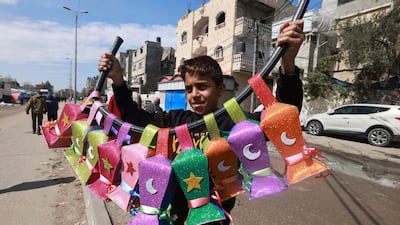
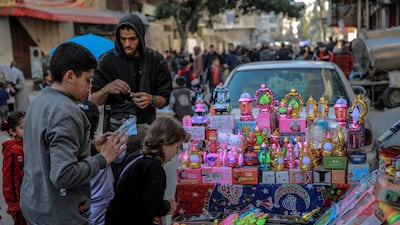
  • A displaced Palestinian child sells handmade Ramadan lanterns in Rafah. AFP
    A displaced Palestinian child sells handmade Ramadan lanterns in Rafah. AFP
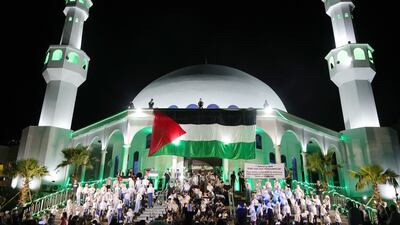
  • Muslims gather to celebrate the beginning of Ramadan at the Omar Ibn Al-Khatab Mosque, in Foz do Iguacu, Brazil. EPA
    Muslims gather to celebrate the beginning of Ramadan at the Omar Ibn Al-Khatab Mosque, in Foz do Iguacu, Brazil. EPA
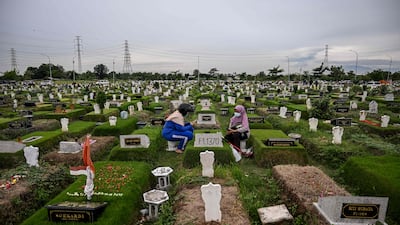
  • People visit the graves of family members in Surabaya, during a tradition before the start of Ramadan. AFP
    People visit the graves of family members in Surabaya, during a tradition before the start of Ramadan. AFP
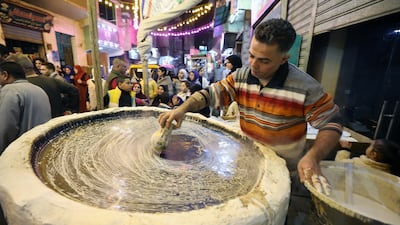
  • An Egyptian baker prepares Knafeh ahead of Ramadan in Giza, Egypt. EPA
    An Egyptian baker prepares Knafeh ahead of Ramadan in Giza, Egypt. EPA
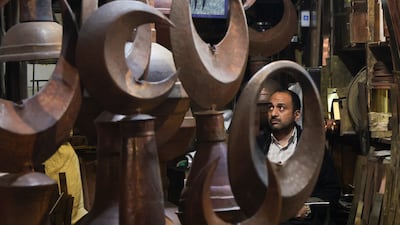
  • A vendor of copper Islamic figures at his shop at El Moez Street in Cairo, Egypt. Reuters
    A vendor of copper Islamic figures at his shop at El Moez Street in Cairo, Egypt. Reuters
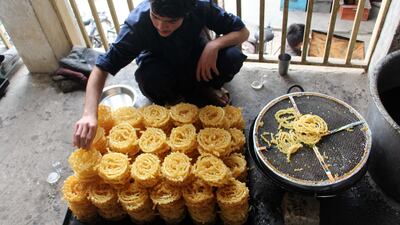
  • Traditional sweets are prepared ahead of Ramadan, in Kandahar, Afghanistan. EPA
    Traditional sweets are prepared ahead of Ramadan, in Kandahar, Afghanistan. EPA
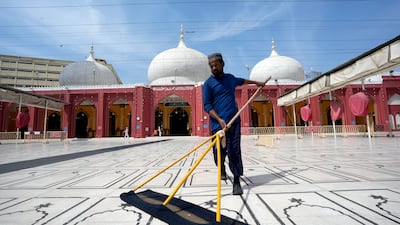
  • Workers clean the carpet in the Badshahi Mosque in preparation for Ramadan, Lahore, Pakistan. AP
    Workers clean the carpet in the Badshahi Mosque in preparation for Ramadan, Lahore, Pakistan. AP
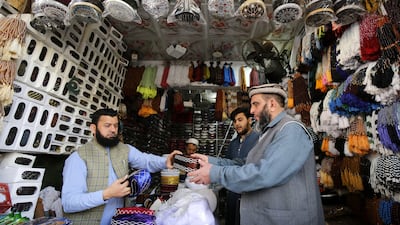
  • People buy prayer caps in Peshawar, Pakistan. EPA
    People buy prayer caps in Peshawar, Pakistan. EPA
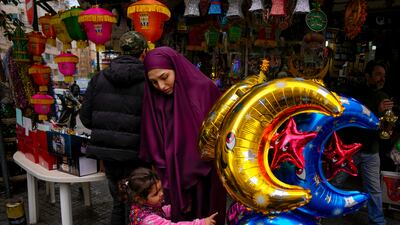
  • People shop for decorations at a shop in Beirut, Lebanon. AP
    People shop for decorations at a shop in Beirut, Lebanon. AP
  • A Pakistani man cleans a mosque in Karachi, Pakistan. AP
    A Pakistani man cleans a mosque in Karachi, Pakistan. AP
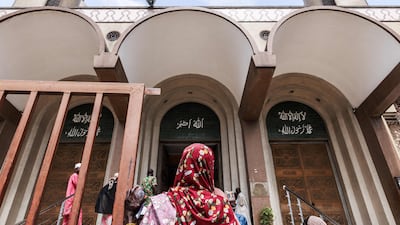
  • A woman stands in front of the Lagos Central Mosque in Lagos. AFP
    A woman stands in front of the Lagos Central Mosque in Lagos. AFP
  • Palestinian children look at toys in Gaza city, amid the ongoing conflict between Israel and Hamas militants, as Ramadan nears. AFP
    Palestinian children look at toys in Gaza city, amid the ongoing conflict between Israel and Hamas militants, as Ramadan nears. AFP
  • A view of the Ramadan lights installation at Piccadilly Circus in London. AP
    A view of the Ramadan lights installation at Piccadilly Circus in London. AP
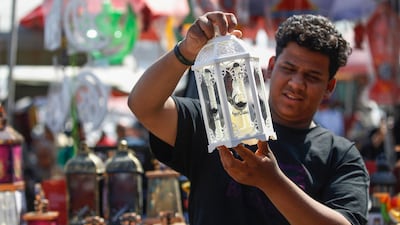
  • An Iraqi man sells traditional lanterns at the Shorja market in central Baghdad. AFP
    An Iraqi man sells traditional lanterns at the Shorja market in central Baghdad. AFP
  • People attend the opening of the Ramadan Market in Beirut, Lebanon. EPA
    People attend the opening of the Ramadan Market in Beirut, Lebanon. EPA
  • People celebrate along a street ahead of the holy month of Ramadan in Giza, Egypt. EPA
    People celebrate along a street ahead of the holy month of Ramadan in Giza, Egypt. EPA
How does ToTok work?

The calling app is available to download on Google Play and Apple App Store

To successfully install ToTok, users are asked to enter their phone number and then create a nickname.

The app then gives users the option add their existing phone contacts, allowing them to immediately contact people also using the application by video or voice call or via message.

Users can also invite other contacts to download ToTok to allow them to make contact through the app.


Ten tax points to be aware of in 2026

1. Domestic VAT refund amendments: request your refund within five years

If a business does not apply for the refund on time, they lose their credit.

2. E-invoicing in the UAE

Businesses should continue preparing for the implementation of e-invoicing in the UAE, with 2026 a preparation and transition period ahead of phased mandatory adoption. 

3. More tax audits

Tax authorities are increasingly using data already available across multiple filings to identify audit risks. 

4. More beneficial VAT and excise tax penalty regime

Tax disputes are expected to become more frequent and more structured, with clearer administrative objection and appeal processes. The UAE has adopted a new penalty regime for VAT and excise disputes, which now mirrors the penalty regime for corporate tax.

5. Greater emphasis on statutory audit

There is a greater need for the accuracy of financial statements. The International Financial Reporting Standards standards need to be strictly adhered to and, as a result, the quality of the audits will need to increase.

6. Further transfer pricing enforcement

Transfer pricing enforcement, which refers to the practice of establishing prices for internal transactions between related entities, is expected to broaden in scope. The UAE will shortly open the possibility to negotiate advance pricing agreements, or essentially rulings for transfer pricing purposes. 

7. Limited time periods for audits

Recent amendments also introduce a default five-year limitation period for tax audits and assessments, subject to specific statutory exceptions. While the standard audit and assessment period is five years, this may be extended to up to 15 years in cases involving fraud or tax evasion. 

8. Pillar 2 implementation 

Many multinational groups will begin to feel the practical effect of the Domestic Minimum Top-Up Tax (DMTT), the UAE's implementation of the OECD’s global minimum tax under Pillar 2. While the rules apply for financial years starting on or after January 1, 2025, it is 2026 that marks the transition to an operational phase.

9. Reduced compliance obligations for imported goods and services

Businesses that apply the reverse-charge mechanism for VAT purposes in the UAE may benefit from reduced compliance obligations. 

10. Substance and CbC reporting focus

Tax authorities are expected to continue strengthening the enforcement of economic substance and Country-by-Country (CbC) reporting frameworks. In the UAE, these regimes are increasingly being used as risk-assessment tools, providing tax authorities with a comprehensive view of multinational groups’ global footprints and enabling them to assess whether profits are aligned with real economic activity. 

Contributed by Thomas Vanhee and Hend Rashwan, Aurifer

The biog

Name: Abeer Al Bah

Born: 1972

Husband: Emirati lawyer Salem Bin Sahoo, since 1992

Children: Soud, born 1993, lawyer; Obaid, born 1994, deceased; four other boys and one girl, three months old

Education: BA in Elementary Education, worked for five years in a Dubai school


Updated: March 10, 2024, 4:07 PM