
Dubai Police have added a Bentley Continental GT V8 to their fleet of supercars.
The force, which already had a Continental GT, took delivery of the vehicle from Al Habtoor Motors at Dubai Police Officers Club.
The 4.0 litre V8 model has an 8-cylinder engine with 542 horsepower, which enables it to accelerate from standstill to 100kph in less than 3.9 seconds, with a top speed of 318 kph (198mph).
In all models, the engine sits largely behind the front axle to optimise weight distribution and dynamic handling, the Bentley website says.
It has an active all-wheel drive system that gives motorists rear-wheel drive when conditions beneath the tyres are good – the all-wheel drive kicks in at the moment the car detects the slightest wheel slip.
In the UAE, the vehicle costs Dh800,000 ($217,800) to Dh1,000,000 ($272,250), depending on features.
Dubai Police's supercar fleet includes Mercedes, Maseratis, Aston Martins and Cadillacs. The luxury cars are used to patrol popular tourist destinations across the city.
They are often seen at national events such as the Dubai Marathon, cycling's UAE Tour, and other parades and celebrations.
Maj Gen Al Jallaf, director of the General Department of Criminal Investigation, said the vehicles help bolster the emirate's security presence at tourist attractions in Dubai.
"This effort is part of the Dubai Police's strategy to upgrade all vehicles used in different operations, contributing to the achievement of the strategic objectives of the Dubai Police in maintaining safety and security," he said.
In May, the force added an electric sports car to their luxury fleet ahead of the Cop 28 climate summit.
Audi RS e-tron GT in Dubai Police livery was shown to the public for the first time on the opening day of the Arabian Travel Market conference.
In October, the force took delivery of a Hongqi E-HS9 SUV - its first electric vehicle.
Dubai Police's supercar fleet - in pictures
-

A Dubai Police Ferrari supercar on display during the Dubai Airshow. Christopher Furlong / Getty Images -

First lieutenant Mohamed Ebrahim Al Suwaidi with the new Dubai Police car an Audi RS e-trom GT, the force's first electric sports car. Chris Whiteoak / The National -

Dubai Police took delivery of a Hongqi E-HS9 suv vehicle - the force's first electric vehicle - from Oneroad Automotive Company at the Dubai Police Officers Club. Dubai Police -

Dubai Police supercars at the start of the Dubai Run. Photo: Dubai Media Office -
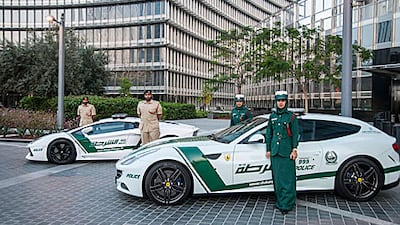
The Lamborghini Aventador, left, and the Ferrari FF were the first supercars to get the Dubai Police decal treatment. Courtesy Dubai Police -
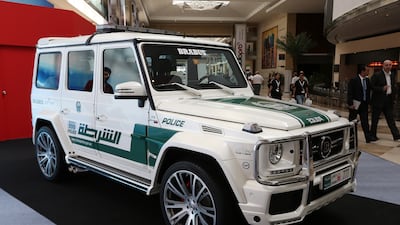
Dubai Police unveiled new supercars at the Dubai International Motor Show including the Mercedes G class Brabus. Pawan Singh / The National -
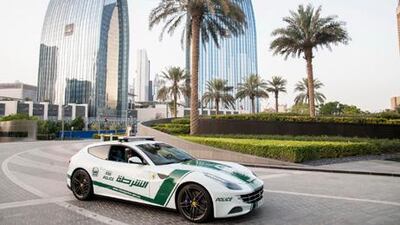
Dubai Police added the Ferrari FF (pictured) to its fleet. Courtesy Dubai Police -
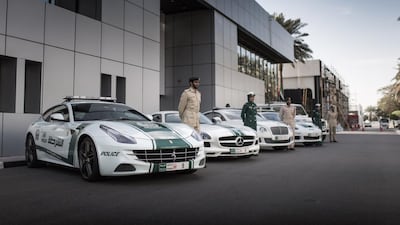
A selection of the Dubai Police fleet: Ferrari FF, Mercedes-Benz SLS-AMG, Bentley Continental GT, Porsche Panamera and Mercedes-Benz/Brabus G700. Photo: WSF Creative -
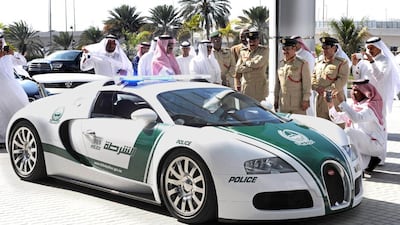
Dubai Police own a Bugatti Veyron, which can reach a speed of more than 400kph. EPA -
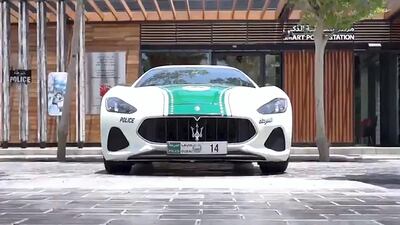
The Maserati GranTurismo allows traffic police to cruise the streets of Dubai in style, as well as comfort. Photo: Dubai Police -
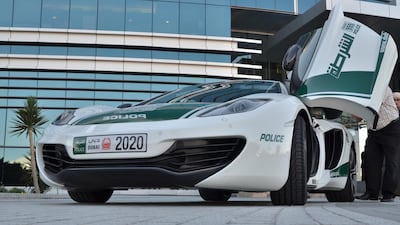
The McLaren MP4-12C packs a punch on the open road with a top speed of about 200kph thanks to its twin-turbo charged V8 engine. Photo: Dubai Police -
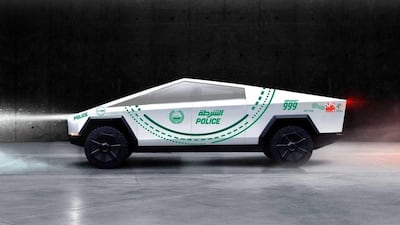
Dubai Police hinted in 2019 that the newly Tesla Cybertruck could be added to the force’s impressive fleet of patrol vehicles. Photo: @mostaqbal_ae / Dubai Future Foundation -
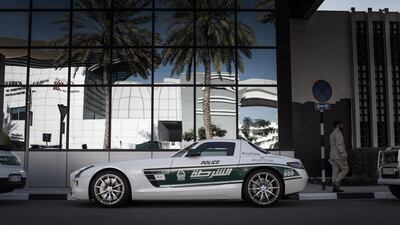
The Mercedes-Benz SLS-AMG can hit 100kph in only 3 seconds thanks to its nine-speed automatic gearbox and AMG-tuned, all-wheel drive system. Photo: WSF Creative -
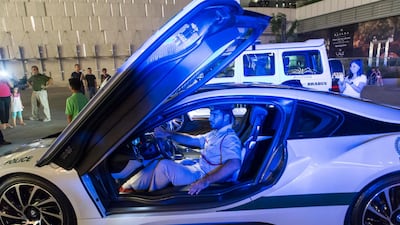
The hybrid electric BMW i8 has a top speed of 250kph. Antonie Robertson / The National -
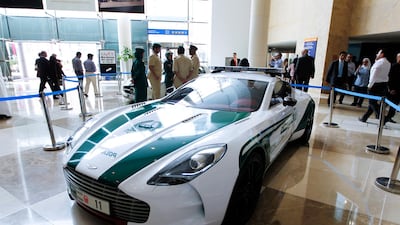
Aston Martin created a special factory staffed by 27 of its finest engineers to produce the exclusive One-77. Sarah Dea / The National -
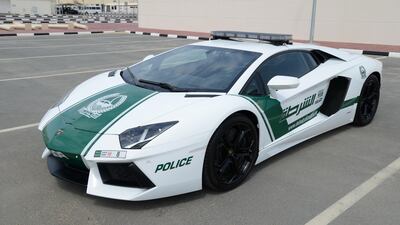
Named after a Spanish fighting bull, the Lamborghini Aventador was initially limited to 4,000 models, with Dubai Police snapping up one of the V12s and coating it in green and white. Photo: Dubai Police -
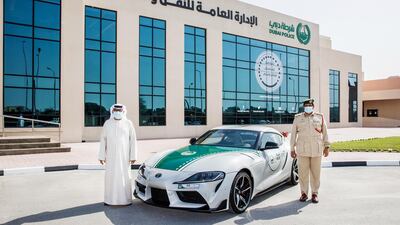
Described by Toyota as delivering a 'powerful but pure' driving experience, the Supra can hit 100kph in only 4.3 seconds and has a top speed of 250kph. Photo: Dubai Police -
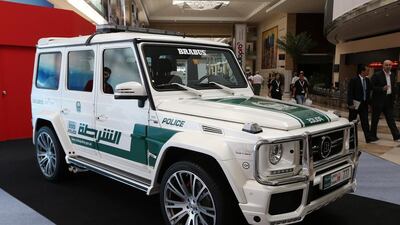
The 4 litre V8 Mercedes-Benz G 63 is ready for action, both on and off the road. Pawan Singh / The National -
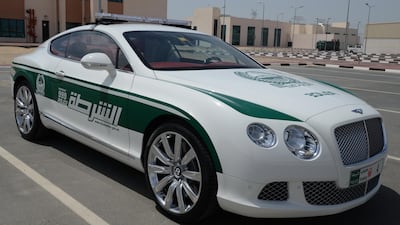
The Bentley Continental GT, with a huge six-litre engine and top speed of 318kph, ensures police can get where they need to be in style, and on time. Photo: Dubai Police



