

A Japanese spacecraft carrying the UAE's Rashid rover will attempt to land on the Moon's surface on April 25.
It is scheduled to touch down at 8.40pm, UAE time.
Ispace, the company that has built the Hakuto-R Mission 1 lander, announced the target date on Wednesday, with backup dates of April 26, May 1 and May 3.
The lander has travelled millions of kilometres since launching on December 11, carrying the UAE's first lunar rover and technologies from other countries stored safely inside it.
The spacecraft entered lunar orbit on March 21 and has since been gradually getting closer to the surface.
"At approximately 15:40 on April 25, 2023, (UTC), the lander is scheduled to begin the landing sequence from the 100km altitude orbit," ispace said.
The landing sequence will take about an hour. If successful, it will make ispace the first company to succeed in a commercial cargo mission to the Moon.
It will also make the UAE the first Arab country to have a rover on another celestial body.
A difficult feat to achieve
But Moon landings are no easy task. Spacecraft touching down on Earth or Mars, for example, can use parachutes to slow themselves down and land safely.
But because the Moon has no atmosphere, complex manoeuvres are required to reduce the speed of the lander to touch down softly on the surface.
Only the US, the former Soviet Union and China have achieved soft landings on the Moon.
Landers operated by India and Israel have crashed on the surface.
Ispace said that during Hakuto-R M1's landing sequence, it will perform a braking burn and fire its main propulsion system to decelerate from orbit.
It will use a series of preset commands to adjust its attitude (positioning in space) and reduce velocity to achieve a soft landing on the surface.
Big win for commercial lunar missions
If ispace does manage to achieve the feat, it will be the first time a private company has delivered cargo for customers to the Moon's surface.
This means government-run space agencies can focus more on lunar science and companies can take over the difficult part of lunar missions — the landings.
It also means that emerging space nations such as the UAE and Saudi Arabia, which do not have lunar landing capabilities, will get more access to the Moon.
-
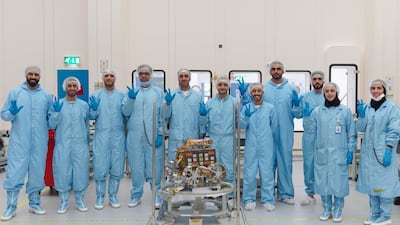
Emirati engineers pictured inside the clean room, along with the Rashid rover, in the Mohammed bin Rashid Space Centre on June 15, 2022. Photo: MBRSC -
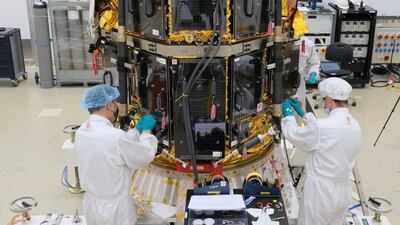
The flight model of the Mission 1 Hakuto-R lander by private company ispace inc. Photo: ispace -

Dr Hamad Al Marzooqi, director of the Emirates Lunar Mission. Chris Whiteoak / The National -

A small team of Emiratis have built the UAE's first mission to the Moon. Here, they are pictured with an old model of the Rashid rover. Chris Whiteoak / The National -
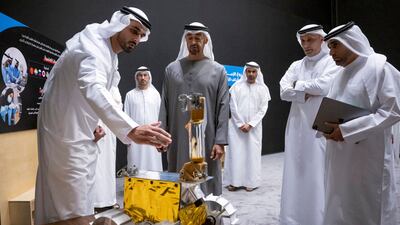
UAE President Sheikh Mohamed bin Zayed attends a presentation by members of the Emirates Lunar Mission in the capital Abu Dhabi on June 15, 2022. Photo: Hamad Al Kaabi / Ministry of Presidential Affairs -

Sheikh Mohamed with the members of the Emirates Lunar Mission team. -
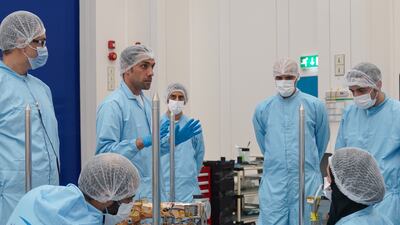
The Rashid rover has now been shipped to France for final testing. Pictured are Emirati engineers at the Mohammed bin Rashid Space Centre on June 15, 2022. Photo: MBRSC -
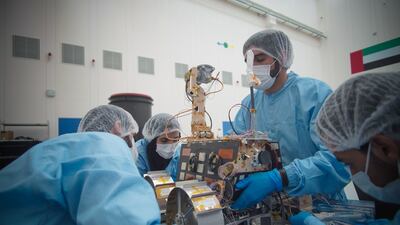
Emirati engineers carry the Rashid rover inside a clean room in the Mohammed bin Rashid Space Centre on June 15, 2022. Photo: MBRSC -

Dr Sara Al Maeeni is the communication and science lead of the Emirates Lunar Mission. Chris Whiteoak / The National -

Ahmed Sharaf is the electrical systems lead for Emirates Lunar Mission. Chris Whiteoak / The National -

Abdullah Al Shehi is the lead of mechanical system for Emirates Lunar Mission. Chris Whiteoak / The National -

Amna Khalifa is the mechanical engineer for Emirates Lunar Mission. Chris Whiteoak / The National


"I am looking forward to witnessing this historic day, marking the beginning of a new era of commercial lunar missions," said Takeshi Hakamada, founder of ispace.
Other companies are also looking to achieve private lunar missions, including US-based company Astrobotic, which plans to launch its Peregrine lander later this year with payloads from eight countries.
Intuitive Machines, another American company, hopes to land its Nova-C lander later this year, as well.
And Texas-based Firefly Aerospace's robotic Blue Ghost lander is also being developed for a touch down.
UAE's first mission to the Moon
Once the Hakuto-R lands on the surface, Emirati engineers will measure the Rashid rover's health.
The lander will then deploy the rover and commands will be sent to it to drive-off on to the lunar surface.
It will then spend 14 days exploring and capturing data, including thousands of images.
Emirati scientists will study the properties of lunar soil, the petrography and geology of the Moon, dust movement, surface plasma conditions and the Moon's photoelectron sheath.
The team also hopes the rover can survive the lunar night, also 14 days, when temperatures plunge to minus 183°C.
The rover will be placed in hibernation mode when night approaches.
"The chances of the rover restarting are slim; however, if the rover is activated after the lunar night then the mission will be extended to operate throughout the second lunar night which will end by the decommissioning phase," the Mohammed Bin Rashid Space Centre said.
Emirati engineers are already working on Rashid 2, the second rover under the country's long-term Moon exploration programme.
It was due to be launched on a Chinese lander, but it is unclear whether that it going ahead.

