



Stunning images of the early cosmos have been captured by the $10 billion James Webb Space Telescope.
The first image from the telescope to be released shows in incredible detail the galaxy cluster SMACS 0723 as it was 4.6 billion years ago.
US President Joe Biden revealed the picture during a live-streamed briefing at the White House on Tuesday.
The Hubble Space Telescope has captured the same area before, but James Webb, the world’s most powerful space observatory, was able to capture more details and in much higher resolution.
The telescope was launched in December to study galaxies formed shortly after the birth of the universe. It is a project by Nasa, the European Space Agency and Canadian Space Agency.
The first full set of images taken by the telescope will be released today at 6.30pm, UAE time.
These findings will allow researchers to learn more about the galaxies’ masses, age, histories and composition.
“The image shows the galaxy cluster SMACS 0723 as it appeared 4.6 billion years ago,” the European Space Agency said.
“The combined mass of this galaxy cluster acts as a gravitational lens, magnifying much more distant galaxies behind it.”
How did James Webb capture this image?
The telescope’s NIRCam (near-infrared camera) instrument has brought distant galaxies into sharp focus, helping show that they have tiny, faint structures never seen before, including star clusters and diffuse features.
Through this camera, the space observatory produced the deepest and sharpest infrared image of the distant universe that is known so far, showing light that has been travelling for 13 billion years.
The NIRCam is able to image the earliest stars and galaxies by capturing their infrared light, radiant energy that is invisible to the human eye but is felt as heat.
“This deep field, taken by Webb’s Near-Infrared Camera, is a composite made from images at different wavelengths, totalling 12.5 hours — achieving depths at infrared wavelengths beyond the Hubble Space Telescope’s deepest fields, which took weeks,” the European Space Agency said.
“Thousands of galaxies — including the faintest objects ever observed in the infrared — have appeared in Webb’s view for the first time.
“This slice of the vast universe is approximately the size of a grain of sand held at arm’s length by someone on the ground.”
Telescope will look even further back in time
Nasa administrator Bill Nelson said that the telescope will soon look back 13.5 billion years in time to make newer discoveries.
“Light travels at 186,000 miles per second, and that light that you are seeing from one of those little specks, has been traveling for over 13 billion years,” he said.
“The universe is almost 13.8 billion years old, so we’re going back further. We’re making discoveries with this.
“You’re going to see whether or not planets are habitable because we’re able to determine their atmospheres’ chemical composition.”
-
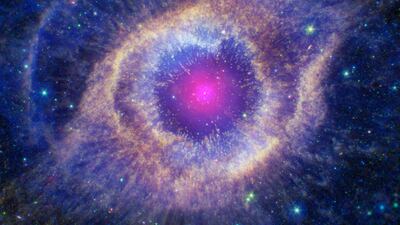
Helix Nebula is a phase when a star like the Sun runs out of fuel, it expands and its outer layers puff off, and then the core of the star shrinks. All photos: Nasa -
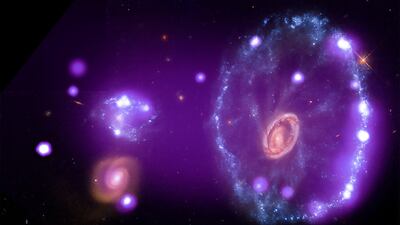
This Cartwheel Galaxy resembles a bull's eye, which is appropriate because its appearance is partly due to a smaller galaxy that passed through the middle of this object. -
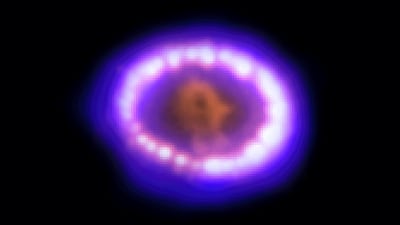
On February 24, 1987, observers in the southern hemisphere saw a new object in a nearby galaxy called the Large Magellanic Cloud. This was one of the brightest supernova explosions in centuries and soon became known as Supernova 1987A. -
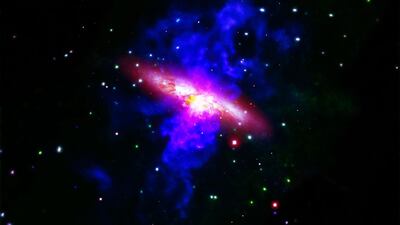
Messier 82, or M82, is a galaxy that is oriented edge-on to Earth. This gives astronomers an interesting view of what happens as this galaxy undergoes bursts of star formations. -
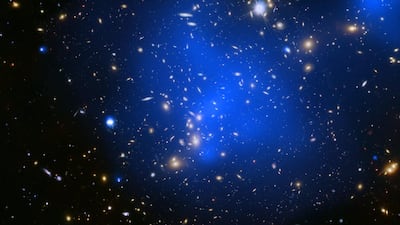
Galaxy clusters are the largest objects in the universe held together by gravity. They contain enormous amounts of superheated gas, with temperatures of tens of millions of degrees, which glow brightly in X-rays and can be observed across millions of light years between galaxies. -

What will be the next star in our Milky Way galaxy to explode as a supernova? Astronomers aren't certain, but one candidate is in Eta Carinae, a volatile system containing two massive stars that closely orbit each other.


He briefed Mr Biden and US Vice President Kamala Harris on the first image.
“What you’re seeing there is galaxies that are shining around other galaxies whose light has been bent and you’re seeing just a small portion of the universe,” Mr Nelson said.
“A 100 years ago, we thought there was only one galaxy. Now, the number is unlimited.
“In our galaxies, we have billions of stars, or suns, and there are billions of galaxies and we’re getting glimpse.”
What’s next?
The space agency had identified five targets, including the first image that was just released.
Others are the Wasp-96 b, a planet that could be half the size of Jupiter and orbits a star 1,150 light years from Earth, the Southern Ring Nebula, Stephan’s Quintet (five galaxies) and the Carina Nebula.

