Sheikh Tahnoun bin Zayed, the UAE's National Security Adviser, meets Sheikh Tamim bin Hamad Al Thani, Emir of Qatar, in Doha. Wam

UAE's Sheikh Tahnoun bin Zayed leads delegation to Qatar


  • English
  • Arabic

A UAE delegation led by the Emirati national security adviser visited Qatar on Thursday.

Sheikh Tahnoun bin Zayed and other officials landed in Doha, state news agency Wam reported.

He was received by Sheikh Tamim bin Hamad Al Thani, Emir of Qatar.

"The two sides discussed bilateral relations and enhancing co-operation between the two countries, especially in the economic and trade fields and vital investment projects that serve the process of construction, development and progress and achieve the common interests of the two countries," state news agency Wam reported.

Sheikh Tahnoun conveyed the greetings of President Sheikh Khalifa, Sheikh Mohammed bin Rashid, Vice President and Ruler of Dubai, and Sheikh Mohamed bin Zayed, Crown Prince of Abu Dhabi and Deputy Supreme Commander of the Armed Forces.

Writing on Twitter, Dr Anwar Gargash, diplomatic adviser to Sheikh Khalifa and former Minister of State for Foreign Affairs, described the meeting as "building bridges of co-operation and prosperity with siblings and friends".

He said the meeting was an example of a "key pillar of Emirati policy" and that they were "turning the page of disagreement and looking to a positive future."

The meeting marks the first time senior Emirati officials have travelled to Qatar since the resumption of diplomatic ties with Doha early this year.

In January, Saudi Arabia, the UAE, Bahrain, Egypt and Qatar signed the Al Ula Declaration to reestablish ties and opened land, sea and air borders with Qatar.

Emirati and Qatari officials later met in Kuwait in February to discuss unity, stability and economic prosperity.

Al Ula Declaration - in pictures

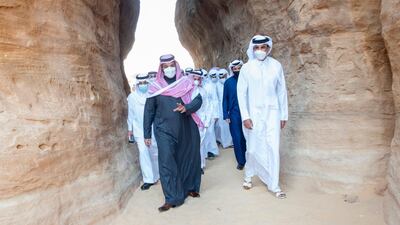
  • Saudi Arabia's Crown Prince Mohammed bin Salman accompanies Qatar's Emir Sheikh Tamim bin Hamad Al Thani on a tour of the archaeological sites in Al Ula. It followed the Al Ula Declaration to restore diplomatic and transport ties with Qatar and the GCC nations. Courtesy of Saudi Royal Court
    Saudi Arabia's Crown Prince Mohammed bin Salman accompanies Qatar's Emir Sheikh Tamim bin Hamad Al Thani on a tour of the archaeological sites in Al Ula. It followed the Al Ula Declaration to restore diplomatic and transport ties with Qatar and the GCC nations. Courtesy of Saudi Royal Court
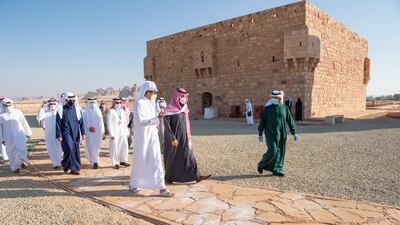
  • Saudi Arabia's Crown Prince Mohammed bin Salman accompanies Qatar's Emir Sheikh Tamim bin Hamad Al Thani on a tour of the archaeological sites in Al Ula. It followed the Al Ula Declaration to restore diplomatic and transport ties between Qatar and the GCC nations. Photo: Saudi Royal Court
    Saudi Arabia's Crown Prince Mohammed bin Salman accompanies Qatar's Emir Sheikh Tamim bin Hamad Al Thani on a tour of the archaeological sites in Al Ula. It followed the Al Ula Declaration to restore diplomatic and transport ties between Qatar and the GCC nations. Photo: Saudi Royal Court
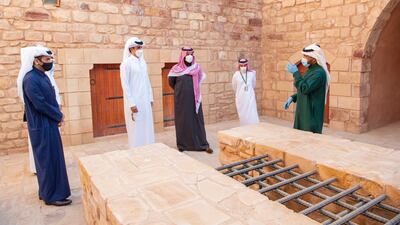
  • His Highness Saudi Arabia's Crown Prince Mohammed bin Salman accompanies His Highness Qatar's Emir Sheikh Tamim bin Hamad al-Thani on a tour of the archaeological sites in Al-Ula. Courtesy of Saudi Royal Court
    His Highness Saudi Arabia's Crown Prince Mohammed bin Salman accompanies His Highness Qatar's Emir Sheikh Tamim bin Hamad al-Thani on a tour of the archaeological sites in Al-Ula. Courtesy of Saudi Royal Court
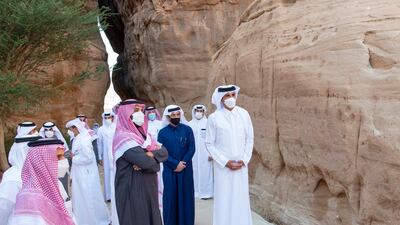
  • His Highness Saudi Arabia's Crown Prince Mohammed bin Salman accompanies His Highness Qatar's Emir Sheikh Tamim bin Hamad al-Thani on a tour of the archaeological sites in Al-Ula. Courtesy of Saudi Royal Court
    His Highness Saudi Arabia's Crown Prince Mohammed bin Salman accompanies His Highness Qatar's Emir Sheikh Tamim bin Hamad al-Thani on a tour of the archaeological sites in Al-Ula. Courtesy of Saudi Royal Court


Fast%20X
%3Cp%3E%3Cstrong%3EDirector%3A%3C%2Fstrong%3E%20Louis%20Leterrier%3C%2Fp%3E%0A%3Cp%3E%3Cstrong%3EStars%3A%3C%2Fstrong%3E%20Vin%20Diesel%2C%20Michelle%20Rodriguez%2C%20Jason%20Statham%2C%20Tyrese%20Gibson%2C%20Ludacris%2C%20Jason%20Momoa%2C%20John%20Cena%2C%20Jordana%20Brewster%2C%20Nathalie%20Emmanuel%2C%20Sung%20Kang%2C%20Brie%20Larson%2C%20Helen%20Mirren%20and%20Charlize%20Theron%3C%2Fp%3E%0A%3Cp%3E%3Cstrong%3ERating%3A%3C%2Fstrong%3E%203%2F5%3C%2Fp%3E%0A
The years Ramadan fell in May

1987

1954

1921

1888

Ten tax points to be aware of in 2026

1. Domestic VAT refund amendments: request your refund within five years

If a business does not apply for the refund on time, they lose their credit.

2. E-invoicing in the UAE

Businesses should continue preparing for the implementation of e-invoicing in the UAE, with 2026 a preparation and transition period ahead of phased mandatory adoption. 

3. More tax audits

Tax authorities are increasingly using data already available across multiple filings to identify audit risks. 

4. More beneficial VAT and excise tax penalty regime

Tax disputes are expected to become more frequent and more structured, with clearer administrative objection and appeal processes. The UAE has adopted a new penalty regime for VAT and excise disputes, which now mirrors the penalty regime for corporate tax.

5. Greater emphasis on statutory audit

There is a greater need for the accuracy of financial statements. The International Financial Reporting Standards standards need to be strictly adhered to and, as a result, the quality of the audits will need to increase.

6. Further transfer pricing enforcement

Transfer pricing enforcement, which refers to the practice of establishing prices for internal transactions between related entities, is expected to broaden in scope. The UAE will shortly open the possibility to negotiate advance pricing agreements, or essentially rulings for transfer pricing purposes. 

7. Limited time periods for audits

Recent amendments also introduce a default five-year limitation period for tax audits and assessments, subject to specific statutory exceptions. While the standard audit and assessment period is five years, this may be extended to up to 15 years in cases involving fraud or tax evasion. 

8. Pillar 2 implementation 

Many multinational groups will begin to feel the practical effect of the Domestic Minimum Top-Up Tax (DMTT), the UAE's implementation of the OECD’s global minimum tax under Pillar 2. While the rules apply for financial years starting on or after January 1, 2025, it is 2026 that marks the transition to an operational phase.

9. Reduced compliance obligations for imported goods and services

Businesses that apply the reverse-charge mechanism for VAT purposes in the UAE may benefit from reduced compliance obligations. 

10. Substance and CbC reporting focus

Tax authorities are expected to continue strengthening the enforcement of economic substance and Country-by-Country (CbC) reporting frameworks. In the UAE, these regimes are increasingly being used as risk-assessment tools, providing tax authorities with a comprehensive view of multinational groups’ global footprints and enabling them to assess whether profits are aligned with real economic activity. 

Contributed by Thomas Vanhee and Hend Rashwan, Aurifer

The biog

Age: 32

Qualifications: Diploma in engineering from TSI Technical Institute, bachelor’s degree in accounting from Dubai’s Al Ghurair University, master’s degree in human resources from Abu Dhabi University, currently third years PHD in strategy of human resources.

Favourite mountain range: The Himalayas

Favourite experience: Two months trekking in Alaska

10 tips for entry-level job seekers
  • Have an up-to-date, professional LinkedIn profile. If you don’t have a LinkedIn account, set one up today. Avoid poor-quality profile pictures with distracting backgrounds. Include a professional summary and begin to grow your network.
  • Keep track of the job trends in your sector through the news. Apply for job alerts at your dream organisations and the types of jobs you want – LinkedIn uses AI to share similar relevant jobs based on your selections.
  • Double check that you’ve highlighted relevant skills on your resume and LinkedIn profile.
  • For most entry-level jobs, your resume will first be filtered by an applicant tracking system for keywords. Look closely at the description of the job you are applying for and mirror the language as much as possible (while being honest and accurate about your skills and experience).
  • Keep your CV professional and in a simple format – make sure you tailor your cover letter and application to the company and role.
  • Go online and look for details on job specifications for your target position. Make a list of skills required and set yourself some learning goals to tick off all the necessary skills one by one.
  • Don’t be afraid to reach outside your immediate friends and family to other acquaintances and let them know you are looking for new opportunities.
  • Make sure you’ve set your LinkedIn profile to signal that you are “open to opportunities”. Also be sure to use LinkedIn to search for people who are still actively hiring by searching for those that have the headline “I’m hiring” or “We’re hiring” in their profile.
  • Prepare for online interviews using mock interview tools. Even before landing interviews, it can be useful to start practising.
  • Be professional and patient. Always be professional with whoever you are interacting with throughout your search process, this will be remembered. You need to be patient, dedicated and not give up on your search. Candidates need to make sure they are following up appropriately for roles they have applied.

Arda Atalay, head of Mena private sector at LinkedIn Talent Solutions, Rudy Bier, managing partner of Kinetic Business Solutions and Ben Kinerman Daltrey, co-founder of KinFitz

The years Ramadan fell in May

1987

1954

1921

1888

GULF MEN'S LEAGUE

Pool A Dubai Hurricanes, Bahrain, Dubai Exiles, Dubai Tigers 2

Pool B Abu Dhabi Harlequins, Jebel Ali Dragons, Dubai Knights Eagles, Dubai Tigers


Opening fixtures

Thursday, December 5

6.40pm, Pitch 8, Abu Dhabi Harlequins v Dubai Knights Eagles

7pm, Pitch 2, Jebel Ali Dragons v Dubai Tigers

7pm, Pitch 4, Dubai Hurricanes v Dubai Exiles

7pm, Pitch 5, Bahrain v Dubai Eagles 2


Recent winners

2018 Dubai Hurricanes

2017 Dubai Exiles

2016 Abu Dhabi Harlequins

2015 Abu Dhabi Harlequins

2014 Abu Dhabi Harlequins

Updated: August 26, 2021, 11:42 AM