• Jupiter is the king of the solar system, more massive than all of the other solar-system planets combined. Although astronomers have been observing the gas-giant planet for hundreds of years, it still remains a mysterious world. Astronomers don't have definitive answers, for example, of why cloud bands and storms change colors, or why storms shrink in size. The most prominent long-lasting feature, the Great Red Spot, has been downsizing since the 1800s. However, the giant storm is still large enough to swallow Earth. The Red Spot is anchored in a roiling atmosphere that is powered by heat welling up from the monster planet’s deep interior, which drives a turbulent atmosphere. In contrast, sunlight powers Earth's atmosphere. From Jupiter, however, the Sun is much fainter because the planet is much farther away from it. Jupiter's upper atmosphere is a riot of colorful clouds, contained in bands that whisk along at different wind speeds and in alternating directions. Dynamic features such as cyclones and anticyclones (high-pressure storms that rotate counterclockwise in the southern hemisphere) abound. Attempting to understand the forces driving Jupiter's atmosphere is like trying to predict the pattern cream will make when it is poured into a hot cup of coffee. Researchers are hoping that Hubble's yearly monitoring of the planet—as an interplanetary weatherman—will reveal the shifting behavior of Jupiter's clouds. Hubble images should help unravel many of the planet's outstanding puzzles. This new Hubble image is part of that yearly study, called the Outer Planets Atmospheres Legacy program, or OPAL.
    Jupiter is the king of the solar system, more massive than all of the other solar-system planets combined. Although astronomers have been observing the gas-giant planet for hundreds of years, it still remains a mysterious world. Astronomers don't have definitive answers, for example, of why cloud bands and storms change colors, or why storms shrink in size. The most prominent long-lasting feature, the Great Red Spot, has been downsizing since the 1800s. However, the giant storm is still large enough to swallow Earth. The Red Spot is anchored in a roiling atmosphere that is powered by heat welling up from the monster planet’s deep interior, which drives a turbulent atmosphere. In contrast, sunlight powers Earth's atmosphere. From Jupiter, however, the Sun is much fainter because the planet is much farther away from it. Jupiter's upper atmosphere is a riot of colorful clouds, contained in bands that whisk along at different wind speeds and in alternating directions. Dynamic features such as cyclones and anticyclones (high-pressure storms that rotate counterclockwise in the southern hemisphere) abound. Attempting to understand the forces driving Jupiter's atmosphere is like trying to predict the pattern cream will make when it is poured into a hot cup of coffee. Researchers are hoping that Hubble's yearly monitoring of the planet—as an interplanetary weatherman—will reveal the shifting behavior of Jupiter's clouds. Hubble images should help unravel many of the planet's outstanding puzzles. This new Hubble image is part of that yearly study, called the Outer Planets Atmospheres Legacy program, or OPAL.
  • A composite image of the Jovian system, which is Jupiter with its Great Red Spot and Jupiter's four largest moons -- Io, Europa, Ganymede and Callisto (top to bottom). Courtesy: Nasa
    A composite image of the Jovian system, which is Jupiter with its Great Red Spot and Jupiter's four largest moons -- Io, Europa, Ganymede and Callisto (top to bottom). Courtesy: Nasa
  • Jupiter's Great Red Spot. Courtesy: Nasa
    Jupiter's Great Red Spot. Courtesy: Nasa
  • An infrared view of Jupiter’s icy moon Ganymede taken by Nasa’s Juno spacecraft on July 20, 2021. Courtesy: Nasa
    An infrared view of Jupiter’s icy moon Ganymede taken by Nasa’s Juno spacecraft on July 20, 2021. Courtesy: Nasa
  • Aurora captured on the poles of Jupiter. This is an image composite of two different observations made by the Hubble Space Telescope. Courtesy: Nasa
    Aurora captured on the poles of Jupiter. This is an image composite of two different observations made by the Hubble Space Telescope. Courtesy: Nasa

Jupiter and its four moons will be visible in UAE skies tonight


Sarwat Nasir
  • English
  • Arabic

Jupiter, the giant gas planet that is the largest in the solar system, will be visible in UAE skies tonight, as will its four moons.

The planet will be visible to the naked eye, but a telescope and special equipment will significantly enhance the viewing experience.

It is believed the planet has 79 moons and its four largest ones – Io, Europa, Ganymede and Callisto – will appear as tiny dots next to the planet.

The planet is visible tonight because Jupiter is in opposition, meaning it is at its closest point to Earth.

  • A view of the Perseid meteor shower over the Church of St Paraskevi of Iconium in the village of Russkoye Khodyashevo in the Russian Republic of Tatarstan in 2021.
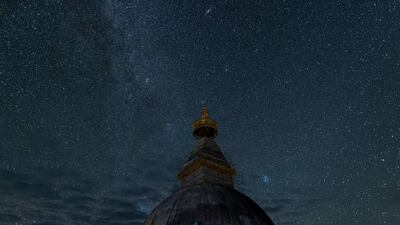
    A view of the Perseid meteor shower over the Church of St Paraskevi of Iconium in the village of Russkoye Khodyashevo in the Russian Republic of Tatarstan in 2021.
  • A Perseid meteor streaks across the sky above the Negev desert near the city of Mitzpe Ramon in Israel.
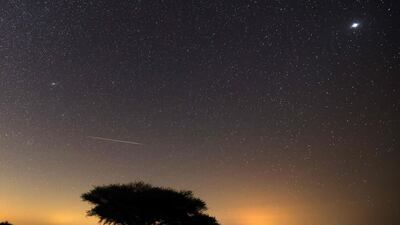
    A Perseid meteor streaks across the sky above the Negev desert near the city of Mitzpe Ramon in Israel.
  • The Perseids are a prolific meteor shower associated with the Swift–Tuttle comet. The meteors are called the Perseids because the point from which they appear to originate lies in the constellation Perseus.
    The Perseids are a prolific meteor shower associated with the Swift–Tuttle comet. The meteors are called the Perseids because the point from which they appear to originate lies in the constellation Perseus.
  • In many places the Perseids are easily visible to the naked eye.
    In many places the Perseids are easily visible to the naked eye.
  • Most of the meteors are small and burn up when they hit the Earth's atmosphere.
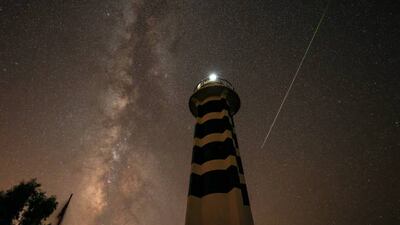
    Most of the meteors are small and burn up when they hit the Earth's atmosphere.
  • Perseid meteors in the sky over Golog Tibetan Autonomous Prefecture, in the Qinghai Province of China.
    Perseid meteors in the sky over Golog Tibetan Autonomous Prefecture, in the Qinghai Province of China.
  • A Perseid meteor over the Sariyer district of Istanbul, Turkey.
    A Perseid meteor over the Sariyer district of Istanbul, Turkey.
  • A Perseid meteor streaks across the sky over Izmir, Turkey.
    A Perseid meteor streaks across the sky over Izmir, Turkey.
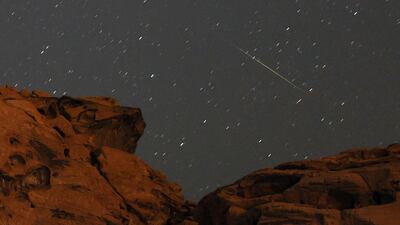
  • A Perseid meteor above a sandstone outcrop at Redstone in the Pinto Valley wilderness area in Nevada, US.
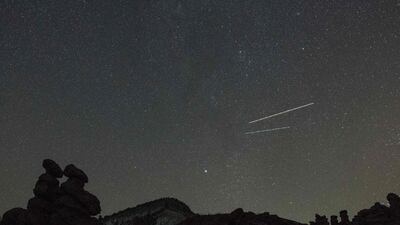
    A Perseid meteor above a sandstone outcrop at Redstone in the Pinto Valley wilderness area in Nevada, US.

Stargazers across the Emirates will be able to observe the celestial bodies from 7.20pm, Gulf Standard Time, tonight and tomorrow.

“Jupiter in opposition is when Jupiter is at its closest point to Earth while directly opposite the Sun, creating a few hours of perfect alignment between the three bodies – Jupiter, Sun and Earth,” said Hasan Al Hairi, chief executive of the Dubai Astronomy Group.

“This relative proximity to Earth means that the planet, already a sight to be seen on other summer nights, will be at its biggest and brightest in the night sky all year.”

Jupiter is in opposition about every 13 months, and is generally visible from Earth each time.

It is recommended to observe the planet and its moons away from light pollution.

The Dubai Astronomy Group is hosting a viewing event at the Al Thuraya Astronomy Centre in Mushrif Park, Dubai.

The event will include an educational session on the cosmic phenomenon, availability of telescopes and astrophotography of the planet using a phone.

Using telescopes, viewers will be able to see the planet’s trademark Great Red Spot and its colourful bands.

10 terrifying worlds in our galaxy – in pictures

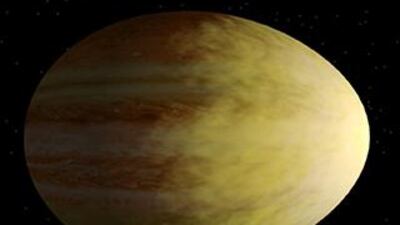
  • WASP-12b is a planet that will be destroyed by its parent star in 10 million years. The star is so hot that it is tearing apart the planet’s atmosphere, with the extreme gravity causing giant tidal forces that are stretching the planet into the shape of an egg. All photos: Nasa
    WASP-12b is a planet that will be destroyed by its parent star in 10 million years. The star is so hot that it is tearing apart the planet’s atmosphere, with the extreme gravity causing giant tidal forces that are stretching the planet into the shape of an egg. All photos: Nasa
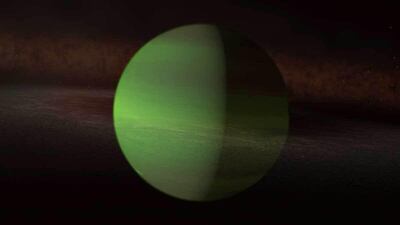
  • AU Microscopii b is constantly blasted with deadly X-rays and other radiation from its star. The gas giant exoplanet takes 8.5 days to complete one orbit around its star. It was discovered in 2020.
    AU Microscopii b is constantly blasted with deadly X-rays and other radiation from its star. The gas giant exoplanet takes 8.5 days to complete one orbit around its star. It was discovered in 2020.
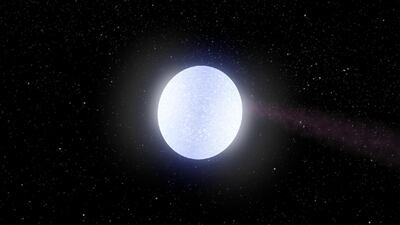
  • KELT-9b was discovered in 2017 and has a mass nearly three times bigger than Jupiter, but is only half as dense as the planet. It has a dayside temperature of more than 4,315°C and orbits a star (pictured) that is almost twice as large and hot as the Sun, which blasts the planet with high levels of ultraviolet radiation.
    KELT-9b was discovered in 2017 and has a mass nearly three times bigger than Jupiter, but is only half as dense as the planet. It has a dayside temperature of more than 4,315°C and orbits a star (pictured) that is almost twice as large and hot as the Sun, which blasts the planet with high levels of ultraviolet radiation.
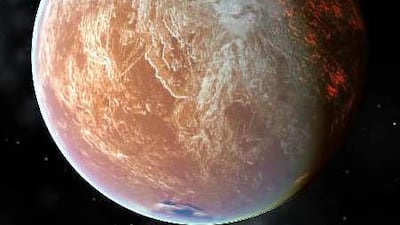
  • Kepler 16b is a rocky planet that orbits two stars. It lies in a habitable zone, where liquid water could exist.
    Kepler 16b is a rocky planet that orbits two stars. It lies in a habitable zone, where liquid water could exist.
  • PSR B1257+12 b was discovered in 1994 and is described by scientists as “one of the creepiest ones”. It orbits a pulsar – a rapidly rotating neutron star, which is the dense core of a massive star that exploded. The planet, like any other the orbits a pulsar, is inhospitable and is bombarded with constant radiation from its star.
    PSR B1257+12 b was discovered in 1994 and is described by scientists as “one of the creepiest ones”. It orbits a pulsar – a rapidly rotating neutron star, which is the dense core of a massive star that exploded. The planet, like any other the orbits a pulsar, is inhospitable and is bombarded with constant radiation from its star.
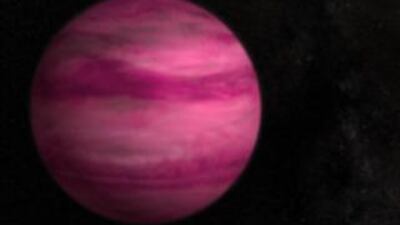
  • GJ 504 b is four times the size of Jupiter and is 57 light-years away from Earth. Nasa reports that this world is still glowing from the heat of its formation and its colour would appear as a dull magenta.
    GJ 504 b is four times the size of Jupiter and is 57 light-years away from Earth. Nasa reports that this world is still glowing from the heat of its formation and its colour would appear as a dull magenta.
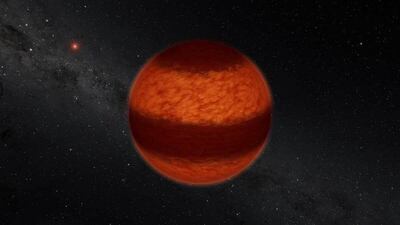
  • TYC 8998-760-1 b is a brown dwarf that was formed so recently, its powerful glow can be detected by ground-based telescope. Nasa classifies this planet as a brown dwarf, meaning it is considered neither a star or a planet, and somewhere in between.
    TYC 8998-760-1 b is a brown dwarf that was formed so recently, its powerful glow can be detected by ground-based telescope. Nasa classifies this planet as a brown dwarf, meaning it is considered neither a star or a planet, and somewhere in between.
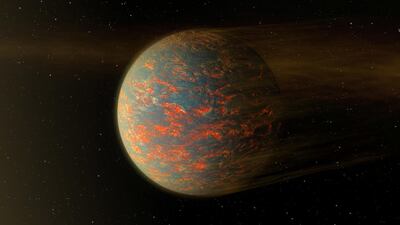
  • 55 Cancri e is a lava planet. Its surface is uninhabitable as it is covered in molten lava. The sky in this world sparkles when the surface lava reflects on the dark side of the planet. Only one side of the planet faces the star, the other is completely dark.
    55 Cancri e is a lava planet. Its surface is uninhabitable as it is covered in molten lava. The sky in this world sparkles when the surface lava reflects on the dark side of the planet. Only one side of the planet faces the star, the other is completely dark.
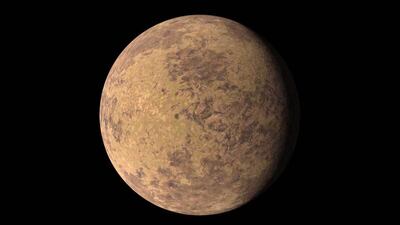
  • TOI-849 b was discovered in 2020. The planet’s atmosphere is being stripped away because it is so close to its parent star. It is 40 times the mass of Earth and has little or no atmosphere. Surface temperature on the planet is about 1,500°C.
    TOI-849 b was discovered in 2020. The planet’s atmosphere is being stripped away because it is so close to its parent star. It is 40 times the mass of Earth and has little or no atmosphere. Surface temperature on the planet is about 1,500°C.
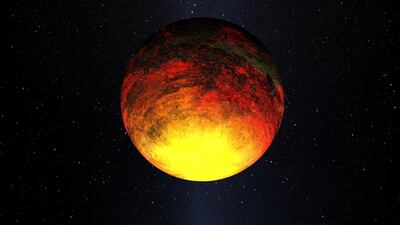
  • Kepler-10b is another lava world, which orbits too closely to its star. Daytime temperatures on this planet are more than 1,371°C – hotter than the lava on Earth.
    Kepler-10b is another lava world, which orbits too closely to its star. Daytime temperatures on this planet are more than 1,371°C – hotter than the lava on Earth.
Updated: August 19, 2021, 9:11 AM