• Passengers arrive at London's Heathrow Airport. The UK has added the UAE to its amber travel list.
    Passengers arrive at London's Heathrow Airport. The UK has added the UAE to its amber travel list.
  • The British government said the move will allow some business travel to resume and help families and friends to reunite with loved ones.
    The British government said the move will allow some business travel to resume and help families and friends to reunite with loved ones.
  • John Holland-Kaye, chief executive of Heathrow Airport, during a television interview at the airport's Terminal 5.
    John Holland-Kaye, chief executive of Heathrow Airport, during a television interview at the airport's Terminal 5.
  • Passengers maintain physical distance at Heathrow.
    Passengers maintain physical distance at Heathrow.
  • A member of cleaning staff sanitising a pillar at Heathrow.
    A member of cleaning staff sanitising a pillar at Heathrow.
  • An all-but-deserted transit at Gatwick Airport, south of London.
    An all-but-deserted transit at Gatwick Airport, south of London.
  • Passengers arrive at Gatwick Airport.
    Passengers arrive at Gatwick Airport.
  • Travellers arrive St Pancras International station in London on the Eurostar train from Paris.
    Travellers arrive St Pancras International station in London on the Eurostar train from Paris.
  • Passengers queue for flights at Heathrow Airport.
    Passengers queue for flights at Heathrow Airport.
  • An arrival from the US is welcomed with open arms at Heathrow Airport's Terminal 5.
    An arrival from the US is welcomed with open arms at Heathrow Airport's Terminal 5.

UK amber list: what are the quarantine rules for UAE residents flying to England?


Kelly Clarke
  • English
  • Arabic

Follow the latest updates on the Covid-19 pandemic here

People from the UAE who want to visit England for the summer can now self-isolate at home after the UK added the country to its amber list.

From August 8, passengers do not have to complete paid mandatory hotel quarantine. Instead, they will be required to self-isolate for 10 days, taking pre-booked PCR tests on day two and day eight. This is compulsory.

There is also an option to escape part of the 10-day quarantine with a Covid-19 test on day five that comes back negative.

Travellers coming from countries with amber status who have been fully vaccinated with inoculations approved and administered in the UK, EU and US do not have to quarantine, but must provide a negative Covid-19 test within two days of arrival.

Any traveller inoculated in the UAE, therefore, will have to follow the 10-day self-isolation rules.

The UAE will move to the amber list at 4am UK time on August 8. If a passenger arrives in England before then, they must follow the red list rules. If UAE residents visited a red country in the ten days before arriving into England they must also enter hotel quarantine. Here is The National's guide to the new travel rules.

Amber list rules:

  • If you have been in an amber list country in the 10 days before you arrive in England you must:
  • Take a Covid-19 test in the three days before you travel to England; pre-book and pay for Covid-19 tests (in England) before you travel, to be taken on day two and day eight after arrival in England; and complete a passenger locator form.

Steps to follow after arrival in England:

  • Quarantine at home or in the place you are staying for 10 days – the day of arrival is counted as day zero.
  • Then take a Covid-19 test on or before day two and on or after day eight.

Option to 'test to release' early:

  • Travellers entering England from the UAE can end quarantine early using the "test to release" scheme.
  • Under this system, people can pay for a private Covid-19 test on day five. If the result is negative (and the result of your day two test was negative or inconclusive), you can end your quarantine.
  • However, you must still book and take your mandatory day two and day eight travel tests, even if your "test to release" result is negative.

Rules for fully UK vaccinated and people under the age of 18:

  • You do not need to quarantine or take a day eight test after you arrive in England if you are either: fully vaccinated in the UK or under the UK vaccine programme overseas; under 18 on the day you arrive in England and resident in the UK or in a country with a vaccination programme approved by the UK; or part of a UK-approved vaccine trial.
  • You still need to book and take a day two test.

Amber list rules if fully vaccinated in Europe or the USA:

  • If you have been fully vaccinated in the United States or many European countries, you will not need to quarantine when you arrive in England or take a day eight test.
  • However, you still need to book and take a day two test
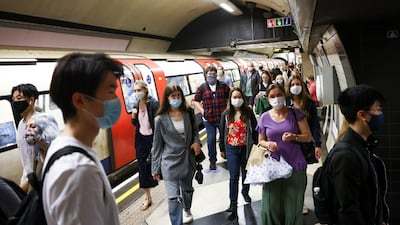
  • People walk along a platform on the London Underground.
    People walk along a platform on the London Underground.
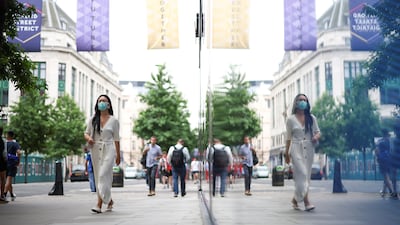
  • People walk along Oxford Street in central London. England lifted most Covid-19 restrictions on July 19.
    People walk along Oxford Street in central London. England lifted most Covid-19 restrictions on July 19.
  • Participants run across Westminster Bridge in London during the Asics London 10km marathon.
    Participants run across Westminster Bridge in London during the Asics London 10km marathon.
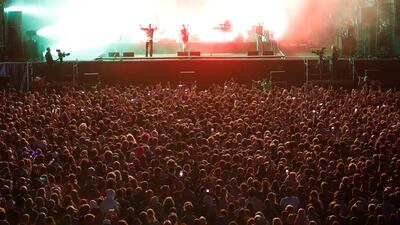
  • Festival-goers watch Wolf Alice perform at Latitude Festival at Henham Park.
    Festival-goers watch Wolf Alice perform at Latitude Festival at Henham Park.
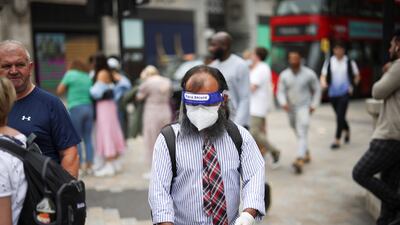
  • A person wearing a protective face shield and face mask walks through Oxford Circus in London.
    A person wearing a protective face shield and face mask walks through Oxford Circus in London.
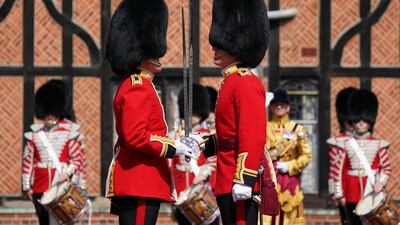
  • The Changing of the Guard at Windsor Castle takes place for the first time since the start of the pandemic.
    The Changing of the Guard at Windsor Castle takes place for the first time since the start of the pandemic.
  • Festival-goers wait to receive a vaccine on board a bus at the Latitude Festival.
    Festival-goers wait to receive a vaccine on board a bus at the Latitude Festival.
  • Empty shelves in a supermarket in London. Brexit lorry shortages combined with large numbers of retail staff isolating have cause shortages of household staples in parts of the UK .
    Empty shelves in a supermarket in London. Brexit lorry shortages combined with large numbers of retail staff isolating have cause shortages of household staples in parts of the UK .
  • Demonstrators hold up banners as they listen to speeches during a "Rally for freedom" protest in London.
    Demonstrators hold up banners as they listen to speeches during a "Rally for freedom" protest in London.

Where can I quarantine?

  • You must quarantine at the address you provided on the passenger locator form.
  • This can include staying in your own home with friends or family or in a standard hotel or other temporary accommodation.
  • You should stay in a well ventilated room with an outside window that can be opened, separate from other people in your home.

How to self-isolate

As per NHS UK rules, you must not leave your home if you're self-isolating.

  • Do not go to work, school or public places – work from home if you can
  • Do not go on public transport or use taxis
  • Do not go out to get food and medicine – order it online or by phone, or ask someone to bring it to your home
  • Do not have visitors in your home, including friends and family – except for people providing essential care
  • Do not go out to exercise – exercise at home or in your garden, if you have one

Tomb%20Raider%20I%E2%80%93III%20Remastered
%3Cp%3EDeveloper%3A%20Aspyr%0D%3Cbr%3EPublisher%3A%20Aspyr%0D%3Cbr%3EConsole%3A%20Nintendo%20Switch%2C%20PlayStation%204%26amp%3B5%2C%20PC%20and%20Xbox%20series%20X%2FS%0D%3Cbr%3ERating%3A%203%2F5%3C%2Fp%3E%0A

Mercer, the investment consulting arm of US services company Marsh & McLennan, expects its wealth division to at least double its assets under management (AUM) in the Middle East as wealth in the region continues to grow despite economic headwinds, a company official said.

Mercer Wealth, which globally has $160 billion in AUM, plans to boost its AUM in the region to $2-$3bn in the next 2-3 years from the present $1bn, said Yasir AbuShaban, a Dubai-based principal with Mercer Wealth.

Within the next two to three years, we are looking at reaching $2 to $3 billion as a conservative estimate and we do see an opportunity to do so,” said Mr AbuShaban.

Mercer does not directly make investments, but allocates clients’ money they have discretion to, to professional asset managers. They also provide advice to clients.

“We have buying power. We can negotiate on their (client’s) behalf with asset managers to provide them lower fees than they otherwise would have to get on their own,” he added.

Mercer Wealth’s clients include sovereign wealth funds, family offices, and insurance companies among others.

From its office in Dubai, Mercer also looks after Africa, India and Turkey, where they also see opportunity for growth.

Wealth creation in Middle East and Africa (MEA) grew 8.5 per cent to $8.1 trillion last year from $7.5tn in 2015, higher than last year’s global average of 6 per cent and the second-highest growth in a region after Asia-Pacific which grew 9.9 per cent, according to consultancy Boston Consulting Group (BCG). In the region, where wealth grew just 1.9 per cent in 2015 compared with 2014, a pickup in oil prices has helped in wealth generation.

BCG is forecasting MEA wealth will rise to $12tn by 2021, growing at an annual average of 8 per cent.

Drivers of wealth generation in the region will be split evenly between new wealth creation and growth of performance of existing assets, according to BCG.

Another general trend in the region is clients’ looking for a comprehensive approach to investing, according to Mr AbuShaban.

“Institutional investors or some of the families are seeing a slowdown in the available capital they have to invest and in that sense they are looking at optimizing the way they manage their portfolios and making sure they are not investing haphazardly and different parts of their investment are working together,” said Mr AbuShaban.

Some clients also have a higher appetite for risk, given the low interest-rate environment that does not provide enough yield for some institutional investors. These clients are keen to invest in illiquid assets, such as private equity and infrastructure.

“What we have seen is a desire for higher returns in what has been a low-return environment specifically in various fixed income or bonds,” he said.

“In this environment, we have seen a de facto increase in the risk that clients are taking in things like illiquid investments, private equity investments, infrastructure and private debt, those kind of investments were higher illiquidity results in incrementally higher returns.”

The Abu Dhabi Investment Authority, one of the largest sovereign wealth funds, said in its 2016 report that has gradually increased its exposure in direct private equity and private credit transactions, mainly in Asian markets and especially in China and India. The authority’s private equity department focused on structured equities owing to “their defensive characteristics.”

Most sought after workplace benefits in the UAE
  • Flexible work arrangements
  • Pension support
  • Mental well-being assistance
  • Insurance coverage for optical, dental, alternative medicine, cancer screening
  • Financial well-being incentives 
The alternatives

• Founded in 2014, Telr is a payment aggregator and gateway with an office in Silicon Oasis. It’s e-commerce entry plan costs Dh349 monthly (plus VAT). QR codes direct customers to an online payment page and merchants can generate payments through messaging apps.

• Business Bay’s Pallapay claims 40,000-plus active merchants who can invoice customers and receive payment by card. Fees range from 1.99 per cent plus Dh1 per transaction depending on payment method and location, such as online or via UAE mobile.

• Tap started in May 2013 in Kuwait, allowing Middle East businesses to bill, accept, receive and make payments online “easier, faster and smoother” via goSell and goCollect. It supports more than 10,000 merchants. Monthly fees range from US$65-100, plus card charges of 2.75-3.75 per cent and Dh1.2 per sale.

2checkout’s “all-in-one payment gateway and merchant account” accepts payments in 200-plus markets for 2.4-3.9 per cent, plus a Dh1.2-Dh1.8 currency conversion charge. The US provider processes online shop and mobile transactions and has 17,000-plus active digital commerce users.

• PayPal is probably the best-known online goods payment method - usually used for eBay purchases -  but can be used to receive funds, providing everyone’s signed up. Costs from 2.9 per cent plus Dh1.2 per transaction.

57%20Seconds
%3Cp%3E%3Cstrong%3EDirector%3A%3C%2Fstrong%3E%20Rusty%20Cundieff%0D%3Cbr%3E%3Cstrong%3EStars%3A%20%3C%2Fstrong%3EJosh%20Hutcherson%2C%20Morgan%20Freeman%2C%20Greg%20Germann%2C%20Lovie%20Simone%0D%3Cbr%3E%3Cstrong%3ERating%3A%20%3C%2Fstrong%3E2%2F5%0D%3Cbr%3E%0D%3Cbr%3E%3C%2Fp%3E%0A
Fight card

1. Bantamweight: Victor Nunes (BRA) v Siyovush Gulmamadov (TJK)

2. Featherweight: Hussein Salim (IRQ) v Shakhriyor Juraev (UZB)

3. Catchweight 80kg: Rashed Dawood (UAE) v Khamza Yamadaev (RUS)

4. Lightweight: Ho Taek-oh (KOR) v Ronald Girones (CUB)

5. Lightweight: Arthur Zaynukov (RUS) v Damien Lapilus (FRA)

6. Bantamweight: Vinicius de Oliveira (BRA) v Furkatbek Yokubov (RUS)

7. Featherweight: Movlid Khaybulaev (RUS) v Zaka Fatullazade (AZE)

8. Flyweight: Shannon Ross (TUR) v Donovon Freelow (USA)

9. Lightweight: Mohammad Yahya (UAE) v Dan Collins (GBR)

10. Catchweight 73kg: Islam Mamedov (RUS) v Martun Mezhulmyan (ARM)

11. Bantamweight World title: Jaures Dea (CAM) v Xavier Alaoui (MAR)

12. Flyweight World title: Manon Fiorot (FRA) v Gabriela Campo (ARG)

Living in...

This article is part of a guide on where to live in the UAE. Our reporters will profile some of the country’s most desirable districts, provide an estimate of rental prices and introduce you to some of the residents who call each area home.

Normcore explained

Something of a fashion anomaly, normcore is essentially a celebration of the unremarkable. The term was first popularised by an article in New York magazine in 2014 and has been dubbed “ugly”, “bland’ and "anti-style" by fashion writers. It’s hallmarks are comfort, a lack of pretentiousness and neutrality – it is a trend for those who would rather not stand out from the crowd. For the most part, the style is unisex, favouring loose silhouettes, thrift-shop threads, baseball caps and boyish trainers. It is important to note that normcore is not synonymous with cheapness or low quality; there are high-fashion brands, including Parisian label Vetements, that specialise in this style. Embraced by fashion-forward street-style stars around the globe, it’s uptake in the UAE has been relatively slow.

The specs

Engine: 2.0-litre 4-cyl, 48V hybrid

Transmission: eight-speed automatic

Power: 325bhp

Torque: 450Nm

Price: Dh289,000

Specs

Engine: Dual-motor all-wheel-drive electric

Range: Up to 610km

Power: 905hp

Torque: 985Nm

Price: From Dh439,000

Available: Now

Updated: August 05, 2021, 11:01 AM