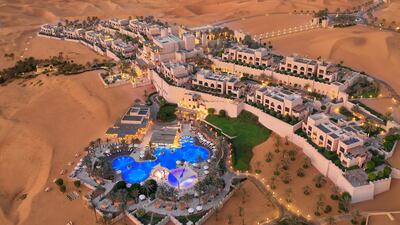
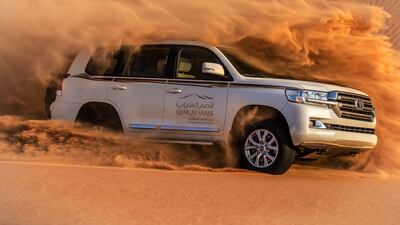
When the city is abuzz and the bright lights dazzle, the Middle East of yesteryear quietly beckons at the Empty Quarter’s Qasr Al Sarab Desert Resort by Anantara.
For almost 15 years, it has helped guests roll back the sands of time with total rest and relaxation; and it recently recorded its busiest night of bookings.
As its popularity goes from strength to strength, The National answered its gentle call.
The welcome
From the first encounter with security at the gates to the last interaction with the concierge, there are huge smiles on faces.
All staff live on-site, meaning there is a genuine sense of camaraderie within the team and it hums throughout the property.
The neighbourhood
A word of advice: fill up with petrol before getting on the E65 connecting Abu Dhabi and the hotel as there is only one fuel station on the way — it's located somewhere between the signpost marking the exact spot of the Tropic of Cancer and my wits' end. Luckily, we trundle into it before breaking down in — literally — the middle of nowhere, having watched the last bar on the fuel gauge blink thirstily for the past 38 minutes.
Approaching the resort, which sits close to the Saudi Arabian border, we turn on to a private road leading us to the 1.8km-long resort which folds into the rolling red and gold dunes of the world’s second-largest sand desert.
It’s about a two-hour drive from Abu Dhabi and three hours from Dubai.
The room
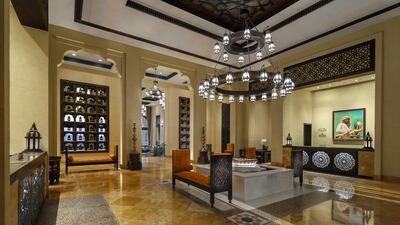
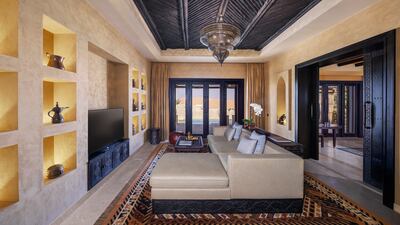
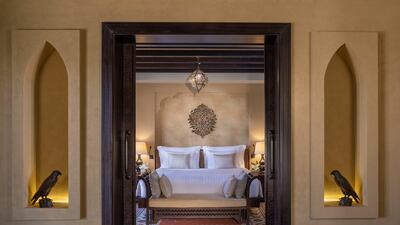
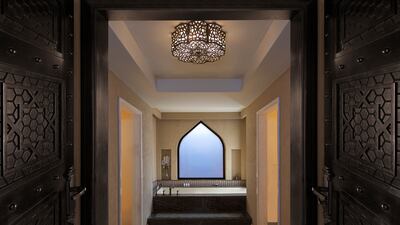
The 207 rooms, as well as the suites, villas and the lobby itself, offer a grand smorgasbord of Bedouin heritage and Emirati opulence, earthy hues and rich embroidery, sun-beaten antiques and vibrant abstract art.
The rooms sprawl out across the low-rise property like sun-kissed cubes in the otherworldly landscape — the Oscar-winning dystopian sci-fi hit Dune and its upcoming sequel were shot nearby, and cast members stayed in the Anantara property.
The standard rooms (if there is such a thing here), family villas and royal villas are linked by quiet pathways that zigzag throughout the resort, with only the occasional electric cart trundling along with guests in tow to break the silence.
Pool villas are surrounded by palm trees and fences, with dining areas and kitchenettes, lounges, vast bedrooms with super-king-sized beds and generous bathrooms.
French doors lead outside, where seating areas, with plunge pools, comfy sun loungers and a double cabana await.
The scene
Complementing its considerable natural charm, the area is also a conservation project operated by the Environment Agency — Abu Dhabi, with breeding programmes for wildlife, including extending the one that successfully saved the oryx from extinction.
There is a growing animal centre on-site, operated by a specialised team and where gazelles have recently moved in alongside camels. It is also home to falcons and salukis, with several greenhouses using recycled water to produce crops and more on the way. It's a springboard where guests can learn about the animals that have mastered the art of desert survival. None more so than camels, or the “ships of the desert”. Guests can set sail on one as part of morning or evening walks, where retired racers or former stars of beauty pageants shuffle riders back in time.
My journeyman Boba may have called it a day on his track career, but there’s still life in the old boy as he breaks rank and overtakes the line of camels (all muzzled, “because they’ll literally stop and chew everything,” our guide reveals) as we learn about them. They can smell water up to 75km away, produce faeces dry enough to be used as fire starters, rarely sweat and use those long, lavish eyelashes to keep out sand and dust. They’re basically the Swiss Army knife of desert survival, with a hump, which itself stores fat to keep the camels going during particularly arduous treks.
Elsewhere, the hotel offers a meditation and wellness centre as well as an extensive spa. I leave my wife to the latter (“The massage was so relaxing, I woke myself up snoring on the table … twice,” she confesses) and take advantage of being in serene landscapes by making a beeline back to the surrounding dunes.
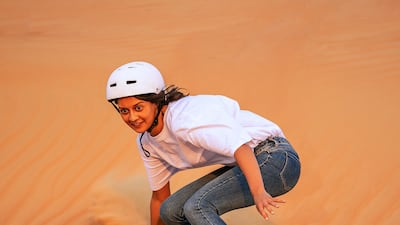
The best way to soak it all in is at the top of the biggest, which stands at 250 metres. I grab a sandboard and some water before charging to the top for sunset — then sliding back down.
The food
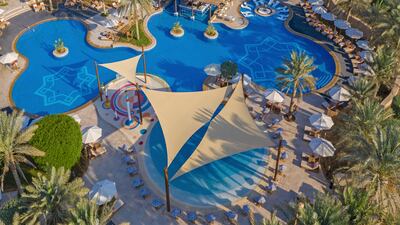
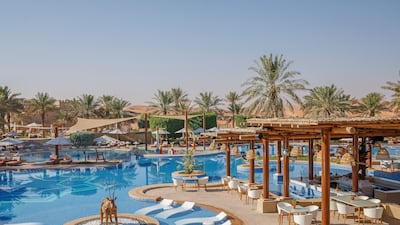
Breakfast at Al Waha, needless to say, is a royal banquet of live cooking stations, fresh fruits and cereals, vegan and gluten-free corners, pastries and noodles, eggs and manakish, juices and smoothies. Suhail is an upscale steakhouse with its own dry-ageing room and rooftop sunset terrace facing the dunes. Ghadeer is a relaxed restaurant next to the family pool serving Mediterranean cuisine.
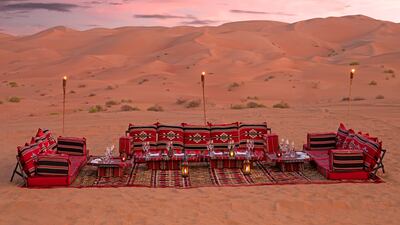
In the cooler months, the outdoor Bedouin-style dinner Al Falaj by Dina Macki (Dh400 per adult, Dh200 for those aged four to 11) is a must. It's hosted under the stars and celebrates traditional Middle Eastern cuisine with a contemporary twist from the charming British-Omani chef. Do not leave without trying the hummus with roasted peaches and 24-hour marinated lamb shuwa.
Highs and lows
The resort’s biggest success story is undoubtedly its staff. “We’re like one big family,” one member reveals. And, as cheesy as it sounds, it appears to be abundantly true.
The only low is leaving, if only I had my trusty steed Boba for the journey back to Dubai. At least he wouldn’t run out of petrol.
The insider tip
Sunrises and sunsets to savour reign supreme here — grab a picnic, head for the tallest dune and breathe it all in.
The verdict
For those looking to lose themselves in the desert or visit one of the UAE’s great wildlife experiences, this blockbuster hotel with a golden history has myriad opportunities to do so.
The bottom line
Stays from Dh2,300 including breakfast, excluding taxes. Check-in is from 3pm, check-out is by noon; www.anantara.com
This review was conducted at the invitation of the hotel. It reflects hotel standards during this time, services may change in the future

500 People from Gaza enter France
115 Special programme for artists
25 Evacuation of injured and sick
WITHIN%20SAND
%3Cp%3EDirector%3A%20Moe%20Alatawi%3C%2Fp%3E%0A%3Cp%3EStarring%3A%20Ra%E2%80%99ed%20Alshammari%2C%20Adwa%20Fahd%2C%20Muhand%20Alsaleh%3C%2Fp%3E%0A%3Cp%3ERating%3A%203%2F5%3C%2Fp%3E%0A
UAE currency: the story behind the money in your pockets
360Vuz PROFILE
Date started: January 2017
Founder: Khaled Zaatarah
Based: Dubai and Los Angeles
Sector: Technology
Size: 21 employees
Funding: $7 million
Investors: Shorooq Partners, KBW Ventures, Vision Ventures, Hala Ventures, 500Startups, Plug and Play, Magnus Olsson, Samih Toukan, Jonathan Labin
Family reunited
Nazanin Zaghari-Ratcliffe was born and raised in Tehran and studied English literature before working as a translator in the relief effort for the Japanese International Co-operation Agency in 2003.
She moved to the International Federation of Red Cross and Red Crescent Societies before moving to the World Health Organisation as a communications officer.
She came to the UK in 2007 after securing a scholarship at London Metropolitan University to study a master's in communication management and met her future husband through mutual friends a month later.
The couple were married in August 2009 in Winchester and their daughter was born in June 2014.
She was held in her native country a year later.
More from Rashmee Roshan Lall
The%20specs
%3Cp%3E%3Cstrong%3EEngine%3A%20%3C%2Fstrong%3E2.3-litre%204cyl%20turbo%0D%3Cbr%3E%3Cstrong%3EPower%3A%20%3C%2Fstrong%3E299hp%20at%205%2C500rpm%0D%3Cbr%3E%3Cstrong%3ETorque%3A%20%3C%2Fstrong%3E420Nm%20at%202%2C750rpm%0D%3Cbr%3E%3Cstrong%3ETransmission%3A%20%3C%2Fstrong%3E10-speed%20auto%0D%3Cbr%3E%3Cstrong%3EFuel%20consumption%3A%20%3C%2Fstrong%3E12.4L%2F100km%0D%3Cbr%3E%3Cstrong%3EOn%20sale%3A%20%3C%2Fstrong%3ENow%0D%3Cbr%3E%3Cstrong%3EPrice%3A%20%3C%2Fstrong%3EFrom%20Dh157%2C395%20(XLS)%3B%20Dh199%2C395%20(Limited)%3C%2Fp%3E%0A
FIGHT CARD
Welterweight Mostafa Radi (PAL) v Tohir Zhuraev (TJK)
Catchweight 75kg Leandro Martins (BRA) v Anas Siraj Mounir (MAR)
Flyweight Corinne Laframboise (CAN) v Manon Fiorot (FRA)
Featherweight Ahmed Al Darmaki (UAE) v Bogdan Kirilenko (UZB)
Lightweight Izzedine Al Derabani (JOR) v Atabek Abdimitalipov (KYG)
Featherweight Yousef Al Housani (UAE) v Mohamed Arsharq Ali (SLA)
Catchweight 69kg Jung Han-gook (KOR) v Elias Boudegzdame (ALG)
Catchweight 71kg Usman Nurmagomedov (RUS) v Jerry Kvarnstrom (FIN)
Featherweight title Lee Do-gyeom (KOR) v Alexandru Chitoran (ROU)
Lightweight title Bruno Machado (BRA) v Mike Santiago (USA)
Ruwais timeline
1971 Abu Dhabi National Oil Company established
1980 Ruwais Housing Complex built, located 10 kilometres away from industrial plants
1982 120,000 bpd capacity Ruwais refinery complex officially inaugurated by the founder of the UAE Sheikh Zayed
1984 Second phase of Ruwais Housing Complex built. Today the 7,000-unit complex houses some 24,000 people.
1985 The refinery is expanded with the commissioning of a 27,000 b/d hydro cracker complex
2009 Plans announced to build $1.2 billion fertilizer plant in Ruwais, producing urea
2010 Adnoc awards $10bn contracts for expansion of Ruwais refinery, to double capacity from 415,000 bpd
2014 Ruwais 261-outlet shopping mall opens
2014 Production starts at newly expanded Ruwais refinery, providing jet fuel and diesel and allowing the UAE to be self-sufficient for petrol supplies
2014 Etihad Rail begins transportation of sulphur from Shah and Habshan to Ruwais for export
2017 Aldar Academies to operate Adnoc’s schools including in Ruwais from September. Eight schools operate in total within the housing complex.
2018 Adnoc announces plans to invest $3.1 billion on upgrading its Ruwais refinery
2018 NMC Healthcare selected to manage operations of Ruwais Hospital
2018 Adnoc announces new downstream strategy at event in Abu Dhabi on May 13
Source: The National
The biog
Hobbies: Writing and running
Favourite sport: beach volleyball
Favourite holiday destinations: Turkey and Puerto Rico
Mercer, the investment consulting arm of US services company Marsh & McLennan, expects its wealth division to at least double its assets under management (AUM) in the Middle East as wealth in the region continues to grow despite economic headwinds, a company official said.
Mercer Wealth, which globally has $160 billion in AUM, plans to boost its AUM in the region to $2-$3bn in the next 2-3 years from the present $1bn, said Yasir AbuShaban, a Dubai-based principal with Mercer Wealth.
“Within the next two to three years, we are looking at reaching $2 to $3 billion as a conservative estimate and we do see an opportunity to do so,” said Mr AbuShaban.
Mercer does not directly make investments, but allocates clients’ money they have discretion to, to professional asset managers. They also provide advice to clients.
“We have buying power. We can negotiate on their (client’s) behalf with asset managers to provide them lower fees than they otherwise would have to get on their own,” he added.
Mercer Wealth’s clients include sovereign wealth funds, family offices, and insurance companies among others.
From its office in Dubai, Mercer also looks after Africa, India and Turkey, where they also see opportunity for growth.
Wealth creation in Middle East and Africa (MEA) grew 8.5 per cent to $8.1 trillion last year from $7.5tn in 2015, higher than last year’s global average of 6 per cent and the second-highest growth in a region after Asia-Pacific which grew 9.9 per cent, according to consultancy Boston Consulting Group (BCG). In the region, where wealth grew just 1.9 per cent in 2015 compared with 2014, a pickup in oil prices has helped in wealth generation.
BCG is forecasting MEA wealth will rise to $12tn by 2021, growing at an annual average of 8 per cent.
Drivers of wealth generation in the region will be split evenly between new wealth creation and growth of performance of existing assets, according to BCG.
Another general trend in the region is clients’ looking for a comprehensive approach to investing, according to Mr AbuShaban.
“Institutional investors or some of the families are seeing a slowdown in the available capital they have to invest and in that sense they are looking at optimizing the way they manage their portfolios and making sure they are not investing haphazardly and different parts of their investment are working together,” said Mr AbuShaban.
Some clients also have a higher appetite for risk, given the low interest-rate environment that does not provide enough yield for some institutional investors. These clients are keen to invest in illiquid assets, such as private equity and infrastructure.
“What we have seen is a desire for higher returns in what has been a low-return environment specifically in various fixed income or bonds,” he said.
“In this environment, we have seen a de facto increase in the risk that clients are taking in things like illiquid investments, private equity investments, infrastructure and private debt, those kind of investments were higher illiquidity results in incrementally higher returns.”
The Abu Dhabi Investment Authority, one of the largest sovereign wealth funds, said in its 2016 report that has gradually increased its exposure in direct private equity and private credit transactions, mainly in Asian markets and especially in China and India. The authority’s private equity department focused on structured equities owing to “their defensive characteristics.”
Benefits of first-time home buyers' scheme
- Priority access to new homes from participating developers
- Discounts on sales price of off-plan units
- Flexible payment plans from developers
- Mortgages with better interest rates, faster approval times and reduced fees
- DLD registration fee can be paid through banks or credit cards at zero interest rates
The%20specs%3A%20Taycan%20Turbo%20GT
%3Cp%3E%3Cstrong%3EEngine%3A%20%3C%2Fstrong%3EDual%20synchronous%20electric%20motors%0D%3Cbr%3E%3Cstrong%3EPower%3A%20%3C%2Fstrong%3E1%2C108hp%0D%3Cbr%3E%3Cstrong%3ETorque%3A%20%3C%2Fstrong%3E1%2C340Nm%0D%3Cbr%3E%3Cstrong%3ETransmission%3A%20%3C%2Fstrong%3ESingle-speed%20automatic%20(front%20axle)%3B%20two-speed%20transmission%20(rear%20axle)%0D%3Cbr%3E%3Cstrong%3ETouring%20range%3A%20%3C%2Fstrong%3E488-560km%0D%3Cbr%3E%3Cstrong%3EPrice%3A%20%3C%2Fstrong%3EFrom%20Dh928%2C400%0D%3Cbr%3E%3Cstrong%3EOn%20sale%3A%20%3C%2Fstrong%3EOrders%20open%3C%2Fp%3E%0A
What is graphene?
Graphene is a single layer of carbon atoms arranged like honeycomb.
It was discovered in 2004, when Russian-born Manchester scientists Andrei Geim and Kostya Novoselov were "playing about" with sticky tape and graphite - the material used as "lead" in pencils.
Placing the tape on the graphite and peeling it, they managed to rip off thin flakes of carbon. In the beginning they got flakes consisting of many layers of graphene. But as they repeated the process many times, the flakes got thinner.
By separating the graphite fragments repeatedly, they managed to create flakes that were just one atom thick. Their experiment had led to graphene being isolated for the very first time.
At the time, many believed it was impossible for such thin crystalline materials to be stable. But examined under a microscope, the material remained stable, and when tested was found to have incredible properties.
It is many times times stronger than steel, yet incredibly lightweight and flexible. It is electrically and thermally conductive but also transparent. The world's first 2D material, it is one million times thinner than the diameter of a single human hair.
But the 'sticky tape' method would not work on an industrial scale. Since then, scientists have been working on manufacturing graphene, to make use of its incredible properties.
In 2010, Geim and Novoselov were awarded the Nobel Prize for Physics. Their discovery meant physicists could study a new class of two-dimensional materials with unique properties.
Director: Laxman Utekar
Cast: Vicky Kaushal, Akshaye Khanna, Diana Penty, Vineet Kumar Singh, Rashmika Mandanna
Rating: 1/5
Some of Darwish's last words
"They see their tomorrows slipping out of their reach. And though it seems to them that everything outside this reality is heaven, yet they do not want to go to that heaven. They stay, because they are afflicted with hope." - Mahmoud Darwish, to attendees of the Palestine Festival of Literature, 2008
His life in brief: Born in a village near Galilee, he lived in exile for most of his life and started writing poetry after high school. He was arrested several times by Israel for what were deemed to be inciteful poems. Most of his work focused on the love and yearning for his homeland, and he was regarded the Palestinian poet of resistance. Over the course of his life, he published more than 30 poetry collections and books of prose, with his work translated into more than 20 languages. Many of his poems were set to music by Arab composers, most significantly Marcel Khalife. Darwish died on August 9, 2008 after undergoing heart surgery in the United States. He was later buried in Ramallah where a shrine was erected in his honour.