
I was in Rome for five days last week, spending much of my time looking at Italy through the lens of defence: military operations, naval capabilities, air power, counter-improvised explosive device expertise and the work behind some of the country’s most important security decisions.
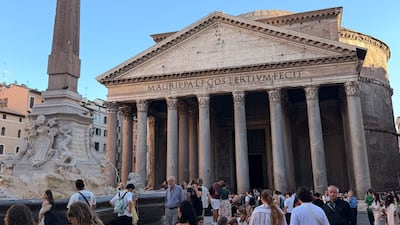
Then, at the end of the trip, I found myself standing beneath the dome of the Pantheon, looking up at the oculus and wondering how a building almost 2,000 years old had survived for so long.
It was an interesting way to end a programme organised by Italy’s Ministry of Defence for foreign media. It had taken me from the country’s joint operations command to its Army Counter-IED Centre of Excellence and Pratica di Mare Air Base. I had also interviewed Defence Minister Guido Crosetto about Italy’s role in a changing security landscape.

It had been a glimpse of modern Italy, concerned with military readiness, technology, alliances and the threats of today. The Pantheon offered another perspective.
I first visited Rome in 2022, so it was not my first time wandering its streets, stopping to admire its fountains, piazzas and layers of history. The city has a way of making the past feel like part of daily life rather than something preserved behind glass.
As my time in Rome drew to a close, visiting the Pantheon made me appreciate it in a different way.
The building is extraordinary even before you know its story. The vast concrete dome, the geometric coffers rising towards the 8.9m-wide oculus and the shaft of daylight falling into the circular interior make it easy to understand why the Pantheon continues to astonish visitors. Its dome, with an internal diameter of about 43 metres, remains the largest unreinforced concrete hemispherical dome in the world.

I was there with a tour guide and a lieutenant-colonel from the Carabinieri, Italy’s gendarmerie, which carries out policing duties at home and abroad.
“Look at the oculus above you,” said the guide. “You might think it’s covered with glass, but it isn’t. It’s completely open to the sky. And I know what you’re going to ask me: What do we do in winter?”
She smiled. “Nothing. It rains, of course, but the water falls through the opening. There are drainage holes in the floor to let it run away.”
She pointed to several small openings beneath our feet.
It was a simple explanation, but it made the building feel all the more remarkable. The Romans had designed it to accommodate the elements, and almost two millennia later, rain still falls through the same opening.

However, what fascinated me most was not just how the Romans built the Pantheon. It was how it survived.
A second life
The present structure dates to the reign of Emperor Hadrian, between AD 118 and 125, although an earlier temple commissioned by Marcus Vipsanius Agrippa had stood on the site. Centuries later, after the decline of the Roman Empire, the Pantheon fell into neglect and was looted.
“It was damaged and destroyed several times by devastating fires,” said the guide.
Then came the decision that would help determine its fate.
In AD 609, the Byzantine emperor Phocas gave the Pantheon to Pope Boniface IV, who consecrated it as a Christian church dedicated to Santa Maria ad Martyres. Its continued religious use helped protect it from the neglect and removal of building materials that affected many other ancient Roman structures during the Middle Ages, the guide explained.

There is something striking about that. The Pantheon was not preserved simply because it was too magnificent to destroy. Its conversion gave it a new purpose and helped protect it for centuries to come.
Its function changed, but the building endured. That stayed with me as I walked back through Rome.
During the previous days there, much of what I had seen was about preparing for the future: military personnel training for emerging threats, aircraft ready for operations and commanders assessing new defence priorities.
Mr Crosetto told me that Italy’s defence spending must continue to rise to meet Nato commitments, but that how the money is spent matters just as much. He highlighted the need for greater investment in counter-drone measures, artificial intelligence and integrated air defence.
The contrast with the Pantheon was hard to miss. Rome makes these differences easy to appreciate. Ancient columns stand beside busy cafes; ruins form part of ordinary streets; monuments that have witnessed emperors, wars and religious change remain woven into the life of the city.

When I stepped back into Piazza della Rotonda, the Pantheon stood amid restaurants, tourists and passing crowds, part of the everyday scene.
I had come to Rome to learn about Italy’s armed forces and how the country is responding to modern security challenges. Yet it was the visit at the end of the programme that left me thinking about how history survives.
The Pantheon’s story is a reminder that preserving the past does not always mean leaving it untouched. Sometimes, giving an old building a new purpose is what allows it to last.