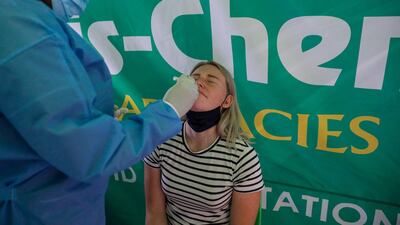
Omicron variant: which countries are restricting travel to and from African nations?


Ian Oxborrow
  • English
  • Arabic

Countries around the world have moved quickly to restrict travel to a number of southern African nations after the discovery of a new coronavirus variant, which has been named Omicron.

Curbs have been placed on travel to and from South Africa, Botswana, Zimbabwe, Namibia, Lesotho, Eswatini, Mozambique and in some cases Malawi.

The Covid-19 mutation as been designated a “variant of concern” by the World Health Organisation, which said: “This variant has a large number of mutations, some of which are concerning. Preliminary evidence suggests an increased risk of reinfection with this variant, as compared to other [variants of concern]."

The UK, the US, Australia and the UAE are among the nations to halt travel to southern Africa.

UK adds four more countries to red list

The UK added Angola, Mozambique, Malawi and Zambia from 4am on Sunday, joining South Africa, Botswana, Lesotho, Eswatini, Zimbabwe and Namibia.

"We're not going to stop people travelling, but we will require anyone who enters the UK to take a PCR test by the end of the second day after their arrival and to self-isolate until they have a negative result," UK Prime Minister Boris Johnson said on Saturday.

Dutch health authorities said that 61 people who arrived in Amsterdam on two flights from South Africa on Friday tested positive for Covid-19, and they were conducting further testing early on Saturday to see if any of the infections are with the recently discovered Omicron variant.

The Dutch government banned all air travel from southern Africa early on Friday.

  • Travellers queue for PCR tests at OR Tambo International Airport in Johannesburg after several countries banned flights from South Africa following the discovery of the Omicron coronavirus variant. AFP
    Travellers queue for PCR tests at OR Tambo International Airport in Johannesburg after several countries banned flights from South Africa following the discovery of the Omicron coronavirus variant. AFP
  • A healthcare worker tests a passenger at OR Tambo International Airport in Johannesburg. Several countries across the world have banned ban flights from southern Africa following the discovery of the Omicron variant. AFP
    A healthcare worker tests a passenger at OR Tambo International Airport in Johannesburg. Several countries across the world have banned ban flights from southern Africa following the discovery of the Omicron variant. AFP
  • A healthcare worker helps a traveller to obtain his PCR test result at OR Tambo International Airport in Johannesburg, after several countries banned flights from South Africa following the discovery of a new coronavirus variant called Omicron. AFP
    A healthcare worker helps a traveller to obtain his PCR test result at OR Tambo International Airport in Johannesburg, after several countries banned flights from South Africa following the discovery of a new coronavirus variant called Omicron. AFP
  • Travellers queue at a check-in counter at OR Tambo International Airport in Johannesburg, after several countries banned flights from South Africa. AFP
    Travellers queue at a check-in counter at OR Tambo International Airport in Johannesburg, after several countries banned flights from South Africa. AFP
  • Several countries across the world have banned flights from southern Africa following the discovery of the Omicron variant. AFP
    Several countries across the world have banned flights from southern Africa following the discovery of the Omicron variant. AFP
  • A passenger checks a noticeboard displaying cancelled flights at OR Tambo International Airport in Johannesburg. AFP
    A passenger checks a noticeboard displaying cancelled flights at OR Tambo International Airport in Johannesburg. AFP
  • Noticeboards display cancelled flights at OR Tambo International Airport in Johannesburg. AFP
    Noticeboards display cancelled flights at OR Tambo International Airport in Johannesburg. AFP
  • Passengers wait to board flights at OR Tambo International Airport in Johannesburg. Reuters
    Passengers wait to board flights at OR Tambo International Airport in Johannesburg. Reuters
  • People wait at OR Tambo International Airport in Johannesburg. Many nations moved to stop air travel from southern Africa on Friday in reaction to news of the Omicron coronavirus variant that was detected in South Africa. AP
    People wait at OR Tambo International Airport in Johannesburg. Many nations moved to stop air travel from southern Africa on Friday in reaction to news of the Omicron coronavirus variant that was detected in South Africa. AP
  • People line up to get on a flight to Paris at OR Tambo International Airport in Johannesburg, South Africa. Many nations have halted air travel from southern Africa in reaction to news of a new, potentially more transmissible coronavirus variant. AP
    People line up to get on a flight to Paris at OR Tambo International Airport in Johannesburg, South Africa. Many nations have halted air travel from southern Africa in reaction to news of a new, potentially more transmissible coronavirus variant. AP
  • Flights are cancelled at Cape Town International Airport. Antonie Robertson / The National
    Flights are cancelled at Cape Town International Airport. Antonie Robertson / The National

Financial effect

Markets plunged on Friday, with stocks of airlines and others in the travel sector hit particularly hard.

Investors said they were worried the variant could cause another surge in the pandemic and stall a global recovery. Oil prices tumbled by about $10 a barrel.

Countries restricting travel to Africa

Australia

Austria

Bahrain

Brazil

Cyprus

Czech Republic

Egypt

France

Germany

Guatemala

Iran

Ireland

Israel

Italy

Jordan

Morocco

Netherlands

Oman

Philippines

Qatar

Russia

Saudi Arabia

Sri Lanka

Thailand

UAE

UK

US

_________________

More Omicron coverage

Company%C2%A0profile
%3Cp%3E%3Cstrong%3ECompany%20name%3A%20%3C%2Fstrong%3ELeap%0D%3Cbr%3E%3Cstrong%3EStarted%3A%20%3C%2Fstrong%3EMarch%202021%0D%3Cbr%3E%3Cstrong%3EFounders%3A%3C%2Fstrong%3E%20Ziad%20Toqan%20and%20Jamil%20Khammu%0D%3Cbr%3E%3Cstrong%3EBased%3A%3C%2Fstrong%3E%20Dubai%0D%3Cbr%3E%3Cstrong%3ESector%3A%20%3C%2Fstrong%3EFinTech%0D%3Cbr%3E%3Cstrong%3EInvestment%20stage%3A%20%3C%2Fstrong%3EPre-seed%0D%3Cbr%3E%3Cstrong%3EFunds%20raised%3A%3C%2Fstrong%3E%20Undisclosed%0D%3Cbr%3E%3Cstrong%3ECurrent%20number%20of%20staff%3A%20%3C%2Fstrong%3ESeven%3C%2Fp%3E%0A
The biog

Nickname: Mama Nadia to children, staff and parents

Education: Bachelors degree in English Literature with Social work from UAE University

As a child: Kept sweets on the window sill for workers, set aside money to pay for education of needy families

Holidays: Spends most of her days off at Senses often with her family who describe the centre as part of their life too

Timeline

2012-2015

The company offers payments/bribes to win key contracts in the Middle East

May 2017

The UK SFO officially opens investigation into Petrofac’s use of agents, corruption, and potential bribery to secure contracts

September 2021

Petrofac pleads guilty to seven counts of failing to prevent bribery under the UK Bribery Act

October 2021

Court fines Petrofac £77 million for bribery. Former executive receives a two-year suspended sentence 

December 2024

Petrofac enters into comprehensive restructuring to strengthen the financial position of the group

May 2025

The High Court of England and Wales approves the company’s restructuring plan

July 2025

The Court of Appeal issues a judgment challenging parts of the restructuring plan

August 2025

Petrofac issues a business update to execute the restructuring and confirms it will appeal the Court of Appeal decision

October 2025

Petrofac loses a major TenneT offshore wind contract worth €13 billion. Holding company files for administration in the UK. Petrofac delisted from the London Stock Exchange

November 2025

180 Petrofac employees laid off in the UAE

'Jurassic%20World%20Dominion'
%3Cp%3EDirector%3A%20Colin%20Trevorrow%3C%2Fp%3E%0A%3Cp%3EStars%3A%20Sam%20Neill%2C%20Laura%20Dern%2C%20Jeff%20Goldblum%2C%20Bryce%20Dallas%20Howard%2C%20Chris%20Pratt%3C%2Fp%3E%0A%3Cp%3ERating%3A%204%2F5%3C%2Fp%3E%0A
UAE currency: the story behind the money in your pockets

Mercer, the investment consulting arm of US services company Marsh & McLennan, expects its wealth division to at least double its assets under management (AUM) in the Middle East as wealth in the region continues to grow despite economic headwinds, a company official said.

Mercer Wealth, which globally has $160 billion in AUM, plans to boost its AUM in the region to $2-$3bn in the next 2-3 years from the present $1bn, said Yasir AbuShaban, a Dubai-based principal with Mercer Wealth.

Within the next two to three years, we are looking at reaching $2 to $3 billion as a conservative estimate and we do see an opportunity to do so,” said Mr AbuShaban.

Mercer does not directly make investments, but allocates clients’ money they have discretion to, to professional asset managers. They also provide advice to clients.

“We have buying power. We can negotiate on their (client’s) behalf with asset managers to provide them lower fees than they otherwise would have to get on their own,” he added.

Mercer Wealth’s clients include sovereign wealth funds, family offices, and insurance companies among others.

From its office in Dubai, Mercer also looks after Africa, India and Turkey, where they also see opportunity for growth.

Wealth creation in Middle East and Africa (MEA) grew 8.5 per cent to $8.1 trillion last year from $7.5tn in 2015, higher than last year’s global average of 6 per cent and the second-highest growth in a region after Asia-Pacific which grew 9.9 per cent, according to consultancy Boston Consulting Group (BCG). In the region, where wealth grew just 1.9 per cent in 2015 compared with 2014, a pickup in oil prices has helped in wealth generation.

BCG is forecasting MEA wealth will rise to $12tn by 2021, growing at an annual average of 8 per cent.

Drivers of wealth generation in the region will be split evenly between new wealth creation and growth of performance of existing assets, according to BCG.

Another general trend in the region is clients’ looking for a comprehensive approach to investing, according to Mr AbuShaban.

“Institutional investors or some of the families are seeing a slowdown in the available capital they have to invest and in that sense they are looking at optimizing the way they manage their portfolios and making sure they are not investing haphazardly and different parts of their investment are working together,” said Mr AbuShaban.

Some clients also have a higher appetite for risk, given the low interest-rate environment that does not provide enough yield for some institutional investors. These clients are keen to invest in illiquid assets, such as private equity and infrastructure.

“What we have seen is a desire for higher returns in what has been a low-return environment specifically in various fixed income or bonds,” he said.

“In this environment, we have seen a de facto increase in the risk that clients are taking in things like illiquid investments, private equity investments, infrastructure and private debt, those kind of investments were higher illiquidity results in incrementally higher returns.”

The Abu Dhabi Investment Authority, one of the largest sovereign wealth funds, said in its 2016 report that has gradually increased its exposure in direct private equity and private credit transactions, mainly in Asian markets and especially in China and India. The authority’s private equity department focused on structured equities owing to “their defensive characteristics.”

TOP 5 DRIVERS 2019

1 Lewis Hamilton, Mercedes, 10 wins 387 points

2 Valtteri Bottas, Mercedes, 4 wins, 314 points

3 Max Verstappen, Red Bull, 3 wins, 260 points

4 Charles Leclerc, Ferrari, 2 wins, 249 points

5 Sebastian Vettel, Ferrari, 1 win, 230 points

Analysis

Members of Syria's Alawite minority community face threat in their heartland after one of the deadliest days in country’s recent history. Read more

What the law says

Micro-retirement is not a recognised concept or employment status under Federal Decree Law No. 33 of 2021 on the Regulation of Labour Relations (as amended) (UAE Labour Law). As such, it reflects a voluntary work-life balance practice, rather than a recognised legal employment category, according to Dilini Loku, senior associate for law firm Gateley Middle East.

“Some companies may offer formal sabbatical policies or career break programmes; however, beyond such arrangements, there is no automatic right or statutory entitlement to extended breaks,” she explains.

“Any leave taken beyond statutory entitlements, such as annual leave, is typically regarded as unpaid leave in accordance with Article 33 of the UAE Labour Law. While employees may legally take unpaid leave, such requests are subject to the employer’s discretion and require approval.”

If an employee resigns to pursue micro-retirement, the employment contract is terminated, and the employer is under no legal obligation to rehire the employee in the future unless specific contractual agreements are in place (such as return-to-work arrangements), which are generally uncommon, Ms Loku adds.

COMPANY%20PROFILE
%3Cp%3E%3Cstrong%3EName%3A%20%3C%2Fstrong%3EKinetic%207%3Cbr%3E%3Cstrong%3EStarted%3A%3C%2Fstrong%3E%202018%3Cbr%3E%3Cstrong%3EFounder%3A%3C%2Fstrong%3E%20Rick%20Parish%3Cbr%3E%3Cstrong%3EBased%3A%3C%2Fstrong%3E%20Abu%20Dhabi%2C%20UAE%3Cbr%3E%3Cstrong%3EIndustry%3A%3C%2Fstrong%3E%20Clean%20cooking%3Cbr%3E%3Cstrong%3EFunding%3A%3C%2Fstrong%3E%20%2410%20million%3Cbr%3E%3Cstrong%3EInvestors%3A%3C%2Fstrong%3E%20Self-funded%3C%2Fp%3E%0A
Updated: December 06, 2021, 7:08 AM