• Emma Raducanu of Great Britain poses with the championship trophy after defeating Leylah Annie Fernandez of Canada to win the 2021 women's US Open. AFP
    Emma Raducanu of Great Britain poses with the championship trophy after defeating Leylah Annie Fernandez of Canada to win the 2021 women's US Open. AFP
  • Emma Raducanu, of Britain, poses outside Arthur Ashe Stadium with the championship trophy. AP Photo
    Emma Raducanu, of Britain, poses outside Arthur Ashe Stadium with the championship trophy. AP Photo
  • Leylah Fernandez of Canada reacts after winning a point against Emma Raducanu of Great Britain. Reuters
    Leylah Fernandez of Canada reacts after winning a point against Emma Raducanu of Great Britain. Reuters
  • Britain's Emma Raducanu celebrates with the trophy after winning the 2021 US Open. AFP
    Britain's Emma Raducanu celebrates with the trophy after winning the 2021 US Open. AFP
  • Emma Raducanu of Great Britain celebrates with the championship trophy after defeating Leylah Annie Fernandez of Canada. Getty Images
    Emma Raducanu of Great Britain celebrates with the championship trophy after defeating Leylah Annie Fernandez of Canada. Getty Images
  • Leylah Annie Fernandez of Canada celebrates with the runner-up trophy. AFP
    Leylah Annie Fernandez of Canada celebrates with the runner-up trophy. AFP
  • The bloodied knee of Britain's Emma Raducanu is seen as she celebrates after winning the 2021 US Open. AFP
    The bloodied knee of Britain's Emma Raducanu is seen as she celebrates after winning the 2021 US Open. AFP
  • Britain's Emma Raducanu celebrates after winning the 2021 US Open. AFP
    Britain's Emma Raducanu celebrates after winning the 2021 US Open. AFP
  • Britain's Emma Raducanu hugs Canada's Leylah Fernandez after winning the 2021 US Open. AFP
    Britain's Emma Raducanu hugs Canada's Leylah Fernandez after winning the 2021 US Open. AFP
  • Emma Raducanu of Great Britain celebrates with the championship trophy and ball kids after defeating Leylah Annie Fernandez of Canada. AFP
    Emma Raducanu of Great Britain celebrates with the championship trophy and ball kids after defeating Leylah Annie Fernandez of Canada. AFP
  • Leylah Annie Fernandez of Canada holds the runner-up trophy as Emma Raducanu of Great Britain celebrates with the championship trophy alongside Billie Jean King, Stacey Allaster, USTA Chief Executive, and USTA President Mike McNulty. AFP
    Leylah Annie Fernandez of Canada holds the runner-up trophy as Emma Raducanu of Great Britain celebrates with the championship trophy alongside Billie Jean King, Stacey Allaster, USTA Chief Executive, and USTA President Mike McNulty. AFP
  • Fans watch British teenager Emma Raducanu compete with Canadian teenager Leylah Fernandez in the US Open final at The Parklangley Club, in Beckenham, England. AP
    Fans watch British teenager Emma Raducanu compete with Canadian teenager Leylah Fernandez in the US Open final at The Parklangley Club, in Beckenham, England. AP
  • Emma Raducanu of Great Britain celebrates defeating Leylah Annie Fernandez of Canada. AFP
    Emma Raducanu of Great Britain celebrates defeating Leylah Annie Fernandez of Canada. AFP
  • Leylah Annie Fernandez of Canada holds the runner-up trophy as Emma Raducanu of Great Britain celebrates with the championship trophy. AFP
    Leylah Annie Fernandez of Canada holds the runner-up trophy as Emma Raducanu of Great Britain celebrates with the championship trophy. AFP
  • Emma Raducanu of Great Britain celebrate. AFP
    Emma Raducanu of Great Britain celebrate. AFP
  • Emma Raducanu of Great Britain returns the ball against Leylah Annie Fernandez of Canada. AFP
    Emma Raducanu of Great Britain returns the ball against Leylah Annie Fernandez of Canada. AFP
  • Suzanne Williams, Strength and Conditioning coach for Emma Raducanu aged 8-12, watches the US Open tennis match remotely at the Parklangley Club in Beckenham, England, as she celebrates Raducanu winning. PA
    Suzanne Williams, Strength and Conditioning coach for Emma Raducanu aged 8-12, watches the US Open tennis match remotely at the Parklangley Club in Beckenham, England, as she celebrates Raducanu winning. PA
  • Emma Raducanu of Great Britain celebrates winning championship point to defeat Leylah Annie Fernandez of Canada. AFP
    Emma Raducanu of Great Britain celebrates winning championship point to defeat Leylah Annie Fernandez of Canada. AFP
  • Leylah Fernandez of Canada hits a backhand against Emma Raducanu of Great Britain. Reuters
    Leylah Fernandez of Canada hits a backhand against Emma Raducanu of Great Britain. Reuters
  • Emma Raducanu of Great Britain celebrates with fans. EPA
    Emma Raducanu of Great Britain celebrates with fans. EPA
  • Britain's Emma Raducanu celebrates with the trophy. AFP
    Britain's Emma Raducanu celebrates with the trophy. AFP
  • Emma Raducanu of Great Britain reacts after defeating Lelyah Fernandez of Canada to win the US Open final. EPA
    Emma Raducanu of Great Britain reacts after defeating Lelyah Fernandez of Canada to win the US Open final. EPA

Djokovic and Raducanu shine but Laver Cup falls flat: Highs and lows of 2021 tennis season


  • English
  • Arabic

The ATP and WTA Tour seasons came to their respective conclusions this month with the season-ending Finals. While this week’s Davis Cup extends the tennis year for another seven days, most players are taking a well-earned break before doing it all over again in January.

With the 2021 campaign now consigned to the record books, here is a look at some of the highs and lows from the past 12 months.

Highs

Djokovic (almost) unstoppable

Such has become the expectations of dominance associated with Novak Djokovic that 2021 will be viewed as an opportunity missed to complete the calendar Grand Slam, rather than the fact he put himself in a position to achieve it in the first place.

Djokovic, 34, was within one win at the US Open to joining Rod Laver as the only men to win all four majors in the same season. He had cruised to a record-extending ninth Australian Open title and was similarly untroubled on his march to a sixth Wimbledon crown. The Serb was pushed much closer by Stefanos Tsitsipas in a five-set epic at Roland Garros, but his brilliance and resilience ultimately shone through.

Daniil Medvedev may have prevented Djokovic from attaining that particular piece of tennis history, but it was still a phenomenal season from the world No 1, who moved level with Roger Federer and Rafael Nadal on 20 Grand Slam titles and ended the season top of the rankings for a record seventh year.

Throw in another two titles, in Belgrade and at the Paris Masters, and a win-loss record of 51-7, and it was another remarkable year for the game's best player.

  • Novak Djokovic celebrates after beating Matteo Berrettini in the Wimbledon final at the All England Club on Sunday, July 11, 2021. Reuters
    Novak Djokovic celebrates after beating Matteo Berrettini in the Wimbledon final at the All England Club on Sunday, July 11, 2021. Reuters
  • Serbia's Novak Djokovic celebrates after sealing his 20th Grand Slam title. EPA
    Serbia's Novak Djokovic celebrates after sealing his 20th Grand Slam title. EPA
  • Novak Djokovic has now won Wimbledon six times. AFP
    Novak Djokovic has now won Wimbledon six times. AFP
  • Novak Djokovic celebrates winning match point against Matteo Berrettini of Italy. Getty
    Novak Djokovic celebrates winning match point against Matteo Berrettini of Italy. Getty
  • Novak Djokovic after sealing victory on Centre Court.
    Novak Djokovic after sealing victory on Centre Court.
  • Novak Djokovic at full stretch. Getty
    Novak Djokovic at full stretch. Getty
  • Matteo Berrettini celebrates winning a point during the final. Getty
    Matteo Berrettini celebrates winning a point during the final. Getty
  • Novak Djokovic plays an unorthodox return. AFP
    Novak Djokovic plays an unorthodox return. AFP
  • Matteo Berrettini plays a shot against Djokovic. PA
    Matteo Berrettini plays a shot against Djokovic. PA
  • Action on Centre Court during the final. PA
    Action on Centre Court during the final. PA
  • Novak Djokovic plays a forehand. Getty
    Novak Djokovic plays a forehand. Getty
  • Novak Djokovic celebrates during the third set. Getty
    Novak Djokovic celebrates during the third set. Getty
  • Matteo Berrettini plays a shot between his legs. PA
    Matteo Berrettini plays a shot between his legs. PA
  • Novak Djokovic plays a backhand. Getty
    Novak Djokovic plays a backhand. Getty
  • Novak Djokovic returns from an unlikely position. EPA
    Novak Djokovic returns from an unlikely position. EPA
  • Matteo Berrettini during the final. AP
    Matteo Berrettini during the final. AP
  • Novak Djokovic plays a drop shot. Getty
    Novak Djokovic plays a drop shot. Getty
  • Novak Djokovic during the match. EPA
    Novak Djokovic during the match. EPA
  • Novak Djokovic plays a shot on Centre Court. Getty
    Novak Djokovic plays a shot on Centre Court. Getty
  • Matteo Berrettini during the final. Reuters
    Matteo Berrettini during the final. Reuters

Norway’s trailblazer

Norway has long been a powerhouse in winter sports, and has produced its share of top-level footballers too, but tennis players from the Scandinavian nation have been few and far between. Step forward Casper Ruud, who must be accustomed to creating Norwegian tennis history by now.

Ruud, 22, became the first Norwegian to win an ATP Tour title last season and he has built on that in 2021 in fine style, winning five titles and surging to No 8 in the world rankings. He is the highest-ranked player in the history of Norwegian tennis, surpassing his father Christian, who reached a career-high 39th.

Deemed a clay-court specialist, Ruud proved he has the game for different surfaces by winning the San Diego title and reaching the semi-finals at the ATP Finals in debut. A bright future awaits.

Casper Ruud won five titles in 2021 and reached No 8 in the rankings. EPA

Masters prizes get shared around

Outside of the four majors, the biggest prizes on the ATP Tour are found at the nine Masters 1000 tournaments dotted across the globe.

During the 'Big Three' era, these titles were largely shared between Djokovic, Federer, and Nadal, with Andy Murray helping himself to a few along the way. This year, though, the eight Masters titles (Shanghai was cancelled due to the pandemic) saw a variety of winners.

Alexander Zverev was the only multiple champion, winning both Madrid and Cincinnati as part of a superb season that also included the Olympic gold medal and ATP Finals title. Hubert Hurkacz, Stefanos Tsitsipas, and Cameron Norrie all won their first Masters titles in Miami, Monte Carlo and Indian Wells respectively, while Medvedev was triumphant in Canada.

Of course, there were still the obligatory titles for Nadal (Rome) and Djokovic (Paris), so the old guard is not quite done yet. But this year suggested that, in a post-Big Three era the bigger prizes might be contested by a wider field of players.

Murray’s reasons for optimism

The past three-and-a-half years have largely been full of uncertainty and setbacks for Andy Murray as the former world No 1 underwent two hip surgeries in a bid to save his career.

It has been a long road back for Murray, and he still has some way to go until he rediscovers the form that won him three major titles. But there have been reasons for optimism in 2021.

Murray, 34, claimed two victories over top-10 opponents in the space of two weeks this Autumn and pushed Tsitsipas to five sets at the US Open. Most importantly, he was active this year, competing in 16 events across the ATP and Challenger tours.

As the season entered its final weeks, it was clear the Scot was making huge improvements and as one of the most popular players among his fellow pros and fans alike, there is widespread hope that he can continue trending in the right direction in 2022.

Andy Murray has made encouraging progress in 2021. AP

Raducanu’s New York history

If the 2021 season was to be remembered for one story alone, that accolade will undoubtedly go to Emma Raducanu's US Open triumph.

The British teenager had already hit the headlines for reaching the Wimbledon fourth round on debut, but no one could anticipate what would happen in New York two months later. After navigating her way through qualifying, Raducanu, then 18, proceeded to march through the main draw to win her first major title without dropping a set. It was her first WTA Tour title of any kind.

Having created several pieces of history and established herself as tennis' next big star, Raducanu's form has dipped since the US Open, which is hardly surprising given her lack of experience. Still, it appears that the sky is the limit.

  • Emma Raducanu after beating Shelby Rogers on day eight of the 2021 US Open. USA TODAY Sports
    Emma Raducanu after beating Shelby Rogers on day eight of the 2021 US Open. USA TODAY Sports
  • Emma Raducanu on her way to booking a place in the last eight. AP
    Emma Raducanu on her way to booking a place in the last eight. AP
  • Emma Raducanu waves to the crowd. AP
    Emma Raducanu waves to the crowd. AP
  • Shelby Rogers, of the United States, returns a shot against Emma Raducanu. AP
    Shelby Rogers, of the United States, returns a shot against Emma Raducanu. AP
  • Emma Raducanu returns a shot against Shelby Rogers. AP
    Emma Raducanu returns a shot against Shelby Rogers. AP
  • Emma Raducanu celebrates after winning her match. AP
    Emma Raducanu celebrates after winning her match. AP
  • Emma Raducanu celebrates after beating Shelby Rogers. AP
    Emma Raducanu celebrates after beating Shelby Rogers. AP
  • Emma Raducanu at the net after beating Shelby Rogers. USA TODAY Sports
    Emma Raducanu at the net after beating Shelby Rogers. USA TODAY Sports

Barty quietly stays top

Ashleigh Barty ended the season as the WTA Tour's top-ranked player for a second successive year, and while it felt like an understated season from the Australian, in truth it was hugely successful. Barty, 25, only competed in 13 tournaments all year but won four of them, including a second Grand Slam title at Wimbledon.

Perhaps it was her absence from the WTA Finals and the fact she called time on her year after the US Open, but with Australia loosening its travel restrictions, hopefully 2022 will see more of Barty - although her rivals may disagree.

Ashleigh Barty had a limited season but still won four titles, including Wimbledon. AP

Jabuer continues making history

Ons Jabeur's immense talent has never been in doubt, but previously her results perhaps did not reflect her ability and potential. That all changed in 2021 as Jabeur set about making more history as the Arab world's leading tennis star.

The Tunisian ticked off another milestone as the first Arab woman to win a WTA Tour title when she lifted the Birmingham Classic trophy, before becoming the first woman from the region to reach the Wimbledon quarter-finals.

Jabeur reached a career-high No 7 - the highest-ever ranked Arab player, female or male - before injury toward the end of the season scuppered her shot at reaching the WTA Finals. The 27-year-old is one of the most exciting players on tour and after her 2021 breakthrough, 2022 looks primed to be another big year.

  • Tunisia's Ons Jabeur celebrates after defeating Poland's Iga Swiatek during the women's singles fourth round at Wimbledon.
    Tunisia's Ons Jabeur celebrates after defeating Poland's Iga Swiatek during the women's singles fourth round at Wimbledon.
  • Tunisia's Ons Jabeur on her way to a n historic victory against Poland's Iga Swiatek.
    Tunisia's Ons Jabeur on her way to a n historic victory against Poland's Iga Swiatek.
  • Tunisia's Ons Jabeur on her way to victory against Poland's Iga Swiatek.
    Tunisia's Ons Jabeur on her way to victory against Poland's Iga Swiatek.
  • Tunisia's Ons Jabeur, left, shakes hand with Poland's Iga Swiatek.
    Tunisia's Ons Jabeur, left, shakes hand with Poland's Iga Swiatek.
  • Tunisia's Ons Jabeur on her way to victory against Poland's Iga Swiatek.
    Tunisia's Ons Jabeur on her way to victory against Poland's Iga Swiatek.
  • Tunisia's Ons Jabeur on her way to victory against Poland's Iga Swiatek.
    Tunisia's Ons Jabeur on her way to victory against Poland's Iga Swiatek.
  • Poland's Iga Swiatek falls after playing a shot between her legs to Ons Jabeur.
    Poland's Iga Swiatek falls after playing a shot between her legs to Ons Jabeur.
  • Poland's Iga Swiatek falls after playing a shot between her legs to Ons Jabeur.
    Poland's Iga Swiatek falls after playing a shot between her legs to Ons Jabeur.

Osaka starts mental health conversation

Naomi Osaka looked set for a season of domination when she captured her fourth major title at the Australian Open, but her impact on tennis - and professional sport in general - went far beyond the court after admitting to struggles with anxiety and depression, and in turn starting a conversation about mental health in tennis.

Osaka, 24, caused a heated debate when she opted to shun media obligations during the French Open to protect her mental health - a decision that resulted in a fine from the organisers, before she withdrew from the tournament. The Japanese star took a six-week hiatus after Roland Garros and returned for the Tokyo Games, where she lit the Olympic torch during the Opening Ceremony.

She played just two more events this year and the scenes from her press conference at the US Open, when she tearfully admitted she didn't know when she would return to tennis, laid bare her ongoing struggles.

As one of the most high-profile athletes on the planet, Osaka's courage to speak openly about her mental health struggles would no doubt have inspired many others engaged in similar battles.

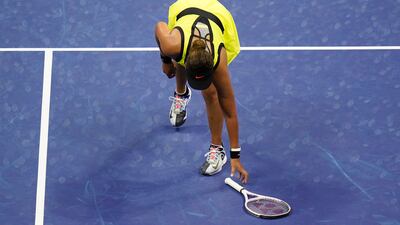
  • Japan's Naomi Osaka shows her frustration during her 2021 US Open third round match against Canada's Leylah Fernandez. AFP
    Japan's Naomi Osaka shows her frustration during her 2021 US Open third round match against Canada's Leylah Fernandez. AFP
  • Naomi Osaka of Japan throws her racket after losing a point against Leylah Fernandez. USA Today
    Naomi Osaka of Japan throws her racket after losing a point against Leylah Fernandez. USA Today
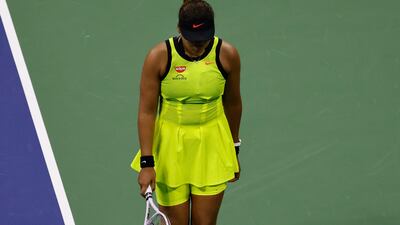
  • Naomi Osaka of Japan walks with her head down after losing a point. EPA
    Naomi Osaka of Japan walks with her head down after losing a point. EPA
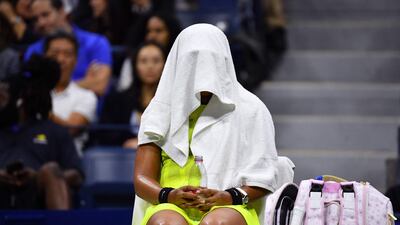
  • Japan's Naomi Osaka sits with a towel over her head during a break in her match against Canada's Leylah Fernandez. AFP
    Japan's Naomi Osaka sits with a towel over her head during a break in her match against Canada's Leylah Fernandez. AFP
  • Japan's Naomi Osaka during her 2021 US Open third round match against Canada's Leylah Fernandez. AFP
    Japan's Naomi Osaka during her 2021 US Open third round match against Canada's Leylah Fernandez. AFP
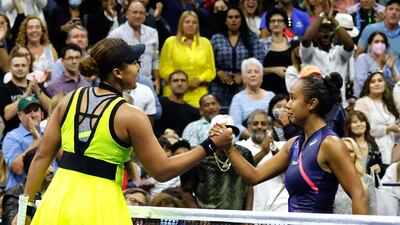
  • Leylah Fernandez of Canada shakes hands with Naomi Osaka. EPA
    Leylah Fernandez of Canada shakes hands with Naomi Osaka. EPA
  • Naomi Osaka of Japan in action. EPA
    Naomi Osaka of Japan in action. EPA
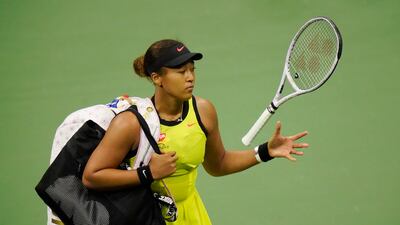
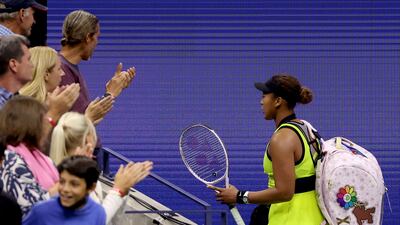
  • Naomi Osaka of Japan gives the peace sign to the crowd as she walks off the court after losing. EPA
    Naomi Osaka of Japan gives the peace sign to the crowd as she walks off the court after losing. EPA
  • Naomi Osaka, of Japan, tosses her racket to herself after losing. AP
    Naomi Osaka, of Japan, tosses her racket to herself after losing. AP
  • Naomi Osaka covers her head between games. AP
    Naomi Osaka covers her head between games. AP
  • Naomi Osaka, of Japan, sits on the bench between games against Leylah Fernandez, of Canada, at the third round of the US Open tennis championships. AP
    Naomi Osaka, of Japan, sits on the bench between games against Leylah Fernandez, of Canada, at the third round of the US Open tennis championships. AP
  • Naomi Osaka picks up her racket after throwing it down. AP
    Naomi Osaka picks up her racket after throwing it down. AP
  • Naomi Osaka walks off the court after losing to Leylah Fernandez. AFP
    Naomi Osaka walks off the court after losing to Leylah Fernandez. AFP

Lows

Superstar absences felt

It has certainly been refreshing to see new players enter the winners' circle this year, although it has felt at times a season that has lacked for star power.

The most notable absentees on the ATP Tour have of course been Federer and Nadal, who have both been struggling with serious injury. Federer, 40, called time on his limited season after Wimbledon and has since undergone another knee surgery which is expected to keep him sidelined until the middle of next season. Nadal, meanwhile, has been troubled by a foot injury and ended his year in August.

It was also a season of irregular action from popular players like Dominic Thiem, Stan Wawrinka, Nick Kyrgios, Milos Raonic (again), and Kei Nishikori.

On the WTA Tour, several of its top stars were absent for large parts of the season, including Serena William who played just nine tournaments. Simona Halep, Osaka, Azarenka, Bianca Andreescu, and Madison Keys, Johanna Konta also endured limited seasons.

  • Swiss great Roger Federer lost the 2021 Wimbledon quarter-final to Poland's Hubert Hurkacz in straights sets.
    Swiss great Roger Federer lost the 2021 Wimbledon quarter-final to Poland's Hubert Hurkacz in straights sets.
  • Roger Federer was thrashed in straight sets by Hubert Hurkacz in the Wimbledon quarter-finals.
    Roger Federer was thrashed in straight sets by Hubert Hurkacz in the Wimbledon quarter-finals.
  • Roger Federer lost the final set to Hubert Hurkacz 6-0.
    Roger Federer lost the final set to Hubert Hurkacz 6-0.
  • Hubert Hurkacz plays a backhand against Roger Federer.
    Hubert Hurkacz plays a backhand against Roger Federer.
  • Roger Federer struggled against Hubert Hurkacz.
    Roger Federer struggled against Hubert Hurkacz.
  • Switzerland's Roger Federer during his defeat..
    Switzerland's Roger Federer during his defeat..
  • Poland's Hubert Hurkacz returns against Switzerland's Roger Federer at The All England Club.
    Poland's Hubert Hurkacz returns against Switzerland's Roger Federer at The All England Club.
  • Roger Federer lost to Hubert Hurkacz in straight sets.
    Roger Federer lost to Hubert Hurkacz in straight sets.

Laver Cup falls flat

Team events have generally struggled to establish themselves long-term in the calendar, aside from the Davis Cup and Fed Cup - and both of those have needed revamps to keep the fans somewhat interested. Now the Laver Cup is threatening to go the same way.

The Europe v Rest of the World tournament played out its fourth edition in September and it was a largely forgettable weekend. Shorn of box office players like Djokovic, Federer, and Nadal, it failed to capture the imagination, and the 14-1 scoreline in favour of Europe was hardly a ringing endorsement of its competitiveness. The highly-anticipated Ryder Cup falling on the same weekend did not exactly help it attract casual fans, either.

If the Laver Cup is to have a long-term future, perhaps it's time to make it a mixed event. Not only would it even out the teams but it would engage it with a larger audience. Whatever its strategy moving forward, it feels like something already has to change.

Team Europe cruised to Laver Cup victory in September. Reuters

Olympic organisers and ITF feel the heat

Given the extraordinary circumstances in which the Tokyo Olympics were staged this summer, most would agree that the Games were an unqualified success.

It wasn't without hiccups, though, and the tennis event was responsible for one of its more controversial episodes. With matches being played in the searing afternoon heat, several players complained about the conditions - Russia's Medvedev went as far as to suggest he could die if he continued.

The ITF, tennis' global federation, initially ignored players' concerns and insisted the tournaments continue at the scheduled time, before backtracking and changing their minds. They may have made the right decision eventually, but not putting players' safety first was hardly a good look for the ITF.

  • Daniil Medvedev, of the Russian Olympic Committee, has a medical timeout during his men's singles third round match against Fabio Fognini, of Italy, at the Tokyo 2020 Olympic Games.
    Daniil Medvedev, of the Russian Olympic Committee, has a medical timeout during his men's singles third round match against Fabio Fognini, of Italy, at the Tokyo 2020 Olympic Games.
  • Russia's Daniil Medvedev is assisted by a physio.
    Russia's Daniil Medvedev is assisted by a physio.
  • Daniil Medvedev is tended to during the medical timeout.
    Daniil Medvedev is tended to during the medical timeout.
  • Daniil Medvedev, of the Russian Olympic Committee, in action against Fabio Fognini.
    Daniil Medvedev, of the Russian Olympic Committee, in action against Fabio Fognini.
  • Daniil Medvedev during the match.
    Daniil Medvedev during the match.
  • Russia's Daniil Medvedev (L) shakes hands with Italy's Fabio Fognini.
    Russia's Daniil Medvedev (L) shakes hands with Italy's Fabio Fognini.
  • Daniil Medvedev suffers in the heat.
    Daniil Medvedev suffers in the heat.
  • Italy's Fabio Fognini reacts as he competes against Russia's Daniil Medvedev.
    Italy's Fabio Fognini reacts as he competes against Russia's Daniil Medvedev.

Covid still lingers

The ATP and WTA Tours were able to resume almost to normal in 2021 after a year severely disrupted by the pandemic. The season started with players undergoing quarantine at the Australian Open and they still competed at many events inside empty stadiums, but thankfully fans returned at different capacities depending on that country's guidelines.

Still, 12 tournaments were cancelled on the ATP Tour, while the WTA Tour saw 20 scrapped this year, largely due to the amount of events played in China. While the world feels like it's gradually returning to normal, there were plenty of reminders this tennis season that Covid still lingers.

  • A tennis player waits in his hotel for a training session in Melbourne on January 19, 2021, as players train while quaratining for two weeks ahead of the Australian Open tennis tournament. AFP
    A tennis player waits in his hotel for a training session in Melbourne on January 19, 2021, as players train while quaratining for two weeks ahead of the Australian Open tennis tournament. AFP
  • Storm Sanders walks back to the hotel after a training session in Melbourne. AFP
    Storm Sanders walks back to the hotel after a training session in Melbourne. AFP
  • Marcelo Melo of Brazil walks back to the hotel after a training session. AFP
    Marcelo Melo of Brazil walks back to the hotel after a training session. AFP
  • Latisha Chan of Taiwan. AFP
    Latisha Chan of Taiwan. AFP
  • Tennis players wait to leave the hotel for a training session in Melbourne. AFP
    Tennis players wait to leave the hotel for a training session in Melbourne. AFP
  • Australian tennis player Ivana Popovic leaves the hotel for a training session. AFP
    Australian tennis player Ivana Popovic leaves the hotel for a training session. AFP
  • French tennis player Alize Cornet. AFP
    French tennis player Alize Cornet. AFP
  • Australian tennis player John-Patrick Smith leaves the hotel. AFP
    Australian tennis player John-Patrick Smith leaves the hotel. AFP
  • Novak Djokovic on the balcony of the M Suites, where some Australian Open competitors are currently under quarantine after testing positive for Covid-19, in North Adelaide, Australia. EPA
    Novak Djokovic on the balcony of the M Suites, where some Australian Open competitors are currently under quarantine after testing positive for Covid-19, in North Adelaide, Australia. EPA
  • Tennis fans gather outside the M Suites. EPA
    Tennis fans gather outside the M Suites. EPA
  • Novak Djokovic on the balcony of the M Suites. EPA
    Novak Djokovic on the balcony of the M Suites. EPA
  • Pakistan tennis player Aisam-ul-Haq Qureshi reacts during a practice session in Melbourne. AFP
    Pakistan tennis player Aisam-ul-Haq Qureshi reacts during a practice session in Melbourne. AFP
  • An unidentified tennis player hits a return during a practice session in Melbourne. AFP
    An unidentified tennis player hits a return during a practice session in Melbourne. AFP
  • Support staff appear with Dominic Thiem on the balcony of the M Suites, where some Australian Open competitors are currently under quarantine after testing positive for Covid-19, in North Adelaide, Australia. EPA
    Support staff appear with Dominic Thiem on the balcony of the M Suites, where some Australian Open competitors are currently under quarantine after testing positive for Covid-19, in North Adelaide, Australia. EPA
  • Romanian tennis player Ioana Raluca Olaru hits a return during a practice session in Melbourne. AFP
    Romanian tennis player Ioana Raluca Olaru hits a return during a practice session in Melbourne. AFP
  • Security at the M Suites in North Adelaide. EPA
    Security at the M Suites in North Adelaide. EPA
  • A radio station welcomes tennis players across the road from the M Suites, where some Australian Open competitors are currently under quarantine after testing positive for Covid-19, in North Adelaide, Australia. EPA
    A radio station welcomes tennis players across the road from the M Suites, where some Australian Open competitors are currently under quarantine after testing positive for Covid-19, in North Adelaide, Australia. EPA
  • Tennis balls are pictured in front of the Australian Open logo. Reuters
    Tennis balls are pictured in front of the Australian Open logo. Reuters

Match-fixing allegations rear ugly head

Match-fixing has been a scourge in professional tennis for a number of years, and 2021 saw fresh allegations brought against players. Two matches at Wimbledon were investigated, while a Russian player was detained by police at the French Open in relation to an investigation from the previous October.

In April, Argentine player Franco Feitt was handed a lifetime ban after admitting to nine breaches of the Tennis Anti-Corruption Program rules, while back in January Roman Khassanov from Kazakhstan was given a 10-year suspension for instances dating between 2014 and 2018.

While it is encouraging to see tennis authorities dish out severe punishments for match-fixers, surely more must be done to prevent the crimes from being committed in the first place.


Company Profile

Name: Thndr
Started: 2019
Co-founders: Ahmad Hammouda and Seif Amr
Sector: FinTech
Headquarters: Egypt
UAE base: Hub71, Abu Dhabi
Current number of staff: More than 150
Funds raised: $22 million

Results
%3Cp%3E%3Cstrong%3EStage%203%3A%3C%2Fstrong%3E%3Cbr%3E1.%20Einer%20Rubio%20(COL)%20Movistar%20Team%20-%204h51%E2%80%9924%E2%80%9D%3Cbr%3E2.%20Remco%20Evenepoel%20(BEL)%20Soudal%20Quick-Step%20-%2014%22%3Cbr%3E3.%20Adam%20Yates%20(GBR)%20UAE%20Team%20Emirates%20-%2015%22%3Cbr%3E%3Cstrong%3EGeneral%20classifications%3A%3C%2Fstrong%3E%3Cbr%3E1.%20Remco%20Evenepoel%20(BEL)%20Soudal%20Quick-Step%3Cbr%3E2.%20Lucas%20Plapp%20(AUS)%20Ineos%20Grenaders)%20-%207%22%3Cbr%3E3.%20Pello%20Bilbao%20(ESP)%20Bahrain%20Victorious%20-%2011%22%3C%2Fp%3E%0A
WOMAN AND CHILD

Director: Saeed Roustaee

Starring: Parinaz Izadyar, Payman Maadi

Rating: 4/5

How will Gen Alpha invest?

Mark Chahwan, co-founder and chief executive of robo-advisory firm Sarwa, forecasts that Generation Alpha (born between 2010 and 2024) will start investing in their teenage years and therefore benefit from compound interest.

“Technology and education should be the main drivers to make this happen, whether it’s investing in a few clicks or their schools/parents stepping up their personal finance education skills,” he adds.

Mr Chahwan says younger generations have a higher capacity to take on risk, but for some their appetite can be more cautious because they are investing for the first time. “Schools still do not teach personal finance and stock market investing, so a lot of the learning journey can feel daunting and intimidating,” he says.

He advises millennials to not always start with an aggressive portfolio even if they can afford to take risks. “We always advise to work your way up to your risk capacity, that way you experience volatility and get used to it. Given the higher risk capacity for the younger generations, stocks are a favourite,” says Mr Chahwan.

Highlighting the role technology has played in encouraging millennials and Gen Z to invest, he says: “They were often excluded, but with lower account minimums ... a customer with $1,000 [Dh3,672] in their account has their money working for them just as hard as the portfolio of a high get-worth individual.”

Ten tax points to be aware of in 2026

1. Domestic VAT refund amendments: request your refund within five years

If a business does not apply for the refund on time, they lose their credit.

2. E-invoicing in the UAE

Businesses should continue preparing for the implementation of e-invoicing in the UAE, with 2026 a preparation and transition period ahead of phased mandatory adoption. 

3. More tax audits

Tax authorities are increasingly using data already available across multiple filings to identify audit risks. 

4. More beneficial VAT and excise tax penalty regime

Tax disputes are expected to become more frequent and more structured, with clearer administrative objection and appeal processes. The UAE has adopted a new penalty regime for VAT and excise disputes, which now mirrors the penalty regime for corporate tax.

5. Greater emphasis on statutory audit

There is a greater need for the accuracy of financial statements. The International Financial Reporting Standards standards need to be strictly adhered to and, as a result, the quality of the audits will need to increase.

6. Further transfer pricing enforcement

Transfer pricing enforcement, which refers to the practice of establishing prices for internal transactions between related entities, is expected to broaden in scope. The UAE will shortly open the possibility to negotiate advance pricing agreements, or essentially rulings for transfer pricing purposes. 

7. Limited time periods for audits

Recent amendments also introduce a default five-year limitation period for tax audits and assessments, subject to specific statutory exceptions. While the standard audit and assessment period is five years, this may be extended to up to 15 years in cases involving fraud or tax evasion. 

8. Pillar 2 implementation 

Many multinational groups will begin to feel the practical effect of the Domestic Minimum Top-Up Tax (DMTT), the UAE's implementation of the OECD’s global minimum tax under Pillar 2. While the rules apply for financial years starting on or after January 1, 2025, it is 2026 that marks the transition to an operational phase.

9. Reduced compliance obligations for imported goods and services

Businesses that apply the reverse-charge mechanism for VAT purposes in the UAE may benefit from reduced compliance obligations. 

10. Substance and CbC reporting focus

Tax authorities are expected to continue strengthening the enforcement of economic substance and Country-by-Country (CbC) reporting frameworks. In the UAE, these regimes are increasingly being used as risk-assessment tools, providing tax authorities with a comprehensive view of multinational groups’ global footprints and enabling them to assess whether profits are aligned with real economic activity. 

Contributed by Thomas Vanhee and Hend Rashwan, Aurifer

Mercer, the investment consulting arm of US services company Marsh & McLennan, expects its wealth division to at least double its assets under management (AUM) in the Middle East as wealth in the region continues to grow despite economic headwinds, a company official said.

Mercer Wealth, which globally has $160 billion in AUM, plans to boost its AUM in the region to $2-$3bn in the next 2-3 years from the present $1bn, said Yasir AbuShaban, a Dubai-based principal with Mercer Wealth.

Within the next two to three years, we are looking at reaching $2 to $3 billion as a conservative estimate and we do see an opportunity to do so,” said Mr AbuShaban.

Mercer does not directly make investments, but allocates clients’ money they have discretion to, to professional asset managers. They also provide advice to clients.

“We have buying power. We can negotiate on their (client’s) behalf with asset managers to provide them lower fees than they otherwise would have to get on their own,” he added.

Mercer Wealth’s clients include sovereign wealth funds, family offices, and insurance companies among others.

From its office in Dubai, Mercer also looks after Africa, India and Turkey, where they also see opportunity for growth.

Wealth creation in Middle East and Africa (MEA) grew 8.5 per cent to $8.1 trillion last year from $7.5tn in 2015, higher than last year’s global average of 6 per cent and the second-highest growth in a region after Asia-Pacific which grew 9.9 per cent, according to consultancy Boston Consulting Group (BCG). In the region, where wealth grew just 1.9 per cent in 2015 compared with 2014, a pickup in oil prices has helped in wealth generation.

BCG is forecasting MEA wealth will rise to $12tn by 2021, growing at an annual average of 8 per cent.

Drivers of wealth generation in the region will be split evenly between new wealth creation and growth of performance of existing assets, according to BCG.

Another general trend in the region is clients’ looking for a comprehensive approach to investing, according to Mr AbuShaban.

“Institutional investors or some of the families are seeing a slowdown in the available capital they have to invest and in that sense they are looking at optimizing the way they manage their portfolios and making sure they are not investing haphazardly and different parts of their investment are working together,” said Mr AbuShaban.

Some clients also have a higher appetite for risk, given the low interest-rate environment that does not provide enough yield for some institutional investors. These clients are keen to invest in illiquid assets, such as private equity and infrastructure.

“What we have seen is a desire for higher returns in what has been a low-return environment specifically in various fixed income or bonds,” he said.

“In this environment, we have seen a de facto increase in the risk that clients are taking in things like illiquid investments, private equity investments, infrastructure and private debt, those kind of investments were higher illiquidity results in incrementally higher returns.”

The Abu Dhabi Investment Authority, one of the largest sovereign wealth funds, said in its 2016 report that has gradually increased its exposure in direct private equity and private credit transactions, mainly in Asian markets and especially in China and India. The authority’s private equity department focused on structured equities owing to “their defensive characteristics.”

Top investing tips for UAE residents in 2021

Build an emergency fund: Make sure you have enough cash to cover six months of expenses as a buffer against unexpected problems before you begin investing, advises Steve Cronin, the founder of DeadSimpleSaving.com.

Think long-term: When you invest, you need to have a long-term mindset, so don’t worry about momentary ups and downs in the stock market.

Invest worldwide: Diversify your investments globally, ideally by way of a global stock index fund.

Is your money tied up: Avoid anything where you cannot get your money back in full within a month at any time without any penalty.

Skip past the promises: “If an investment product is offering more than 10 per cent return per year, it is either extremely risky or a scam,” Mr Cronin says.

Choose plans with low fees: Make sure that any funds you buy do not charge more than 1 per cent in fees, Mr Cronin says. “If you invest by yourself, you can easily stay below this figure.” Managed funds and commissionable investments often come with higher fees.

Be sceptical about recommendations: If someone suggests an investment to you, ask if they stand to gain, advises Mr Cronin. “If they are receiving commission, they are unlikely to recommend an investment that’s best for you.”

Get financially independent: Mr Cronin advises UAE residents to pursue financial independence. Start with a Google search and improve your knowledge via expat investing websites or Facebook groups such as SimplyFI. 

Updated: November 24, 2021, 11:52 AM