

A multitude of thoughts must race through the mind of a long jumper as they stand at their mark, absorbing the energy in the stadium before refocusing on executing the perfect technique.
When Mohammad Amin Alsalami prepares for his first jump at the Stade de France this summer, his mind might wander back to his childhood in Syria. It might take him to the violence and turmoil that forced his family to flee Aleppo, or a terrifying dinghy crossing in the Mediterranean where he doubted if he’d live to see the other side.
“The start of the journey was the most dangerous part – I will never forget that,” he told the official Olympics website. “I was sitting in a rubber dinghy with many other people, it was a very hard decision whether or not I should get into it.
“After getting out of the dinghy, with solid ground under my feet, I knew: I won’t die. Now everything is getting better. It can’t get worse than this.”
Alsalami was right. But despite telling himself, “My future starts now”, even in his wildest dreams he probably couldn’t have envisaged a future where he would fulfil his lifelong dream of becoming an Olympian.
Yet this summer, in Paris, that is exactly what will happen when he competes in the long jump wearing the vest of the IOC’s Refugee Olympic Team.
“That moment was so … wow. I get to go to the Olympics. I cried so much. It was really cool,” the 29-year-old told the Associated Press of receiving his invite.
Alsalami discovered his ability for athletics at school where he also enjoyed success as a sprinter. A teacher spotted his talent for long jump when he was 15 and encouraged him to participate in local and national competitions in Syria.
But when civil war erupted in 2011 he could no longer train or compete. His family – Alsalami is the youngest of nine siblings – was displaced several times within Syria before fleeing to Turkey.
Alsalami decided to continue on to Europe on his own, which meant crossing the Mediterranean Sea on a rubber boat to Greece. He then walked, hitched and chanced his way to Germany in the hope of starting a new life.
Almost a decade later, he has been granted asylum. He settled in Berlin, learnt German and made new friends. Nothing has come easy, though, even after arriving in Germany, where his first few months were cold, confusing and lonely.
Alsalami says his passion for athletics helped him through those initial hardships. During his first weeks in Berlin, he searched online for stadiums and gyms in the hope that he might start jumping again.
“All the other Berlin track and field athletes were training in this hall,” he said of his first experience of a German gym. “When I came in and saw how full and how warm it was inside … it was almost like paradise for me.”
The talent that had made Alsalami one of the top long jumpers in Asia was still there and it didn’t take long for him to find a coach. On that very first day at the gym, a man watched him jump and approached him with a proposition.
“I didn’t understand anything, not in English either,” Alsalami said. “And then I said, ‘Hey, I’m Syrian’ on my mobile phone, and he said, ‘I’m your trainer from now on'.”
From there things started to improve. “You have to be patient. Everything will get better,” he told himself.
In Germany, Alsalami was given the opportunity to revive his sporting aspirations. He now wants to show people through his results that he will compete at Paris 2024 on merit, not just because he is part of the Refugee Olympic Team.
“Looking back since 2011, there were some hard days in my life but I always had this dream [to go to the Olympics],” said Alsalami, who has a personal best of 7.88 metres and won silver at the 2014 Asian Championships before his ordeal started.
“I also struggled with injuries, some of them were so serious I thought I had to end my career. I can’t wait for the day when I’m at the Olympics – pressure increases but I will try to stay cool and just enjoy the Games.
“I will give it my all, I want to prove that I’m not only in Paris because I’m a refugee, but also because I deserve it as an athlete.”
Despite his excitement for the Games, Alsalami admits sadness that he will not be representing the country of his birth. “Syria is home, I miss it every day,” he said. “In the end, that’s my country, that’s where I come from.”
He is, however, extremely optimistic about his future in Germany and wants to transition into coaching once his own career winds down.
“I want to start a family and become very happy here in Germany,” he said. “I just want to enjoy my life and I want to become a coach. I definitely want to do that.
“I want to do my sport as long as I can. There’s a feeling you only get in sports – it gives me the feeling that I’m alive. I’m a refugee and far away from home, but I’m doing what I love.”
Refugee Olympic Team athletes
-

Iranian wrestler Iman Mahdavi, 28, practices at the Lotta Club Seggiano gym in Pioltello, Italy. Mahdavi fled his home country in October 2020. Now, he will compete in Paris as part of the Refugee Olympic Team. AP -

Iranian wrestler Iman Mahdavi, 28, is part of the IOC Refugee Olympic Team for the Paris Games. AP -
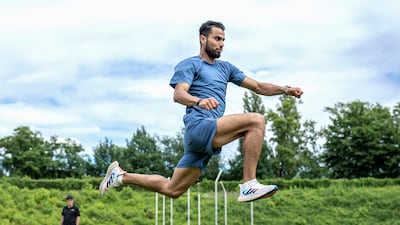
Syrian refugee Mohammad Amin Alsalami, 29, trains at the Wilmersdorf Stadium in Berlin. He now compete in Paris as part of the Refugee Olympic Team. AP -
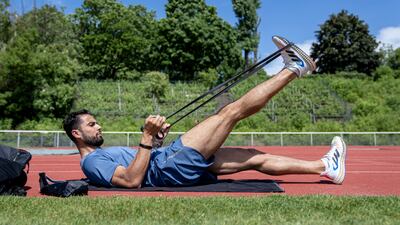
Syrian refugee Mohammad Amin Alsalami trains at the Wilmersdorf Stadium in Berlin. After leaving his war-torn hometown of Aleppo, he made it by foot to Germany through Turkey, Greece and the Balkans in 2015. AP -
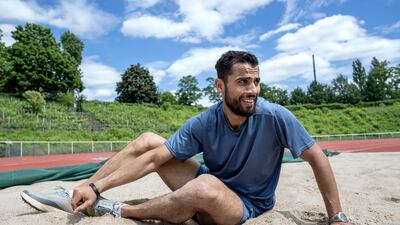
Syrian refugee Mohammad Amin Alsalami, 29, trains at the Wilmersdorf Stadium in Berlin on May 29, 2024. After leaving his war-torn hometown of Aleppo, he made it by foot to Germany through Turkey, Greece and the Balkans in October 2015. After almost a decade, he is thriving. He was granted asylum, has learned German, made new friends, and will now compete in Paris as part of the Refugee Olympic Team. (AP Photo / Ebrahim Noroozi) -

Manizha Talash, originally from Afghanistan, practices outside the Parish of the Inmaculado Corazon de Maria in Madrid. The 21-year-old will compete with the Refugee Olympic Team at the Paris Olympics, where breaking has been included for the first time. AP -
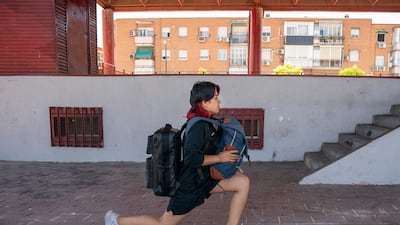
Manizha Talash practices in Madrid for the Paris Olympics. AP -
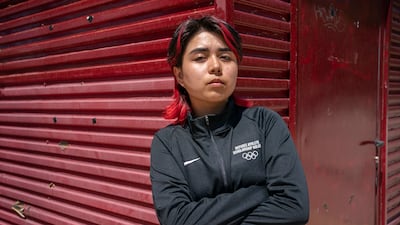
Manizha Talash, originally from Afghanistan, outside the Parish of the Inmaculado Corazon de Maria in Madrid, where she was granted asylum. AP -
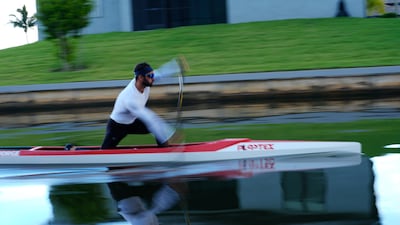
Rower Fernando Dayan Jorge paddles his canoe during a training session ahead of the Paris Olympics. Jorge, who will compete in canoe sprint for the Refugee team, rowed for his native country Cuba at the Rio 2016 and the Toyko 2020 Olympics, where he won a gold medal in men's canoe double 1000m and finished seventh in the singles event. AP -
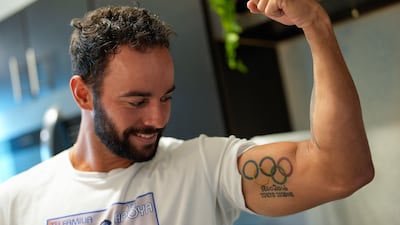
Fernando Dayan Jorge during a training session ahead of the Paris Olympics. AP



