


If Borussia Monchengladbach go to Madrid as buoyant as they were in Kiev five weeks ago, it should be decided fairly quickly.
That evening the German club were 4-0 up against Shakhtar Donetsk by half-time. If Shakhtar, who really are the Jekyll and Hyde of this season’s Champions League, blitz Inter Milan as they blitzed Real Madrid back in October – 3-0 at the break – everybody can finally stop biting their nails.
Club football’s premier competition is sometimes thought dull and stagnant through its autumn months, because of a group phase which takes too many games to filter out the good from the ordinary.
Uefa, the designers of the system, are working on reforming it. They may want to look at whatever weird ingredient was slipped into the mix of this season’s Group B.
After five rounds, any two of the four contestants can still go through to the last 16, which is a welcome straw to clasp at for the clubs currently sitting third and fourth. They were widely expected to finish first and second. They are Madrid and Inter. Both are playing last-gasp catch-up on a rollercoaster that has defied all forecasts.
In all three opening matchdays, points were grasped and lost with goals scored in the last 10 minutes; Monchengladbach averaged a goal every 18 minutes in their two matches against Shakhtar.
Yet in Milan on Wednesday night, Shakhtar could conceivably take their place in the knockouts with only a draw against Inter, a club who have a fair idea of how hot and cold the Ukrainians blow.
In August, they met in a Europa League semi-final, and Inter won 5-0. In October, Shakhtar cemented their place at the top of barmy, bewildering Group B by holding the Inter of Romelu Lukaku and Lautaro Martinez to 0-0 thanks to a 19-year-old goalkeeper, Anatoliy Trubin, promoted from third-choice to first because a Covid-19 crisis had ruled out other keepers.
Beat Inter on Wednesday evening and Trubin’s troops would finish top if a Shakhtar win combines with Monchengladbach taking fewer than three points from their trip to the Spanish capital.
The complex arithmetic exerts greater pressure on the so-called ‘giants’ of La Liga and Serie A. Madrid can still guarantee progress if they win, but in a group where the leaders, Monchengladbach, are just three points ahead of Inter at the bottom, it will be a night when coaching staff in Milan and Madrid are constantly tuned to events elsewhere.
______________
Gallery: Shakhtar Donetsk 2 Real Madrid 0
-
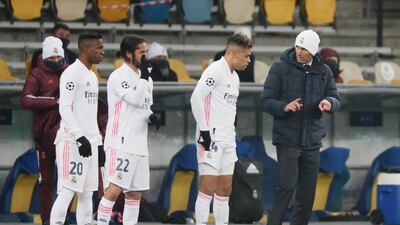
Real Madrid manager Zinedine Zidane gives instructions to substitutes Mariano, Isco and Vinicius Junior during the Champions League defeat against against Shakhtar Donetsk. Reuters -
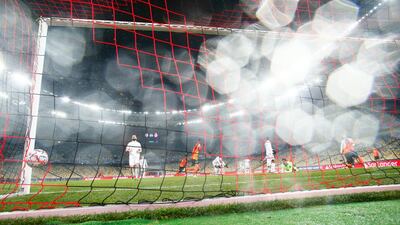
Shakhtar Donetsk's Dentinho scores their first goal against Real Madrid. Reuters -
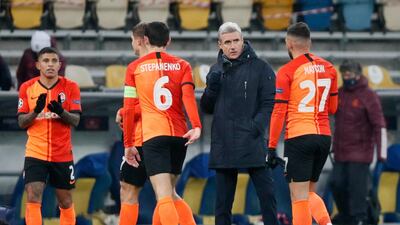
Shakhtar Donetsk manager Luis Castro celebrates with his players at the end of the match after beating Real Madrid. Reuters -

Real Madrid's Lucas Vazquez tackles Shakhtar Donetsk's Manor Soloman. Reuters -
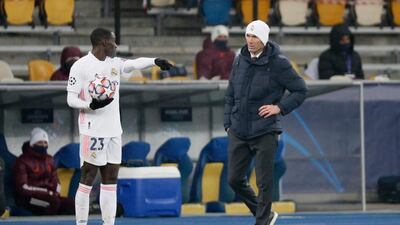
Zinedine Zidane and Real Madrid defender Ferland Mendy talk on the touchline. Reuters -

Shakhtar Donetsk's Manor Soloman celebrates scoring the second goal with Mateus Tete. Reuters -
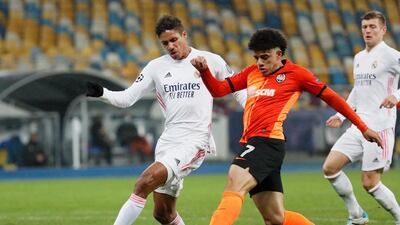
Shakhtar Donetsk's Taison takes on Real Madrid defender Raphael Varane. Reuters -

Real Madrid forward Lucas Vazquez goes to catch the ball as Zinedine Zidane watches on from the touchline. AFP -

Shakhtar Donetsk midfielder Dentinho runs with the ball during the Champions League match against Real Madrid. AFP -
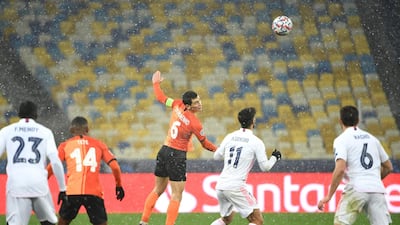
Shakhtar Donetsk midfielder Taras Stepanenko heads the ball during the Champions League match against Real Madrid. AFP -

Real Madrid goalkeeper Thibaut Courtois lays on the ground as Shakhtar Donetsk's Marlos celebrates the first goal scored by Dentinho. Reuters -
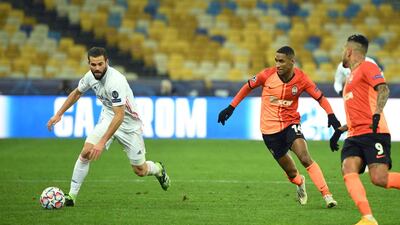
Shakhtar Donetsk forward Tete tracks Real Madrid defender Nacho Fernandez. AFP -
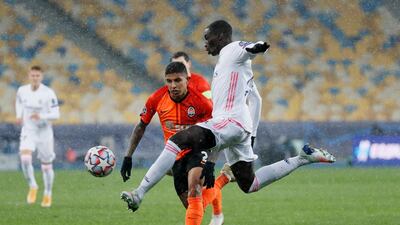
Real Madrid's Ferland Mendy attempts to control the ball under pressure from Shakhtar Donetsk's Dodo. Reuters -
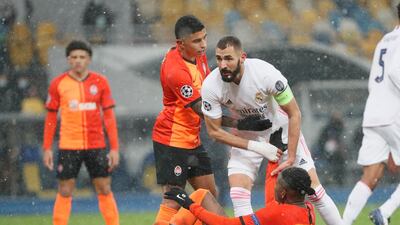
Shakhtar Donetsk's Vitao in action with Real Madrid's Karim Benzema. Reuters


______________
Having collected only one point from their first two games, Madrid have been mostly on the back foot. Their manager, Zinedine Zidane, has called every game since "a final"; the back-to-back "finals" against Inter launched Madrid's recovery, with a 2-0 win in Milan and a 3-2 victory at home. Then came Kiev: Shakhtar 2, Real Madrid 0, the Ukrainians' second victory over the Spanish champions.
The Real midfielder Casemiro spoke on Tuesday,and peppered almost every phrase with the word "final". “Everyone in the dressing-room and in the club knows this is a final,” he said of the visit of Monchengladbach, “and at this club, we win finals.” Under Zidane, Madrid have played in nine finals, taking in European and Spanish Super Cups, and won all of them.
That includes three successive Champions League finals, up to 2018. Madrid were the original governors of the European Cup and they have mastered its modern version, the Champions League, like nobody else. Should they not climb out of third place tonight, they will make unwanted history. Madrid have never been eliminated in a group phase.
Monchengladbach, by contrast, have never progressed beyond a Champions League group. “This is not a ‘small’ team, they are the group leaders,” said Casemiro of the free-scoring Germans, “but it is in our hands to go through.”
That message was heard loud and clear in Milan, where Inter manager Antonio Conte needs not only a win against Shakhtar but a positive result, either way, in Madrid.
News of Real-Borussia drawing would extinguish Inter’s morale. “We can’t think about what’s happening in the other game,” said Conte, warning his players against imagining that Monchengladbach and Madrid might settle for a convenient stalemate if they know Inter are well ahead in the later stages of the evening.
But every actor in the drama that is Group B should know by now that nothing can be stage-managed or second-guessed. “A week ago, we were dead and buried,” said Conte, “and now we can glimpse a shaft of light.”
_________________
Gallery: Real Madrid 3 Inter Milan 2
-

Real Madrid's Sergio Ramos in action with Inter Milan's Lautaro Martinez. Real won the Champions League group match 3-2 on November 3. Reuters -

nternazionale midfielder Arturo Vidal. EPA -

Inter Milan's Croatian midfielder Marcelo Brozovic. AFP -

Real Madrid defender Sergio Ramos heads the ball to make it 2-0. AFP -

Inter Milan's Croatian midfielder Marcelo Brozovic and Real Madrid's German midfielder Toni Kroos fall down. AFP -

Real Madrid's Spanish defender Sergio Ramos celebrates his goal. AFP -

Real Madrid defender Raphael Varane vies for the ball against Internazionale's Ivan Perisic. EPA -

Madrid's striker Karim Benzema in action against Internazionale's Stefan De Vrij. EPA -

Real Madrid goalkeeper Thibaut Courtois reacts after Ivan Perisic scores to make it 2-2. EPA -

Real Madrid's winger Rodrygo celebrates after scoring the to make it 3-2. EPA -

Inter Milan's Samir Handanovic after Real Madrid's Rodrygo scores their third goal. Reuters -

Real Madrid goalkeeper Thibaut Courtois in action. EPA -

Real Madrid's Karim Benzema. Reuters -

Inter Milan's Chilean midfielder Arturo Vidal vies with Real Madrid's Belgian forward Eden Hazard. AFP



