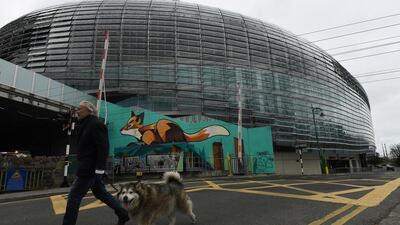
A general view of the Aviva Stadium as the Irish government advised that fans cannot be present during Euro 2020 games owing to the Covid-19 pandemic in Dublin. Reuters

June 'too soon' for Ireland to host Euro 2020 matches: deputy PM Leo Varadkar


  • English
  • Arabic

Euro 2020 matches in Dublin are unlikely to go ahead if Uefa continues to insist on minimum spectator levels, Irish deputy prime minister Leo Varadkar said Wednesday.

Varadkar told Today FM radio organisers are pessimistic about meeting Uefa's requirement they "commit to having at least 25 per cent of the stadium full" in matches slated this summer.

"We're just very cautious about that," he said. "We just think June is too soon."

"I think if they continue to insist on that it'll be hard for it to go ahead quite frankly."

Dublin's Aviva Stadium is currently scheduled to host three group matches and a last-16 game in the delayed tournament running from June 11 to July 11.

But the games are in doubt as Ireland is still in the grip of tight coronavirus restrictions and the nation has been tethered to the European Union's sluggish vaccine rollout.

According to latest official figures, 4,847 have died from Covid-19 in the Republic.

Pubs, restaurants, bars and non-essential retail have all been shut since Christmas and there are still limits on domestic and international travel.

Earlier this month the Football Association of Ireland (FAI) told Uefa that "owing to the Covid-19 pandemic it is not in a position at this point to provide assurances on minimum spectator levels".

Nine of the proposed 12 host cities for Euro 2020 have committed to allowing crowds of 25 per cent of capacity in for the tournament.

Bilbao and Munich are the other two cities in danger of being dropped by Uefa.

European football's governing body is due to take a final decision on Friday over where all matches will be held.

jts/kca/jc

The specs

Engine: 3.8-litre twin-turbo flat-six

Power: 650hp at 6,750rpm

Torque: 800Nm from 2,500-4,000rpm

Transmission: 8-speed dual-clutch auto

Fuel consumption: 11.12L/100km

Price: From Dh796,600

On sale: now

Ten tax points to be aware of in 2026

1. Domestic VAT refund amendments: request your refund within five years

If a business does not apply for the refund on time, they lose their credit.

2. E-invoicing in the UAE

Businesses should continue preparing for the implementation of e-invoicing in the UAE, with 2026 a preparation and transition period ahead of phased mandatory adoption. 

3. More tax audits

Tax authorities are increasingly using data already available across multiple filings to identify audit risks. 

4. More beneficial VAT and excise tax penalty regime

Tax disputes are expected to become more frequent and more structured, with clearer administrative objection and appeal processes. The UAE has adopted a new penalty regime for VAT and excise disputes, which now mirrors the penalty regime for corporate tax.

5. Greater emphasis on statutory audit

There is a greater need for the accuracy of financial statements. The International Financial Reporting Standards standards need to be strictly adhered to and, as a result, the quality of the audits will need to increase.

6. Further transfer pricing enforcement

Transfer pricing enforcement, which refers to the practice of establishing prices for internal transactions between related entities, is expected to broaden in scope. The UAE will shortly open the possibility to negotiate advance pricing agreements, or essentially rulings for transfer pricing purposes. 

7. Limited time periods for audits

Recent amendments also introduce a default five-year limitation period for tax audits and assessments, subject to specific statutory exceptions. While the standard audit and assessment period is five years, this may be extended to up to 15 years in cases involving fraud or tax evasion. 

8. Pillar 2 implementation 

Many multinational groups will begin to feel the practical effect of the Domestic Minimum Top-Up Tax (DMTT), the UAE's implementation of the OECD’s global minimum tax under Pillar 2. While the rules apply for financial years starting on or after January 1, 2025, it is 2026 that marks the transition to an operational phase.

9. Reduced compliance obligations for imported goods and services

Businesses that apply the reverse-charge mechanism for VAT purposes in the UAE may benefit from reduced compliance obligations. 

10. Substance and CbC reporting focus

Tax authorities are expected to continue strengthening the enforcement of economic substance and Country-by-Country (CbC) reporting frameworks. In the UAE, these regimes are increasingly being used as risk-assessment tools, providing tax authorities with a comprehensive view of multinational groups’ global footprints and enabling them to assess whether profits are aligned with real economic activity. 

Contributed by Thomas Vanhee and Hend Rashwan, Aurifer

War and the virus
The National in Davos

We are bringing you the inside story from the World Economic Forum's Annual Meeting in Davos, a gathering of hundreds of world leaders, top executives and billionaires.

AI traffic lights to ease congestion at seven points to Sheikh Zayed bin Sultan Street

The seven points are:

Shakhbout bin Sultan Street

Dhafeer Street

Hadbat Al Ghubainah Street (outbound)

Salama bint Butti Street

Al Dhafra Street

Rabdan Street

Umm Yifina Street exit (inbound)
