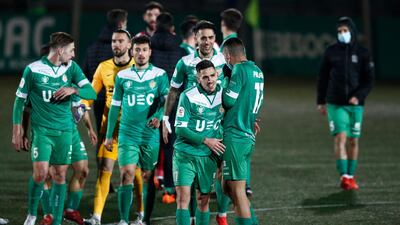

“You hope for one Gordo, you don’t expect two,” smiles Jordi Lopez. El Gordo is Spain’s lottery, held annually on December 22 since 1814 and considered the largest in the world. But the man who played at Barcelona, Real Madrid, Sevilla and QPR isn’t talking about winning some of the €800 million prize money, but regional third-tier team UE Cornella being drawn with one of Spain’s super clubs. First the team for which Lopez is assistant manager drew La Liga leaders Atletico Madrid and now, after beating them, they’ve drawn neighbours Barcelona at home in the Copa del Rey this Thursday.
Cornella play on a small, far from latest generation artificial surface whose single 1,500-seater stand is easily big enough to hold their 600 crowds in non-lockdown times. There are no spectator facilities on the other three sides. Cornella have the smallest average crowds of the 20 teams normally playing in their league and they’re usually up against far bigger foes: Castellon, who beat them in the play-off final to reach Spain’s second tier last season, averaged 10,790. Then there are the B teams of Barca, Espanyol, Valencia, Villarreal and Levante – all stocked with full-time professionals who play at luxurious training grounds rather than Cornella’s well-worn pitch by the motorway.
Cornella are playing at their highest level in their 70-year history – and they’ve pushed to go even higher in each of the last four seasons, finishing fourth in each of them to qualify for the play-offs. It’s a tight league: four points separated the top six teams last term.
Before promotion to this level six years ago, Cornella have gradually spent 40 years climbing from Spain’s sixth tier, even if their fan base hasn’t. Cornella struggle for fans for several reasons. One, they play in Barcelona, where Barca are the huge elephant in the room. If that wasn’t enough, Espanyol’s 41,000-seater stadium is separated from Cornella’s home by a 15 metre walkway. There are no two grounds as close in world football. The difference in size of neighbouring Espanyol’s pitch is clear on any online map.
Cornella got into this season’s Copa del Rey by being one of the top seven teams in their league last season. They drew Marino from Tenerife, a three-hour flight to the south in the first round and won 1-0. Atletico Madrid came next on January 6 and Diego Simeone’s La Liga leaders played a team with €127 million signing Joao Felix, Saul Niguez, Vitolo and Angel Correa. Atleti were behind after six minutes and saw Ricard Sanchez red carded after 62 minutes.
“It was our dream and anything is possible in football,” reflects Lopez. “Most of the players will never experience anything like this and maybe they’ll never do it again. We had to play our best game and hope that Atletico didn’t play theirs. They struggled to adapt to our small pitch, our old surface, our stadium.” Simeone admitted Cornella deserved their win.
No fans were allowed, but the stadium is so small that locals watched from the streets outside. The players ran to the fence after to celebrate with fans – and others who looked like they were walking to the nearby shops.
To appreciate how Cornella not only survive but flourish under director general Andres Manzano, club president Alex Talavera, manager Guellermo Fernandez and his assistant Lopez, you need to understand their model. Cornella’s players are professionals, earning between €1,000 and €2,500 a month for what is the 13th biggest budget of the 20 teams normally in their league.
“We have to convince players to come here,” explains Lopez. “They don’t come for the money or to play on our small pitch, which is not attractive. We lose players who want to play in big stadiums too and there are several in our division, but we explain our plans, our style and how we will work every day.”
One of the photos on the president’s twitter feed shows Cornella at Hercules in Alicante, a 30,000-seater that has staged internationals, World Cup matches and La Liga football in 2011.
"Cornella play physical football and sign players who suit their football and their pitch: strong and good on the second balls," one coach who has managed at several clubs in the same division tells The National. "After Barcelona and Espanyol, Cornella have one of the best academy and youth team in Catalonia. This brings players and money."
Cornella isn’t only about their first team and nor is their revenue. The club boast 1,100 footballers and under 11s, Cornella have an incredible 15 teams. The players in 12 of those sides pay to be coached. The best two teams at this age group don’t and Cornella’s elite youth teams play in the Liga Nacional against their equivalents at Barca or Espanyol in a 10-team group.
English Championship side Birmingham City joined up with Cornella’s talent factory in 2017. Birmingham and Cornella share information and contacts, partly in the hope that the Midlands club will have access to the next Jordi Alba, who Cornella signed after he was released from Barcelona as a 16-year-old. When Alba went to Valencia and then back to Barca, Cornella made €1.4 million.
Player sales is one source of income and key to Cornella’s plan with former players at clubs from Betis to Brentford; the stability of staff and the same personnel is another. It’s a tiny club, professionally run and the subscriptions from so many of the young players, as well as support from the local council who want so many children doing sport helps. The municipal stadium is used all hours, the young players having an attachment to the club, but they have no benefactor and play in an area that will never be described as monied.
Cornella is way out to the south west on the Barcelona’s urban fringe near the Llobregat river, the motorway to Madrid and heavy industry. This is not the Barcelona that the tourists see, but a red belt settled by economic migrants from outside Catalonia in the 1950s, and 60s. Most speak Spanish over Catalan in the street, if not the classroom.
The location helps: a densely populated area with a big population, a working class football factory. Other clubs around Barcelona see the same benefits of a vast talent pool on their doorstep while youngsters in Catalonia have access to more qualified coaches, top facilities and often footballing philosophies that have succeeded at the highest level at Camp Nou. Few games are cancelled because of inclement weather, but Covid has all but stopped the club bar the first team.

“It’s a shame we can have no fans for many reasons, one being that it’s less money for the club,” explains Lopez, a man who knew what it was like to play in front of huge crowds as a first-team footballer for Real Madrid and Sevilla. His career has been a varied one.
“I didn’t play much but I was playing with some of the best players in the world at Real Madrid: Ronaldo, Figo, Zidane, Raul, Beckham and Roberto Carlos. That was incredible. It was the time when the president described Madrid’s attitude to building a team as the ‘Zidanes and the Pavons’ (graduates from the B team). I was a Pavon. I enjoyed my career. I played in England at Queens Park Rangers which I enjoyed and Swansea which I did not because I had injuries."
Cornella make a success of selling their youth graduates on and there’s always the first team option. The coaches move on, too.
“I want to be a coach myself soon but I’m enjoying it here,” says Lopez, 39. But first Barcelona. “It’s completely different to being a player and competition to be a coach is strong, but I’m learning and looking forward to Barca. Cornella enjoy positive relations with Barca and Espanyol. Some of our young players go there and vice versa. With the first team, we cannot afford their players, so we have to sell our ideas to players who maybe don’t want to come here because they know they can earn more money playing for other clubs in the same division.”
Barca’s B team came to Cornella a few weeks ago and won 1-0. Several of Barca’s young first-team players have already played at Cornella including Lionel Messi who played for Barca C in 2004 aged 16. Cornella also met Real Madrid in the cup six years ago and lost 9-1 over two legs. Then, the game was played next door at Espanyol and 25,000 fans turned up. On Thursday, the game will be a one-off on the little pitch next door, with two legged matches cancelled because of the pandemic.
-
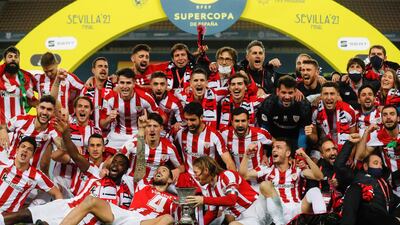
Athletic Bilbao celebrate their 3-2 Super Cup win over Barcelona in January 2021. EPA -

Barcelona's Lionel Messi walks off the pitch after being sent off against Athletic Bilbao at the Estadio La Cartuja de Sevilla. Reuters -

Barcelona's Antoine Griezmann celebrates scoring his second goal. AFP -

Inaki Williams celebrates after scoring Bilbao's third goal. AFP -

Athletic Bilbao's Unai Nunez in action. Reuters -
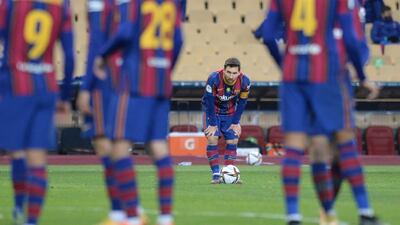
Barcelona's Argentinian forward Lionel Messi prepares to take a free-kick. AFP -

Athletic Bilbao's Spanish forward Asier Villalibre plays trumpet as he celebrates with teammates after the match. AFP -
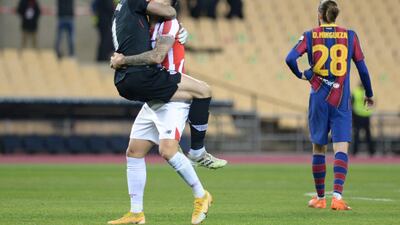
Athletic Bilbao players celebrate their victory. AFP -

Barcelona's Lionel Messi looks dejected after Athletic Bilbao's Asier Villalibre scores their second goal. Reuters -

Barcelona's Lionel Messtakes a free kick. AFP -
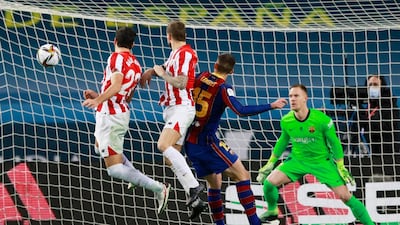
Athletic Bilbao's Raul Garcia scores but the goal is disallowed following a referral to VAR. Reuters -

Athletic Bilbao striker Inaki Willians with the trophy. EPA -

Athletic Bilbao players celebrate a goal that was disallowed by VAR. AFP -
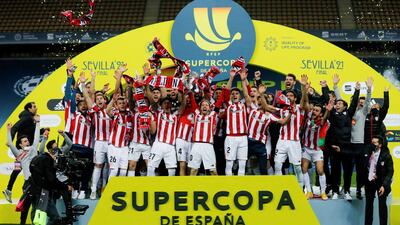
Athletic Bilbao celebrate their Super Cup win. EPA -
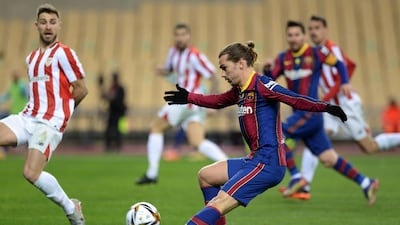
Barcelona's French midfielder Antoine Griezmann shoots. AFP -
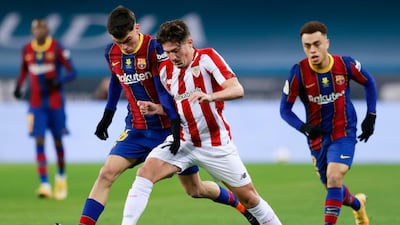
Bilbao's Unai Vencedor battles with Pedri Barcelona. Reuters -
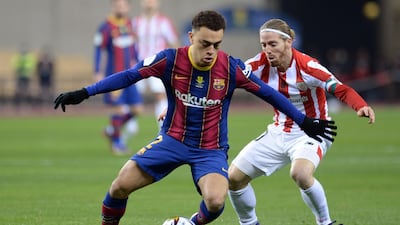
Barcelona defender Sergino Dest under pressure from Athletic Bilbao's Iker Muniain. AFP -

Barcelona defender Sergino Dest. AFP -

Barcelona midfielder Sergio Busquets battles for possession with Bilbao's Raul Garcia. AFP -

Barcelona's Lionel Messi and Bilbao forward Iker Muniain. AFP


Barca already had one cup defeat this week as Athletic Bilbao came from behind to win the Spanish Super Cup 3-2 in Sevilla, a game which saw Messi sent off for the first time in his career. The ensuing two-game ban means Messi will miss the game.
Ronald Koeman’s side take the Copa del Rey very seriously and have won the competition a record 30 times including five times in the last eight years. A second cup defeat in five days would be unthinkable and they’re clear favourites, but they’re not used to playing on surfaces like Cornella, nor the tight pitches. Nor are Barca used to playing without Messi, who Lopez played against when he was at Sevilla, Mallorca and Racing Santander.
“Anything can happen in a one-off game,” he says. Atletico Madrid found that out two weeks ago but can Cornella tear up the form book twice in quick succession?

