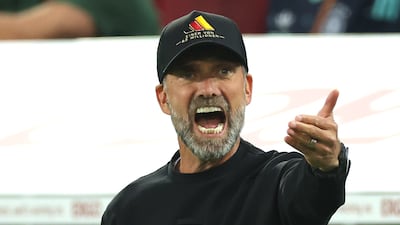
Just two matches into his reign as manager of the German national team and it is already clear the size of the challenge facing Jurgen Klopp.
Having come away from his opening game against the Netherlands in Amsterdam with a respectable 1-1 draw – where the Dutch needed Cody Gakpo's stoppage-time volley to level Felix Nmecha's first-half goal – Germany then fell to a historic home defeat against Greece in Augsburg.
A deflected shot from midfielder Dimitrios Kourbelis earned Greece their first victory over Germany at the 11th attempt and left Klopp with one point from two Nations League Group A2 games.
“The result isn’t great, but it’s part of the process – absolutely,” said the former Mainz, Borussia Dortmund and Liverpool manager.
“The line-up, the way the team was put together, and all the changes were 100 per cent my responsibility … I could have easily lived with not winning the game by a big margin, but you can’t lose it.
“We’ve only been together for a week, we’re a newly formed team, so we need routines. Football needs training. Everything was great this week, except for large parts of this game.”
Klopp's team enjoyed 76 per cent possession at the WWK Arena, registering 16 attempts on goal, twice as many as Greece who managed only a single shot on target. But the 59-year-old made it clear it will take time to change the fortunes of a team that exited the World Cup by Paraguay on penalties in the last-32.
“Let the new players develop,” said Klopp, who took over from Julian Nagelsmann. “Feel free to criticise me, but not the boys. We don't need to completely tear everything apart. I was surprised that some people booed. The future is as bright as we make it.”
For Thursday's game against Serbia in Munich – and the return game in Greece three days later – Klopp will turn to the other half of the huge 44-man squad, which includes 16 uncapped players, he named after this extended international window.
Klopp stands by bumper squad call
“From my point of view, there was no alternative but to do it this way [with a double squad]. I stand by it 100 per cent,” insisted Klopp, who carried over just six players from the first two games. “The plan is to gather as much information as possible in these two and a half weeks.
“Imagine if we had simply brought the same team here that also played in the World Cup: I don't know if the game today would have looked so different. That would have been very bad news.
“Now we are in the process of opening the door for many new faces. The new faces didn't do much wrong. It's also not about blaming anyone. Even for the established players, it's not easy to play with the youngsters. But I saw many positive things that just didn't lead to a dominant style of play.”
Germany sporting director Rudi Voller confirmed on Tuesday that Klopp will not be repeating squad experiment for November's Nations League fixtures in Serbia and home to the Dutch.
“November is when it counts, then we will see Jurgen's condensed squad,” he told Bild am Sonntag. “There won't be 44 players invited any more.”
Over at Germany's neighbours in the Netherlands, Xavi Hernandez heads into his third game as Dutch coach with four points from two matches.
While Klopp began his first international job on the back a club coaching career stretching back more than a quarter of a century and well over 1,000 games, Xavi took over as Oranje manager with far less experience in the dugout.
Xavi at 'university of football'
One of the all-time great midfielders for Spain and Barcelona, Xavi had been in charge of Qatari side Al Sadd and the Catalonian giants for around seven years in total, and less than 250 matches.
But Xavi – who was part of Barca's La Masia academy where the 'Total Football' philosophy developed by the great Dutch coaches Rinus Michels and Johan Cruyff remain the driving force – made clear the attraction of replacing Ronaldo Koeman as Netherlands manager.
“My feeling today is that I’m going to the university of football,” said the 46-year-old at his August unveiling. “I learnt a lot from this university of football during my career as a player and as a coach. I have many connections with this country.
“With Johan in the last period of his life … Even when he was sick, he was positive. This is what I learnt: always smiling. This is what I want to show here to the players. My first goal is to help them, and then enjoy the process. And we will be in a process to win.”
Having started with that draw with Germany at Ajax's Johan Cruyff ArenA, Xavi's side followed that up with a hard-fought 2-1 victory in Serbia on Sunday, with AZ Alkmaar forward Mexx Meerdink scoring both Dutch goals.
“It is always most important to get the three points,” said Xavi. “But we do need to play better, because, especially in the first half, we did not press well,” he said. “Nevertheless, I'm very satisfied after a week of work.”
Next up will be surprise Group A2 leaders Greece in Thessaloniki on Thursday with Xavi clear on where the Netherlands – who were knocked out of the World Cup by Morocco on penalties, also in the last-32 – need to improve.
“There were many moments when we needed to attack the spaces, but we didn’t do it. That is something we need to improve. But also things such as making the pitch wider and moving the ball around more quickly,” he said.
“But the most important thing is that we are creating a lot of chances. The players feel comfortable on the pitch with the structure we are playing in, so a lot of things are also going well.”

