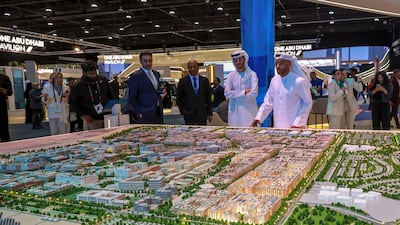

Abu Dhabi's plan to create communities in which residents can reach work, schools, healthcare and leisure facilities within 15 minutes can form the foundation of the UAE’s future development, urban planners said on Tuesday.
The '15-minute city' model is intended to make daily life more convenient and return time lost to long journeys and traffic congestion, with Dh240 billion ($65.4 billion) to be pumped into the capital's infrastructure over the next decade to help see it to fruition.
Shaded corridors and reduced urban sprawl, with improvements in public transport to reduce dependence on cars, will be central to the emirate's smart-city plans over the next 10 years.

Eisa Almazrouei, director general of the Infrastructure Development Directorate at the Abu Dhabi Department of Municipalities and Transport, said the purpose is to build a city that people will enjoy every day.
“We want to make Abu Dhabi the most enjoyable and liveable city in the world,” he said at the opening day of LiveX in Abu Dhabi. “We involve communities to understand what actually their requirements are, and what are their needs.”

Liveable cities that free up time for residents are the focus of the three-day exhibition in the capital, which will show how developers are utilising autonomous vehicles and technology to maximise the efficiency of living in new and established communities.
From moving affordable housing closer to where people work to more autonomous transport to cut traffic congestion, several solutions are being discussed to make cities easier to live in.
Mr Almazrouei referred to improved access to Reem Island that has helped ease congestion and shorten travel times around the capital. In March, two new bridges opened linking Reem Island directly to the Sheikh Khalifa bin Zayed Highway.
The bridge is designed to handle up to 7,200 vehicles an hour and reduce travel times by 60 per cent, or 15 minutes, during peak hours.
“This is one of the beautiful islands in Abu Dhabi that is showing big growth in the future,” he said. “This project has reduced peak travel time by 15 minutes, which means a lot.”
“This was done to simplify life for people, as we don't want them to feel the pressure during their mobility from point-to-point. We have also added up to 350 parks around Abu Dhabi and increased cycle tracks from 900km to more than 2,000km. It does not serve only the infrastructure, it has served the city and it has served the community.”
The idea of a 15-minute city is nothing new and it has proved a popular concept. In Paris, schools, parks, and services have been brought closer to families to improve accessibility and community cohesion.
In Australia, Melbourne has developed a policy of child-friendly cities that prioritise safe walking routes, access to nature and play areas under it urban development strategy.
Technology's roles
Jim Hagemann Snabe, chairman of Siemens AG, said technology can do a lot of the work towards developing efficiency in urban areas.
“If we design environments with the four dimensions in mind of viability, feasibility, desirability and sustainability, we have an opportunity to rethink how we design these environments,” he said.
“Technology is taking up more space, but I feel we have an opportunity and an obligation to make sure that it doesn't become just about technology, but about humans.”
Developing smart traffic systems, multi-modal public transport, and pedestrian-first or car-free urban spaces aims to improve sustainability in the city.
Meanwhile, key tourist and cultural hubs of Saadiyat Island, Yas Island and Al Maryah Island are to benefit from closer integration with the roll-out of autonomous vehicles.
“When technology in urban areas works, it becomes invisible,” said Mr Snabe. “It's only when things don't work that you see the technology. Technologies that work behind the scenes help predict patterns of behaviour.
“That helps reduce wasted time in traffic situations, it helps deliver the services we need almost in invisible ways and with that offer human beings [the chance] to spend more time with other human beings rather than with technology.”

Masdar City was described as a flag bearer to show the world how technology can fit seamlessly into urban design to make modern cities more desirable places in which to live.
Twenty years since its launch, the city’s 15-minute ethos with everything within easy reach for residents is viewed as a model for the design of larger cities and communities.
Since 2006, Masdar City has carried more than three million people in autonomous vehicles.
“The whole master plan of Masdar City was revolving around sustainability and urban development at that time,” said Ahmed Baghoum, chief executive of Masdar City.
“Of course it was centred around environmental sustainability, commercial sustainability, as well as social sustainability.
“We have over 200,000 square meters of public parks covered by solar panels and canopies to make it very welcoming for families to spend their evenings and time. We're very lucky because from day one, we knew that belonging is critical for not only residents, but also for visitors,” Mr Baghoum said.

