


On the last Wednesday of June 1994, an intrepid young Saudi Arabian dared himself to take on 70 metres of highly contested space in Washington DC.
His name was Saeed Al Owairan and the 11 seconds he took to receive a pass deep in his own half, slalom past three attempted challenges from opponents and then thump a rising shot into the Belgian net would make him a global star - at least for the course of a World Cup that declared Al Owairan’s solo effort better than any of its other 140 goals.
His virtuosity that day at the RFK stadium also delivered a historic outcome, the 1-0 win over Belgium pushing Saudi Arabia into the knockout phase at a World Cup for the first and, so far, only time.
Given Saudi football’s obvious ambition to be a superpower in the sport, another step beyond a group stage seems overdue, not least while other Mena countries are conspicuously raising their standards.
At least eight nations from the region will be part of the World Cup’s return to North America, proud qualifiers for a 2026 tournament that will make the 24-team USA 94 look almost miniature by comparison.
On Friday, when group stage fixtures for the next World Cup are assigned to 48 participants, in an elongated draw ceremony at Washington’s Kennedy centre - named after JFK rather than RFK - they will all have a clearer idea of how high to set their aspirations.
Back in the summer of 1994, Al Owairan dedicated his special goal “to every Arab in the world”. And in a small way, the legacy of that goal is that many, many more people from the Arab world can feel they have a direct stake in what happens tonight in Washington and unfolds next June and July in a tournament spread across the US, Mexico and Canada.
The expanded number of finalists is recognition that football is ever more global, as much about standards set by the likes of an Al Owairan or an Achraf Hakimi as by a Romario or a Kylian Mbappe; and that the sport belongs to wider audiences than those in the traditional centres of Europe and South America.
One measure of that is that World Cup 2026 now looks almost an outlier in the modern timeline of the event, the only finals in a sequence of four that will not have a Gulf or Maghreb country hosting: In 2022 it was Qatar; in 2030, Morocco will jointly stage it with Spain and Portugal. In 2034, it goes to Saudi Arabia.
On the pitch, the World Cup map is far more inclusive than it used to be. Where Asia and Africa sent a mere five nations to USA ‘94 between them, those continents will be represented in 2026 by at least 17 teams, perhaps 19 by the time the March play-offs are completed. The Mena contingent would rise to nine should Iraq win their play-off final.
But few will end today feeling they have a straightforward path into the knockouts. The dread for a World Cup newcomer like Jordan would be a group so formidable that it obliges them to face Spain, Mohamed Salah’s Egypt and two-time World Cup-winners Uruguay.
-
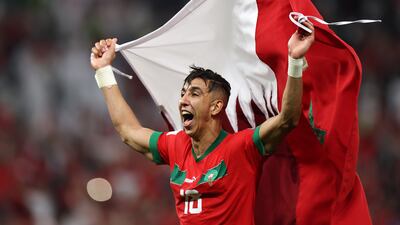
Morocco's Jawad El Yamiq celebrates after the 1-0 World Cup quarter-final win against Portugal at Al Thumama Stadium on December 10, 2022. Getty -
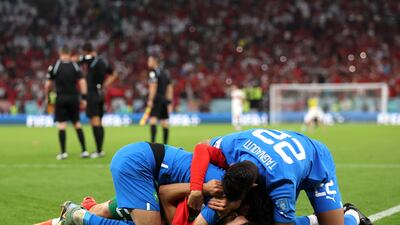
Yassine Bounou, Bilal El Khannouss, Reda Tagnaouti and Achraf Hakimi of Morocco celebrate the team's victory. Getty -
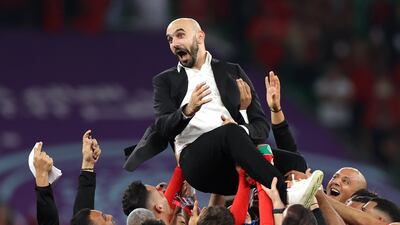
Walid Regragui, coach of Morocco, celebrates with the team. Getty -
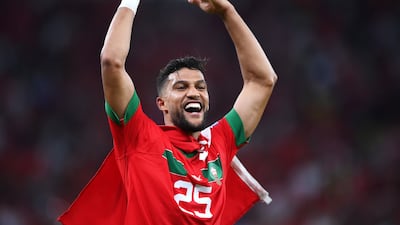
Yahya Attiat-Allah of Morocco celebrates. Getty -
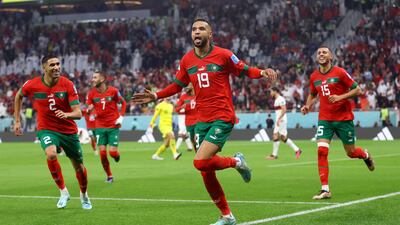
Morocco's Youssef En-Nesyri celebrates after scoring the only goal. Reuters -
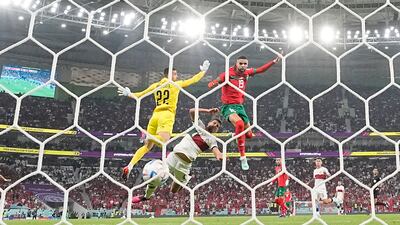
Morocco's Youssef En-Nesyri heads home in the first half. AP -
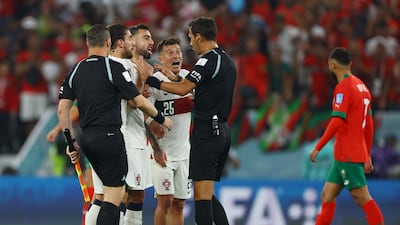
Portugal's Otavio, Bruno Fernandes and Ruben Neves argue with referee Facundo Tello. Reuters -
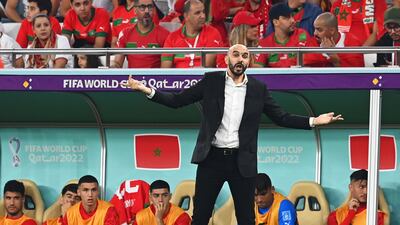
Morocco manager Walid Regragui. EPA -
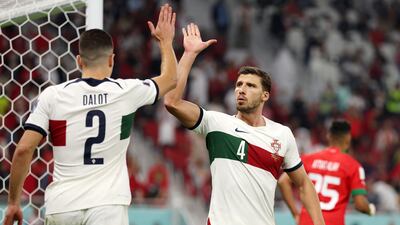
Portugal's Ruben Dias with Diogo Dalot. Getty -
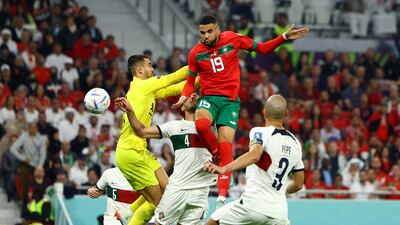
Moussef En-Nesyri scores for Morocco. Reuters -
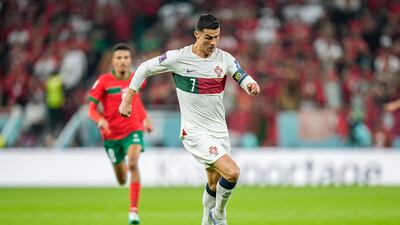
Portugal's Cristiano Ronaldo runs with the ball after coming on in the second half. AP -
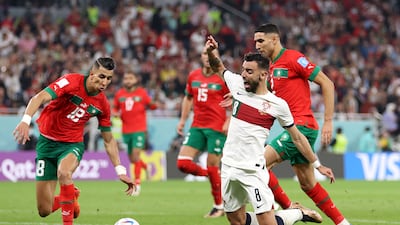
Portugal's Bruno Fernandes goes down in the box but no penalty was given. Getty -
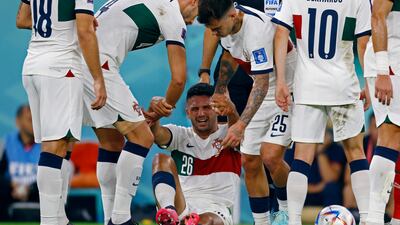
Portugal's Goncalo Ramos is helped up by Ruben Dias and Otavio. Reuters -

Morocco's Achraf Hakimi goes head-to-head with Otavio of Portugal. EPA -
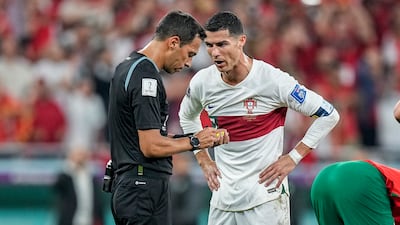
Portugal's Cristiano Ronaldo talks with the referee Facundo Tello. AP -
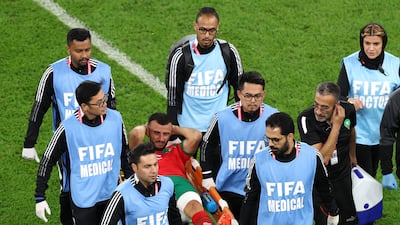
Morocco's Romain Saiss is carried off in the second half. Getty -
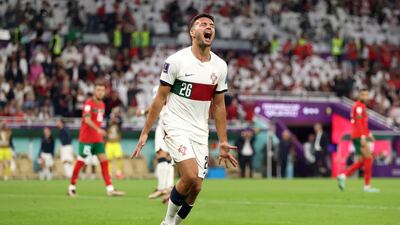
Goncalo Ramos of Portugal reacts after missing a chance. Getty -
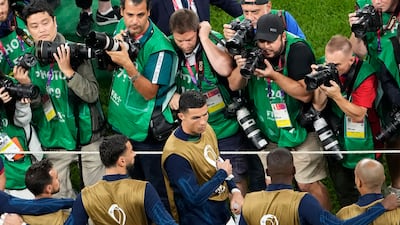
Phtographers surround Portugal subsitute Cristiano Ronaldo before the match. AP


A bad draw for Morocco, the best-equipped squad from the region, could be as ominous as matches against Argentina, Erling Haaland’s Norway and Italy.
Seeding is based largely on the Fifa rankings as they stood after last month’s rounds of international matches.
In a fresh tweak to the traditional format, the top two in those rankings - Spain (1) and Argentina (2) - will be assured of separate pathways towards a possible meeting in the final if they win their groups and, of course, triumph in their last-32, last-16, quarter and semi-final matches. The same rule of separate paths will apply to the next best in the Fifa rankings, France (3) and England (4).
The highest ranked of the Mena nations are Morocco, 11th according to Fifa and all-conquering if you ask any opponent who has had to share a pitch with Walid Regragui’s men the last 20 months.
The Atlas Lions are on a run of 18 consecutive victories and will arrive in North America in June with the status of pioneers. They were semi-finalists in Qatar three years ago, a landmark achievement for Africa and the Arab world.
And they were mould-breakers long before then. Should Morocco, whose ranking puts them in Pot 2, find themselves in a group that has fixtures in Mexico, there will be further reminders of the country’s pathfinder past.
In 1970, when Mexico were sole hosts of a 16-team World Cup, Morocco became the first African team to claim a point at a finals; in 1986, as one among 24 teams in Mexico, they set a new bar, the first country from the Mena region to make the knockouts.
The less helpful precedent for Morocco would be that of USA 94, when Al Owairan and his fellow Saudis made history at the Atlas Lions’ expense, beating them in an all-Mena group-stage clash immediately before Saudi Arabia defeated Belgium. Morocco went home with no points from three games.
A similar concentration of Mena teams in a single group is possible under the format for World Cup 2026.
While countries from the same African confederation will be kept apart - meaning Pot 3-seeded Egypt, Tunisia and Algeria cannot be grouped with Morocco - and no members of the Asian Confederation - Pot 2’s Iran; Pot 3’s Saudi Arabia and Qatar; and Pot 4’s Jordan - can meet a fellow Asian, there is a scenario where, say, Iran could face Egypt; or Jordan find themselves confronted with the daunting Egyptian strike force of Salah and Omar Marmoush or one of the three Maghreb teams.
From the 12 groups, the top pair will progress to the next stage and be joined there by the eight best third-placed finishers. But if that sounds a gentle format, remember that Norway are in Pot 3 and that any team that qualifies from March’s play-offs will automatically fill a Pot 4 slot.
Italy are in that list, as are Iraq and Turkey, Robert Lewandowski’s Poland and the Sweden of Alexander Isak and Victor Gyokeres.
Their potential slots will be filled with a question mark in Friday’s group schedule - six missing names to be inked in in the late spring, and to worry about for anybody grouped with them.

