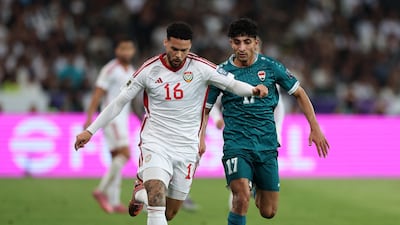
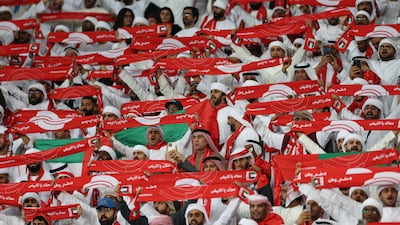
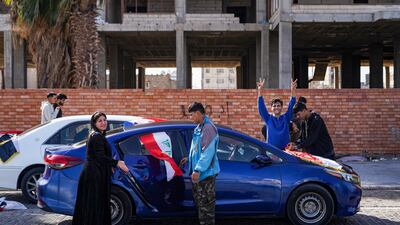
Iraq's Zidane Iqbal, right, during the World Cup play-off second-leg match against the UAE at Basra International Stadium. AP

Iraq's Zidane Iqbal on beating UAE, 'crazy' atmosphere in Basra and being one game away from World Cup


Andy Mitten
  • English
  • Arabic

Iraq defeated UAE 2-1 in the second leg of the World Cup qualifier play-off last week in Basra, thanks to Amir Al Ammari’s dramatic penalty winner in the 17th minute of added time. It sealed a 3-2 aggregate win and took Iraq a step closer to next year's finals in North America.

Former Manchester United youngster Zidane Iqbal, 22, now with Utrecht in the Netherlands, came off the bench with his side 1-0 down. He was influential in changing the game and The National spoke to him after he got off his flight back from Iraq.

Q: How did it feel to defeat UAE and be only a game away from Iraq’s first World Cup finals for 40 years?

A: Honestly, it was surreal. We were 1-0 down, then we equalised and when I heard the noise the fans made I knew we had a winner in us. I looked around and I saw my boys, everyone jumping, everyone pumped up. It was like we had another 10 per cent energy.

It’s hard to describe it, but I got goosebumps. Then we got a penalty in the last minute. I saw the corner come in and the ball hit someone's hand, but I wasn't that sure that would be handball from my angle.

Then I saw the referee touching his ear, speaking to someone. And you know that when he does the VAR sign, he's going to have a look at a screen with a high chance of giving the penalty.

The referee came back, did the square with his hands and pointed at the penalty spot. The crowd just went crazy, 60,000 people. Wow!

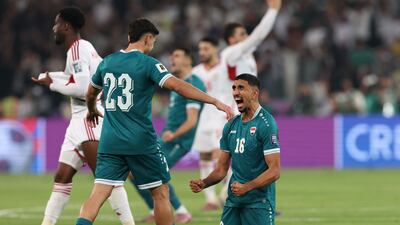
  • Iraq players celebrate after their World Cup play-off victory over the UAE at Basra International Stadium on November 18, 2025. Reuters
    Iraq players celebrate after their World Cup play-off victory over the UAE at Basra International Stadium on November 18, 2025. Reuters
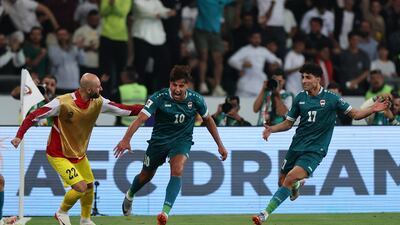
  • Ecstastic Iraq players celebrate their 2-1 win on the night over the UAE and a 3-2 aggregate win. Reuters
    Ecstastic Iraq players celebrate their 2-1 win on the night over the UAE and a 3-2 aggregate win. Reuters
  • Mohannad Ali celebrates scoring Iraq's first goal. Reuters
    Mohannad Ali celebrates scoring Iraq's first goal. Reuters
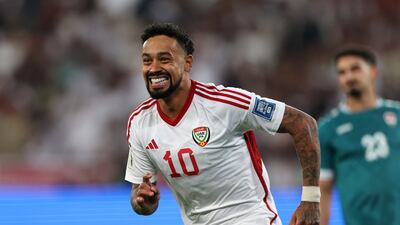
  • UAE attacker Caio Lucas makes it 1-0 in Basra. Reuters
    UAE attacker Caio Lucas makes it 1-0 in Basra. Reuters
  • Caio Lucas celebrates scoring for UAE. Reuters
    Caio Lucas celebrates scoring for UAE. Reuters
  • UAE's Kouame Autonne wins a header. Reuters
    UAE's Kouame Autonne wins a header. Reuters
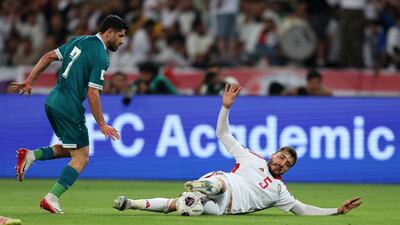
  • UAE's Alaeddine Zouhir slides in the win the ball from Sherko Kareem of Iraq. Reuters
    UAE's Alaeddine Zouhir slides in the win the ball from Sherko Kareem of Iraq. Reuters
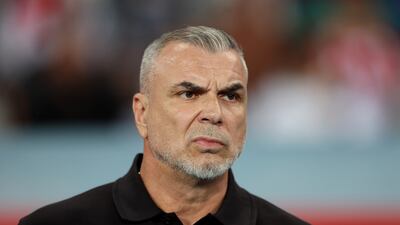
  • UAE coach Cosmin Olaroiu. Reuters
    UAE coach Cosmin Olaroiu. Reuters
  • UAE's Marcus Meloni under pressure from Ali Jasim of Iraq. Reuters
    UAE's Marcus Meloni under pressure from Ali Jasim of Iraq. Reuters
  • Iraq coach Graham Arnold before the game. Reuters
    Iraq coach Graham Arnold before the game. Reuters
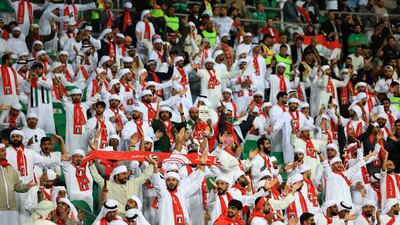
  • UAE fans at Basra International Stadium. Reuters
    UAE fans at Basra International Stadium. Reuters
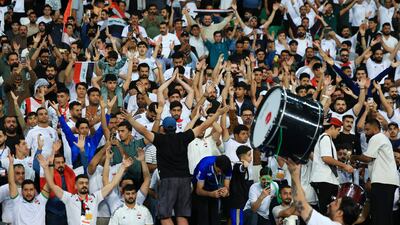
  • Iraq fans in the stands at Basra International Stadium. Reuters
    Iraq fans in the stands at Basra International Stadium. Reuters
  • UAE fans at Basra International Stadium. Reuters
    UAE fans at Basra International Stadium. Reuters
  • fans ahead of the match in Basra. Aymen Al Ameri / The National
    fans ahead of the match in Basra. Aymen Al Ameri / The National
  • Fans ahead of the game in Basra. Aymen Al Ameri / The National
    Fans ahead of the game in Basra. Aymen Al Ameri / The National

How do you think Iraq played?

At the start, the team was a bit nervous and a bit wary because we knew the consequences if we lost. It was a very high-stakes game, nobody wanted to make a mistake, but we also must show our personality a bit more.

We went 1-0 down, but that also meant we had nothing to lose and we could go for it. I thought we deserved to win and thankfully we did because our dream's still alive and now we're 90 minutes away from cementing our names in Iraqi football history.

We've been waiting for a long time and all sharing the same goal. It'll be nice to pay fans back because they support us so much and I think it's only right they get to watch us at a World Cup.

You’ve been injured and came on with 40 minutes to play. Was it difficult entering the game like that?

Having no pre-season was tough as that’s where you gain your fitness. So I came back and everyone else had a pre-season and rhythm, while I was trying to pick up minutes.

For Iraq, the manager Graeme Arnold and his assistant, Rene Meulensteen, told me of my importance to the team. They told me to be ready and as soon as we conceded the first goal, the gaffer just pointed at me and said, “You're coming on”.

It's tough coming back from injury but I think I'm coming back to myself more. And I think I had a positive impact on the game. We controlled the game better, had better ball possession and, of course, we had more chances and we won.

I'm just ready to give 100 per cent, whether they need me in the first minute, the last minute, whether I start or I'm off the bench making an impact.

How did the UAE play?

So they were decent, they have quality. And the players originally from Brazil and Portugal add quality. UAE have good technical ability and scored an offside goal. The games are about little moments like that.

We also had a big chance that we missed then they scored seconds later before VAR checked and it was offside. When things like that happen you start to think it’s going to be your night. And so do your fans.

Do you speak to the UAE players after the game?

Yes. It's another Arab team and the public are respectful. You greet people because they're your guests coming to your country. I felt we were greeted well and with respect when we came to Abu Dhabi and wanted to return that feeling.

In football, we fight on the pitch to try to win the game. Some you win, some you lose. Football shouldn't separate anyone, but it brings everyone together.

If we’d lost I would have said ‘congratulations’ but instead we said ‘unlucky’. A few of my teammates went to the UAE fans and clapped them.

You’ve mentioned the atmosphere in Basra a few times. It looked crazy. The stadium is modern, but people might not associate Iraq with scenes like this?

Maybe when some think of Iraq they don’t think of football, but football is their freedom, their enjoyment, it brings the whole country together. Our country is unique: we have Christians, Muslims, Jews, Kurds, Arabs.

Everybody becomes one when we play. There's no politics, no arguments, everyone is supporting the team. It's nice to know we have that responsibility that brings the whole country together.

And then you have the stadium. It’s close to full three hours before (kick-off). When we check the pitch, we clap the fans, they sing back. You start to get goosebumps. Then you walk out of the tunnel for the game and it's just amazing. It takes 5-10 minutes to relax into these surroundings.

And then, when we scored the winning goal in the 107th minute … honestly I’ve not heard a noise as loud as that in a stadium before. And I've been to many, many stadiums. It’s a moment that will stick with me for a long time.

After everyone was jumping up and down, our bench ran on the pitch, my other teammates were all running around jumping on each other. We knew that in four months we have 90 minutes to get to the finals. We spoke after: none of us have experienced something like that before.

What language do the players speak to each other in?

We've got quite a few foreign Iraqis. I'm half Pakistani, half Iraqi and eligible to play for my mum's side. And we've got a lot of Iraqis that moved to Sweden, Norway and Denmark. We've got a couple in Germany, quite a few in Europe. We all speak English.

Then with the Iraqi players that were born and raised in Iraq, some of them speak English and some of them speak just Arabic. Most of the team can speak both languages. With me, my Arabic is not amazing but it's decent. I've got enough to get by.

But football is one language, you know? One game, pitch, movement, passing, patterns. Everyone understands what you need to do when the game starts.

You’ll play Suriname or Bolivia next in Monterrey, Mexico. Your thoughts on that?

Yes, March 31st. Both teams are strong. Bolivia were in the tough South American group. And Suriname have a lot of players in the Eredivisie [The Dutch top-flight, where Iqbal plays for Utrecht]. There's a lot of Surinamese people here, so most of their team is like Iraq – players who qualify through their parents.

I can't even guess who's going to win between Suriname and Bolivia, but I'm excited because we've never been so close to a World Cup. I see on social media that they’re so excited.

What did your Iraqi mother say?

To be honest, it's more my dad celebrating and so happy for me. My mum was just in tears of happiness – like many Iraqis, she loves football.

Mum, dad and brother came to the game in Abu Dhabi for the first leg and my brother came to Iraq. He’s never been to Basra to watch a game, so that was his first time. And what a first time.


Mercer, the investment consulting arm of US services company Marsh & McLennan, expects its wealth division to at least double its assets under management (AUM) in the Middle East as wealth in the region continues to grow despite economic headwinds, a company official said.

Mercer Wealth, which globally has $160 billion in AUM, plans to boost its AUM in the region to $2-$3bn in the next 2-3 years from the present $1bn, said Yasir AbuShaban, a Dubai-based principal with Mercer Wealth.

Within the next two to three years, we are looking at reaching $2 to $3 billion as a conservative estimate and we do see an opportunity to do so,” said Mr AbuShaban.

Mercer does not directly make investments, but allocates clients’ money they have discretion to, to professional asset managers. They also provide advice to clients.

“We have buying power. We can negotiate on their (client’s) behalf with asset managers to provide them lower fees than they otherwise would have to get on their own,” he added.

Mercer Wealth’s clients include sovereign wealth funds, family offices, and insurance companies among others.

From its office in Dubai, Mercer also looks after Africa, India and Turkey, where they also see opportunity for growth.

Wealth creation in Middle East and Africa (MEA) grew 8.5 per cent to $8.1 trillion last year from $7.5tn in 2015, higher than last year’s global average of 6 per cent and the second-highest growth in a region after Asia-Pacific which grew 9.9 per cent, according to consultancy Boston Consulting Group (BCG). In the region, where wealth grew just 1.9 per cent in 2015 compared with 2014, a pickup in oil prices has helped in wealth generation.

BCG is forecasting MEA wealth will rise to $12tn by 2021, growing at an annual average of 8 per cent.

Drivers of wealth generation in the region will be split evenly between new wealth creation and growth of performance of existing assets, according to BCG.

Another general trend in the region is clients’ looking for a comprehensive approach to investing, according to Mr AbuShaban.

“Institutional investors or some of the families are seeing a slowdown in the available capital they have to invest and in that sense they are looking at optimizing the way they manage their portfolios and making sure they are not investing haphazardly and different parts of their investment are working together,” said Mr AbuShaban.

Some clients also have a higher appetite for risk, given the low interest-rate environment that does not provide enough yield for some institutional investors. These clients are keen to invest in illiquid assets, such as private equity and infrastructure.

“What we have seen is a desire for higher returns in what has been a low-return environment specifically in various fixed income or bonds,” he said.

“In this environment, we have seen a de facto increase in the risk that clients are taking in things like illiquid investments, private equity investments, infrastructure and private debt, those kind of investments were higher illiquidity results in incrementally higher returns.”

The Abu Dhabi Investment Authority, one of the largest sovereign wealth funds, said in its 2016 report that has gradually increased its exposure in direct private equity and private credit transactions, mainly in Asian markets and especially in China and India. The authority’s private equity department focused on structured equities owing to “their defensive characteristics.”

The%20Roundup
%3Cp%3EDirector%3A%20Lee%20Sang-yong%3Cbr%3EStars%3A%20Ma%20Dong-seok%2C%20Sukku%20Son%2C%20Choi%20Gwi-hwa%3Cbr%3ERating%3A%204%2F5%3C%2Fp%3E%0A
Gulf Under 19s final

Dubai College A 50-12 Dubai College B

The%20specs%3A%202024%20Mercedes%20E200
%3Cp%3E%3Cstrong%3EEngine%3A%20%3C%2Fstrong%3E2.0-litre%20four-cyl%20turbo%20%2B%20mild%20hybrid%0D%3Cbr%3E%3Cstrong%3EPower%3A%20%3C%2Fstrong%3E204hp%20at%205%2C800rpm%20%2B23hp%20hybrid%20boost%0D%3Cbr%3E%3Cstrong%3ETorque%3A%20%3C%2Fstrong%3E320Nm%20at%201%2C800rpm%20%2B205Nm%20hybrid%20boost%0D%3Cbr%3E%3Cstrong%3ETransmission%3A%20%3C%2Fstrong%3E9-speed%20auto%0D%3Cbr%3E%3Cstrong%3EFuel%20consumption%3A%20%3C%2Fstrong%3E7.3L%2F100km%0D%3Cbr%3E%3Cstrong%3EOn%20sale%3A%20%3C%2Fstrong%3ENovember%2FDecember%0D%3Cbr%3E%3Cstrong%3EPrice%3A%20%3C%2Fstrong%3EFrom%20Dh205%2C000%20(estimate)%3C%2Fp%3E%0A
Jetour T1 specs

Engine: 2-litre turbocharged

Power: 254hp

Torque: 390Nm

Price: From Dh126,000

Available: Now

Masters%20of%20the%20Air
%3Cp%3E%3Cstrong%3EDirectors%3A%3C%2Fstrong%3E%20Cary%20Joji%20Fukunaga%2C%20Dee%20Rees%2C%20Anna%20Boden%2C%20Ryan%20Fleck%2C%20Tim%20Van%20Patten%3C%2Fp%3E%0A%3Cp%3E%3Cstrong%3EStarring%3A%3C%2Fstrong%3E%20Austin%20Butler%2C%20Callum%20Turner%2C%20Anthony%20Boyle%2C%20Barry%20Keoghan%2C%20Sawyer%20Spielberg%3C%2Fp%3E%0A%3Cp%3E%3Cstrong%3ERating%3A%3C%2Fstrong%3E%202%2F5%3C%2Fp%3E%0A
COMPANY%20PROFILE%20
%3Cp%3EName%3A%20DarDoc%3Cbr%3EBased%3A%20Abu%20Dhabi%3Cbr%3EFounders%3A%20Samer%20Masri%2C%20Keswin%20Suresh%3Cbr%3ESector%3A%20HealthTech%3Cbr%3ETotal%20funding%3A%20%24800%2C000%3Cbr%3EInvestors%3A%20Flat6Labs%2C%20angel%20investors%20%2B%20Incubated%20by%20Hub71%2C%20Abu%20Dhabi's%20Department%20of%20Health%3Cbr%3ENumber%20of%20employees%3A%2010%3C%2Fp%3E%0A
While you're here
Libya's Gold

UN Panel of Experts found regime secretly sold a fifth of the country's gold reserves. 

The panel’s 2017 report followed a trail to West Africa where large sums of cash and gold were hidden by Abdullah Al Senussi, Qaddafi’s former intelligence chief, in 2011.

Cases filled with cash that was said to amount to $560m in 100 dollar notes, that was kept by a group of Libyans in Ouagadougou, Burkina Faso.

A second stash was said to have been held in Accra, Ghana, inside boxes at the local offices of an international human rights organisation based in France.

Winners

Ballon d’Or (Men’s)
Ousmane Dembélé (Paris Saint-Germain / France)

Ballon d’Or Féminin (Women’s)
Aitana Bonmatí (Barcelona / Spain)

Kopa Trophy (Best player under 21 – Men’s)
Lamine Yamal (Barcelona / Spain)

Best Young Women’s Player
Vicky López (Barcelona / Spain)

Yashin Trophy (Best Goalkeeper – Men’s)
Gianluigi Donnarumma (Paris Saint-Germain and Manchester City / Italy)

Best Women’s Goalkeeper
Hannah Hampton (England / Aston Villa and Chelsea)

Men’s Coach of the Year
Luis Enrique (Paris Saint-Germain)

Women’s Coach of the Year
Sarina Wiegman (England)

BMW M5 specs

Engine: 4.4-litre twin-turbo V-8 petrol enging with additional electric motor

Power: 727hp

Torque: 1,000Nm

Transmission: 8-speed auto

Fuel consumption: 10.6L/100km

On sale: Now

Price: From Dh650,000

Profile box

Company name: baraka
Started: July 2020
Founders: Feras Jalbout and Kunal Taneja
Based: Dubai and Bahrain
Sector: FinTech
Initial investment: $150,000
Current staff: 12
Stage: Pre-seed capital raising of $1 million
Investors: Class 5 Global, FJ Labs, IMO Ventures, The Community Fund, VentureSouq, Fox Ventures, Dr Abdulla Elyas (private investment)

Updated: November 24, 2025, 12:33 PM