

Thousands of Emirati supporters have descended on Doha, turning the city centre all white ahead of the national team’s World Cup qualifier play-off campaign.
The UAE allocation of around 5,000 tickets for the opening fixture of the three-team competition, against Oman at the 15,000-capacity Jassim bin Hamad Stadium on Saturday night, is sold out.
The winner of the three-team group, which also involves hosts Qatar, will qualify for the World Cup in the United States, Canada and Mexico next year.

For the UAE, that would be a first appearance since 1990. Qatar played in the last one as hosts, while Oman have yet to make it to a World Cup.
Given what is at stake, as well as the proximity to the UAE, the appetite for fans to show their support has been massive.
-
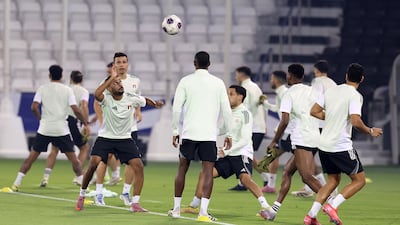
UAE players train ahead of their World Cup qualifier against Oman at the Jassim Bin Hamed Stadium in Doha, Qatar. All images Chris Whiteoak / The National -

Khalid Essa trains at the Jassim Bin Hamed Stadium -
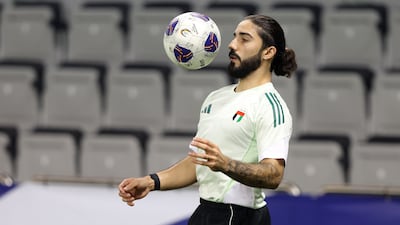
Erik trains with the UAE team for the World Cup qualifier on Saturday -
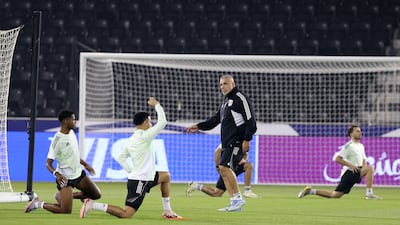
UAE head coach Cosmin Olaroiu oversees training -

The UAE prepare to take on Oman on Saturday -

Yahia Nader trains at the Jassim Bin Hamed Stadium -
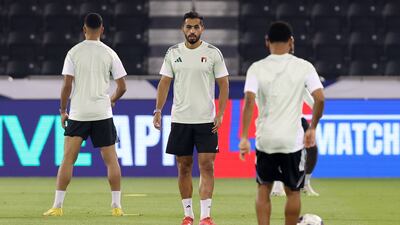
Majed Hassan during training in Doha


Thousands have made use of the various flights that have been specially arranged for fans from various airports across the Emirates.
Hundreds more have made the 700km drive to get there, with the football authorities coordinating with the land border officials to ease entry, according to the UAE Football Association.
Fans who collected their match tickets in person from the UAE FA delegation at the Radisson Blu Hotel in Doha were given scarves and gifts to thank them for their support.
The fans later on Friday night congregated in vast numbers at Souk Waqif, the marketplace in the centre of Qatar’s capital city.
Sheikh Hamdan bin Mubarak, the president of the UAE FA, wished the players success in the fixture against “their brotherly Omani counterpart”.
“The UAE football fans stand firmly behind the national team to qualify for the 2026 World Cup,” Sheikh Hamdan said.
“The team includes talented players armed with local and international experience, and these talents are capable of achieving their dreams.”
Khalid Essa, the UAE goalkeeper and captain, likened the feeling ahead of the play-off to the Gulf Cup. The regional competition evokes fierce support among fans of each of the nations.
When the UAE won the first of their two titles in that event in 2007, it coincidentally came with a win in the final against Oman.
That success, secured when Ismail Matar, the UAE’s star striker, scored the lone goal past Ali Al Habsi, Oman’s keeper who was playing club football in the English Premier League at that time, sparked days of celebration in the Emirates.
Essa acknowledges, though, that the rewards for success will be different this time around.
“It is like a mini Gulf Cup with different goals maybe, or maybe higher stakes than what you usually see in the Gulf Cup,” Essa said.
“Not that the Gulf Cup is something we underestimate. That is a championship of its own, a very strong championship with a legacy, and a long history amongst us as Gulf teams.
“But today is like a mini Gulf Cup but with different goals and objectives. And you know where this round is going to take you [to next summer’s World Cup].”
Fixtures between UAE and Oman are generally more cordial than those between the national team and the other side in the group, Qatar, for example.
It is often claimed that the fixture means more to Oman’s players, given the greater attention generally paid to UAE football.
Cosmin Olaroiu, the UAE coach, refuted the idea that his players will be any less motivated than their counterparts.
“I don’t [understand] why Omanis are used to playing this derby and Emiratis are not used to playing this derby,” Olaroiu said.
“If it is a derby between two teams, then both are used to playing this kind of competition and these kind of derbies.
“Of course, they will fight because for them is not less important than for us. We know they will fight, we saw the games they play.
“It’s a team that has a wonderful spirit, but of course, we have to fight back, and we have to fight more than them. And I think we are able to do this.”

