


Live updates: Follow the latest on Israel-Gaza
Emmanuel Macron, the French president, will attend France’s Uefa Nations League match against Israel at the Stade de France on Thursday evening and is expected to be accompanied in an unusually sparse crowd by his predecessors Francois Hollande and Nicolas Sarkozy.
Their united presence, along with a deployment of police and security personnel almost double the usual for an international fixture in Paris, is designed as a show of confidence in the country’s law enforcement and, as the Minister of the Interior, Bruno Retailleau, told the French parliament, of France’s refusal to “bow down to hatemongers”.
Protests in favour of sporting sanctions against Israel are anticipated in Paris ahead of the match and – following violence last week in Amsterdam, when supporters of the Israeli club Maccabi Tel Aviv were attacked before and after a Europa League match at Ajax and fans wearing Maccabi colours chanted anti-Arab slogans and tore down a Palestine flag – an extra 2,000 police and private security officers will patrol the Stade de France, its surroundings and be working across the French capital.
With his government resisting calls to move the fixture outside France, or to a smaller venue than the 80,000-capacity Stade de France, Macron said he intended “to send a message of fraternity and solidarity after the intolerable acts of anti-Semitism after the match in Amsterdam”. Dutch police made 62 arrests and five people were treated for injuries in hospital.
Israel’s National Security Council has advised its citizens against travelling to the fixture. But some support for the visiting team, who have lost all four of their Nations League group matches so far, is expected to be visible and audible in a stadium likely to set a new record for empty seats at a game involving France’s national men's team.
Twenty one years ago, a mere 36,842 came to the country’s principal sporting venue, with seating for 80,000, to watch Les Bleus beat New Zealand 5-0 on a June evening in the old Confederations Cup. In the newer Uefa Nations League, with Israel the visitors, fewer are expected.
“We’re obviously aware of what’s going on around the game,” said the France goalkeeper Lucas Chevalier, called up for the first time to the senior squad. “We’ll try to behave as if it is a normal game but in the end it isn’t really.”
“I can understand why people don’t want to come,” said the France defender Dayot Upamecano.
The fixture will be the last away match Israel play in this edition of the Nations League. They will complete their schedule with a “home” meeting with Belgium in Hungary, which has been the preferred venue for Israel’s home games since the conflict in Gaza escalated last October and Israeli stadiums were deemed unsafe for visiting international teams.
But this season, some European countries slated to host Israeli representative teams have also moved their own “home” meetings with Israel. Belgium-Israel in September was played behind closed doors in Hungary after Brussels’ city authorities found safety issues made it “impossible” to stage the game there. Other Belgian cities took the same position.
Meanwhile, Maccabi Tel Aviv’s next Europa League game, later this month, is away at Besiktas. Turkey’s government told the Istanbul club to play the match elsewhere. Agreement has been reached with Uefa to stage it in Debrecen, Hungary.
-

A woman embraces her son, a supporter of Maccabi Tel Aviv, as he arrives at Israel's Ben Gurion International Airport from Amsterdam, where Israeli football fans were attacked following a match against Dutch team Ajax. AP Photo -

Zarko Lazetic, manager of Maccabi Tel Aviv, arrives at the airport in Lod, Israel, from Amsterdam. Reuters -

A Maccabi Tel Aviv fan gestures to his scarf as he arrives from Amsterdam at Ben Gurion International Airport. AFP -
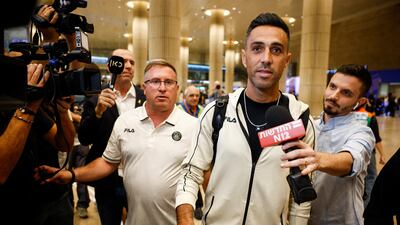
Eran Zahavi of Maccabi Tel Aviv arrives at Ben Gurion International Airport. Reuters -
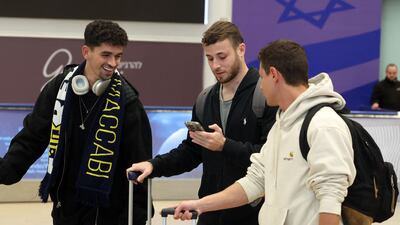
Maccabi Tel Aviv fans and players arrive at Ben Gurion International Airport, on the outskirts of Tel Aviv. AFP -
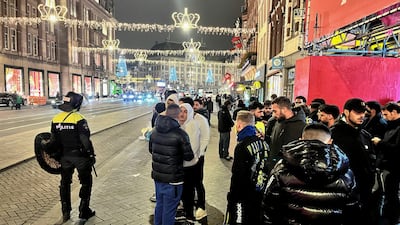
Israeli Maccabi Tel Aviv supporters are guarded by police after violence targeting Israeli football fans broke out in Amsterdam on Thursday night. Reuters -
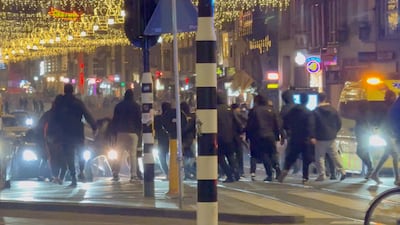
Israeli football supporters and Dutch youths clash near Amsterdam Central Station. Reuters -
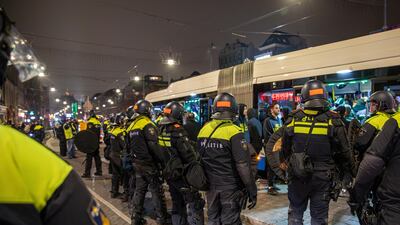
Police officers make a security cordon around a bus after the football match between Ajax and Maccabi Tel Aviv, in Amsterdam. EPA -
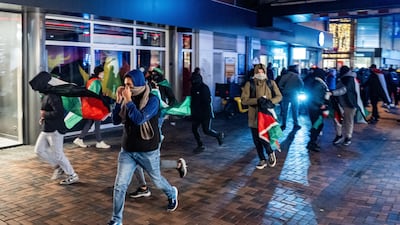
Demonstrators with Palestinian flags ahead of the Uefa Europa League match between Ajax and Maccabi Tel Aviv, in Anton de Komplein, Amsterdam. EPA -
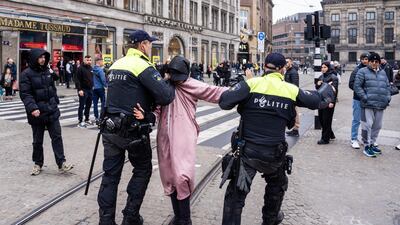
Dutch police detain a man at Dam Square in Amsterdam for allegedly provoking Maccabi Tel Aviv supporters before the Uefa Europa League match. EPA -

Royal Military Police vehicles parked outside the departure hall at Amsterdam Schiphol Airport on Friday morning. EPA


France, whose security operation around the Paris Olympic and Paralympic Games during the summer drew praise for its effectiveness, have by contrast made a priority of neither relocating the “high-risk” France-Israel game outside the country, or away from what is its marquee sporting venue.
“The chief of police has told me he can ensure security around the Stade de France,” said Retailleau, “and there’s also something fundamental. This is France. I want a football match, even if it’s France-Israel, to go ahead under normal conditions.”
A rally in the suburb of Saint-Denis, where the Stade de France is located, was being planned for Thursday evening to make the case that Israel’s continuing participation in international sport is not normal.
Organised under the slogan “We don’t play with genocide. No to the France-Israel match”, it intends to push the case for sanctions against Israel, a case that has been put in detail to Fifa by the Palestinian Football Association and which football’s world governing body says is currently “under investigation”.
But there is little indication that Fifa would be ready to rule on possible sanctions, which could include a ban from competitions, before next month’s draw for the European qualifying competition for the 2026 World Cup.
That draw will put Israel in a group with three or four other Uefa nations for matches to be played between March and November next year, with possible play-off rounds the following spring. It remains to be seen how many of Israel’s next scheduled hosts follow the example of France and how many seek to have their “home” matches played on neutral territory.

