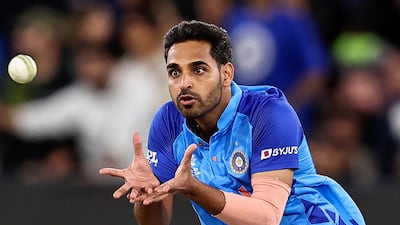
Bhuvneshwar Kumar last played an international match for India in 2022. His international career looked as good as over after England smashed him for 25 runs in two overs in the 2022 T20 World Cup semi-final in Adelaide during a thumping 10-wicket win.
His lack of bite with the new ball, in the absence of Jasprit Bumrah, led the team management to quickly move on from him. Mohammad Siraj nestled into the white-ball team and formed a lethal pace trio with Bumrah and Mohammad Shami as India dominated the ensuing ODI World Cup at home, only to lose the final to Australia.
India have since won successive T20 World Cups, Asia Cups and Asian Games T20 gold medals, plus the 50-over Champions Trophy. But with the ICC cycle moving out of Asia for the upcoming seasons, India have gone back to the bowler they had decidedly moved on from.

In 2023, right-arm seamer Bhuvneshwar had told The National that he just wants to enjoy his remaining years of fast bowling. Now, he is back in the Indian T20 team, at the age of 36, for the forthcoming tour of New Zealand.
Actually, he has forced himself back into the Indian set-up. The seamer went back to the drawing board, upped his fitness and recalibrated his game around the shortest format to emerge as the most lethal 20-over pacer in the country.
Bhuvneshwar was the driving force behind Royal Challengers Bengaluru’s IPL triumphs, finishing as the second-highest wicket taker last season and delivering match-winning spells in both finals. This season, he took his domestic team Lucknow to the final of the state-level Uttar Pradesh T20 league.
Bhuvneshwar’s sustained excellence over two seasons has coincided with the continued struggles of the next crop of Indian fast bowlers.
Young quicks like Prasidh Krishna, Gurnoor Brar, Mayank Yadav and Anshul Kamboj are among a long list of quicks who have come in and failed to cement their spot in any format.
During the recent ODI series against the West Indies, India’s bowling attack conceded 400 runs in the second game and saw the Windies easily chase down a 350-run target in the third ODI.
Among the experienced lot, only Siraj and Arshdeep Singh can be viewed as first-choice picks. Everyone else is a work in progress, at best.
However, even Arshdeep was pummelled for 45 from his four overs as India were beaten by six wickets by the Windies in the second of five T20s on Friday.
It all explains why India’s selectors have gone back to Bhuvneshwar for the T20 series in New Zealand which begins later this month. And which is also why many hope that veteran pacer Shami, 36, finds his way back into the Indian team for next year’s ODI World Cup in southern Africa.
Experience matters
Bhuvneshwar’s comeback fits perfectly with a peculiar quirk of international cricket – many of the top-ranked fast bowlers across formats are well into their 30s, while most of the best batters are in their mid 20s.s
Jasprit Bumrah (32), Mitchell Starc (36), Josh Hazlewood (35), Kagiso Rabada (31), Jofra Archer (31), Matt Henry (34), Pat Cummins (33), Ollie Robinson (32), Taskin Ahmed (31), Scott Boland (37) … the list is really long.
A few standout exceptions are South Africa’s Marco Jansen (26), Bangladesh tearaway quick Nahid Rana (24) and Pakistan’s Shaheen Afridi (26).
Compare that to the best and most promising batters in the world. Harry Brook (27), Shubman Gill (27), Abhishek Sharma (26), Rachin Ravindra (26), Vaibhav Sooryavanshi (15), Dewald Brevis (23), Ishan Kishan (28), Saim Ayub (24), Pathum Nissanka (28) are all young and well on their way to excelling in one or many formats over the coming years.
Sure, veterans like Joe Root, Steve Smith, Virat Kohli and others are still piling on the runs. But the next generation is clearly up to the task.
That does not seem to be the case with bowling. India’s reliance on Bumrah, decision to go back to Bhuvneshwar and clamour for the return of Shami shows that when it comes to pace bowling, the new crop is not quite matching up to the old stock.
One can understand why. Fast bowling requires miles in the legs and bowlers can get that only by playing red ball, multi-day cricket.
Only bowlers of a certain vintage have played enough first-class and Test matches and have the experience in their body to last the distance for consecutive seasons or adapt their bowling according to match situations.
Those who developed their bowling in the T20 arena don’t seem to have the complete set of tools required to master conditions and formats. Which is why teams are holding on to their older generation of fast bowlers for as long as physically possible, barring Bangladesh who have an exciting and high-class young bowling attack.
Now you understand why Australia are squeezing every bit of life out of their awesome quartet of Starc, Hazlewood, Cummins and Boland.
That has proven to be the case elsewhere, too. Because, in almost every corner of the world, they just don't make them like they used to.