

A five-Test series generally takes a decisive turn by the end of the third Test, providing a glimpse into how the teams will negotiate the final two contests as resources generally start to dwindle and teams are routinely forced to make do with replacements.
That was absolutely not the case this Ashes. Resources were depleted from the outset, and yet Australia retained the urn at the first opportunity - the third Test in Adelaide.
England hit back to win the two-day Melbourne Test but that proved to be a flash in the pan. The Aussies fought their way to a five-wicket win in Sydney to complete a 4-1 series triumph, extending their hold over the urn to a decade.
Travis Head the deciding factor
In a series where two Tests finished inside two days and 400 was breached only twice across five Tests, here is a player who was asked to move from the middle order to open and ended up smashing 600 runs.
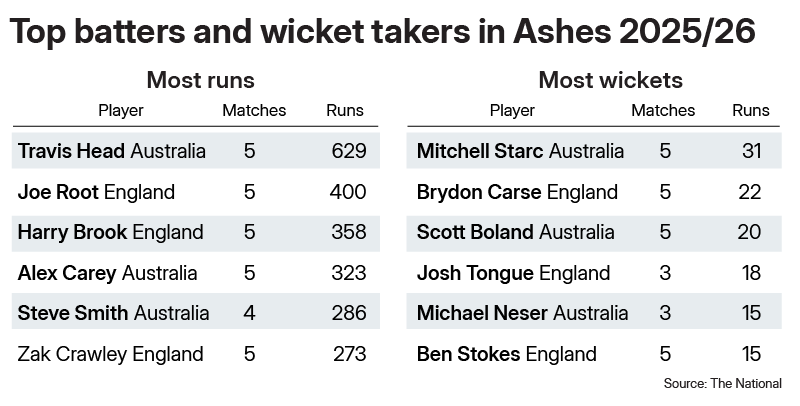
Travis Head's tally of 629 is over 200 runs more than the next best. He was one of five centurions in the series, and he made three. But more than the quantum of runs, it was his 83-ball 123 in the opening Test that pretty much won the Ashes – on the second day of the series. That two-day Test on a lively fast pitch finished in unprecedented fashion as Australia, chasing 205 in a low-scoring contest, reached home inside 30 overs. All thanks to Head, who smashed 16 fours and four sixes against the new ball after playing in the middle order in the first innings.
The audacity of Head to play that knock on that pitch is what set the two teams apart. England and other teams can try to match Australia in many departments but no one grabs the big moments by the throat like Head.
England have numbers but not results
A 4-1 scoreline looks horrendous. And usually costs one or two personnel their jobs. But individually, England did fare reasonably. Two of the top three run-getters in the series are English, while the top six wicket takers are split between the home and away teams.
Joe Root scored two centuries, Harry Brook got a start in every innings bar one, to be among the top three. Brydon Carse was the second-highest wicket-taker in the series with 22 scalps – although his average of 30 was high – and was only behind the outstanding Mitchell Starc with 31 wickets. Josh Tongue and Ben Stokes both took 15 wickets apiece. But most of it did not matter in the decisive moments of the series.
When England's bowlers really needed to go for the jugular in the first Test, their fully-fit first-choice attack that included Jofra Archer, Mark Wood, Carse and Gus Atkinson were battered into submission.
The tour is littered with Brook's dismissals against the run of play while attempting audacious shots. The final Test in Sydney encapsulated the tour for him. Batting on 84 in the company of Root and England comfortably placed at 226-3, Brook played a late nudge with two slips in place. He went and England were bowled out for 384 when 450 seemed the bare minimum.
England have talented batters and bowlers. But the sum of the parts is smaller than the whole.
Back-ups take the lead
The performance of the back-up players gave Australia the tactical edge over England. Michael Neser was one the best bowlers in the series with 15 wickets in three games at an average of under 20; Starc, as is expected of him even at 35 years of age, finished with extraordinary numbers – 31 wickets from five Tests at an average of 19.9.
Neser is probably seventh in the pecking order of Australia's bowling hierarchy when all quicks are available.
For a 35-year-old back-up seamer, who has the keeper standing up to him more often than not, to get those numbers in Australian pitches is incredible.
Beau Webster played just the one Test – in Sydney – and scored a match-defining 71 at number nine and took three important wickets with his part-time off spin – is a seam bowler.
Compare that to what England's regulars did. Ben Duckett managed to face fewer deliveries than Aussie newbie Jake Weatherald, while frontline quick Atkinson bled runs at almost 50 while the top bowlers hovered around the mid-20s.
In a long Test series, the second in line and back-ups are the deciding factor.
Golden opportunity missed
England fans will be wondering if they will ever get a better chance to defeat Australia in their conditions. The home team are clearly going through a transition phase. Captain Pat Cummins missed most of the series due to injury while Josh Hazlewood, arguably the best Test bowler, missed the series altogether. Nathan Lyon found himself pushed towards the sidelines, Usman Khawaja fumbled his way to retirement and half of the Aussie seam attack required the keeper to stand up to the stumps. Still, Australia did not give England a sniff.
A visiting team could not have hoped for a better set of circumstances. And yet, England failed completely. Makes you wonder what would have happened if the first-choice Australian team had played the full series.
Australia are here to stay
The Aussies can now rest assured that the legacy of this great generation of cricketers has been secured. Their core of Cummins, Starc, Hazlewood, Steve Smith and Head has won – mostly alongside each other – the T20 World Cup, ODI World Cup, World Test Championship and the long-lost Border-Gavaskar Trophy within the past four years. And they have held on to the Ashes for a decade now.
This was possibly the last Ashes series for most of them together. And there was a fear that they might part ways in front of home fans having lost the urn to a dynamic England team, especially given their fitness concerns early on.
Even if some of the star players begin to drift away, Australia now have confidence flowing through their system where they know the next in the queue will get them over the finish line.
And if this was their final Ashes together, then it is only apt that a master of pressure moments like Head and the indefatigable Starc led the way with bat and ball.

