


Salman Agha has reiterated he will not instruct Pakistan’s players to curb their aggression in Sunday’s Asia Cup final against India.
Relations between the two sides threatened to boil over in the aftermath of India’s decision to opt out of post-match handshakes after the first meeting between the sides in this competition.
When they met again in the Super Four phase, the match was littered with angry confrontations, both between players and also involving fans beyond the boundary.
Two Pakistan players were censured by the ICC for their behaviour during the game. Haris Rauf was fined for making inflammatory gestures towards Indian supporters, while Sahibzada Farhan was cautioned for miming shooting a gun when celebrating a half century.
The Pakistan Cricket Board chairman, Mohsin Naqvi, has reportedly offered to pay Rauf’s fine himself. He also twice posted a video on X showing Cristiano Ronaldo performing the same gesture as Rauf, apparently that of a jet exploding mid flight.
Suryakumar Yadav, the India captain, was also fined 30 per cent of his match fee for his comments after the opening win, which included dedicating the result to India’s armed forces.
He further ratcheted up hostilities between the sides when he said after the second win that India-Pakistan cricket matches no longer constitute a rivalry, given how lopsided the results are in India’s favour.
The backdrop means Sunday’s final at Dubai International Stadium will likely be played out in a fraught atmosphere again. But Agha, Pakistan’s captain, said his players will not take a backward step.
“Every player has his own ways,” Agha said. “If a player wants to be aggressive then why not? If you take aggression away from a fast bowler, then there is nothing left.
“All players know how to deal with their emotions. As a captain I give my players a free hand on how to react on the ground, unless or until there is any sort of disrespect.”
Agha said he had never seen a team not shake hands before, and that he felt it was bad for the game.
“I have played competitive cricket since 2007; in all of my cricket career I have never seen teams not shake hands,” Agha said.
“Even my father who has been watching cricket for a lot longer than that said to me he has never seen that happen. In fact, I don't think it has ever happened before.
-
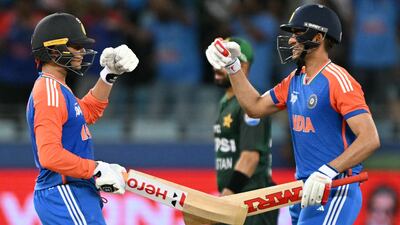
An opening partnership of 105 between Abhishek Sharma, left, and Shubman Gill put India on the way to a six-wicket victory over Pakistan in the Asia Cup match at Dubai International Stadium on September 21, 2025. AFP. -
Pakistan bowler Haris Rauf has words with Abhishek Sharma and Shubman Gill of India. Getty Images -
India opener Abhishek Sharma cracked 74 off 39 balls. AFP -
Pakistan's Haris Rauf, second left, celebrates with teammates after taking the wicket of Indi batter Suryakumar Yadav for a duck. Reuters -
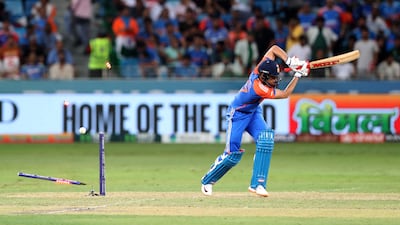
India opener Shubman Gill is bowled out by Pakistan's Faheem Ashraf for 47. Reuters -
Pakistan's Sahibzada Farhan celebrates reaching his half century. He was eventually out for 58 off 45 balls. Getty Images -
India's Abhishek Sharma, centre, celebrates after taking a catch to dismiss Pakistan batter Saim Ayub. AFP -
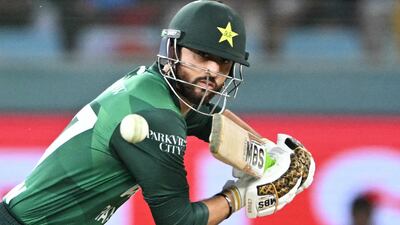
Pakistan captain Salman Agha finished unbeaten on 17 as his team ended on 171-5 off their 20 overs. AFP -
India's Abhishek Sharma drops a catch off Pakistan batter Sahibzada Farhan. AP -
Pakistan's Saim Ayub hits a six during his 17-ball knock of 21. AP -

Pakistan's fans at the Dubai International Stadium. AFP -
Pakistan's Sahibzada Farhan looses control of his bat only to be caught by Suryakumar Yadav of India. Getty Images -
India's Hardik Pandya, second from right, celebrates with teammates claiming the wicket of Pakistan opener Fakhar Zaman for 15. AP


“Relations have previously been even worse between India and Pakistan yet the teams shook hands. I believe that not shaking hands is not a good thing for cricket.”
The two captains did not partake in a photocall with the trophy on Saturday, as is customary on the day before major finals in international cricket.
The organisers are hopeful it will take place on the day of the match itself, and Agha said he will do what is expected of him, even if Suryakumar does not.
“The Indian captain can do what he wants,” Agha said. “I will fulfil the protocol. If he wants to come to the photo shoot that's fine, if he doesn’t then that’s up to him, we can’t do anything about it.”
Despite Agha’s combative statements, India are the strong favourites for the final. They have won all six of their matches so far in the competition, including two comprehensive successes against Pakistan.
Morne Morkel, the India bowling coach, said there will be no complacency within their ranks, suggesting the side have yet to play to their potential in the competition.
“We by no means are a finished article, and we know that,” Morkel said.
“But luckily, we have won, and we have won sometimes in ugly fashion, but we will take that. And as a group, we always look to take the learnings and look to improve and [that is the aim] on Sunday.”

