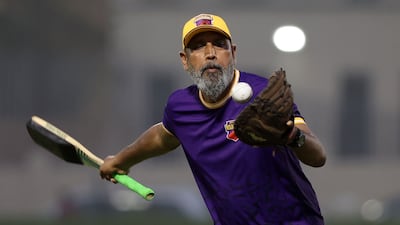

There are two days in his life which Ali Asad can recall instantly. The first was the one on which he gave up his career as a cricketer, his home life in Pakistan, and started out for new horizons in the UAE.
“I remember the day and date: it was Thursday, November 14, 1996, and the time of my flight was 4.40pm,” Asad says. “I still remember it clearly after 29 years.”
Without some context of history, it seems like an easy enough decision to make. The potential for a better financial future in a land of opportunity, a mere few hours’ flight from his home in Lahore.

And if the cricket was not going to be exactly the same as back home, then the Emirates is not exactly barren for the sport.
Well, it is not now, at least. In 2025, there are over 50 grass ovals in the country. Some of them, particularly in Dubai Sports City and Abu Dhabi Cricket and Sports Hub, are immaculate training facilities which would be the envy of most major cricket nations.
Asad oversaw the creation of another one himself, after being made project manager of the gorgeous boutique ground at Batayeh in the rolling dunes of the Sharjah desert.
But three decades ago, the scene for cricket was entirely different. There was Sharjah Cricket Stadium, plus a couple of now defunct grass fields near what is now Dubai Healthcare City, and no other provision for turf cricket.

And Asad had been on the brink of something significant in his homeland. As a bustling seam bowler, he had toured New Zealand with Pakistan’s Under-19 side.
He had played against England, who were preparing for the 1996 World Cup, and had taken five wickets, scalping players of the pedigree of Alec Stewart and Graeme Hick.
Leaving all that behind for a cricket wilderness seemed impossible. But, as one of 10 siblings in a low-income family, it was also a no-brainer.
“I am not shy of saying I belong to a very poor family,” says Asad. “At that time my mother was working, my father was working, and I was the first brother after seven sisters.
“I wanted to help my family, so I took this opportunity and responsibility. I quit my career and came here.”
The UAE had just played in the World Cup for the first time. The Sharjah Cup was well established. Other than that, though, opportunities in cricket were limited.
“The main objective was financial; I thought, ‘Why not move and help my family?’” he says.
“When I moved, I had no knowledge of UAE cricket. It was 1996 and I was 19. When I first came here, I was surprised to see there were concrete pitches with rubble everywhere. But there was no option for me to move back.
“It was very difficult to bowl at that time. I wasn’t used to bowling without spikes. I kept waiting and waiting, then, finally, the coach Syed Abid Ali was very interested in my bowling. He requested to the board, saying, ‘I want this guy.’
“Thanks to God, I got my opportunity.”
All of which is the preface to the second most memorable day of his life. Asad qualified to play for the UAE in late 2003. It was a long seven-year wait, but he was eligible for his adopted country just in time for the Asia Cup in Sri Lanka.

The UAE’s first opponents were the all-star Indians. It meant, opening the bowling in his first official international match, he would be faced with Sachin Tendulkar and Virender Sehwag.
“Somebody asked me the day before the match: ‘How do you think you will feel bowling to Sachin Tendulkar?’,” Asad said.
“Of course, he is a great cricketer. It is Sachin. But because of the cricket I had played in Pakistan, and the players I had played against, I felt that I bowled within my limitations, nobody could play me easily.
“If I didn’t bowl within my area, then anybody could play me any way they want. I just kept controlling my line and length, and he only hit me for one boundary.”
He finished with 10 overs, one maiden, none for 38, as UAE limited India to 260-6. Highly respectable figures, given the opposition included the “Fab Four” of Tendulkar, Rahul Dravid, Sourav Ganguly and VVS Laxman, plus Sehwag and Yuvraj Singh besides.
They were figures that might easily have been embellished with a couple of wickets. He saw an edge off Tendulkar drop just short of slip. Sourav Ganguly was dropped off his bowling off the first ball he faced, and survived an lbw shout.
The following day, he was similarly thrifty as the UAE held their own with the ball again, albeit in another defeat, against the hosts Sri Lanka. This time he got two wickets, one of which was the great Sanath Jayasuriya.

And that was the beginning and end of his international career. Official one-day internationals were not as readily available to UAE cricketers back then.
The next one the national team played was four years later, by which point Asad was out of the side.
Now 48, he remains in the UAE, having served roles at a variety of banks – chiefly, of course, as the spearhead of their staff cricket teams’ bowling attack.
He has been the head coach of the cricket team of Dubai Police for the past three years, and also helped out his former UAE skipper, Khurram Khan, with coaching the Sharjah Warriorz development team.
He is happy to help out. And, if any of his young charges ever wanted to ask him about it, he would be happy to tell them about the day he opened the bowling against Sachin Tendulkar, too.
“Alhamdulillah, I was proud,” he says. “It was dream come true and a memory I will never forget.”