

There was a time, before they had been fully Glazered and long before Sir Jim Ratcliffe decided all the staff should eat soup, that Manchester United were simultaneously the most popular and unpopular football team in the world.
Perennially successful, and with all the sport’s most recognisable players, they had more supporters than anyone else. But everyone outside of that hated them. It was a case of ABU: Anyone But United.
Has world cricket become a case of ABI: Anyone But India? At times over the past couple of weeks, it certainly felt like it.
They are unquestionably the best backed side in world cricket. With a large chunk of India’s 1.4 billion population being cricket mad, simple maths suggests no sports team ever has enjoyed quite the support they do.
The scenes across the country in the wake of their Champions Trophy win were testament to it. There were outpourings of joy from Amritsar to Ahmedabad, and everywhere else besides.
-
India players celebrate after beating New Zealand in the ICC Champions Trophy final at Dubai International Stadium on March 9, 2025. Getty Images -
India captain Rohit Sharma with the trophy after defeating New Zealand. AP -
AP Photo -
KL Rahul and Ravindra Jadeja celebrate after India defeated New Zealand by four wickets. Getty Images -
India captain Rohit Sharma hit 76 off 83 balls, including seven fours and three sixes. AFP -

New Zealand fielder Kyle Jamieson drops India's Shreyas Iyer on 44. Iyer would only contribute another four runs to his team's total, though. AP -
India's KL Rahul hit an unbeaten 34 off 33 balls including one four and one six. AFP -
New Zealand's Michael Bracewell, left, celebrates with teammates after the dismissal of India batter Virat Kohli via lbw for just one. Bracewell finished with figures of 2-28 off his 10 overs. AFP -
New Zealand fielder Glenn Phillips after his wonder catch to dismiss India's Shubman Gill. AP -
India opener Shubman Gill hit 31 off 50 balls including one six in an opening partnership of 105 with Rohit Sharma. AFP -
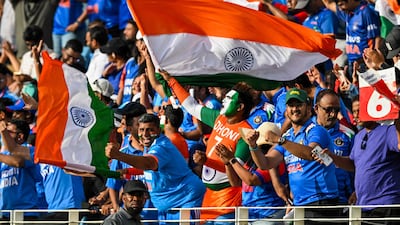
India fan during the Champions Trophy final in Dubai. AFP -
Daryl Mitchell top scored for New Zealand with 63 off 101 balls, including three fours as his team reached 251-7 in their 50 overs. Reuters -
India wicketkeeper KL Rahul runs-out New Zealand captain Mitchel Santner for eight. AP -
India spinner Varun Chakravarthy, centre, celebrates with teammates after trapping New Zealand's Glenn Phillips lbw for 34. Chakravarthy finished with figures of 2-45 off his 10 overs. AFP -
New Zealand's Michael Bracewell hit an unbeaten 53 off 40 ball including three fours and two sixes. AFP -
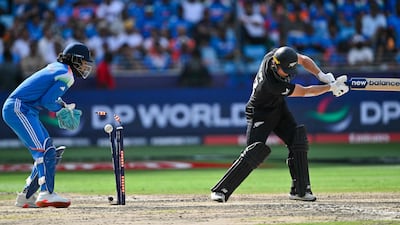
New Zealand batter Glenn Phillips is bowled by India's Varun Chakravarthy for 34. AFP -
India's Ravindra Jadeja celebrates after trapping New Zealand batter Tom Latham lbw for 14. AP -
New Zealand opener Rachin Ravindra is bowled by India's Kuldeep Yadav bringing to an end his quickfire 37 off 29 balls that included four fours and a six. AP -
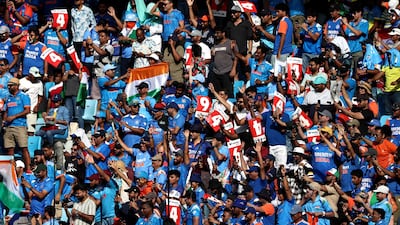
India fans at the Dubai International Stadium watching their team coast to victory. AFP -
India's Kuldeep Yadav, front, celebrates with teammate Virat Kohli after the dismissal of key New Zealand batter Kane Williamson for 11. Yadav finished with figures of 2-40 off his 10 overs. AP -
New Zealand opener Will Young takes a ball to the face during his knock of 15. Getty Images


But what does everyone else make of them? Hate is definitely a bit much. It is difficult to stay too cross when you see one of Rohit Sharma’s pull shots, or a Shubman Gill straight drive, or a spitting carrom ball by Varun Chakravarthy, or Mohammed Shami and that seam position. Let alone the theatre of Virat Kohli’s every movement.
And yet the perception for many is that the dice is being increasingly loaded in India’s favour, and that it makes them less easy to like.
A third of the 15 matches at the ICC Champions Trophy 2025 Pakistan, to give it its full name, were not staged in the nominal host country. That included the final.
In Dubai, we were the lucky beneficiaries. Five packed out fixtures, watching an all-time great side, at a venue that is no stranger to box-office events. The fan experience at Dubai International Stadium is better than it has ever been before.
So, what’s not to like? Maybe it was the lingering feeling that decisions are made with India’s interests in mind, and the hostility with which any challenge to that is met.
Playing every match at the same venue is an advantage. It does not guarantee success, but it helps.
India had no choice in this. It was a government decision for their national team not to travel to Pakistan for this tournament, not a cricket one.
Had the neutral venue not been an option, they would not have been able to play. Even if the impasse had been navigated, and they had gone to Pakistan, all their matches would have been at one venue in Lahore anyway.
And remember, this is a reciprocal arrangement. Whenever India host tournaments in the foreseeable future, Pakistan will have the same privilege India had at this one. Meaning, basing themselves at a neutral venue, potentially Dubai again.
Whether they overpower everyone in the same way India did feels very unlikely, given the state of Pakistan’s national team at present.
This is not a new phenomenon. India were due to be hosts of the 2018 Asia Cup. In the end, circumstances dictated all that event was transposed to the UAE.
The fixture schedule for that was announced two months ahead of the tournament. Initially, it followed the tried and tested format of group placings dictating where knockout matches were staged.
Then, after the tournament had started, the schedule was suddenly revised so India could play its knockout matches in Dubai, no matter where they finished in the group. Bangladesh and Pakistan both criticised the decision. Obviously, both were wasting their breath.
In the time since, it has gradually become standard that there is one schedule for India, and everyone else has to plan theirs – often at late notice – around it.
In 2023, at another Asia Cup, in which Pakistan were the nominated hosts, nine of 15 matches were staged in Sri Lanka instead. India’s encounter with Pakistan was the only group game in which there was a scheduled reserve day.
At the 2024 T20 World Cup, India knew they would be playing their semi-final in Guyana ahead of time – so long as they qualified. Now there was this Champions Trophy, where India were able to set up base in Dubai for the duration.
The erosion of the integrity of tournaments has become accepted. And pointing it out is a poisonously polarising business.
That is not to say India are not the best team. They are. By miles. They are No 1 in the world rankings, and have won 23 of 24 matches at major ICC events in the past three years.
It is global domination on any metric, in any format, no matter where they play. They even coasted to the Champions Trophy title without arguably their best player, the injured Jasprit Bumrah.

But every time a valid point is there to be made that does not wholly endorse India, the answer cannot always be: well, they bring in all the money/are paying your wages.
Why so defensive? The issue at the Champions Trophy germinated from a podcast by Mike Atherton and Nasser Hussain, two of the best informed and most measured commentators in the game. Ex-England captains, yes, but devoid of jingoism.
Having assessed the demise of England, they turned their attention to the rest of the sides, and stated India had an “undeniable advantage” by being based at one venue.
Cue the counter-attack. “They just cannot seem to understand where India stands in international cricket, in terms of quality, income, talent, and, more importantly, in terms of generating revenue,” Sunil Gavaskar, the India great, was quoted as saying by India Today.
“India’s contribution to global cricket, through television rights and media revenue, plays a massive role. They need to understand that their salaries also come from what India brings to the world of cricket.”
The team themselves were riled. Rohit pointed out “this not out our home. This is Dubai,” and Gautam Gambhir played more shots than he was known doing for as a player.
“Some people are just perpetual cribbers, man,” Gambhir, now the India coach, said. “They’ve got to grow up. I feel that there was nothing like we had any undue advantage.”
But then Shami went off message and absent-mindedly pointed out the blindingly obvious. “It definitely helped us because we know the conditions and the behaviour of the pitch,” Shami said. “It is a plus point that you are playing all the matches at one venue.”
Of course it was. As South Africa’s Rassie van der Dussen put it, you don’t have to be a rocket scientist to know that.
An obvious way it helped was to inform squad selection. Another was that India knew how hard to push when batting.
The experience of playing there in recent days – even on a different pitch - would have given them a gauge of what a par total was when batting first, for example, or how the conditions might alter across the course of a run chase.
Maybe they had that knowledge already from experience. India’s XI for the final have played nearly 1,400 ODIs between them, almost exactly double that of their opponents New Zealand.
So they have accrued plenty enough savvy to assess and adapt on the hoof. But their instincts were also informed by what happened in the previous games, too.
The advantage was not necessarily an unfair one, or even unprecedented. Teams have had a sequence of appearances at the same venue at tournaments in the past, too.
Way back in the mists of time, England staged the first three ODI World Cups, for all the good it did them. A common gripe among some India fans is that they don’t want to be lectured by a former power like England, given how inward looking they were when they ran the game.
The counterpoint to that is that you can’t change the past, but you can use it to shape a better future.
India did not need to play all their matches in Dubai to win the Champions Trophy. They could have played in the car park out the back of the stadium and still taken everyone else to the cleaners.
They are so far ahead of the rest. But skewing tournament schedules to suit them does them no favours, and detracts from their greatness. Just make it a clean fight in future.

