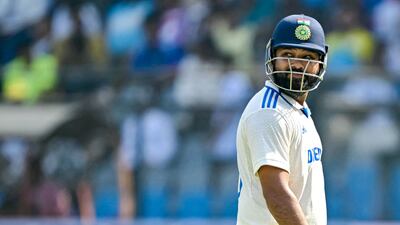
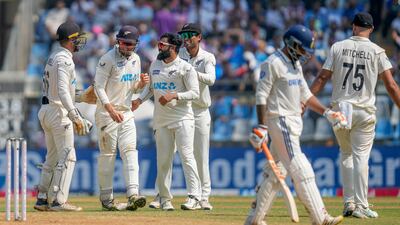
Rohit Sharma has been out of form with the bat and has now become the first Indian captain to lose a Test series 3-0 at home. AFP

Knives out for Rohit Sharma amid captaincy uncertainty for Australia Test tour


  • English
  • Arabic

The ramifications of India’s historic 3-0 home Test series defeat to New Zealand are beginning to be felt with doubts already being raised about the captaincy of Rohit Sharma for the upcoming Test tour of Australia.

Most Indian cricket followers had been busy planning for the five-match series in Australia which begins at the end of this month, possibly looking at the recently concluded New Zealand series as a glorified warm-up.

But by the end of the third Test in Mumbai, India had been cooked to a crisp. Their main batsmen captain Rohit and Virat Kohli had failed monumentally, star spinners Ravichandran Ashwin and, to a lesser extent, Ravindra Jadeja outbowled by opposition spinners and their hopes of a third straight World Test Championship final more or less done and dusted.

India had lost series by bigger margins and for longer periods in the past but this was different. Not only because it was India’s first ever 3-0 Test whitewash at home, but also because they were outplayed in all departments in all matches by an under strength New Zealand team.

The historic setback has put the Indian cricket board in a quandary as the squad for the Australia tour has already been announced.

  • New Zealand's Glenn Phillips, centre, celebrates the dismissal of India's Akash Deep during the third day of the third Test at the Wankhede Stadium in Mumbai on Sunday, November 3, 2024. AP
    New Zealand's Glenn Phillips, centre, celebrates the dismissal of India's Akash Deep during the third day of the third Test at the Wankhede Stadium in Mumbai on Sunday, November 3, 2024. AP
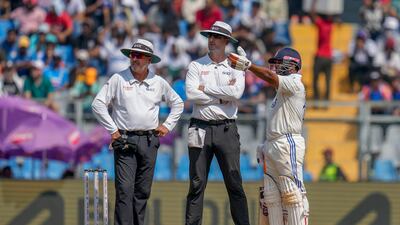
  • India's Rishab Pant, right, speaks to umpires Michael Gough, center, and Richard Illingworth after his controversial dismissal on Sunday. AP
    India's Rishab Pant, right, speaks to umpires Michael Gough, center, and Richard Illingworth after his controversial dismissal on Sunday. AP
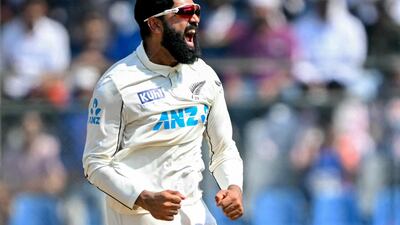
  • Left-arm spinner Ajaz Patel picked up six wickets as New Zealand defeated India in the third Test in Mumbai by 25 runs. AFP
    Left-arm spinner Ajaz Patel picked up six wickets as New Zealand defeated India in the third Test in Mumbai by 25 runs. AFP
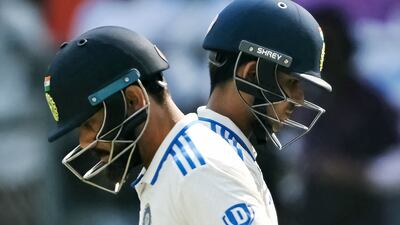
  • Shubman Gill and Virat Kohli both failed in the second innings as India suffered their first ever 3-0 home Test series defeat. AFP
    Shubman Gill and Virat Kohli both failed in the second innings as India suffered their first ever 3-0 home Test series defeat. AFP
  • Rohit Sharma failed with the bat and in the field as India suffered their first ever 3-0 home Test series defeat. AFP
    Rohit Sharma failed with the bat and in the field as India suffered their first ever 3-0 home Test series defeat. AFP
  • New Zealand's Aijaz Patel, third left, celebrates the dismissal of Ravindra Jadeja. AP
    New Zealand's Aijaz Patel, third left, celebrates the dismissal of Ravindra Jadeja. AP
  • Ravindra Jadeja picked up 10 wickets in the Mumbai Test. AFP
    Ravindra Jadeja picked up 10 wickets in the Mumbai Test. AFP

Rohit is leading the side there again, with India now desperate to avoid a whitewash in a country where they won on their last two tours.

Even more intriguing is the issue of Rohit’s availability for the opening leg of the tour. The 37-year-old batsman is said to be unlikely to feature in the first and/or the second Test for personal reasons. If that happens, India will most likely be captained by fast bowler Jasprit Bumrah, who has been named vice-captain and who has already shown leadership potential.

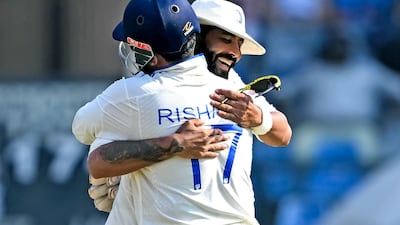
Another player who could be entrusted with Test captaincy is wicketkeeper Rishabh Pant, who has been by far the most reliable player in the team home and away recently.

Rohit’s potential absence has resulted in some hand wringing, mainly due of the dire straits the team finds itself in.

Former India captain Sunil Gavaskar said if Rohit is not available for the opening Test, the next in line should be named skipper for the entire tour.

“It is important for the captain to play the first Test match. It’s different if he is injured, but if he is not available, then the deputy leader will be under a lot of pressure,” Gavaskar told Sports Tak channel.

“If Rohit Sharma is not available, I feel the selection committee should tell him to play only as a player whenever he returns. And they should name the vice-captain as captain for the tour. Because there has to be clarity. Especially because we have lost 3-0, the leader has to be there. Had India won 3-0, it would have been a different case.”

Virat Kohli and Rohit Sharma are running out of time to retain their spots in the Test team. AFP

Senior members of the Indian cricket establishment generally refrain from taking aim at the captain, even after defeat. But the extreme nature of the loss to New Zealand has thrown all restraint out the window.

The series whitewash brought out some uncomfortable truths about the Indian team – they still don’t play their best team according to the playing conditions.

In the opening Test in Bengaluru, India decided to bat first on a wet pitch in overcast conditions, having picked an extra spinner for some reason, and were shot out for 46.

India decided to bench batsman KL Rahul even though he had better numbers than Rohit and Kohli, admittedly not something to brag about as both seniors average less than 30 over the past 12 months. They brought in all-rounder Washington Sundar who was not even part of their original plans. All this while, their most valuable cricketer in Indian conditions with bat and ball – Axar Patel – did not get a single game.

In the second and third Tests in Pune and Mumbai, India went for rank turners even though their own batsmen have shown to be woefully incapable of handling any kind of spin on a turning surface – as was the case during the recent ODI series defeat in Sri Lanka.

On the field, Rohit went ultra defensive early on and gave New Zealand easy singles in the second and third Tests even when a new batsman came in. The lack of confidence and poor planning became evident in the second innings of the third Test when main fast bowler Mohammad Siraj did not bowl a single over even after India had taken the lead.

Rohit is running out of support as leader of the team and even though he is expected to return as captain in the Australia Tests, the blot of the home series defeat has likely sullied his leadership record permanently.


How%20to%20avoid%20getting%20scammed
%3Cul%3E%0A%3Cli%3ENever%20click%20on%20links%20provided%20via%20app%20or%20SMS%2C%20even%20if%20they%20seem%20to%20come%20from%20authorised%20senders%20at%20first%20glance%3C%2Fli%3E%0A%3Cli%3EAlways%20double-check%20the%20authenticity%20of%20websites%3C%2Fli%3E%0A%3Cli%3EEnable%20Two-Factor%20Authentication%20(2FA)%20for%20all%20your%20working%20and%20personal%20services%3C%2Fli%3E%0A%3Cli%3EOnly%20use%20official%20links%20published%20by%20the%20respective%20entity%3C%2Fli%3E%0A%3Cli%3EDouble-check%20the%20web%20addresses%20to%20reduce%20exposure%20to%20fake%20sites%20created%20with%20domain%20names%20containing%20spelling%20errors%3C%2Fli%3E%0A%3C%2Ful%3E%0A

Mercer, the investment consulting arm of US services company Marsh & McLennan, expects its wealth division to at least double its assets under management (AUM) in the Middle East as wealth in the region continues to grow despite economic headwinds, a company official said.

Mercer Wealth, which globally has $160 billion in AUM, plans to boost its AUM in the region to $2-$3bn in the next 2-3 years from the present $1bn, said Yasir AbuShaban, a Dubai-based principal with Mercer Wealth.

Within the next two to three years, we are looking at reaching $2 to $3 billion as a conservative estimate and we do see an opportunity to do so,” said Mr AbuShaban.

Mercer does not directly make investments, but allocates clients’ money they have discretion to, to professional asset managers. They also provide advice to clients.

“We have buying power. We can negotiate on their (client’s) behalf with asset managers to provide them lower fees than they otherwise would have to get on their own,” he added.

Mercer Wealth’s clients include sovereign wealth funds, family offices, and insurance companies among others.

From its office in Dubai, Mercer also looks after Africa, India and Turkey, where they also see opportunity for growth.

Wealth creation in Middle East and Africa (MEA) grew 8.5 per cent to $8.1 trillion last year from $7.5tn in 2015, higher than last year’s global average of 6 per cent and the second-highest growth in a region after Asia-Pacific which grew 9.9 per cent, according to consultancy Boston Consulting Group (BCG). In the region, where wealth grew just 1.9 per cent in 2015 compared with 2014, a pickup in oil prices has helped in wealth generation.

BCG is forecasting MEA wealth will rise to $12tn by 2021, growing at an annual average of 8 per cent.

Drivers of wealth generation in the region will be split evenly between new wealth creation and growth of performance of existing assets, according to BCG.

Another general trend in the region is clients’ looking for a comprehensive approach to investing, according to Mr AbuShaban.

“Institutional investors or some of the families are seeing a slowdown in the available capital they have to invest and in that sense they are looking at optimizing the way they manage their portfolios and making sure they are not investing haphazardly and different parts of their investment are working together,” said Mr AbuShaban.

Some clients also have a higher appetite for risk, given the low interest-rate environment that does not provide enough yield for some institutional investors. These clients are keen to invest in illiquid assets, such as private equity and infrastructure.

“What we have seen is a desire for higher returns in what has been a low-return environment specifically in various fixed income or bonds,” he said.

“In this environment, we have seen a de facto increase in the risk that clients are taking in things like illiquid investments, private equity investments, infrastructure and private debt, those kind of investments were higher illiquidity results in incrementally higher returns.”

The Abu Dhabi Investment Authority, one of the largest sovereign wealth funds, said in its 2016 report that has gradually increased its exposure in direct private equity and private credit transactions, mainly in Asian markets and especially in China and India. The authority’s private equity department focused on structured equities owing to “their defensive characteristics.”

Updated: November 05, 2024, 9:00 AM