It is for good reason that talk of a Middle East-based bid to stage the 2035 Rugby World Cup has cooled.
The formal deadline for submitting bids to World Rugby is next month. Despite the announcement last year that a combined project involving Saudi Arabia, the UAE and Qatar was being readied, it is likely to be too soon for that to happen.
Once Saudi Arabia’s Public Investment Fund announced revised plans for its support for sport earlier this year, the rugby project was edged further towards the margins.
But it is still worth pondering where the region sits in the international game’s future.
Coincidentally, in the same week in which LIV Golf filed for bankruptcy following the withdrawal of PIF funding, a Test involving the two best sides in rugby is set to take place in the United States.
The deciding fourth match of “Rugby’s Greatest Rivalry” series between South Africa and New Zealand will be played in Baltimore on Saturday.
It is all part of the long-term plan to generate interest in the sport in the country, given that the United States will host the World Cup in 2031.
Clearly, there is recent evidence to suggest major events in sports that are not traditionally central to American life can thrive in the world’s biggest market for sport.
Whatever its failings, football’s World Cup in the States this summer was massively successful financially.
But that is the world’s most popular sport. No other sport, not least rugby, can compare.
2026 World Cup final - in pictures
-

Spain's Rodri lifts the Fifa World Cup trophy after victory over Argentina in the final at the New York-New Jersey Stadium. AFP -

Spain's Ferran Torres celebrates scoring to make it 1-0 against Argentina in the World Cup final. Reuters -

Ferran Torres scores for Spain. Reuters -

Spain's Mikel Merino after missing a chance to score. Reuters -

Argentina's Emiliano Martinez saves a shot from Spain substitute Nico Williams. Reuters -

Argentina's Enzo Fernandez is shown a red card by referee Slavko Vincic. Reuters -

Argentina's Enzo Fernandez fouls Pau Cubarsi of Spain resulting in the midfielder's sending off. Reuters -

Argentina keeper Emiliano Martinez saves a free-kick from Spain attacker Lamine Yamal. Reuters -

Argentina goalkeeper Emiliano Martinez makes a save. Reuters -

Argentina's Lisandro Martinez sits down on the ground before limping off injured in the first-half. AFP -

Argentina's Lisandro Martinez is shown a yellow card by referee Slavko Vincic. Reuters -

Argentina's Alexis Mac Allister was lucky not to be booked for this challenge on Dani Olmo of Spain. AFP -

Spain winger Lamine Yamal missed the game's first big chance. Reuters -

Spain's Lamine Yamal sees his defelcted shot saved by Argentina goalkeeper Emiliano Martinez. Reuters -
Argentina's Gonzalo Montiel complains after being penalised for fouling Alex Baena of Spain. EPA -

Spain's Lamine Yamal after missing an early chance. Reuters -

Teams enter the pitch for the national anthems ahead of the final. EPA


Rugby has rarely veered from its mainstream when hosting its main - and most money-spinning - event. The one time it did, it was wildly successful.
The 2019 World Cup in Japan was the only time it has been staged in Asia. The tournament was an economic and sporting hit.
It was the most-watched event in rugby history, with over 857 million global viewers and had a 99.3 per cent capacity attendance with 1.84 million tickets sold, according to World Rugby.
The difference between rugby in East Asia and the West is vast, though. A World Cup in the Gulf, where the population density is nothing like Japan and rugby remains a niche sport, would look entirdifferent from 20192019.
But that does not mean it is not worth trying. Qais Al Dhalai, the ambitious head of Asia Rugby, said last year: “As our leaders in the Gulf believe, nothing is impossible.”
If they are to build a foundation, surely a good first step would be to bring elite Test rugby to the region, as is happening in Baltimore this weekend.
There has been talk of it happening in the past. After seeing the popularity of an exhibition match in Jebel Ali involving Springbok legends, an independent organiser floated the idea of a Test between South Africa and Ireland in Dubai.
It did not happen. Later, a planned fixture between France and the Barbarians did not come to pass, either.
The annual Dubai Sevens is vastly popular. Nearly 90,000 people went through the gates across the three-day weekend last year.
UAE v Germany - in pictures
-

UAE put up a brave fight in their Test against Germany at The Sevens in Dubai on Saturday, November 16, 2024. All images Pawan Singh / The National -

UAE's Jack Stapley during the rugby Test against Germany at The Sevens in Dubai -

UAE lost narrowly to Germany despite being reduced to 14 men early -
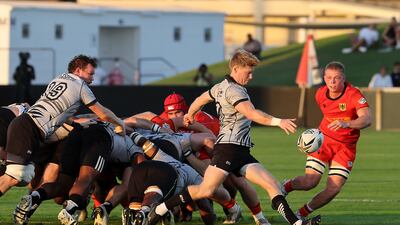
UAE put up a vastly improved performance against Germany in Dubai -

UAE showed tremendous fight against Germany at The Sevens -

UAE said they were proud of the fight they showed in a 26-20 defeat to the higher-ranked Germany -

UAE players greet their German counterparts after the match


XVs matches involving sides like the UAE, Belgium, Samoa, Japan and Brazil have proved moderately popular, even without the player recognition that comes with the leading sides in the game.
“The ease of travel is great,” said Bob Skinstad when considering the idea of a big Test when he was in the city for the Dubai Sevens Long Lunch this month.
“A lot of people can make it into two weeks [holiday]. I think in a place like this, it's so well frequented and well looked after that it would be a great idea.”
Skinstad is well placed to suggest that anything is possible in rugby here. He played in the Dubai Sevens in 1995, when grass had just been installed for the first time.
From 1970 to 1994, the event was played on sand. Joost van der Westhuizen and Chester Williams, who would become World Cup winners a year later, played on sand in Dubai and rrecommended that Skinstad give it a try too.
“They told us that was great, but that you’ve got to play on gravel,” Skinstad said.
“Then when we came back, they had laid all the grass. I don't think all the stands were even fully formed.”

He suggests following the formula on the United States, which has had plenty of success holding matches involving New Zealand, Ireland, Wales and the US national team, is sensible.
“It's a very calculated, smart approach to get some extra coverage on the way to an American World Cup,” Skinstad said.
“We've got Australia next year, then four years later we've got America. If you look at how well the football World Cup went down with the attendances, I think it's a great move.
“South Africa, New Zealand and World Rugby have jointly taken a punt to take it to Baltimore, which I think is a great idea.
“As I understand it, it's sold out. There's a huge expat community of both Kiwis and South Africans [in the area].
“Loads of people will have said, ‘Well, there's a Test match on home soil, I'm going to go and watch it.’”