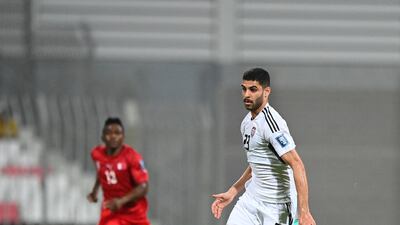
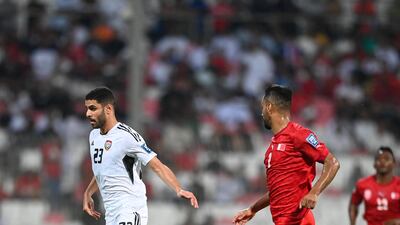
United Arab Emirates coach Paulo Bento issues instructions during the win over Bahrain. Reuters

Paulo Bento off to perfect start with UAE but patience is required as 2023 Asian Cup looms


John McAuley
  • English
  • Arabic

Paulo Bento’s start with the UAE could barely have gone any better.

Facing his first competitive assignment since his July appointment, the Portuguese built upon a trio of friendly victories with two wins to open qualification to the 2026 World Cup.

The UAE cast aside Nepal, as admittedly they were expected to do, in Dubai. Then they came through against Bahrain in Riffa, in what should represent the toughest test of their second-round campaign.

In triumphing 4-0 and 2-0, the national team sit top of Group H with maximum points and no goals conceded. It extended Bento’s winning streak with his new side to five.

For sure, as the second-lowest ranked side of Round 2, and at 173rd in the Fifa standings more than 100 spots below their hosts, Nepal provided a welcome introduction to competitive life for the UAE manager.

After slowly working their way into the contest at Al Maktoum Stadium, by half-time the UAE were four goals to the good. Points secure, and with Bahrain to come five days later, Bento rested some of his starters and offered opportunities to others.

But it was in Bahrain where it felt like Bento began to truly stamp his authority on the team. Much to the majority's surprise, Bento dropped captain Ali Mabkhout, the UAE’s all-time top scorer, to the bench. Against Nepal, Mabkhout had added another two goals to his international tally.

Yet Bento opted for Al Ain loanee Sultan Adil, who, at just 19, was making his full debut for the UAE. Fabio De Lima, another of the country’s chief attacking threats and scorer of the fourth against Nepal, was also named among the substitutes.

However, it worked. Adil led the line well, offering the UAE a real physical presence up front. Mabkhout even came off the bench late on to net the game’s second goal, making safe the result. Bento's judgement call was justified.

So, qualification double-header expertly negotiated, and the road to World Cup 2026 paused until March, attention shifts now to matters closer to home.

The 2023 Asian Cup, relocated and thus rescheduled, takes place in Qatar from January 12. Drawn in Group C alongside Iran, Hong Kong and Palestine, the UAE have not been granted the easiest of passages to the knockout stages. Hosts Qatar, the reigning champions, could wait in the last 16.

After semi-final appearances in the past two tournaments – a vibrant UAE took bronze in Australia in 2015, but the 2019 side were beaten heavily at their home event by Qatar – a similar target, or even better, has been mooted.

Caution, though, should be exercised. By the time the UAE open their Asian Cup bid against Hong Kong on January 14, Bento will have been in position for six months; still then, those matches against Nepal and Bahrain would mark his only two official games with the national team.

Patently, and despite the fast start, the UAE remain very much a work in progress. In defence, Khalifa Al Hammadi looks a settled presence in the centre, but his partnership with Khalid Al Hashemi clearly needs time. Multiple options are required, also, at left-back; Abdullah Idris, the enterprising Al Jazira defender, looked shaky this past week in the qualifying double-header.

In front of the backline, Ali Salmeen and Abdullah Ramadan were reunited for the Bahrain encounter. Preferred by Bert van Marwijk, one of Bento’s many recent predecessors, they appear the most reliable axis in central midfield.

Keeping Salmeen fit, however, has been a worry dating back to qualification for Qatar 2022. Salmeen, 28, has started three of Al Wasl’s seven league matches this season. Of the options to replace him, Yahia Nader, who played against Nepal in Salmeen’s absence, and Majid Rashid have yet to show they deserve to usurp the Wasl stalwart.

Fortunately for Bento, he has no lack of competent options in attack. The hope is a long-standing overreliance on Mabkhout – with 84 goals for the UAE, he sits some way out in front as record holder – has been reduced somewhat by the emergence of Adil, albeit still largely unproved, and Caio Canedo’s ability to play centrally.

In behind, or out wide, Bento can call upon De Lima, Ali Saleh, Yahya Al Ghassani and Tahnoun Al Zaabi. Harib Abdallah, meanwhile, might well be the standout youngster in what continues to be transitional team. Much is expected of the Shabab Al Ahli winger, still a few days short of his 21st birthday.

UAE supporters are right to be buoyed by the beginning of Bento's tenure, although you suspect the former Portugal and South Korea manager will most certainly not be getting carried away. Expectation must be tempered, especially now the UAE fix their focus on a testing Asian Cup quest.

Given the past four years of upheaval - Bento is the UAE's sixth permanent manager in that time - progress, slow and steady, would be an appreciated path to plot.

Bahrain 0-2 UAE - in pictures

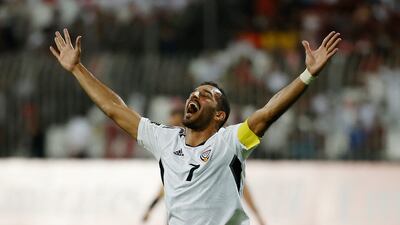
  • The UAE's Ali Mabkhout celebrates after scoring their second goal from the penalty spot in the 2-0 World Cup qualifier victory against Bahrain at Bahrain National Stadium on Tuesday, November 21, 2023. Reuters
    The UAE's Ali Mabkhout celebrates after scoring their second goal from the penalty spot in the 2-0 World Cup qualifier victory against Bahrain at Bahrain National Stadium on Tuesday, November 21, 2023. Reuters
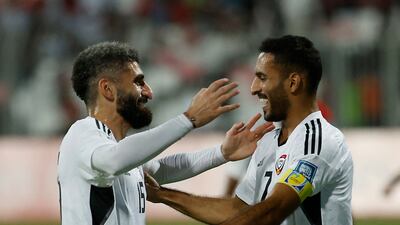
  • The UAE's Ali Mabkhout celebrates after scoring their second goal with teammates. Reuters
    The UAE's Ali Mabkhout celebrates after scoring their second goal with teammates. Reuters
  • UAE players celebrate the opening goal against Bahrain. Photo: UAE FA
    UAE players celebrate the opening goal against Bahrain. Photo: UAE FA
  • UAE's Caio Canedo, left, takes the game to Bahrain. Photo: UAE FA
    UAE's Caio Canedo, left, takes the game to Bahrain. Photo: UAE FA
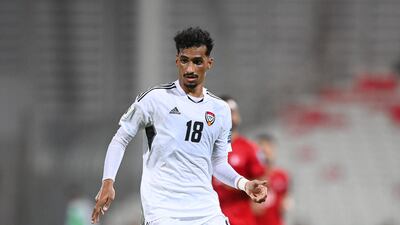
  • UAE's Harib Abdalla takes a shot on against Bahrain. Photo: UAE FA
    UAE's Harib Abdalla takes a shot on against Bahrain. Photo: UAE FA
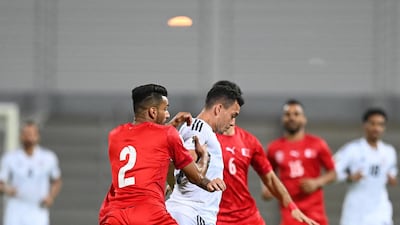
  • Bahrain's Amine Benaddi tries to stop a UAE attack. Photo: UAE FA
    Bahrain's Amine Benaddi tries to stop a UAE attack. Photo: UAE FA
  • UAE goalscorer Abdalla Ramadan gets on the ball. Photo: UAE FA
    UAE goalscorer Abdalla Ramadan gets on the ball. Photo: UAE FA
  • Sultan Adil runs with the ball for the UAE in Bahrain. Photo: UAE FA
    Sultan Adil runs with the ball for the UAE in Bahrain. Photo: UAE FA
  • Sultan Adil takes the game to Bahrain. Photo: UAE FA
    Sultan Adil takes the game to Bahrain. Photo: UAE FA
Tamkeen's offering
  • Option 1: 70% in year 1, 50% in year 2, 30% in year 3
  • Option 2: 50% across three years
  • Option 3: 30% across five years 
The specs

Engine: 2-litre 4-cylinder and 3.6-litre 6-cylinder

Power: 220 and 280 horsepower

Torque: 350 and 360Nm

Transmission: eight-speed automatic

Price: from Dh136,521 VAT and Dh166,464 VAT 

On sale: now

Global state-owned investor ranking by size

1.

United States

2.

China

3.

UAE

4.

Japan

5

Norway

6.

Canada

7.

Singapore

8.

Australia

9.

Saudi Arabia

10.

South Korea

Mercer, the investment consulting arm of US services company Marsh & McLennan, expects its wealth division to at least double its assets under management (AUM) in the Middle East as wealth in the region continues to grow despite economic headwinds, a company official said.

Mercer Wealth, which globally has $160 billion in AUM, plans to boost its AUM in the region to $2-$3bn in the next 2-3 years from the present $1bn, said Yasir AbuShaban, a Dubai-based principal with Mercer Wealth.

Within the next two to three years, we are looking at reaching $2 to $3 billion as a conservative estimate and we do see an opportunity to do so,” said Mr AbuShaban.

Mercer does not directly make investments, but allocates clients’ money they have discretion to, to professional asset managers. They also provide advice to clients.

“We have buying power. We can negotiate on their (client’s) behalf with asset managers to provide them lower fees than they otherwise would have to get on their own,” he added.

Mercer Wealth’s clients include sovereign wealth funds, family offices, and insurance companies among others.

From its office in Dubai, Mercer also looks after Africa, India and Turkey, where they also see opportunity for growth.

Wealth creation in Middle East and Africa (MEA) grew 8.5 per cent to $8.1 trillion last year from $7.5tn in 2015, higher than last year’s global average of 6 per cent and the second-highest growth in a region after Asia-Pacific which grew 9.9 per cent, according to consultancy Boston Consulting Group (BCG). In the region, where wealth grew just 1.9 per cent in 2015 compared with 2014, a pickup in oil prices has helped in wealth generation.

BCG is forecasting MEA wealth will rise to $12tn by 2021, growing at an annual average of 8 per cent.

Drivers of wealth generation in the region will be split evenly between new wealth creation and growth of performance of existing assets, according to BCG.

Another general trend in the region is clients’ looking for a comprehensive approach to investing, according to Mr AbuShaban.

“Institutional investors or some of the families are seeing a slowdown in the available capital they have to invest and in that sense they are looking at optimizing the way they manage their portfolios and making sure they are not investing haphazardly and different parts of their investment are working together,” said Mr AbuShaban.

Some clients also have a higher appetite for risk, given the low interest-rate environment that does not provide enough yield for some institutional investors. These clients are keen to invest in illiquid assets, such as private equity and infrastructure.

“What we have seen is a desire for higher returns in what has been a low-return environment specifically in various fixed income or bonds,” he said.

“In this environment, we have seen a de facto increase in the risk that clients are taking in things like illiquid investments, private equity investments, infrastructure and private debt, those kind of investments were higher illiquidity results in incrementally higher returns.”

The Abu Dhabi Investment Authority, one of the largest sovereign wealth funds, said in its 2016 report that has gradually increased its exposure in direct private equity and private credit transactions, mainly in Asian markets and especially in China and India. The authority’s private equity department focused on structured equities owing to “their defensive characteristics.”

The biog

Name: Sari Al Zubaidi

Occupation: co-founder of Cafe di Rosati

Age: 42

Marital status: single

Favourite drink: drip coffee V60

Favourite destination: Bali, Indonesia 

Favourite book: 100 Years of Solitude 

GOLF’S RAHMBO

- 5 wins in 22 months as pro
- Three wins in past 10 starts
- 45 pro starts worldwide: 5 wins, 17 top 5s
- Ranked 551th in world on debut, now No 4 (was No 2 earlier this year)
- 5th player in last 30 years to win 3 European Tour and 2 PGA Tour titles before age 24 (Woods, Garcia, McIlroy, Spieth)

ENGLAND SQUAD

Team: 15 Mike Brown, 14 Anthony Watson, 13 Ben Te'o, 12 Owen Farrell, 11 Jonny May, 10 George Ford, 9 Ben Youngs, 1 Mako Vunipola, 2 Dylan Hartley, 3 Dan Cole, 4 Joe Launchbury, 5 Maro Itoje, 6 Courtney Lawes, 7 Chris Robshaw, 8 Sam Simmonds

Replacements 16 Jamie George, 17 Alec Hepburn, 18 Harry Williams, 19 George Kruis, 20 Sam Underhill, 21 Danny Care, 22 Jonathan Joseph, 23 Jack Nowell

Key Points
  • Protests against President Omar Al Bashir enter their sixth day
  • Reports of President Bashir's resignation and arrests of senior government officials
While you're here

Various Artists 
Habibi Funk: An Eclectic Selection Of Music From The Arab World (Habibi Funk)
​​​​​​​

Updated: November 24, 2023, 8:39 AM